A Bit More Sour Sourdough Baguette

I know, I know… I have several baguette recipes on here already. Despite that, I mostly use one dough development method no matter the type of baguette I happen to be making: pointage en bac, or the slow rise method, and I only vary it by the type of leavening agent I use. And whether I use yeast or starter, the process is exactly the same.

Of course, there is the exception (when isn’t there) of Baguettes de Tradition which is a straight-dough, same-day bake with no preferment. But I don’t make those too often and only when I’m pressed for time.

As for all the different recipes I have for baguettes, I’ve always been compelled to experiment. In Jeffrey Hamelman’s book, Bread, he has several recipes for baguettes and I’ve baked them all and shared those recipes here. But for my own baguettes, I riff on the original method I learned from Master Chef Markus Farbinger. It’s straight-forward and invariably yields me GREAT results.

Historically, baguettes were developed as a welcome change from sour breads. Leading up to the creation of the baguette – and other bread made with commercial yeast – all bread was sour because they were risen with natural starters. And we’re talking centuries here, folks! Baguettes offered up a different flavor profile; frankly, a neutral one, and based on the popularity of baguettes through the years, it was a welcome change.

Technically, there’s nothing wrong with making baguettes from sourdough starter as the French Decrét Pain states – however vaguely – that bread must be risen with a leavening agent suitable for bread. But, given how parochial the French are about food, using a natural starter isn’t quite de riguer.

Plus, the whole purpose behind the baguette was to create a neutral flavor platform, and sourdough is anything but neutral – and here I have to agree with the French: A baguette isn’t defined by its shape, but by its dough. But that doesn’t mean that you can’t do it, and dammit! These “baguettes” taste great!

Now the interesting thing about these baguettes is that the acid in the starter acts as both a dough conditioner and a preservative. Even after a couple days, the crumb is still supple and pliable – even if left in the open at room temp!

So here’s the basic formula for the baguettes:

Baker’s %Example
Flour*100%644
Water76%462
Salt1.8%14
Yeast0.07%.53
Preferment35%227
Optimal Dough Temp75°-78°FYield: 1346
*I use a blend of flour which is basically 40% unbleached high-extaction flour and 60% AP flour.

I deliberately used the word preferment instead of sourdough starter or levain because you can use a poolish for this formula as well, which I have done. But for this discussion, we’ll focus on a levain.

Using the example numbers above, this will yield 4 baguettes scaled at 335g apiece, leaving a few extra grams of dough for loss during processing, which almost always happens, so I always calculate a few grams more than I actually need so I can scale my loaves to the exact weight I want them.

Make the Levain

Though I listed the levain as being 35% of the flour, I need to clarify where I got this number. I didn’t just pull it out of thin air. Assuming I’m using a 100% hydration levain, it turns out that if the flour of the levain represents 15% of the total flour of the recipe, the levain’s total weight comes out to be just a smal fraction over 35% of the flour weight.

I factor in the flour of the levain as part of the overall flour because a levain is simply part of the overall dough development. I do this to calculate my yield as I now bake according to the amount of dough I need for a particular bake. This keeps my loaf weights absolutely consistent.

In any case, using a mature starter, make a liquid (100% hydration) levain (like a 1:3:3 or 1:5:5) and let it activate until it passes the float test. I’m not putting a time on this because it can vary wildly based on the microbe density in starters. For example, when I make a levain using botanical starter water and a mother I maintain based on the botanical starter, my levain will be ready in about 3 hours. And it’s super-active.

Make the Dough

  1. Dissolve the levain and yeast in the water. The water should be at the appropriate temp to get the dough to the optimal temp. At this time of the year, that’ll probably be around 90°-95°F.
    1. You can actually eliminate the yeast altogether. The resultant bread will be a bit more chewy. And depending on how long you let it ferment, the acid in the dough will keep the crust lighter in color.
  2. Add the salt to the flour and mix well, then gradually add the liquid to the flour and mix until you form a shaggy mass with no dry ingredients.
  3. Scrape down the sides of your mixing bowl and let the dough rest.
  4. Initial Fermentation: 1 1/2 hour. During this first hour, fold the dough every 30 minutes, making sure to pay attention to building up the gluten. After the second fold, rest the dough for another 30 minutes, cover and put in the fridge for 12-16 hours, or until the dough has at least doubled in size. For the sourdough baguettes, the dough may seem a bit slack. This is due to the acid in the starter which breaks down gluten.
  5. FROM THIS POINT ON, BE ABSOLUTELY GENTLE WITH THE DOUGH!
  6. Divide and scale the dough. For demi-baguettes, weight should be around 250g. I make 20″ baguettes scaled at 335g. Roll each piece up like a jelly roll and rest for 30 minutes seam-side-up on a well-floured couche or tea towel.
  7. Preheat your oven to 500°F.
  8. Once the dough has relaxed sufficiently (it’s normally 20-30 minutes for me, but sometimes it takes longer if I pre-shaped them tight, remove the pieces from the couche and place on a well-floured surface, then shape into baguettes, moving them back to the couche to do their final fermentation from 30-60 minutes. This step is important. You want to do a finger-dent test after 30 minutes. If it’s still really springy; that is, your dent essentially disappears right away, let it go another 20-30 minutes. But if your dent springs back quickly but some of it still remains, it’s ready to bake. Note that that partial spring is ultra-important. That means that there’s still life in yeast.
  9. Score the loaves (see below).
  10. Bake with steam at 500°F for 12 minutes, then 12-15 more minutes at 450°F dry.

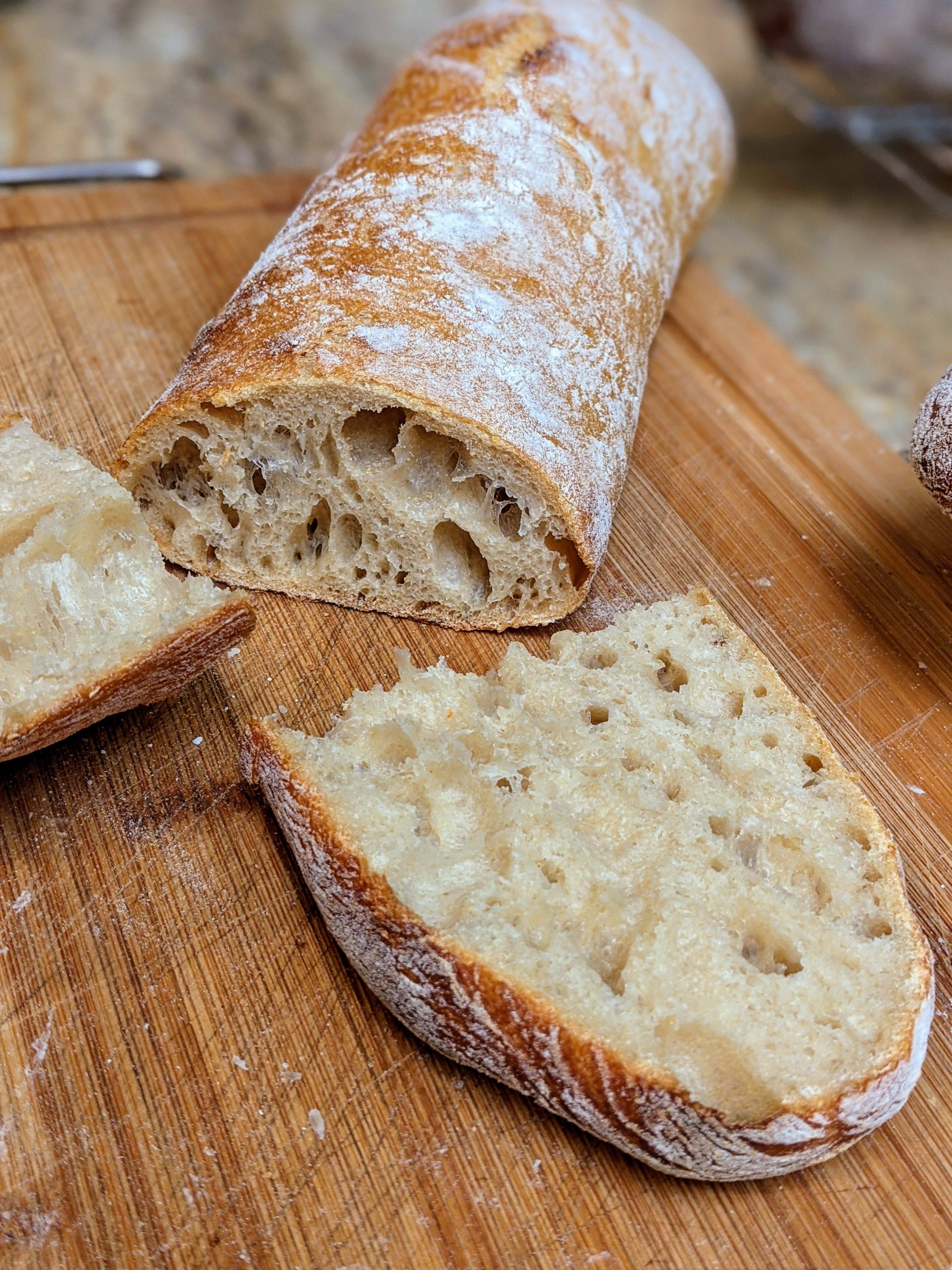
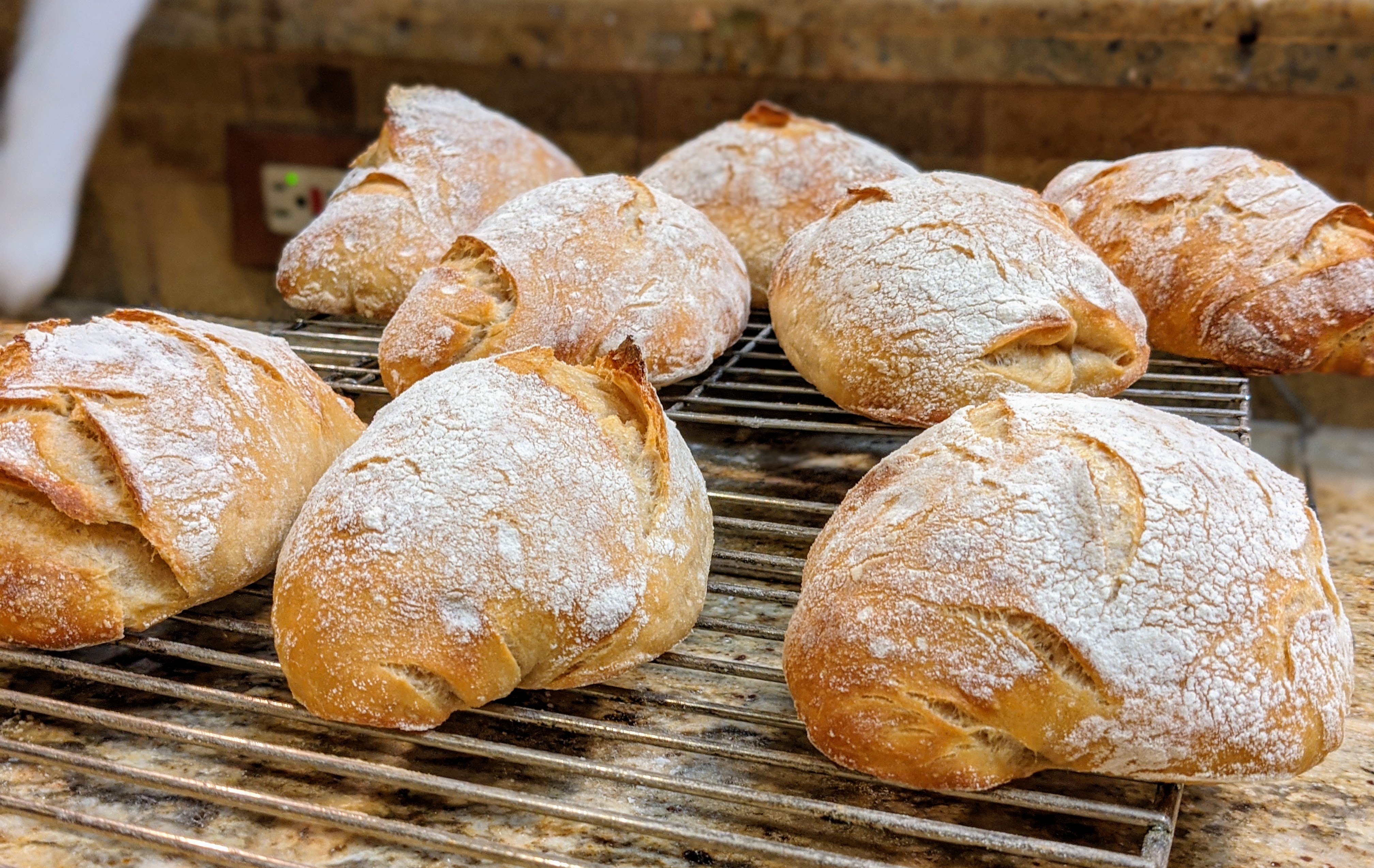
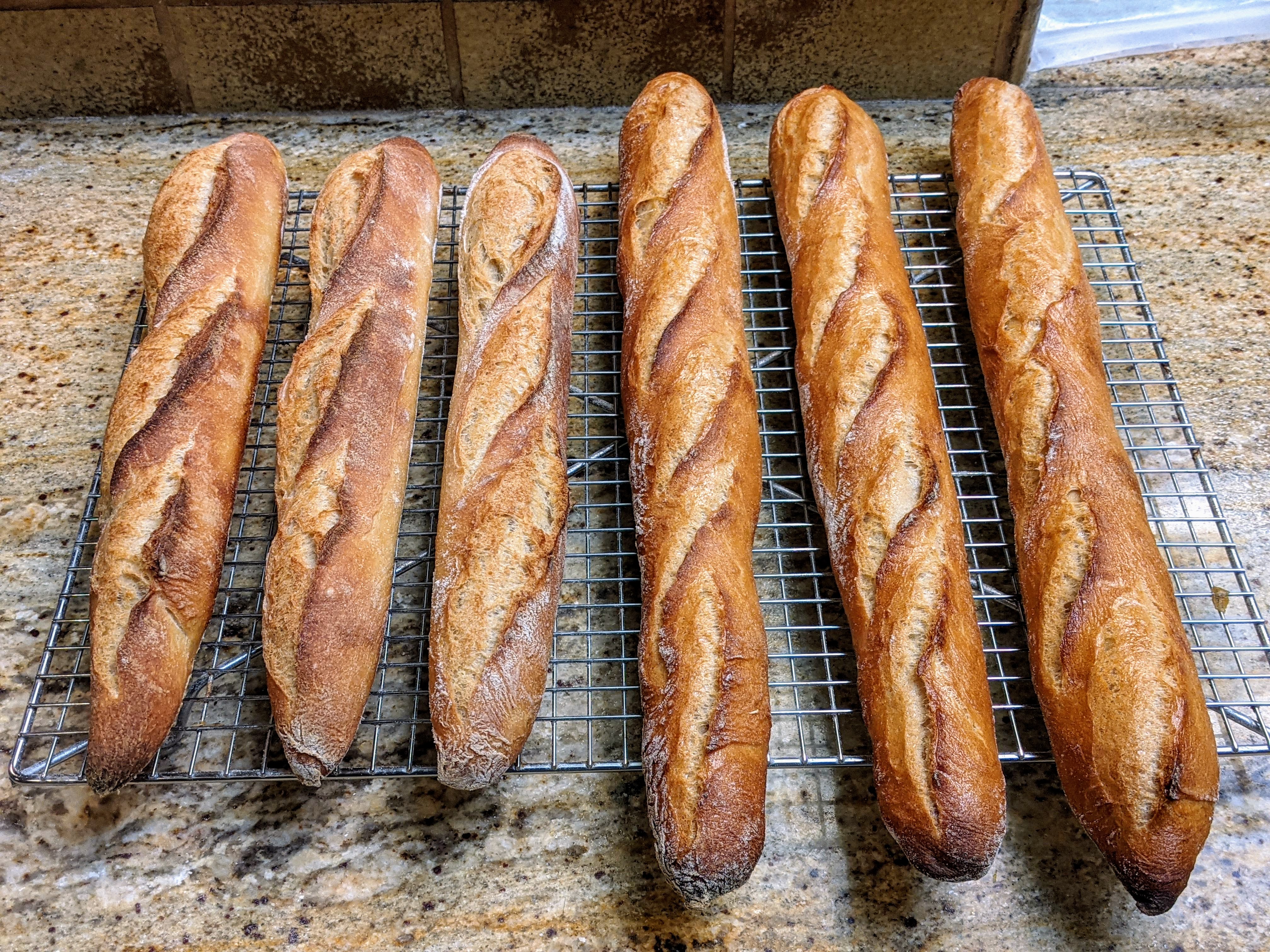
These baguettes really benefit from a full bake to ensure a nice, crisp crust. I’m not a big believer in taking the crust out to chocolate as I do with my boules and batards. But a deep, golden-brown like the loaves above yields a delicious crust.

If you’ve baked traditional baguettes, you’ll immediately notice that once you bake these, the sourdough crust will not get as dark within the given times. You could bake them longer to get a darker crust, but you just might dry out the insides if you bake them for too long. I have a feeling that it has a lot to do with the amount acid in the starter which, at least for my very sour starter, is a clear indicator that there wasn’t much available sugar for browning.

But the other thing about these baguettes is that they stay fresh longer because of that acid. While they won’t remain as crisp as long as traditional baguettes, they will continue to be pliable for several days after the bake!

Scoring Baguettes
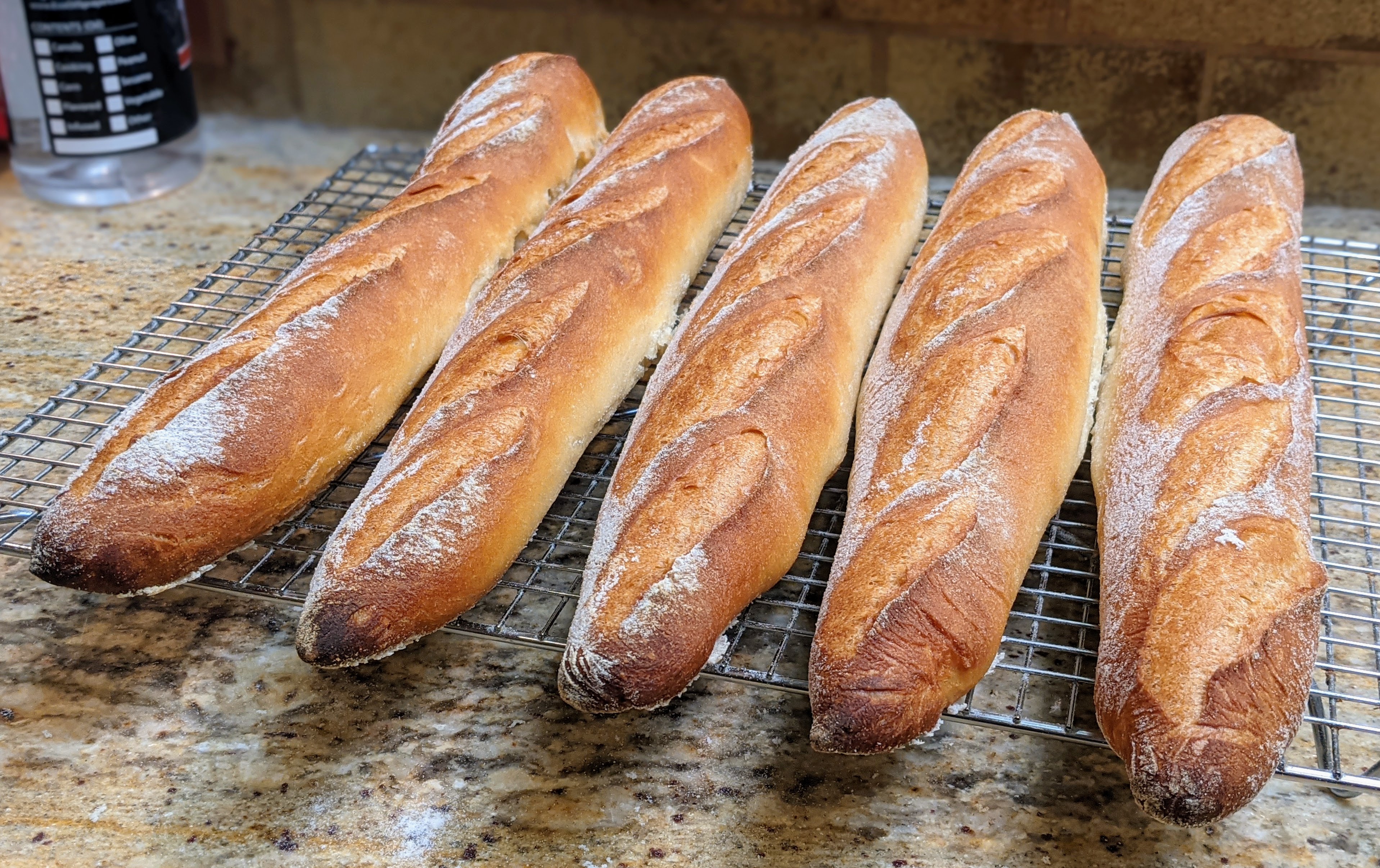
When you’re new to making baguettes – this included me when I first started making them – there’s a mistaken belief with scoring that the loaves are scored in a diagonal fashion. Technically, they are, but not nearly at the extreme angles that many beginners score them. I’ve seen otherwise gorgeous, straight loaves online whose aesthetics were essentially ruined by improper scoring.

To be honest, there’s no big secret or special technique to score baguettes. Just remember this: Use shallow angles! The diagram below illustrates the angles you should be using:

In both the top and the cross-sectional views, the proper scoring and blade angles are much more shallow that what most might think. From the top, the lines are long, starting from the center of the loaf, and deflecting just a few degrees. The blade angle from the cross-section is absolutely critical as it creates a flap which will produce that distinctive ear that you see in the picture immediately above.

Especially with baguette scoring, you need to be assertive in your strokes. Avoid making choppy motions with your scoring and do your best to be as smooth as possible. Also, aesthetically – and according to Master Chef Jeffrey Hamelman – an odd number of scores is much more appealing to the eye than an even number.

Recipe: Biga Baguettes

I needed to make lunch for the family tomorrow and I didn’t figure out what I was going to make until too late. I knew that I wanted to make sandwiches, but I wanted to make them on baguettes. But since it was late afternoon by the time I was going to start making them, my recipe options were a bit limited. I couldn’t make my normal Pointage en Bac baguettes which require an overnight cold fermentation (I had to have the sandwiches prepared early in the morning). That also left out making a poolish.

But what I did have on hand was some nice, ripe biga that was in my fridge. So I pulled it out of the fridge, let it warm up for an hour or so, and started preparing the dough. They turned out fantastic! They’re so good that I thought I’d share the recipe.

Biga

Make the biga the night before you bake. This will make a lot, so put the unused portion of the biga in the fridge in an airtight container. It’ll keep for over a week. It’s actually much more flavorful a few days old. The biga I used for my baguettes was five days old and had a rich and slightly sour flavor. Here’s the formula:

Flour500g100%
Water390g78%
Yeast0.25g0.05%
Biga will be ready to use when it has doubled in size and is slightly domed at the top.

Final Dough

AP Flour500g100%
Water* (warm)390g78%
Salt10g2%
Yeast4g0.8%
Biga200g40%
*Target dough temp is 78-80° F

The process we’re going to use here is loosely based on Hamelman’s Baguettes de Tradition which is a great recipe for making straight dough baguettes.

  1. Sift the dry ingredients together and set aside then mix the biga and water together until biga is broken up. Add the wet mixture to the dry ingredients and mix thoroughly, making sure there are no lumps (there’s shouldn’t be if you sifted the dry ingredients together). Mix until you form a shaggy mass. Don’t worry if it resembles more of a batter than a dough. It’ll all smooth out and come together nicely.
  2. Bulk ferment for 3 hours. During the first hour of bulk fermentation, fold the dough every 20 minutes. I recommend doing stretch and folds as opposed to coil folds as this is a fairly fast fermentation and the commercial yeast will expand the dough nicely. By the third fold, the dough will have built up plenty of strength with noticeable bubbles. Try not to degas the dough too much with the third fold. Let the dough rest for 2 hours or until it has nearly doubled.
  3. The yield will be about 1100g, which will give you 4 20″ baguettes at about 276g apiece. If you’re using a 15″ length, it will make 5 baguettes at 220g apiece. Divide and scale out the size that works for you. With each piece, lightly flatten, then letterfold it, then gently roll it into a compact log. Place each piece seam side up on a well-floured couche or tea towel. Bench rest for 20-30 minutes or until the dough has relaxed.
  4. Shape into baguettes and let rise for 1 hour or until loaves have reach about 75-80% fermentation.
  5. Bake at 485°F for 12 minutes with steam, then 425°F for 8-12 minutes. Note that the baguettes will not be very dark.

What amazed me about these baguettes is that despite the fact that I baked them for much longer than the final 12 minutes they didn’t get darker than when the time was up. But no matter, the crust on these baguettes is thin but very crisp and the crumb is super-soft. The crumb isn’t really open and pockmarked with holes, but it it’s super-light – almost like a banh mi crumb.

When I pick up a baguette and it feels as if it has very little weight, I know it’s going to be a great baguette, and these baguettes are great!

Happy Baking!

Jeffrey Hamelman’s Poolish Baguette (Adapted)

It’s no secret that I love making baguettes. In fact, I made a batch of sourdough baguettes based on Hamelman’s Baguettes de Tradition from his great book “Bread” this morning. Technically, Baguettes de Tradition is a straight dough. But I love the processing technique and it’s difficult to make because the hydration is 76%. And using a levain further exacerbates things because the acid in it makes the dough more extensible – and sticky.

But after I made them, I wondered what the chef’s poolish formula was like, so I looked it up and was a little shocked by his formula. A 66% hydration dough? That couldn’t be right. It’s commonly accepted that baguette dough is around 75% hydration, give or take a percentage point or two. It’s a fairly wet dough. But 66% is getting close to stiff!

But the kicker for this recipe is the long bulk fermentation at 2-2 1/2 hours and the long final fermentation at 1-1/2 hours. This gives the dough plenty of time to form lots of air bubbles, which is what you want with baguettes plus, the long periods of rest in the bulk fermentation give the dough plenty of time to relax. With a moderately stiff dough like this, you want to give it plenty of relaxation time if you can.

As my title indicates, this is an adapted recipe. The reason for this is that in the book, the quantities are all listed in kilos and pounds, which leads me to believe that this recipe really is geared towards a full-fledged bakery. But everything can be scaled if you work out the percentages properly. Also, the chef uses fresh yeast in his final dough, but I adapted the recipe to use regular, instant dry yeast for both the poolish and final dough. There’s no difference in what either does. You just use less granulated yeast. Here’s the formula:

PoolishFinalTotalBaker’s %
Bread Flour3306701000100.00%
Water330330*66066.00%
Salt0.0020202.00%
Yeast0.704**4.700.47%
*Target dough temp is 76-78°F so adjust water temp accordingly.
**If you have fresh yeast and want to use it in place of the granulated yeast, just divide by 0.4.

Poolish

  1. Mix all the ingredients together until smooth. I like mixing the yeast into the flour first to distribute it, then adding the water. Let ferment at room temperature for 12 to 16 hours or until the top is highly pockmarked and bubbling and ever so slightly domed.
  2. When the poolish is ready, dump everything thing into a mixing bowl and mix thoroughly. If using a mixer, incorporate ingredients at low speed for a couple of minutes, then increase speed to second speed and run for 1-2 minutes to break up any large lumps. Once the dough starts to pull cleanly off the sides, stop. If mixing by hand, thoroughly mix until moderately smooth being careful not to knead the dough too much.1
  3. Bulk ferment the dough for 2 hours, gently folding it after the first hour and being careful not to degas it too much.
  4. Divide2 the dough and lightly shape it into rounds, then bench rest (covered) on a lightly floured surface seam side up for 10 to 30 minutes depending on tightly you preshaped them. I recommend having a fairly light touch as you don’t want a skin to form.
  5. Once the dough has relaxed, shape them into long cylinders then set them on a well-floured couche or tea towel seam side up.
  6. Let the shaped loaves do a final fermentation for 1-1 1/2 hour. This is VERY important because shaping the loaves will have degassed them a bit and this long, final fermentation allows the gluten to relax and reform bubbles.
  7. Preheat oven to 460°F. When the loaves are ready, bake them for 24-26 minutes applying steam for the first 15 minutes.

Notes

  1. Whether using a machine or mixing by hand it’s important to NOT knead a baguette dough too much. You want the fermentation process to naturally form the gluten bonds and not force it by kneading. This will really tighten up the dough which you don’t want.
  2. Since I bake on a stone, I divide the dough into five pieces at about 336g apiece and 20″ long. You can do 8 pieces at about 14-15″ long as well to fit on a baking or baguette tray.

I’ve been writing this post while smack dab in the process of making these baguettes. I have to admit that I was really surprised at how supple the dough was when it ready to shape. It wasn’t nearly as pliable as my normal, high-hydration baguettes, but it was still pliant and luxurious.

And because it was rather cool in my kitchen, I let bulk fermentation go for almost three hours. And even at that point, it was easily less than 80% fully proofed. But that’s okay because it gave me plenty of runway for final fermentation, which I’ll probably take to a full 1 1/2 hour to ensure the loaves are close to fully proofed. This is definitely a recipe where I need to let everything that happens before baking get most of the work done on the dough!

Happy Baking!

Recipe: Pane di Como Antico

This bread’s name translates to “bread of Como of the past.” This is now known as pane francese in Italy or French bread, though this “French bread” is quite different in taste and texture from the actual French loaf which has a thinner crust and lighter crumb. But irrespective of all that, this is an ancient bread that is magnificent in both texture and taste and very easy to make.

I adapted this recipe from what I consider to be the definitive book on Italian Bread called “The Italian Baker” by the late Carol Fields. This is a GREAT book. Ms. Fields traveled throughout Italy to learn these recipes directly from local bakers in the regions she visited, so these are authentic.

As with most Italian loaves, this bread is started with a biga the day before, which is much like a poolish, using flour, water and a tiny amount of yeast, only stiffer. A poolish is 100% hydration where a biga can be anywhere from 60%-80% hydration. This recipe’s biga is 80% hydration. Let’s get started!

Overall Formula

Flour100.00%
Water75.00%
Salt1.60%
Yeast0.30%

Day 1 – Make the Biga

Unbleached AP Flour*100g
Water (75° – 80° F)80g
Yeast0.4g
*I highly recommend using either Bob’s Red Mill or King Arthur, or any unbleached AP flour that has a protein content greater than 11%. Most generic brands are 10%. Gluten development is very difficult with those flours. Also, organic is better.

I’m going to come clean and admit that I actually used my sourdough starter to make an 80% hydration levain. The Italians call this type of biga “Biga Naturale.” My levain was 100% whole wheat, so I didn’t use the whole wheat flour that’s listed in the final dough below.

Mix all the ingredients and let ferment for 12-16 hours at room temperature. As with any preferment, you want to make sure it’s nice and bubbly.

Day 2 – Final Dough

Biga180g
Unbleached AP Flour435g
Whole Wheat Flour65g
Water (80°-85° F)360g
Salt10g*
Yeast2g**
*You may see a recipe online that lists the salt as 16 grams. For this small amount of dough, 16 grams is WAY too much.

**If the weather is cold, adding a little yeast will help the process along.

The Process

According to Carol Fields, Italians predominantly use a mixer to mix up their dough. But you can mix by hand if you choose or if you don’t have a mixer. The process is pretty much the same.

  1. Set aside about 50 grams of the water and dissolve the salt in it.
  2. In a large mixing bowl, break up and dissolve the biga with the rest of the water, then add the flour in batches. If you use the yeast, add it to the water before the flour.
  3. Once you form a shaggy mass (and there are no dry ingredients), let it rest for 20 minutes to help hydrate the flour. This is kind of a hybrid autolyse.
  4. Add the saltwater to the mass, then thoroughly mix until you start forming a smooth dough that feels elastic. This is where a mixer really comes in handy.
  5. Dump the dough onto a board and knead for 8 minutes or until you feel the dough has built some strength.

    You don’t have to knead if you don’t want to. I instead mix until everything’s incorporated, transfer the dough to a container, then do two sets of folds in the first hour or so. This will create plenty of dough strength. This is more like baguettes.
  6. Transfer the dough to a lightly oiled container, then cover with plastic wrap and let it rise until almost doubled. The dough should have plenty of bubbles and should be blistering on top with a nice dome. 1 1/2 to 2 hours or until dough has expanded 50%-75% of its original size.
  7. Pour the dough onto a lightly floured board and divide it in half.
  8. Shape each half into a nice, taut ball (like you would a boule), sealing the seams, then set it aside seam side down.
  9. Sprinkle a little flour over each ball, then cover with a cloth for 20-30 minutes to bench rest. The dough should be relaxed.
  10. Preheat your oven to 485° F.
  11. After the balls have rested, shape into cylinders about a forearm’s length. I use a baguette shaping method to create some internal structure and to ensure the cylinder is even, though I don’t make pointy ends. The cylinders will be much thicker than baguettes, but they’ll have a structure you can feel.
  12. Lay each cylinder seam side down (or up if you prefer) onto a transfer board lined with parchment paper, or if you don’t have a baking stone, a parchment-lined baking sheet. The cylinders will spread and flatten a bit and that’s okay!
  13. With floured hands, dimple the cylinders all over to prevent over-springing. Don’t worry, they’ll puff up.
  14. Cover with a well-floured cloth or couche and let rise for 1 to 2 hours. You should see bubbling and blistering. Carol Fields says to wait until they’re doubled in size. But based on my experience with baguettes, what you want to look for is a puffiness to the loaves and a little resilience when you poke them. You don’t want to take final fermentation out too far, lest you lose oven spring.
  15. Bake with steam for 15 minutes (I use a broiler pan on the bottom rack and pour a cup of scalding water in it).
  16. After 15 minutes, remove your steaming tray/container and the parchment paper, turn the oven down to 425° F, then bake for another 12-15 minutes until the loaves are golden brown.
  17. Cool on racks for 30 minutes. They taste GREAT while they’re still a little warm!

I originally got “The Italian Baker” because I wanted to get a recipe for Pane Pugliese from a credible source. I made the Pane Pugliese from the book, and it turned out okay, but as I pored over the book, I saw this simple, straightforward recipe and knew I had to make it.

I think the romance of this recipe being ancient really got to me. In fact, my whole bread-making obsession has stemmed from the romanticism of making bread from recipes that are hundreds, maybe even thousands of years old. Granted, the flour of today is so much more refined than the flour of yesteryear, but to replicate bread from ages-old recipes and traditions… That’s just so FREAKIN’ cool to me!

This is what keeps me exploring. I don’t know if this will turn into anything other than a hobby, but I do know one thing: I love continuing tradition!

Recipe: Sourdough Ciabattas

Besides baguettes, ciabattas are my other favorite loaves to make. Once I learned Master Chef Markus Farbinger’s recipe, I was hooked! Ciabattas are SO easy to make. Whether you use the standard recipe that I linked to above, or use a sourdough starter, it can be a same-day bake! Though if you go the sourdough route, I suggest doing an overnight bulk ferment, which I’ll explain below.

With this particular recipe, I’m going for a much lighter crumb and am using bread and AP flour. I know that I have eschewed using white flours, but the enzymes in the sourdough starter help break down the flour to make it more digestible, so while the flour may not be as nutritious as whole wheat and high-extraction flour, we’ll still get plenty of nutrition from the bread. That said, let’s get started!

Ingredients

Levain

Starter200 grams
Unbleached Flour150 grams
Water (90°-95° F)150 grams
For flour, I use a high-extraction flour from Azure Standard called Ultra Unifine Bread Flour.

Final Dough

Levain500 grams
Unbleached Bread Flour250 grams
Unbleached AP Flour500 grams
Water*550-600 grams
Salt20 grams
Instant Yeast** (optional)2 grams
*With water, you have to gauge it. 550 grams will get you to 80% hydration. But depending on your flour, if the dough is a little stiff, you’ll want to add more water. The initially mixed dough sh9uld be the consistency of a stiff batter.

**Using a bit of instant yeast is purely optional, but I’ve found that it is very helpful on cold days. I wouldn’t use it on hot days where I can rely on the ambient temperature of my kitchen to keep the microbes super-active.

Instead of using separate containers for the levain and the final dough, I just use a 6-quart Cambro tub. When my levain’s ready, I just add all the ingredients to the tub. It’s much more convenient. I’m going to provide some times as guides during the process. By no means are they hard and fast, especially with varying kitchen temps where the bulk and final fermentations can be shorter or longer depending on the ambient temperature of your kitchen.

Make the Levain

  1. Feed your starter so you can produce 200 grams of starter. When the starter’s ready, transfer 200 grams to a large mixing bowl or a large plastic tub. Note that the starter doesn’t have to be active and at its peak. My daily grape starter is maintained at 400 grams total, so I just use 200 grams from my mother culture, then feed her. Works like a charm!
  2. (4:00 pm) To the 200 grams of starter, add 150 grams of unbleached flour (here’s where I use my high-extraction flour, but you can use any unbleached flour that you want) and 150 grams of water. Mix thoroughly until smooth.
  3. (4:15 pm) Place the levain container in a warm place to ferment. It has been cold as of late, so I put my levain container in my oven with the door cracked to get a little heat from the oven light.
  4. (8:30 pm) If you have a fairly active starter, your levain should be actively bubbling by now. If it’s not, I suggest waiting until it’s really active.

Mix the Final Dough

  1. (8:40 pm) There’s no autolyse with a ciabatta, so just add all the final dough ingredients to the levain and mix thoroughly until you’ve incorporated all the dry ingredients and create a shaggy mass (about 5 minutes). Note: If you’re going to do a same-day bake, I suggest turning on your oven to 250° C or ~485° F now.
    1. It’s a bit messy, but I prefer to mix the dough by hand, alternating squeezing the dough through my open fingers, then using a stretch and fold motion to turn the dough. I’ll do this until I feel comfortable that the salt and yeast have been totally incorporated.
  2. Clean off your mixing hand and let the shaggy mass rest for 20 minutes.
  3. (9:05 pm) Using a wet hand, do a series of stretch and folds until you feel the tension in the dough building. When it kind of fights you, then let the dough rest for another 20 minutes.
  4. (9:25 pm) Dump the dough onto your well-floured work surface – it should be really well-floured – making sure you clean and scrape all the excess dough left in the container, then wipe the container with a paper towel.. Using quick motions, pull the dough into a rough rectangle, then do letter folds, front to back, and side to side at least three rounds. Make sure that when you fold, you also pull flap, then fold over. Once you feel that the dough strength has been built up (it will fight you a bit), roll the dough onto its seams, then using your bench scraper, form the dough into a ball.
  5. (9:30 pm) Spray the container with a light coat of olive oil (I use one of those PAM olive oil spritzers) then gently pick up the dough ball (you can form it up a bit more to make it easier), then drop it into the container.
  6. So here we have two alternatives:
    1. Let the dough rest for 5-10 minutes, then put the container in your fridge for an overnight bulk ferment.
    2. Let the dough rest for 20 minutes, and you’ll be ready for shaping.

Dividing and “Shaping”

Again, depending on how you do the bulk ferment there are two routes to take. The steps are similar, but different enough to warrant discussing them in separate sections.

Same-Day Bake

  1. After 20 minutes, again liberally sprinkle flour on your work surface, then slide the dough ball out of the mixing bowl.
  2. Using quick motions, gently tug the ball into a rough rectangle, then divide the dough into equal pieces. If I’m making loaves, I cut the rectangle in half.
  3. Technically, you’re not supposed shape the ciabatta dough. You pull it into a basic form. But I like to make my loaves into little rectangular pillows, so I gently letter fold the divided dough pieces, being extremely careful not to degas them.
  4. Once you’ve formed the loaves, gathering them from the long ends and cupping under the dough, transfer them to a well-floured couche, seam side up.
  5. Sprinkle the loaves with a bit of flour, then cover them and let proof for 10 minutes.
  6. After 10 minutes, check the loaves for springiness using the finger dent test. You want to have some spring. If there’s a bit too much; that is, the dough immediately springs back, let it rest another 10 minutes.

Overnight Ferment

If you did the overnight ferment, check your dough in your fridge. It should have at least doubled in size. If it hasn’t, you’ll have to wait. My retarder is set to 39° F and it takes 10-12 hours for my dough to double. So if you’re dough’s ready, turn on your oven now and set it to 250° C or about 485° F. Do not proceed until your oven is up to temp, then divide. If you’re using a baking stone, wait at least an hour before proceeding.

  1. Gently slide the fully fermented dough out of the bowl or container on a very well-floured surface. It should easily slide out since you oiled it down.
  2. As above, gently tug the ball into a rough rectangle then divide the dough into equal-sized pieces. Personally, the anal-retentive part of me, can’t resist scaling the pieces so they’re all roughly the same weight.
  3. (optional) As I mentioned above, you don’t have to shape the loaves, but I always do a simple letter fold, then place the loaves on seam side up on a well-floured couche.
  4. Sprinkle the loaves with flour, cover them, then let them rest for 20 minutes.
  5. At this point, I transfer the loaves, seam side down to my transfer board, covered with parchment paper. If you’re not going to use a baking stone, you can use a parchment-covered metal baking sheet.
  6. Sprinkle the tops with flour, cover them, then let the loaves rest for 20 minutes.

Bake

  1. Bake the loaves for 20 minutes (250° C/485 F) with steam (I now use a broiler pan on the bottom rack of my oven and pour a cup of scalding water into it).
  2. Remove your steaming tray after 20 min. Turn down the oven to 200° C/400° F) and continue baking for another 15 minutes, though check for doneness at 10 minutes.
  3. If you want a real crunchy crust, turn the oven off, then leave the loaves in the oven with a slightly cracked door for 10-15 minutes to cure the crusts.

As with my other recipes, I realize that I’ve been a bit long-winded. But I want to make sure I cover as much nuance as possible.

Recipe: Buttertop Whole Wheat Pan Bread

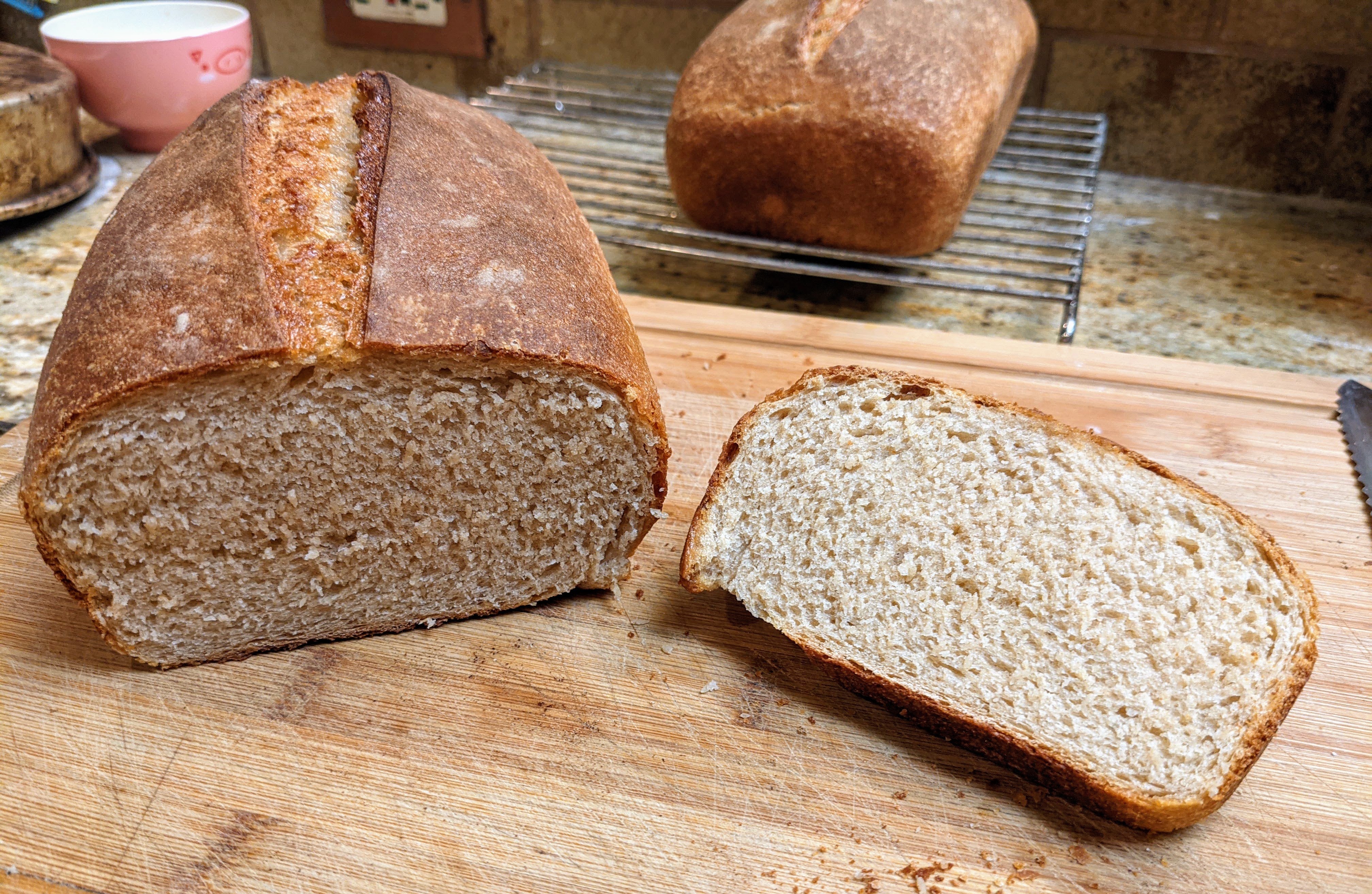
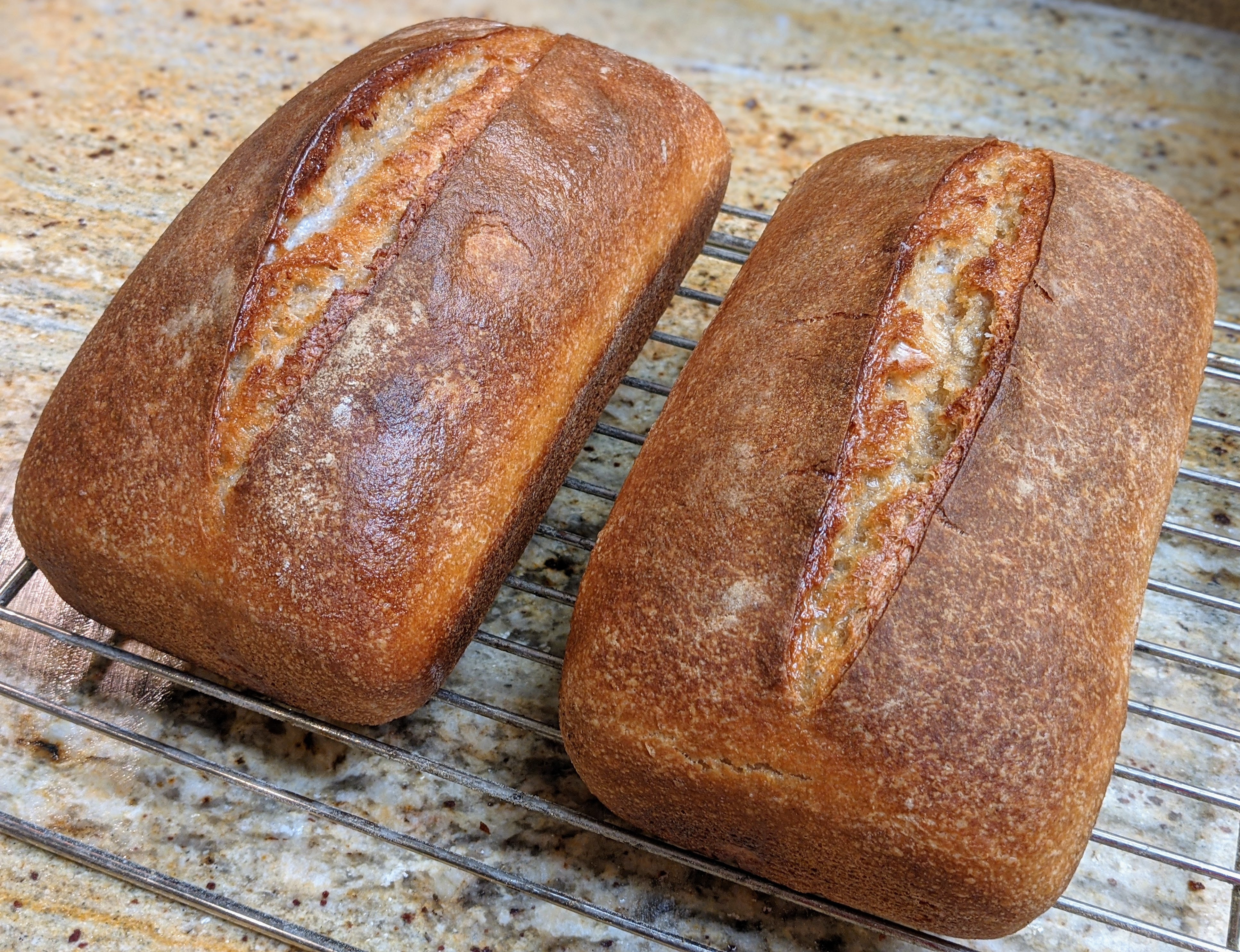
Okay, it’s not 100% whole wheat which is why I didn’t put 100% whole wheat in the title. But it’s damn close. This uses my favorite flour combination of 25% White Whole Wheat / 75% High-Extraction Flour, both milled using the Unifine process. The high-extraction flour is like a Type 85 flour that retains at least 85% of the bran and germ of the wheat berry when milled, though this particular flour is more like Type 90. What this means is that it is very close to whole wheat but it’s SO much smoother.

This recipe uses an overnight poolish. But unlike other recipes I’ve developed, where the poolish only accounts for about 20-25% of the total flour, this recipe uses a poolish that accounts for 50% of the total flour. The reason for this is because all the whole wheat flour goes into the poolish and soaking it overnight ensures that the bran and germ are fully hydrated. Here we go!

The Night Before ~ Make the Poolish

FlourWaterYeast
250 g High-Extraction Flour
250 g Whole Wheat
500 g0.5 g
1. If you don’t have any high-extraction flour, I advise using whole wheat bread flour. It’s milled finer than regular whole wheat flour.
2. Mix everything together until you form a thick, but smooth batter with no dry flour left over, and no lumps (this is important).

Baking Day – Make the Final Dough

FlourWhole Milk or Half N HalfSaltYeastButter
500 g High-Extraction Flour200 g20 g12 g1 tbl
(softened, not melted)
  1. In a separate bowl, mix the dry ingredients together with a whisk.
  2. Use the milk to loosen up the poolish by slowly pouring it around the edges of the poolish, then use a scraper or spatula to tease it away from the sides. Then moving about the container, pull the spatula towards the center (like you would making an omelet), scraping the bottom of the container. The poolish should now just pour out and into your mixing bowl.
  3. Once your poolish is transferred, make sure to get as much of the residual material out of the poolish container, then incorporate the milk into the poolish until it’s fully dissolved.
  4. Working in batches, add the dry ingredient mix to the poolish. Once you’ve added a cup or so, drop the softened butter into the mix, then continue mixing until all the ingredients are incorporated and you’ve created a shaggy dough.
    1. You can also do this in a stand mixer, which is my preferred method of mixing ingredients.
  5. Dump out the dough onto an unfloured work surface, and knead it until smooth (about 8 minutes). Again, you can do this in a stand mixer as well (about 3-4 minutes).
  6. Transfer the dough back to your mixing bowl and cover with a towel or plastic wrap and let the dough rest for 30 minutes.
  7. After 30 minutes, do a stretch and fold of the dough, then turn it over onto the folds.
  8. Rest the dough another 30 minutes and do a final stretch and fold.
  9. Rest the dough from 1-2 hours until it has risen about 50%
    1. This is the tricky part. I just made my loaves early this morning, around 6 am, and my kitchen was a bit cold, so even though I proofed in my oven with the door slightly ajar so that the oven light provides a little heat, it took a little over 2 hours to rise.
  10. After the bulk ferment, dump out the dough and divide and scale it into 2 equal pieces.
  11. Pre-shape the dough into balls, either using the stretch and fold technique, or the scraper technique. Set the balls aside, sprinkle a little flour on top of them, and let rest for 20 minutes.
  12. Preheat your oven to 485° F (about 250° C)
  13. Take a ball, flip it over onto the floured side onto a lightly floured surface.
  14. Using your fingers, gently form press out the ball into an 8″ X 12″ rectangle (it doesn’t have to be perfect).
  15. Roll the sheet up by folding from the top and gently pressing out, much like you’d shape a batard. What we’re trying to do here is really get the skin taut.
  16. Seal the seam, then place it into a well-oiled loaf pan.
  17. Repeat steps 12 through 15 for the second loaf.
  18. Cover the loaves with a floured cloth and let them go through their final proof for at least an hour.
    1. Mine took about an hour and a half this morning until they passed the finger dent test.
  19. Once proofed, score the top of each loaf with one long slash, then place the pans gently in the oven and apply steam.
    1. For steam, I use an old metal cake round that I put about a cup of scalding water, and I throw a few ice cubes on the bottom of my oven.
  20. Set the timer for 15 minutes and once it goes off, turn the loaf pans around to ensure even baking and remove your steaming container.
  21. Bake 10 more minutes, then remove from the oven.
  22. Melt about a 1/2 stick of butter, then slowly pour it into the cracks of the loaves.
    1. Some butter may run off the sides, so I suggest placing a plate under the loaves to catch the spilled butter, then use a paper towel to soak up the excess and wipe it on the top surface of each loaf.
  23. Let the loaves cool at least 45 minutes before cutting (if you can last that long).

Notice I don’t have any added sugar in this recipe. It doesn’t need it. The use of butter and milk provide fat which helps soften the bread.

No-Knead 100% Whole Wheat Hamburger Buns

These burger buns are light, airy and fluffy, and guess what? They’re nutritious because of the whole wheat or high-extraction flour retaining the wheat’s nutrients! The dough is no-knead, but you’re still going to have to do stretch and folds for the first hour or so to help develop the gluten network and because we’re using flour with more of the bran and germ than regular flour, this dough is wet. Kneading really isn’t an option.

Tip: Though you can do the initial mix completely by hand, I’d recommend using a stand mixer if you have one.

A Note About the Flour You Use

It is critical that you use fine or extra-fine flour if you’re going to use 100% Whole Wheat. Course-ground flour has too many sharp particles in it that will literally cut the gluten strands. Myself, I use high-extraction bread flour that has about 90% of the bran and germ. It works like regular bread flour, but bakes like whole wheat flour which means it needs a really high hydration rate.

Without further ado, here’s the recipe!

Burger BunsFlourWater*ButterHoneySaltYeast**Malt
Weight (grams)900720 (@ 105º)60 7211163
Baker’s %100.00%80.00%6.69%8.00%1.27%1.80%0.35%
*Butter should be room temp, not melted
** Diastatic Malt Powder (I use diastatic malt powder from Modernist Kitchen) It’s optional, but it really helps with the oven spring.
  1. Mix the flour, butter, salt, yeast, and diastatic malt powder until fully incorporated.
  2. Measure out the 105º water into a container, then add the honey to it and stir until the honey is completely dissolved.
  3. Slowly add the water/honey mixture to the dry ingredients, then mix until smooth with no lumps (this is why I suggest using a stand mixer as it makes it a lot easier).
  4. Check the dough. It will be too wet, so with your mixer running at Speed 2, add a couple of extra tablespoons of flour until the dough pulls away from the sides of the bowl, but is still pooled at the bottom. You don’t want to make a dense ball with this dough!
  5. Transfer the dough to a large mixing bowl and cover it with a towel to rest for 10 minutes.
  6. Stretch and fold the dough, turn the dough over onto the folds, then let it rest for another 10 minutes.
  7. Repeat the stretch and folds every 10 minutes for the next hour for a total of 6 stretch and folds. By the last stretch and fold, you should see plenty of large bubbles forming.
  8. Cover the bowl again and let the dough rest for an hour or until the ball doubles in size (don’t worry, with this amount of yeast and with the diastatic malt powder, the yeast will go crazy).
  9. Once doubled, gently pour the dough out onto an unfloured bench being careful no to tear the dough and ruin all the hard work the yeast has just done.
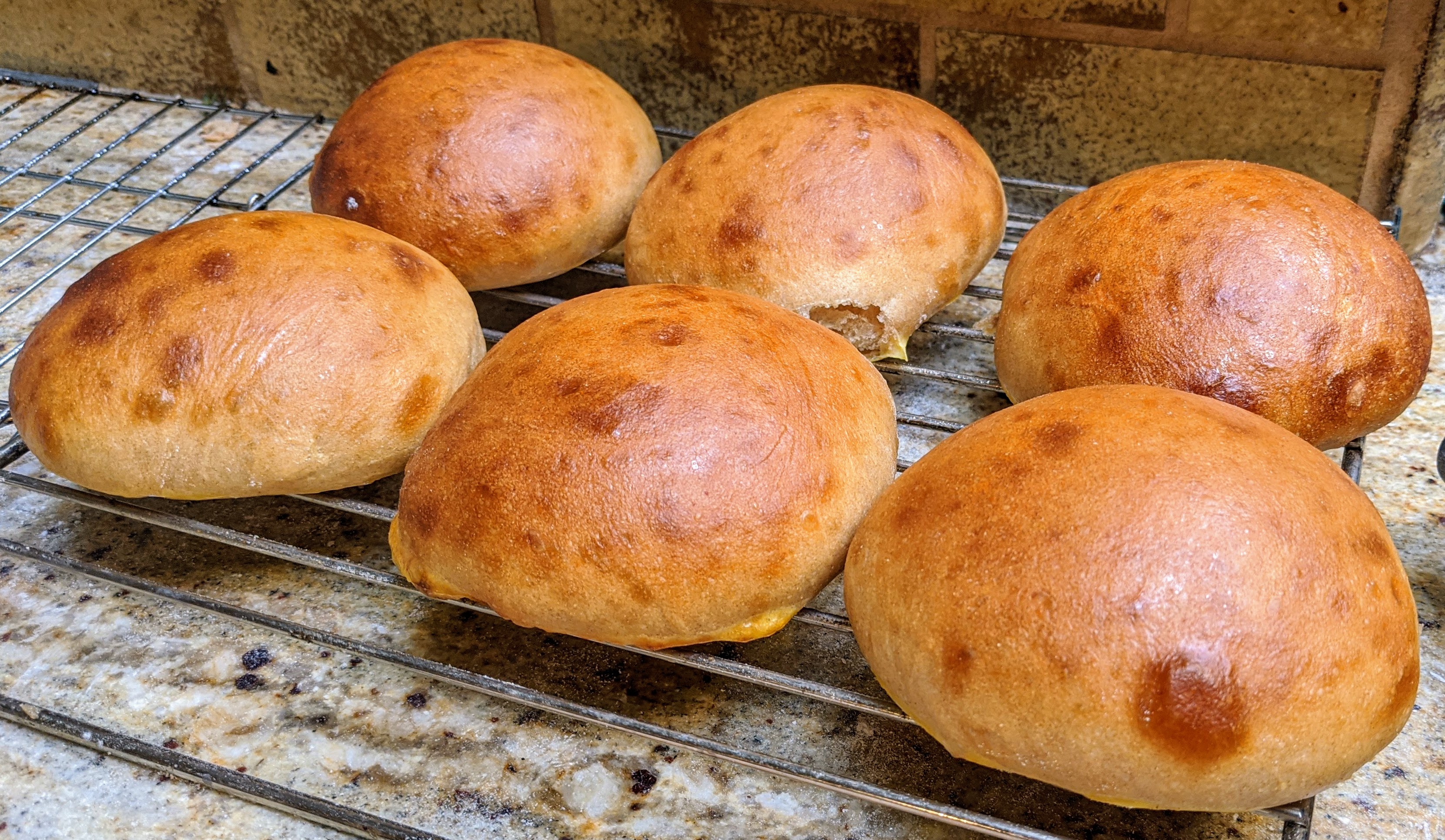
  10. Divide the dough into 125-gram pieces. This recipe will make about 14 buns. Only 6 will fit on a standard cookie sheet, so you can do as I did and make a baguette or mini-batard with the excess dough.
  11. Sprinkle flour over the tops of the divided pieces. These will be the tops of your buns.
  12. Now, lightly flour your work area.
  13. Take a piece of dough, flip it over, gently, press it out into a circle, then shape it just like you would shape a boule, pulling an edge and bringing it to the center. If the dough sticks, add a bit of flour underneath the piece. We’re building tension on the top, so this is important!
  14. Now, flip the ball over onto its seams, then round the ball out using a claw-like shape with your hand and rotating.
  15. Once you’ve got a reasonably nice spherical shape, gently flatten the ball until it’s about 3-3 1/2″ in diameter, being careful not to degas it.
  16. Place the shaped disc on a parchment-covered cookie sheet.
  17. Repeat steps 12 – 16. But only re-flour your bench if it needs it.
  18. Once you’ve created your discs, sprinkle flour on the top of them, then cover the cookie sheets (you’ll need 2) with a paper towel and let them proof for an hour.
  19. At this point, pre-heat your oven to 425º. If you have double oven, then heat both so you can bake the sheets at the same tie.
  20. After an hour, the buns will be ready to bake. If you only have a single oven, pop the other sheet into the fridge to retard the proof (don’t worry, you can bake them right out of the fridge).
  21. Bake for 25 minutes. Hint: To help them pop up, I put some hot water (1/2 cup) in a metal pan on the bottom rack of my oven. This develops steam and helps with the oven spring in the first 15 minutes of the bake.
  22. Once finished, immediately transfer for cooling racks! Do not let them cool on the cookie sheet as the bottoms will get all gooey!

100% Honey-Whole Wheat Bread Recipe

Here’s my recipe for a great-tasting bread that I love to make. I normally use local honey to add a slight sweetness, but if I don’t have it on hand, I replace it with an equal weight of brown sugar. I provide different hydration ratios to reflect the types of breads you can make. The 90% is excellent for making pan loaves. I use the 85% for making boules and batards, and use the 75% for hard rolls and buns.

Ingredients

All numbers are in grams.

Flour90%85%75%Gluten**SaltYeastHoney
Whole Wheat Flour*1000900850750502012227
3/4 Recipe75067563856338159170
1/2 Recipe50045042537525106113
Provided three hydration levels for water: 90%, 85%, 75%.

*Use fine or extra-fine grind of whole wheat flour. I myself prefer to use white whole wheat flour.

**Gluten = Vital Wheat Gluten. This is optional, but really helps in gluten development and oven spring. You can usually find this at a grocery store. My local Lucky carries Bob’s Red Mill brand.

Baker’s Percentages:

IngredientPercentage
Flour100%
Water90%, 85%,75%
Gluten5%
Salt2%
Yeast1.2%
Honey22.7%

As I mentioned in my article on moving to whole wheat flour, things take longer and you have to do more when you use whole wheat flour. This mainly has to do with the slow moisture absorbance and thus slower gluten development. I also discovered that it’s better to do all the fermentation and proofing with a colder dough, so having room in your fridge is important – or in my case, I got a mini fridge to act as a retarder.

Instructions

Day 1

Mix flour, vital wheat gluten until well-incorporated. If using brown sugar, add it at this step. Add water and honey and mix into a shaggy dough then let rest for at least a half-hour.

After the dough has autolysed sprinkle salt and yeast evenly over the top of the dough, then mix thoroughly. Work the dough until smooth.

If you used a stand mixer to mix, transfer to a large bowl and let it rest for 30 minutes; otherwise, just let it rest.

Every half-hour for the next two hours, fold the dough. You may not have to do this many. After folding check the strength of the dough by doing the windowpane test to see if it has enough strength. In my warm kitchen, I only had to do three folds.

After your last fold, allow the dough to rise for at least a half hour or until it has expanded about 30% to 40% of its original size.

Cover your bowl with plastic wrap or transfer to a container and place it in your fridge. If you used plastic wrap, make sure air can escape.

Day 2

“Day 2” can be the next day or up to a week out. The longer you let it sit, the more flavor will develop.

Remove the container from the fridge and allow it to warm to near room temperature (~2 hours).

Dump the dough onto your unfloured work surface, and using your bench scraper, pre-shape the dough into balls. Bench rest the dough for 30 minutes.

After bench resting, divide the dough and do your final shaping, either into a boule or batard. If I’m making loaf bread, I shape using the batard method.

If you do the full 1000 gram recipe, divide the dough into three or four. The three-quarter recipe can be made into two large loaves, and the half recipe is great for single, large loaf.

Once shaped, place in proofing baskets or well-greased pan loaf pans. If you don’t have proofing baskets, use a lightly-oiled bowl that’s dusted with flour.

Chill the dough for two hours in your fridge.

A hour before baking, heat your oven to 475o, making sure your baking stone or Dutch oven are also in the oven to warm up.

Remove proofed dough from containers and slash/score. No need to let it come to room temperature.

If using a Dutch oven, place dough in oven and bake for 20 minutes. Remove the lid, then bake for 10 more minutes or until crust is the desired color.

If using a baking stone and a metal pan for steam, place the loaf on the stone, and pour a cup of hot water into the pan. Remove the pan after 20 minutes, then continue baking for another 10 minutes or until the crust is the desired color.

Allow the bread to cool completely before cutting! I used to disregard this, but if you don’t allow it to cool, the interior will get gummy. Not good.

My Afternoon Batard Recipe and Process

This bread is meant to be made in an afternoon (or less than half a day). And while using a pre-ferment like a poolish or a levain will certainly have more complexity in flavor, this is an absolutely delicious bread that stands on its own!

FYI, this loaf shaped by hand and proofed in a couche. I didn’t have any suitable batard baskets at the time! 🙂

Ingredients

The following will make two loaves about a pound and a half each. Note, I do all the mixing with a stand mixer. You can do all of this by hand if you want. I use a mixer up-front because I know I’ll get consistent results. This is a 70% hydration dough. It’ll be a little tacky but not floppy, and as you work it, it will become smooth and really strong.

Bread FlourWaterSaltInstant Yeast
800 grams560 grams15 grams (~1 tbls)3 grams (scant 3/4 tspn)
100%70%2%.4%
This is a 70% hydration ratio if you’re curious

A couple of important points:

  • Alternatively, you can replace 200 grams of the bread flour with fine or extra-fine grind whole wheat flour. But if you do that, up the water to 584 grams to make a 73% hydration dough – the wheat flour needs some extra water. Also, up the autolyse time from 20 to 45 minutes.
  • The amount of flour indicated is optimized for a 5-qt. stand mixer bowl. Other recipes call for 1000 grams, but I found that the standard KitchenAid dough hook will make the dough climb into the mechanism, and you’ll get machine oil in your dough – not good.
  • Note also that I use instant yeast. If you’re going to use active dry yeast, wake it up in a couple of tablespoons of 105-108 degree water. But bear in mind that you’ll need to remove that amount from the water measurement above. With instant yeast, you’ll just dump it into the dough.
  • You’ll notice that this recipe uses a significantly smaller amount of yeast than other recipes you might see. This is to ensure a nice, moderate yeast development. Don’t worry, you’ll distribute the yeast throughout the process by folding!

Dough Temperature Is Important!

Most online recipes will list water temps at 105-108 degrees to wake up the yeast, and that’s fine to wake up active dry yeast in a couple of tablespoons of water as mentioned above. But it’s too high if you use instant yeast, and at that temperature, your dough will go crazy and rise way too fast. This will affect the flavor and your finished product will be a little bland.

The prevailing wisdom is that your dough temperature should be only 75-80 degrees when working it. To figure that out, you need to measure the temperature of your flour (I use a digital thermometer), then you can use the table below to get near the proper temp (it doesn’t have to be exact):

Flour TempWater Temp
55110
60100
6590
7080
7570
8060
8550

Hydrate the Dough

Mixing the flour and water first activates enzymes and releases sugars in the flour that help with fermentation and also start activating the gluten in the dough. Also, especially with high hydration doughs, it gives the flour a chance to absorb water up-front. This process is called autolyse (pr. ahto-lees).

Place the flour into your mixing bowl. Attach your dough hook to your mixer. Set the mixer to its slowest speed, then slowly add the water. Mix until the flour and water are incorporated (it’ll be lumpy). You can help the mix by occasionally stopping the mixer and scrape the sides down with a silicon spatula. Once fully incorporated, let the flour-water mix rest for at least 20 minutes.

You can also mix by hand, which some may prefer. I like to use a mixer for this first step because I get a more consistent and faster mix.

Start the Fermentation and Initial Folds ~ First Hour

Evenly sprinkle the salt and yeast over the top of the dough, then slowly incorporate them at the lowest speed setting on your mixer (you may have to do the occasional scrape down of the sides). Once the salt and yeast are incorporated, dump the dough onto your board or counter. Do not flour the surface as you will mess up the ratio!

Knead the dough for 6 minutes. You can refer to this video for proper kneading technique:

In the video above, Jack said to knead the dough for 10-12 minutes. But after initial kneading, we’re going to fold the dough a couple of times (or a few times) over the course of the first hour, so we don’t need to do the full 10 minutes. Just make sure you work out the lumps!

Let the dough rest for 10 minutes.

After 10 minutes, fold the dough. Here’s a great video on how to properly fold dough:

My preferred method of folding is in a bowl, but I use my hand instead of a scraper or spatula as in the video. It allows me to feel the dough better. No matter what method you use, be careful to not tear the dough.

Rest the dough for 50 minutes, then fold again. Once you’re done folding, invert the dough to rest on the folds.

TIP: At this point, the dough should feel smooth and luxurious in your hands. I love when it gets to this point!

Fermentation ~ Hour 2

After letting the dough rest and ferment for an hour, do one more fold and again invert the dough to rest on the folds and let it sit for another hour.

TIP: If you replaced a 1/4 of the bread flour with whole wheat flour, I’d recommend doing a fold after a half-hour after your first fold, then do the final fold a half-hour after that.

Final Fermentation?

Maybe… This final step can take an hour or it may require more time. What we’re looking for is that the dough ball has expanded in size (around 50%) with plenty of bubbles on the surface (not popped, mind you). But with dough fermentation, there are so many variables that affect how fast a dough rises from ambient room temperature and dough temperature or how much yeast you used that it’s difficult to pinpoint an exact time. But in general, the final fermentation should take 1 1/2 to 2 hours after the final fold if the ambient temperature of your room is around 70- to 75-degrees.

TIP: When I have the time, I use a scant 1/2 teaspoon of yeast to let the yeast develop slowly. I also do a couple of more folds than are called for in this recipe. I also use this small amount of yeast if my kitchen is really warm.

That said, check the dough after an hour. If it doesn’t show much activity, don’t panic. As long as you smell a sourness and perhaps a bit of alcohol, it’s all good. You can help the dough along at this point by doing one more fold. But this time, be extremely gentle with the dough and do not tear it! Once you do this last fold, your dough should really expand and become jiggly. Just be patient!

TIP: For goodness’ sake, don’t fret about the time! 🙂 Fermentation is not something that can be bound by time. I do a lot of vegetable fermentation (specifically hot peppers, and it sometimes takes several weeks to get the peppers where I like them – especially in cool weather). Take note that published recipes are written to address an average of conditions. Use your eyes and your hands. Don’t just blindly follow a recipe’s time table!

The reason we’re going 3-4 hours for fermentation is to allow the bacteria to do some work as well as the yeast. This is why I use a small amount of yeast. It gives airborne bacteria and naturally occurring yeast to play a role, however minor, in the fermentation process and flavor development.

Shape the Dough

I learned to shape a batard by watching the following YouTube video (actually I watched a bunch of them, but I prefer Jack’s method of pre-shaping and shaping). Check it out:

NOTE: You can certainly divide into fourths, as in the video, but this recipe is optimized for two medium-sized loaves.

Before you start shaping, turn your oven on to 475 degrees. If you have a pizza or baking stone, make sure it’s in the oven on the middle rack. And on the lowest rack, place a metal baking pan (you’ll be adding a cup of water later to create steam for the first 10-15 minutes of the bake – I’ll explain later).

Once shaped, sprinkle flour on the top of each loaf.

Place a piece of parchment paper on a peel or the bottom of an inverted cookie sheet if you don’t have a peel. Cover each loaf with a clean towel or paper towel.

TIP: You can also proof in a proofing basket, but it’s not mandatory. If you’ve created enough tension on the surface of your dough while shaping, it will stand on its own just fine and not collapse during the final proof.

In warm weather, your proof may not take long. At the height of summer as we are in right now in California, my loaves have been fully proofed in just 20 minutes, which is why I don’t provide a specific time. But, it’s easy to determine if your dough’s ready using the finger-dent test.

If you push your finger into the dough about a 1/2″, and it springs back immediately, leaving a very small indentation, it’s not ready. But if the dough springs back slowly and the indentation stays even after a few seconds, it’s ready. I realize that this isn’t very exact – it’s a real feel kind of thing. But to me, that’s one of the beauties of mastering bread making – and I’m not a master by any means, but I do love the uncertainty.

Scoring the Loaf

Scoring your loaf gives it that artisan look, but it also ensures that you’ll be letting out steam from the bread in a controlled fashion and prevent huge bubbles forming under your crust or eruptions in odd places on your loaf. Here’s a great video showing different scoring patterns and techniques:

In general, with long loaves like batards and baguettes, cuts should be made fairly parallel to the long axis of the loaf. With boules, you’re pretty free to do what you want. This article explains the hows and whys of scoring a little more in-depth than the video.

Time to Bake!

Before you place the loaf in the oven, heat up some water (it can be hot tap water). Fill a glass or container with about a cup and set it near the oven.

Now, get your loaf, and slide it onto the baking stone. Before you close the door, carefully pour the cup of hot water into the metal baking pan. This will create steam which will help the oven spring.

Set your timer for 20 minutes. Once it goes off, remove the parchment paper and rotate your loaf 180-degrees to ensure even baking. Also, remove the water pan if there’s still water in it. Bake for 10-15 minutes more: 10 minutes if you want a golden crust, 15 if you want a darker crust. Personally, I like the darker crust, and will sometimes even bake 17-20 minutes longer to get to a darker crust color.

A dark crust ensures that the Maillard reaction occurs, which happens at high heat, causing the amino acids and sugars to interact. It’s what gives carmelized foods their distinct taste. It’s not burned, it’s caramelized and to me at least, it’s the sign of well-baked bread. In my finished loaves, I want to see three colors on the crust: Brown, Yellow, and White.

Finally, remove your loaf and place it on a cooling rack and let it cool for at least 45 minutes before cutting.

That’s it! I know this was a rather lengthy article, but if you follow these steps, you’ll make a great straight dough bread time after time!

Want to Use Whole Wheat Flour?

If you want to use whole wheat flour, I recommend starting with half whole wheat and half bread flour with this recipe. You may not get all the benefits of a 100% whole wheat, but you’ll get more nutrition than a pure white bread. Given that, unfortunately, this turns the process into a bit of an all day affair – you just start in the morning instead of the afternoon and most of the time’s spent waiting anyway, so it shouldn’t be a big deal.

Given a 50-50 ratio white to whole wheat flour, keep these things in mind:

  • Increase the hydration up to 77-80% (640 grams of water) instead of 560 grams. Wheat flour absorbs more water than white.
  • Increase autolyse to at least an hour to allow the whole wheat flour to absorb the water. Some folks autolyse for hours anyway, but in keeping with doing this in a day, you don’t have to go so long.
  • Because this is higher hydration dough, I don’t recommend kneading after mixing. Instead, do at least 4 or more folds in the first two hours. You’ll know you’ve done enough folds when the dough has good tension and it doesn’t collapse much after folding. You can also do the windowpane test to check your dough’s doneness.
  • Alternatively, you can avoid doing all the folding and popping your dough into a container and let it ferment in the fridge for 24 hours or even up to 5 days. This slower fermentation really develops flavor!