My Master Pizza Dough

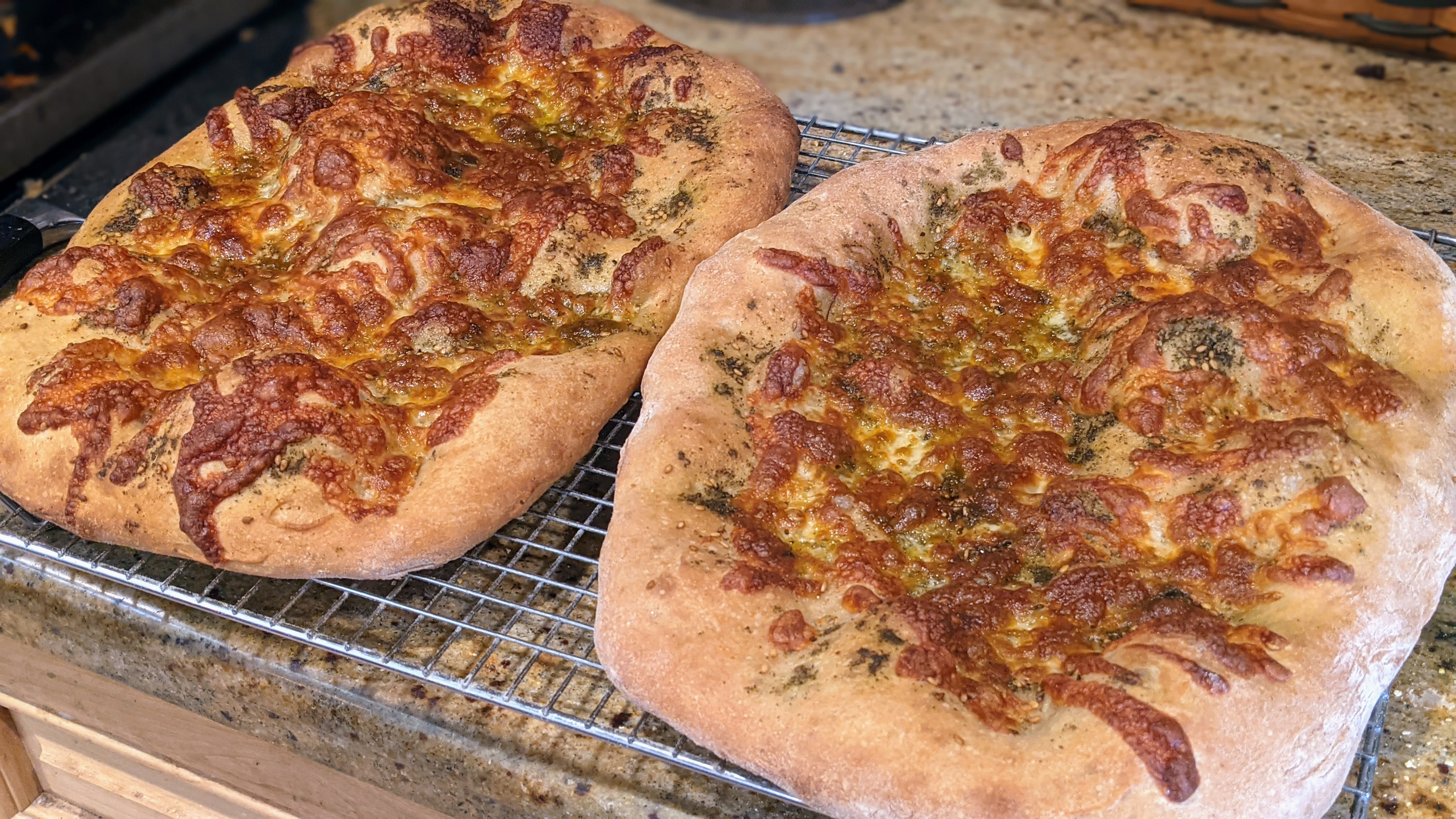
Za’atar Flatbread

Though I haven’t ever posted anything about pizza dough, I actually make pizza or flatbread a couple of times a month. I just haven’t posted anything about it because I’ve been working on my formulation as well as my dough development technique. But I finally developed a formula and method that I’ve been using the past few times I’ve made pizza and as I’m getting consistent results, I thought I’d share it.

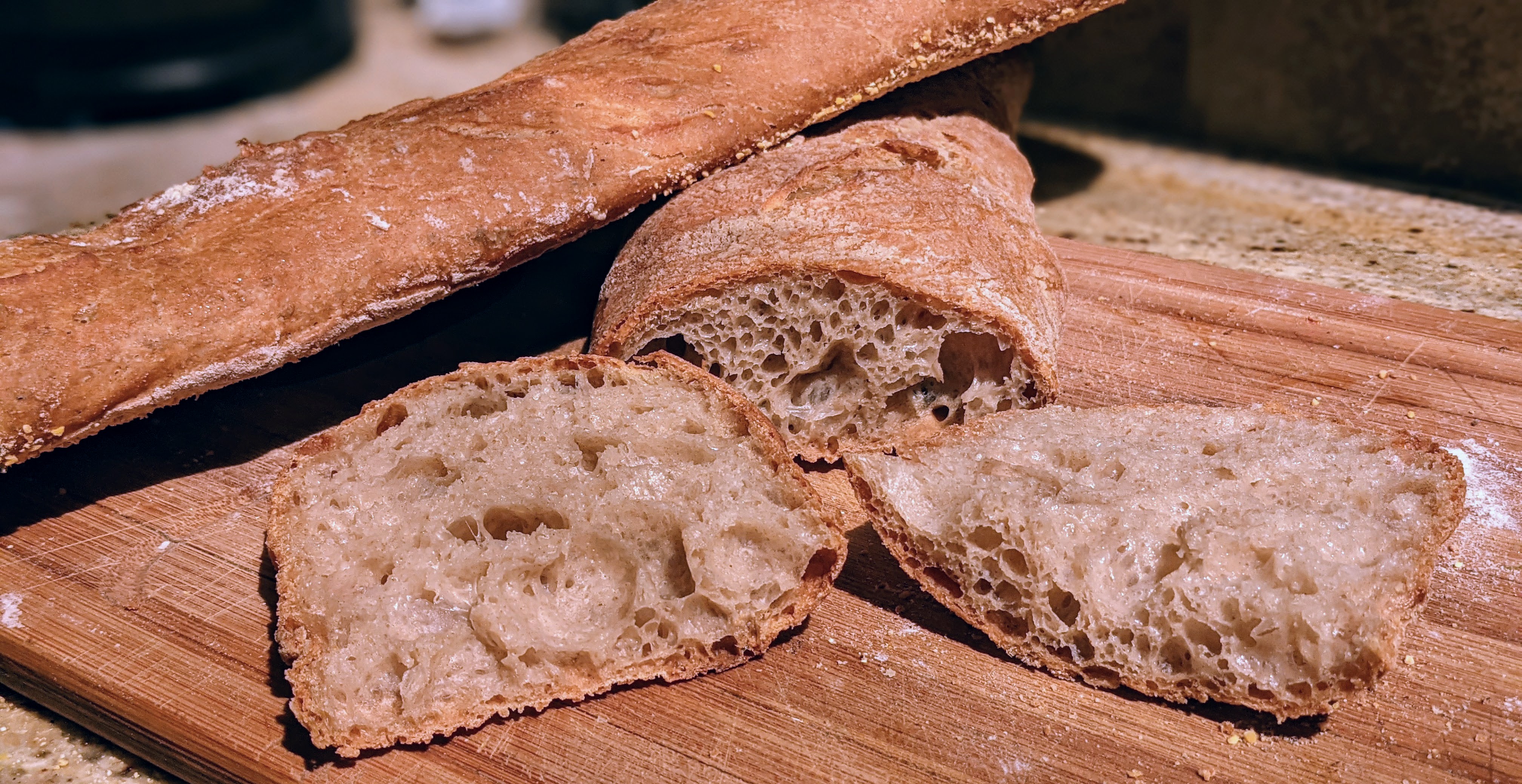
This dough may not be for everyone, especially those who like a thin, crusty crust. I like a crust that’s similar to baguettes: A crispy exterior and a chewy, toothy crumb. If you like a crust like that, this dough will fulfill that!

One thing I love about this particular dough is that it’s highly extensible due to the olive oil. But what I discovered is that you can’t add the olive oil too early as it inhibits gluten formation (I actually had to do some research on that). So the olive oil is always added last, after the dough has been worked a bit.

Contributing to the dough’s extensibility is the use of a stiff biga. But it also lends a very nice, slightly sour flavor profile from the long, slow fermentation. That, combined with a cold final fermentation makes this dough very tasty! Let’s get to the formula!

Overall Formula

Flour100.00%
Water68% – 70.00%
Salt1.80%
Yeast1.30%
Olive Oil5.00%
Total Percentage178.10%

Biga

Preferment Flour % of Total17%
Hydration %60%
Preferment Yeast %0.20%

Final Dough

Flour430
Water299
Salt9
Yeast7
Olive Oil26
Biga138
Yield909.00 / 2 X 450g pieces
Total Flour510.39
Total Water357.27

For both the biga and the final dough, I like using a high-protein flour. Something in the range of 14-17% protein content. You can use King Arthur or Bob’s Red Mill bread flour and add a bit of vital wheat gluten to get you over the 14% mark. I wrote an article on upping the protein percentage in your dough using vital wheat gluten that you can use as a reference.

Biga. As I make a lot of Italian bread, I usually have a couple of different biga formulations in my fridge, so when I need some, I just scale out what I need for a particular bake. For this, you want to make a 60% hydration biga. Most folks won’t have a 60% biga on hand, so you should make it the day before you mix. So for this recipe, take 100 grams of high-protein flour, 60 grams of water and a half-gram of yeast. Mix it all together then form it into a ball. Place it into a lightly oiled bowl and cover tightly with plastic. Let it begin to ferment at room temp for an hour, then pop it into the fridge. It will be ready when the surface is riddled with holes and the center is ever-so-slightly recessed.

While I recommend using a mixer to mix, you can do this by hand. It’s just a little harder.

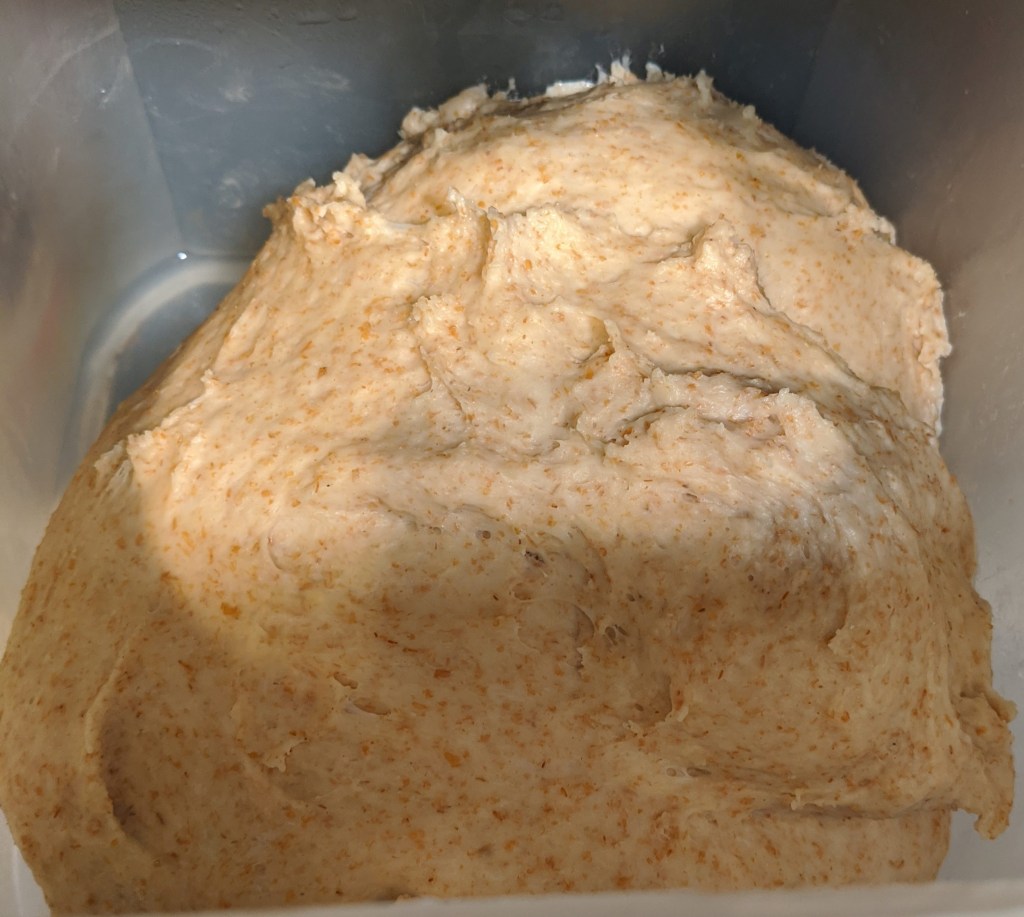
Mix. Measure out the water to 68% (the final dough indicates what you’ll need for 68%). Place all the ingredients in a mixing bowl except for the biga and the olive oil. Thoroughly mix all the ingredients together. As the ingredients start coming together, add the biga in chunks, then mix until fairly smooth. Once everything has been incorporated, the dough should be sturdy, but still pliable. If it seems a little dry and stiff, add a few grams of water to correct the hydration. Work the dough a little to start developing the gluten, then once you’ve got some gluten development, add the olive oil. At this point, I usually squeeze the olive oil into the dough with my hands. To use the mixer would mean to mix at a higher speed, and I don’t want to tear the gluten strands to incorporate the oil.

Bulk Fermentation. 1-2 hours or until the dough has doubled. It was 83°F in my kitchen yesterday when I made the dough and the dough doubled in 45 minutes! So in warm weather, keep an eye your dough!

Folding. If you mixed by hand, you can optionally fold after an hour. But I never fold if I use a mixer. I get good enough gluten development with it.

Divide and Shape. Scale the dough into 450g pieces. These will be big enough for a 16″ peel. If you want smaller pieces, then just half the halves again. Form the pieces into rounds (it’s not important to form a super-taut skin), then place on a floured surface, seam-side-down. If you plan to bake them the same day, let the balls rest for 20-30 minutes then they’ll be ready to press out or thrown. Otherwise, sprinkle the tops with flour, then wrap each piece individually with plastic then place them in the fridge. Alternatively, you can place the pieces unwrapped in a sealable container. Store in the fridge for up to 24 hours. That said, with this amount of yeast in the final dough, I’ve had the most success with a 12-hour final ferment. If you rested your rounds in the fridge, allow them rest at room temp for an hour before baking and shaping into flats.

Note: If you want do an even longer cold fermentation, use 25%-50% of the prescribed yeast. Depending on how cold your fridge is, you could take a two or three days.

To shape, press the ball into a flat circle or a rough oval if making flatbread. Stretch the dough with both hands on the backs of your knuckles, rotating often to ensure an even thickness. As the dough thins, it will tear, so be careful not to tear it! These particular dough balls will make 16″ pizzas. Once finished shaping, place on a peel that has been well-dusted with semolina or coarse-grind cornmeal (my preference), then add toppings.

There’s technically no final fermentation step unless you count the bench rest after shaping into rounds or resting in the fridge. .

Bake. This is where it kinds of gets tricky. And as much as I’d like to say you can bake your pizza or flatbread on baking trays, you get the best results with a stone or steel. Even though you can’t get the high 700° temps of a wood-burning oven, you can still get pretty good results. So bake at 500°F dry for 10-12 minutes. The crust will be golden brown.

Bread Baking “Soft” Skills

I was on an online forum and someone made this post (paraphrased):

Can someone please tell me why I can’t seem to make a decent loaf of bread? It seems I’ve made hundreds of loaves, tried dozens of recipes. I’ve tried wheat gluten, different kinds of flour, kneaded for hours, and resting at different temperatures. I’ve tried less sugar, more salt. But every loaf I make comes out the same: Cakey and totally lacking in flavor. Please help!

Several people answered the person’s plea for help with some very sound advice, albeit technical. I read through all the answers and figured that any specific technical advice I’d add to the thread might be a little redundant. On the other hand, it did occur to me that that person was lacking in what I call the soft skills department.

Soft skills are those skills that everyone assumes one should have, but no one really talks about them. But they are absolutely critical to success – in practically anything. Unfortunately, so much of our society focuses on technical acumen and ability that we end up completely missing or misunderstanding the critical nature of those soft skills.

Every discipline has an accompanying set of soft skills. In my professional life as a software engineer, much emphasis – and quite rightly so – is placed on technical aptitude. In fact, early on in my career, before it became popular to go into software engineering, if you had the skills, you got the job. But as the wold evolved, soft skills such as teamwork, initiative, persistence, and even compassion became important factors in hiring. After all, who wants to work with an asshole? And at my level now, it’s assumed I possess the technical knowledge and recruiters are more interested on how well I can integrate into their team.

Such is the case with baking. Like many, I’ve picked up techniques from blogs, cooking sites, and books. All of them focus on technical stuff. And mind you, there’s absolutely nothing wrong with that. But non-technical or “soft” skills are also critical to baking success. So I thought I’d talk about a few of them in this latest post.

Patience

In his book, “Flour Water Salt Yeast,” Ken Forkish has a section that calls time and temperature ingredients. In that section, he shows how those two things can affect how dough behaves. But after doing several bakes, I realized that even more so, patience is even more important.

Dough takes time to develop. Full stop. Let me say that again: Dough takes time to develop. How much time it takes to finish a particular step is dependent on a variety of factors: temperature, hydration, humidity, etc. It could be a short period of time or it could take seemingly forever to develop. But no matter whether it’s short or long, when you’re dealing with anything that takes time, you have to have patience. When instructions tell you to wait until the dough doubles, wait until the dough doubles!!! It may come up in half the time the baker lists, or it may take two or three times as long. But whichever, have the patience to wait it out!

Adaptability and Flexibility

As a corollary to patience, because dough takes time to develop and that time is variable, we have to be able to adapt and be flexible with our process. The same goes for temperature. For instance, as I write this post, I’m in the middle of a big bake for a luncheon tomorrow where I have to provide garlic bread for 100 people, so I’m making Pane di Como Antico to pair with the Italian menu. Normally, the hydration for this bread is 73%. But today, it’s warm in my kitchen, so I lowered the hydration to 71%. Lowering the percentage also allows the gluten to form more easily, so instead of the normal four folds that I do, I only needed to do three sets as the dough strength developed earlier.

Also, because it’s warm, rising times significantly decreased. The basic recipe calls for a final ferment of 1- 1 1/2 hour. But with the ambient temp in my kitchen at 78°F, I’m thinking it’ll take about 45 minutes to do the final proof.

The point to this is that though the original recipe states specific times, you have to remember that those times were based on the author’s kitchen conditions at the time. I need to be flexible and adapt to the conditions in my own kitchen. If I stuck with the original prescription of an hour to an hour-and-a-half, my dough would overproof. Not good.

Also, as being dogmatic can be problematic, tweaking a recipe on the fly in response to something not happening according to some condition the author lists is just as bad. You’ll be forever chasing after one bad situation after another!

Tidiness (read: Having Your S$%t Wired)

Having been a longtime home cook, and having worked in food service in the past, I’ve learned the very important lesson of mise en place, or “everything in its place.” I have a few chef and cook friends and one thing they always talk about is their “meez.” Their most commonly used items and seasonings are right within reach. Chopped veggies and herbs are prepped well before service. And most importantly, they keep their stations clean! And as one chef friend said to me once, “I know a line cook has his or her s%^t wired just by looking at how they’ve arranged their station and how clean they keep it during service.”

As for me, whether I’m cooking or baking, I prep EVERYTHING I need first, and I wash every pot and pan or scale or bowl as soon as I can after I’m done with it. My counter is kept scrupulously clean. And woe the person that comes along and leaves crap on my counter when I’m cooking. They get an earful till it’s cleared.

The point to this is that an uncluttered space means you have an uncluttered mind. It also requires immense focus to maintain the cleanliness of your space that just aids in keeping you on your A-game while baking. For instance, if you read this blog with any regularity, you know that I bake a lot of baguettes. When I do, I have my board and couch conditioned, all my scrapers lined up and all my ingredients weighed out and in containers before I even consider mixing stuff together. When I started being disciplined, the quality of my baguettes went through the roof as did the consistency of them from bake to bake.

Geeking Out

If you want to bake with any proficiency at all, you have to have to do a bit of studying. As they say, knowledge is power, that couldn’t be more true than with artisan bread baking. And there is nothing wrong with that. When I first started baking, my wife would tease me that I study more than bake. She was actually teasing me, and I knew it, but I did respond by saying that just as with the great Nancy Silverton, I was obsessed with dough. I wanted to learn all I could about it.

I woudn’t expect others to be nearly as obsessive about baking and dough as I am, but it’s never a bad thing to gain knowledge. Never.

The Importance of Breathing: In Other Words, Chill Out!

This might not seem like a skill, but it requires a lot of practice to be relaxed and chilled out when baking. When we’re nervous, we tighten up and we constrict our breathing. This slows the oxygen to our brains and we become muddled, which in turn makes us even more frantic. It’s really a vicious cycle that we get ourselves into.

But if we’re breathing and relaxed in our actions, we breeze right through everything. Everything is clear because our brains are getting oxygen. And though I’m speaking within the context of baking, it applies to everything in life.

But as far as baking is concerned, we also have to do – or not do – things that will trigger our nervousness. That whole mise-en-place discussion I had above contributes to our relaxations, whereas the lack of it creates chaos. So breathe. Relax. It’s good for you!

Mindfulness

I’m Catholic and one year at Lent, as opposed to giving something up like candy or booze, I instead decided to be more mindful; that is, be more aware of what I was doing and doing my best to see the interconnectedness of my life and world around me. While I didn’t necessary dive down into the depths of the details, I made sure I was at least always aware of what those details were.

Practicing mindfulness during that time became a habit, and I learned to apply it to my baking. At least to me, being mindful is that extra insurance for a successful bake as mindfulness prevents me from skipping steps or taking shortcuts. It keeps me aware of what’s happening with a dough that I’m working on.

For instance, as I write this section, I have a flatbread dough that’s going through its bulk fermentation. On normal days when it’s 72-75 degrees in my kitchen, that dough takes 2-hours to complete bulk fermentation. But it is a VERY hot day today and it peaked at 102 degrees. I had my are conditioning on, but my kitchen was still a balmy 84 degrees. So I’m being extra-mindful of my dough.

Whew! I kind of wrote a novel this time! But this was as much for myself as for sharing it with others.

Happy Baking!

Ciabatta with Biga

Like the humble baguette, a ciabatta is the model of simplicity when it comes to its ingredients. But also like the baguette, if you don’t bring your A-game to this bake, it’ll bite you in the ass! The dough is so wet that you have to use quick movements when working with it. I can’t tell you how many times I’ve ended up with my hands covered with dough (more like batter). I don’t want to discourage anyone from making this, but just be prepared.

Speaking of preparation, I’ve adapted this recipe from a few sources, but mainly from what I learned from Carol Fields’ book, “The Italian Baker” and her Ciabatta Polesana, which she in turn adapted from former race driver Arnaldo Cavallari who quit racing and started baking the flour from his family’s mill. In her recipe, she recommends using high-gluten flour. I’m not sure just how high of protein content she was talking about, but the high-protein flour I use is 17% protein. At 88% hydration, it’s like working a regular dough. So I upped my hydration to 93% when using this flour to get it to a looser consistency. But I do recommend bread flour or a mix of bread and AP flour at this hydration.

Ms. Fields also recommend using a mixer. I usually use one if I’m making a larger batch of ciabatta. But when I’m just whipping up a couple of loaves, I just mix by hand. But as I often recommend, a Danish dough whisk really comes in handy. That said, let’s get to the formulas!

Overall Formula

Flour100.00%
Water88.00%
Salt1.80%
Yeast0.75%
Total Percentage190.55%

Biga

Make a 75% hydration biga from 35% of the flour you’ll need (we’ll get into that in just a bit). Whatever that weight comes out to, make a bit more than what you calculate. For this particular recipe, our yield will be 2 X 500g loaves and I always add a percent or two for process loss, so about 1010g total dough weight. The biga formula is as follows:

Preferment Flour % of Total35%
Hydration %75%
Preferment Flour Weight185.52
Preferment Water139.14
Preferment Required325

As the table above shows, to make the total dough weight, we need 325g of biga. I made 350g and just measured out what I needed the next day.

To figure out how much total flour you’ll need for ANY recipe, take your target dough weight (this recipe is 1010g) and divide that by the total percentage (in this case 190.55% or 1.9055). That will give you about 530g. So, for the biga, you’ll need about 185g of flour as that is 35% of the total flour.

Final Dough

Flour345
Water327
Salt10
Yeast4
Biga325
Total Yield1,010.00
Total Flour530.04
Total Water466.44

Biga. The night before, mix the flour, yeast, and water you’ll need for the biga. Form into a ball, cover with plastic and let it rest. The next morning, it should be covered with bubbles and slightly domed. For my kitchen, it took about 10 hours to get to this state. It will be shorter in warm weather and longer in cold weather. Carol Fields recommends putting the biga in the fridge after an hour. But be forewarned that it will take 18-24 hours to get to the proper state. This is NOT a bad thing as it will develop the flavors of the organic acids.

Mix. In a large bowl, mix biga, yeast and water. Break up the biga (it will not completely dissolve. Add the flour, then sprinkle the salt over the flour. Mix until well incorporated and get the mixture to be as smooth as possible. Adjust hydration so that the dough is loose, but not quite a batter.

Bulk Fermentation. Approximately 1 to 1 1/2 hour.

Folding. After mixing, let the dough rest for 20 minutes then stretch and fold the dough.

Be sure with your folding that you do not tear the dough! However, do plenty of stretch and folds and feel the gluten strands develop. You will not get a lot of resistance at first, but you will feel it build. Also, don’t be afraid of wetting your folding hand often to prevent the dough from sticking.

Laminate. Pour the dough out onto a well-floured surface (be generous with the flour). Using wet or well-floured hands (and I also use my bench scraper), gently tug the dough into a large rectangle about 3/4″ thick. You don’t want to pull it too thin because you want to retain the bubbles as much as possible. Gently stretch out one of the short sides of the dough then fold it 2/3 over the sheet, then repeat with the other side. Do this again with the short sides of the dough until you’ve completed a north-south-east-west pattern. Gently pat the dough a little flatter, then repeat the NSEW pattern two more times, with a light pat-down in between. The dough will build up after each lamination, so be careful not to flatten it out too much. After the third lamination, gently roll it over onto the seams – no need to seal. Move the dough ball to a lightly oiled bowl for the final stage of bulk fermentation. Let the dough almost triple. This will take anywhere from 30 minutes to an hour and a half. At this point, we’re after bubble production!

Do yourself a favor and use really good olive oil. While you can use the standard stuff you can find in a grocery store, I’ve found that even the small amount that’s used with this bread makes a huge difference in the taste. I use Frantoi Cutrera Segreto Degli Iblei cold-extracted extra-virgin olive oil from Sicily.

Dividing and “Shaping.” At this point, you can be pretty generous with the flour you put on your board. Slide your dough out onto a well-floured work surface and tug into a rectangle about 3/4″ to 1″ thick. You’re going to divide it along the length, so try to make the rectangle as even as possible. Placing your fingers under the ends of a piece, quickly bring your hands together to scoop up the dough and transfer it to a very well-floured couche, or well-floured baking pan. Do some final arrangements to evenly distribute the dough across the flat loaf. The loaves will not be of even weight, though you can get pretty close. (Update: I scale out to 500 grams pieces – I like ’em even)

You will also notice bubbles just under the surface of the skin. Do not pop them!

Note: If you use a baking pan, use a mixture of flour and course-grind cornmeal or semolina. You won’t be transferring the loaves to a stone.

Final Fermentation. This is a little tricky because all you really want to do is let the dough reset from dividing and shaping. Chef Markus Farbinger only waits 10 minutes for this final stage. I go from 15-30 minutes. The poke test will not work here. What I look for is if the dough has puffed up a bit and the sharp edge of my cut is all but gone.

A good ciabatta will be riddled with holes!

Bake. Transfer the loaves to a transfer board. For added texture, I sprinkle a generous amount of cornmeal on my transfer board to give the bottoms of the loaves a nice crunch. Lightly spray olive oil on the tops of the loaves. Bake with steam at 485°F for 12 minutes. Remove the steaming container, turn the oven down to 435°F and bake for another 20-25 minutes until the crust is a deep golden brown. Cool for 30 minutes before cutting.

Fully baked, a ciabatta will feel a lot lighter than what its size may indicate. My ciabatta are 22″ long, but they feel light as a feather. If your loaves feel a little heavy, bake them for a few more minutes. It’s the water that makes them heavy.

Happy Baking!

What About Using Sourdough?

That is entirely possible, though I’d change the formula a little to use a hybrid starter/commercial yeast method of rising as indigenous yeast tends to make finer holes. You’ll use half the yeast prescribed in the original recipe and cut the starter’s flour percentage to 20%.

Furthermore, I recommend building a levain from AP flour to keep the flavor mild. Or if your starter is based on whole-grain flour, I’d recommend a grain that has some gluten in it. If you want to use a rye-based starter, then knock the hydration down a couple of percentage points.

Given all that, here’s what the adjusted formula would look like:

Overall Formula

Flour100.00%
Water88.00%
Salt1.80%
Yeast0.30%
Total Percentage190.10%

Starter

Preferment Flour % of Total20%
Hydration %75%

Final Dough (Yield: 2 X 500g loaves)

Flour425
Water388
Salt10
Yeast2
Preferment186

Notes

  1. Though I mentioned using a hybrid rising technique you could still go with using nothing but a levain to raise the dough. But if you do, I highly recommend doing a long, cold bulk fermentation for at least 12-16 hours to ensure good bubble formation. Also, after you remove the dough from the fridge, you’ll need to give it a couple to a few hours to come up to near room temp before proceeding with the rest of the processing.

Janie’s Mill High Protein Flour

When I first started making high-hydration loaves (75%+), they were disastrously flat. And since I was baking on a stone, I didn’t have the luxury of the sidewalls of a Dutch oven to save me. So I had to learn how to build structure into my dough.

And I learned all sorts of techniques, from proper folding to shaping method and even getting a better sense of how my dough was fermenting. And as a result, my loaf height seriously improved.

But I had run across some posts online where people had made beautiful high-hydration loaves and mentioned that they were using high-protein flour – almost to a person. And that got me thinking that if I could combine my development and shaping techniques with good, strong flour I could improve the structure of my loaves even more.

So I went on a quest for high-protein flour and that first led me to Azure Standard Unbleached Bread Flour Ultra-Unifine. This is my #1 flour, and I absolutely love it. At 14.7% protein, it develops plenty of strength and my loaf structure immediately improved as a result. But as a it is a high-extraction flour, it has a very grain-forward flavor profile. Mind you, it’s not a bad thing, but too much of a good thing can be bad as well. So I always cut it with a little King Arthur bread or AP flour.

But that kind of bugged me because I knew that was reducing the protein levels in my loaves. Look, they still came out great, but I’m the type of person that doesn’t just want to get the job done, I want it done right and with no compromises in quality.

It’s how I approach music and performance. For instance, when I first took on the role of musical director for the youth and young adult Mass at my church, the musicians initially balked at me requiring a two-hour rehearsal prior to service. But I explained to them that even though we were volunteers, that didn’t exempt us from providing a high-quality product that enhances the prayer experience. Mistakes and misalignment would only serve to detract from that. And after seeing the results of that kind of commitment, they got it. Now, twenty-five years later, we’re still going strong – a bunch of old farts rocking with God! 🙂

Sorry for going off on a tangent…

Anyway, I wanted to find a high-protein flour that had less of a grain-forward flavor. So after trying a few different ones, I ran across this wonderful flour from a small mill in Illinois called Janie’s Mill. They produce a high-protein flour from Glenn wheat, which is a hard spring wheat. And at 17% protein, it was sure to provide plenty of structure – even up the protein levels of my high-extraction flour!

The flour arrived about a week ago, and I’ve baked a few loaves with it. This is wonderful flour to with which to work. And the bread that I’ve made with it has a gorgeous, nutty flavor profile and the crumb is pleasingly chewy. Notice how dark the crumb is in the picture to the left. That actually surprised me because the flour is very light in color, as is the dough. But it browns with baking. VERY cool!

My next test will be to cut it with my high-extraction flour to see how that performs. I’ll probably start with a 50/50 blend, then go from there.

I’ve included the nutrition information card to the right. When I saw the 6g per serving size of 35g, I nearly flipped! Just on that number alone, I knew I had to try it. And now that I’ve baked with this flour a few times, it’s going to be a regular part of my flour blend.

Mind you, this flour is NOT cheap. Actually, it’s pretty expensive at $48 / 25lb bag. I bought two bags, plus a small bag of Red Fife flour and it set me back over $100. But it’s great flour, totally organic and GMO-free and most of all, it’s produced by a small, independent mill. I think it’s important to support the little guy.

For more information, go to the Janie’s Mill website.

Recipe: Sourdough Baguettes (Updated)

As I’ve often mentioned in the past, baguettes are my favorite bread to make. Nothing gets me in the zone as much as making baguettes. The reason for this is that though they seem so easy to make at first blush, they’re actually incredibly difficult to get right. For me at least, making baguettes requires me to be on my game every step of the way; forcing me to be absolutely mindful of what I’m doing because one misstep can result in total disaster. Which explains why I haven’t released a sourdough baguette recipe until now. I’ve had quite a few disasters and I didn’t want to publish a recipe until I had a few successful runs.

As with all my baguettes, I make them for the express purpose of being a platform for sandwiches. But they work just as well for tearing up and dipping into olive oil and balsamic vinegar. They’re also optimized for baking in a domestic oven, so they’re more demi-baguettes than full-sized 60-80 cm loaves.

Also, these use a hybrid rising technique using a levain and some yeast. Yeah, yeah, yeah, I can hear the sourdough purists out there screaming, but I prefer the results of the hybrid technique over a pure levain-risen dough. I’ve baked several permutations and I have to be honest: While I love the flavor profile of a pure levain-risen dough, it’s far too extensible, and backing off the hydration creates too tight of a crumb. The small amount of commercial yeast used here helps open the crumb. But that said, you still can choose to not use any commercial yeast. The process will take longer and the crumb may not be as open.

This can be up to a two-day process, depending on how long you want to do the bulk fermentation. But unlike a poolish baguette where you make the poolish the day before then mix, shape, and bake the final dough the next day, with this you’ll build the levain and mix the final dough on the same day, then either bake that day or cold ferment overnight. Let’s get to the formula:

Overall Formula

Flour100.00%
Water76.00%
Salt2.00%
Yeast0.50%
Total Percentage178.50%

Levain

Preferment Flour % of Total25%
Hydration %100%
Levain Flour192.5
Levain Water192.5
Levain Required for Recipe385

Final Dough

Flour577
Water392
Salt15
Yeast4
Levain385
Total Yield~1374g total dough
4 X 340g loaves (60 cm)
6 X 226g loaves (40 cm)
Optimal Dough Temp76°F

Levain. Build a levain to yield the amount you’ll need for the bake. With these baguettes, the flour of the levain represents 25% of the total flour needed in the recipe, which would be 192.5g out of a total of 770g. Your levain will be ready when it passes the float test.

As far as the type of starter to use, for baguettes, I normally use one based on AP flour as I want less sourness in my dough. But you can use any flour to evoke different flavor profiles.

NOTE: I’m not going into building a levain as there are plenty of resources available for making and building a 1:1 (flour:water) starter. As for how much you should make, while the requirement for this recipe is 385g of levain, make more than that – like 400g – to account for evaporation and levain sticking to your mixing utensil.

Initial Mix/Autolyse. Reserve 50-75g of the water. In the remaining water, break up the levain until it’s fully dissolved, then add the flour and combine well, being careful not to develop the gluten much. Autolyse for at least 20-30 minutes on up to an hour (remember, there’s starter in this, so you don’t want fermentation to progress too far).

Final Mix. Sprinkle the yeast over the dough. Dissolve the salt into the reserved water, then mix in the, salt, and reserved water into the dough until well incorporated with no large lumps. The dough should be shaggy.

The rest of the process can also be seen here in my Master Baguette Recipe.

Folding. Gently stretch and fold 3 times in the first hour at 20-minute intervals. By the third fold, the dough should be smooth and supple, with bubbles forming. When you do your stretches, try to be as smooth as possible, but do make sure to stretch the dough to its full extent. This is important, especially with baguettes because you only have a narrow window – one hour – in which to build dough strength.

I love this part of the process because the dough goes from this ugly, uneven mass and transforms into a smooth, luxurious and structured dough.

Bulk Fermentation. 1-2 hours depending on room temp. Or you could pop the dough into the fridge for a long, cold nap. In either case, take the dough out to about 75-80% and NOT doubled as you might see in other recipes. You don’t want to take it too far.

Divide and Shape. Pour dough out onto a floured surface and gently tug it into a rectangle of even thickness. Scale out 4 X 340g pieces. Letter fold each piece, making sure to stretch the sides out when folding, then roll each piece out into a jellyroll shape, and seal the seam. Place seam-side-up on a well-floured couche and let relax for at least 20 minutes (maybe more depending on how tightly you rolled the logs). After resting, shape the logs into baguettes.

Final Fermentation. 1-1½ hour. This could be shorter in warm weather.

Bake. Transfer loaves to a loading board or baguette pan. Score, then bake at 500°F for 8-10 minutes with steam (baguette should just start getting color). Remove your steaming container, then bake at 425°F for 12-15 minutes on convection if you have a convection setting, otherwise bake at 435°F for 12-15 minutes. Bake longer to a deep russet color, but beware that because of the acid in the dough, you don’t want to take these out too far as the crumb will dry if baked too long.

NOTE: You could technically leave out the commercial yeast, especially if your levain is super-active. With its flour representing 25% of the total flour, there will be plenty of yeast to rise the dough. However, if you do this, lengthen the time between folds to 30 minutes and be super gentle with your folding. Consider doing a coil fold for the final fold. Pure sourdough dough is much less forgiving than one that has commercial yeast. Also, final fermentation time will increase as the density of yeast in a levain is much less than that of commercial yeast.

Pointage En Bac / Slow Rise Baguettes

Okay, I admit it. I’m a baguette freak. I make baguettes at least once or twice a week. And up until this past week, I’ve been experimenting with different methods from baguettes made with a poolish to paté fermenté to levain. But to tell you the truth, my favorite baguette to make is based on the slow rise or pointage en bac method; a method similar to the one Master Baker Markus Farbinger teaches in his baguette and ciabatta video series.

So what is the pointage en bac method? Simply put, it’s a straight dough that slowly rises in the fridge. Traditionally, it was retarding the shaped dough. The technique has its roots in busy French bakeries where bakers wanted to provide baguettes throughout the day. After all, baguettes are best eaten within the first hour or two of baking – and they’re MUCH better warm! However, that had an issue of the shaped loaves collapsing, so to prevent that, the bakers would add dough conditioners to help the shaped loaves maintain their structure. Not a fan.

However, as Jeffrey Hamelman put it in “Bread,” the close cousin to this technique is to create a huge batch of dough then separate it into several batch buckets and allow the individual batches to bulk ferment in a cold environment. From a production standpoint, this has huge advantages because all the baker has to do is pull a bucket from the retarder, then shape and bake as opposed to whipping up another batch of dough. This is the method that Chef Markus Farbinger teaches in his baguette video series, though he only makes a single batch.

I prefer this technique simply because it keeps things simple: Throw all the ingredients into a mixing bowl, let it ferment for an hour, fold the dough, cover it, then pop it into the fridge for 6-18 hours. I’ve even used a third of the amount of yeast called for and let it ferment for over 24 hours to develop flavor. It’s a very flexible technique that can easily be adjusted to accommdate different schedules.

AND if you’re going to be baking in separate batches, it’s an ideal method. For instance, in the next couple of days, I’m going to have to make a few batches for an upcoming graduation party. I’m going to make a huge batch of dough, then separate it into separate batches. When the dough’s ready, I’ll take a batch from the fridge, shape it, then bake it. While those loaves are in the oven, I’ll remove the next batch from my fridge, shape them, then let them go into their final fermentation. By the time the previous batch is finished and the oven comes back to temp, the next batch should be ready to bake.

What makes it possible is retarding the dough. Yes, the later batches will be slightly more fermented, but there shouldn’t be too much of a flavor difference between the batches. Let’s get to the formula/recipe, shall we?

Note that the final dough will produce 4 loaves at 335g apiece. With the baking method, the finished loaves will have be approximately 250 grams, which is the official French weight for a baguette (those French are very exacting about their bread standards).

Formula

IngredientBaker’s %Final Dough
AP Flour (11-12% protein)100%763g
Water75%573g
Salt2%15g
Yeast0.3%2g
Total Yield
(Accounts for about 1% weight loss during processing)
1353g
Optimal Dough Temp76°F
Target dough temp: 78-80°F

The yeast amount can be varied. Go up to 5g if you intend to just bake them that day, but 2g and an overnight cold rest yield the best flavor!

Process

This is one of the few doughs that I make where I mix entirely by hand mainly because I only make enough dough to make 4 X 330g pieces for a single batch. I use a mixer if I’m doing multiple batches.

Mixing. Use a mixer or mix by hand and mix to a shaggy mass with no large lumps. As I mentioned above, I almost always mix by hand for a single batch, though I use a Danish dough whisk – that’s a must-have tool. Make sure though to sift the flour if you mix by hand.

Shaggy mass with very little gluten development. The folds at 20-minute intervals will build the strength and has-retention properties of the dough!

Bulk Fermentation: 6-18 hours. 1 hour @ room temp; the rest of the time in the fridge.

Folding. Fold 3 times at 20-minute intervals for the first hour to develop the gas-retention properties of the dough. This is gentle folding. Though I do stretch and folds I do my best to not press down on the dough too much when folding a flap over. After the third fold, pop the dough into the fridge for a long, cold rest, or until the dough has expanded around 50%. It’s best not to let it go too much further than this.

You may notice that this folding schedule is different from my original instructions of letting the shaggy mass sit for an hour, then doing a single fold and popping it into the fridge. But once I started making Baguettes de Tradition, I’ve preferred this folding schedule because it ensures equal distribution of the yeast and salt AND the dough develops lots of strength, especially if I mix by hand so I now use this folding schedule for all the baguettes I make.

Divide and Shape. Dump your dough out onto a lightly floured surface, tug the dough into a rough rectangle with even thickness throughout, then scale out 335g pieces. Preshape each piece by letter folding it, then rolling it like a jelly roll into a log. Seal the seams, then set aside on a well-floured couche – seam-side-up – for 20-30 minutes to relax the dough (this could be longer if you rolled the log tight, but don’t go over 45 minutes). After resting, shape the dough into baguettes, returning each piece to the couche, giving ample room for the loaves to expand.

There’s technically no official weight and length, though in general, the accepted final weight and length of a finished loaf is around 250g and 60cm in length. After a lot of tweaking with different weights, I found that a 335g dough weight is optimal to achieve the 250g finished weight.

Final Fermentation. 30-minutes – 1 1/2 hour depending on ambient temp. This is where feel is extremely important. While traditionally “doubling” is a decent visual cue, that will take the loaf close to full fermentation and leave very little room for expansion in the oven. And with a dough like this, which is wet and narrowly shaped, the finger dent test isn’t revealing because when you poke into it, most of the time, the dent will remain – even in the early stages of the final fermentation. So it’s best to check the loaves every 30 minutes. The loaf will be ready when it feels like poking a marshmallow.

65% AP flour / 35% Kamut flour. Whole grain flour will limit spring but will provide tons of flavor!

Score. Score the loaves according to the diagram below. Do not score on the bias! Even though the scoring may appear to be on the bias, the slashes are actually fairly parallel, with just a few degrees of deflection down the middle third of the loaf. Though there’s no rule governing how many slashes you make, aesthetically, an odd number looks better.

Scoring should be done within the middle third of the loaf, with each slash overlapping roughly 1/3 of the previous slash. Your blade angle should be about 20-degrees to the surface of the dough.

Bake. Bake at 475°F/250°C for 12 minutes with steam. Remove steam container, then bake for 12-15 minutes at 435°F/225°C, or if you have a convection setting, 425°F/220°C. These baguettes really benefit from a full bake.

Happy Baking!

Ugh! With Baguettes, You Have to Be on Your Game!

Okay… I have to admit that this is a bit of a rant – at myself. As I sit and write this post, I’m pissed off! I just finished shaping a set of baguettes and while ultimately they’ll turn out okay, the dough fought me every step of the way, and I tore the skin – not bad, mind you, but I still did it – on each and every one! The dough seemed to fight me every step of the frickin’ way! The gluten was so tight. On top of that, it kept on sticking to my left palm, hence the tearing!

What I should have done was let the dough rest a little more because they were obviously not relaxed. And what I also should’ve done was to make sure my palms were nicely floured. DUH!

The big lesson here is that you can’t force the dough to do something it just won’t do. You need the patience to let it get to the point where you can manipulate it the way you want.

And I think what pisses me off so much is that I KNOW this! Yet this morning, I was being a stubborn ass because I was already pissed off about another thing. Oy-vay!

The point of all this is that me being pissed off completely threw me off my game. Simple things like flouring my hands that I would normally just do I didn’t do! The patience that I normally have was just gone. And that affected the quality of my work, and it only pissed me off even more that I knew I was messing up yet couldn’t get back on my game!

And that’s the thing about baguettes. Once you start messing up, it’s hard to recover; not impossible, but it’s frustrating just the same. The dough’s so simple to make, and it’s so beautiful when it’s ready for shaping. But I’ll be damned if one little mistake can turn into an uncontrollable fiasco, like that little crack on a windshield that seemingly expands to a fissure all on its own.

Luckily, I was able to recover somewhat. After my dough relaxed after shaping, I was able to nudge and pull the loaves a bit on my couche and they ultimately turned out alright. But even still, that only slightly lightened my mood.

So I whipped up another batch of dough and did a redemption batch of Baguette de Tradition Francaise which, in my mind, are the most difficult of the baguette doughs with which to work – especially for a same-day bake. The 76% hydration with AP flour makes handling tricky, and you REALLY have to be on your game. This batch turned out gorgeous! Now I’m back in my happy place!

I Think I’ve Got It! My Master Baguette Recipe (Updated)

As I mentioned previously, my favorite bread to make is a baguette. And I think the primary reason is that I love to make sandwiches out of baguettes! To me, happiness is a great sandwich made with great bread. But I was SO excited because I think I finally found the perfect flour blend for my baguettes!

Yeah, yeah… I’m always tweaking. Well, not for my boules and batards any longer. I have the flour blend down for that. But with my baguettes, I’ve been trying to strike a good balance between texture, taste, and especially, nutritiousness. I didn’t want to do a pure white flour baguette, but I also didn’t want the bread to be as heavy as my 75-25 high-extraction/whole wheat blend. So I decided to lighten it up. But instead of using bread flour, I decided to use regular old AP flour, and the results were magnificent!

Before I get into the recipe, especially if you’re new to making baguettes, the formula and process may seem a bit daunting. But I wanted to include as much detailed information as possible because there’s a lot to know and frankly, baguettes are one of the hardest breads to make well. I’ve learned how to make baguettes through a lot of trial and error plus a variety of sources, both online and from books. What I’m presenting here is kind of a conglomeration of all the stuff I’ve learned.

Flour That I Use

In general, I use high-quality and if possible organic flour. For common AP flour, it’s almost always King Arthur or Bob’s Red Mill. Both offer consistent quality for baking (though I’ve recently taken to using Central Milling organic AP flour – it’s very nice).

For my baguettes, I use a blend of flour that is predominantly unbleached AP flour. By using a substantial amount of AP flour, I lower the protein content slightly. The one thing I found about baguettes is that you don’t want a real tight internal gluten structure. You want a nice, taut skin when shaping, but internally, you don’t want nearly as much dough strength as you would a boule or batard – just enough dough strength to hold the bubbles together.

  • Azure Market Organics Unbleached Bread Flour, Ultra Unifine, Organic – In its place you can use a Type 85 flour or another high-extraction flour. And make sure that the flour is ground fine- to extra-fine. If you can’t find any high-extraction flour, no problem. Just use regular bread flour. However, one of the main reasons I suggest using high-extraction flour is that it retains most of the natural yeasts, oil, and microbes that are essentially removed from white flours; not as much as whole grain flour, but certainly much more than white flour. They will add more complexity to the overall flavor of the bread!
  • As for 100% whole-wheat flour, you should sift it before mixing. Retain the bran, then sprinkle it over the shaped loaves right before baking. It’ll give the tops of the baguettes a rustic look.
  • AP Flour – I struggle with this because technically you could use standard grocery store brands like Gold Medal or store label AP flour. King Arthur, Bob’s Red Mill, and Azure Standard are 11.5% to 11.7% protein. It’s really not that much difference in protein amount, but it makes a world of difference in oven spring and dough strength!

Bleached or Unbleached Flour?

My preference is to use unbleached flour which is aged naturally as opposed to bleached flour which uses chemical agents to speed up the aging process. From a taste perspective, you shouldn’t notice any differences. Texturally, it is said that unbleached flour has a denser grain and tougher texture, but I’ve only used unbleached flour, so I couldn’t tell you the difference.

Without further ado, here’s the formula.

Overall Formula

Flour100%
Water75%
Salt2%
Yeast0.43%
Total Percentage177.43%

Poolish*

Flour100%200
Water100%200
Yeast0.16%0.3
Flour of the poolish represents 25% of the total flour (see below Final Dough)

*It’s a good idea to make more poolish than you actually need. There will always be some loss due to evaporation and dough sticking to your mixing utensil. So even though the dough technically calls for 190g of flour/water (380g poolish), I’d use at least 200g flour and water each.

Final Dough

Flour572g
AP flour (75%): 428g, High-extraction (25%): 143g
Water381g
Salt15g
Yeast5g
Use half if bulk fermenting cold
Poolish380g
Yield1340g (+ 13g wiggle room)
4 X 335g (60cm) loaves
6 X 225g (40cm) loaves
Optimal Dough Temp76°- 80°F
Total Flour (incl. poolish)762g
Total Water (incl. poolish)572g

Instructions

Day 1

Prepare the poolish 6-12 hours before you intend to mix the final dough. I usually make it the evening before my bake, but also, since I’m an early-riser, I’ll make the poolish at 5-6am, then mix the final dough in the afternoon.

Day 2

Mixing. Break up and completely dissolve the poolish into the water. In a separate bowl, thoroughly combine all the dry ingredients. Then mix the wet and dry ingredients together. Mix until all the ingredients are combined with no large lumps. If mixing by hand, a Danish dough whisk works great! If using a mixer, mix on the slowest speed and regularly scrape down the sides. Mix until you form a well-combined, but shaggy mass as shown to the left.

Bulk Fermentation. 2 – 2½ hours. Take the dough to no more than 50% of its original size. Though you can take it to double, you want some food for the final ferment, and doubling cuts it real close. Rolling out the baguettes will degas the dough, so you want to have enough yeast activity for the shaped dough to rise.

Folding. Fold three times (stretch and fold in the bowl), every 20 minutes in the first hour. I want to stress that you need to be very gentle with the folding. Definitely stretch the dough but be very careful to not tear it or degas it too much! Stretch and fold until the dough no longer wants to be stretched then stop. By the end of the third folding session, your dough will be smooth and luxurious, as in the picture to the right. You will see bubbles formed just beneath the surface of the dough.

(optional) Cold Bulk Fermentation. After the first hour, you can pop the dough into your fridge for some further flavor development. With this amount of commercial yeast though, I wouldn’t recommend doing this for more than 6-8 hours. You want to make sure the dough is still well-domed when you remove it from the fridge. The reason for this is commercial yeast – even at 36°F- 39°F – are pretty hardy little buggers. They’ll certainly slow down, but unlike indigenous yeast, they’re like little Energizer Bunnies! 🙂 That said, if you want to do an even longer cold bulk fermentation, cut the yeast in half or even down to a quarter of what I listed and you can cold bulk for a couple of days!

Divide and Pre-shape. Gently pour the dough out onto a lightly floured surface. Tug it into a rectangle, then divide it into 4 X 335g pieces for standard 60cm baguettes or 6 X 220g pieces for 40cm baguettes. Letter fold each piece by gently pulling out the sides and folding to the middle, then jelly-roll it perpendicular to the letter fold seam to form a rough, short log. Seal the seam, then place on a well-floured couche, seam-side-up (on the left). Allow the dough to relax for 10-30 minutes depending on how tightly you rolled the initial log. The dough should be very relaxed before you shape, otherwise, it will fight you!

Shaping. After the bench rest, shape the logs into baguettes about 15-20″ depending on the size of your oven (I have a baking stone, so I roll mine out to 24″). and return to the couche for final fermentation. Make sure to leave lots of room in between the pieces to prevent tearing during the final ferment. You’ll know the dough’s relaxed enough when you can stretch it and it doesn’t fight you. If you find the dough fighting you, let it sit for a few minutes then resume shaping.

Final Fermentation. 1 – 1½ hour. This could be shorter or longer depending on the weather! Use 1 hour as the baseline, but during warm weather, check the progress of the loaves at 30 minutes.

Bake. Transfer the loaves to a transfer board, score, then bake at 475°F for 12 minutes with steam. Release steam (remove your steaming container), turn down oven to 425°F and bake another 15-20 minutes until you achieve a rich, russet color. Personally, I’m not a fan of taking baguettes out to super-dark. The crust at that point becomes too hard to be enjoyable. But that’s just me.

The ideal baguette will have various sized holes that dot the crumb.

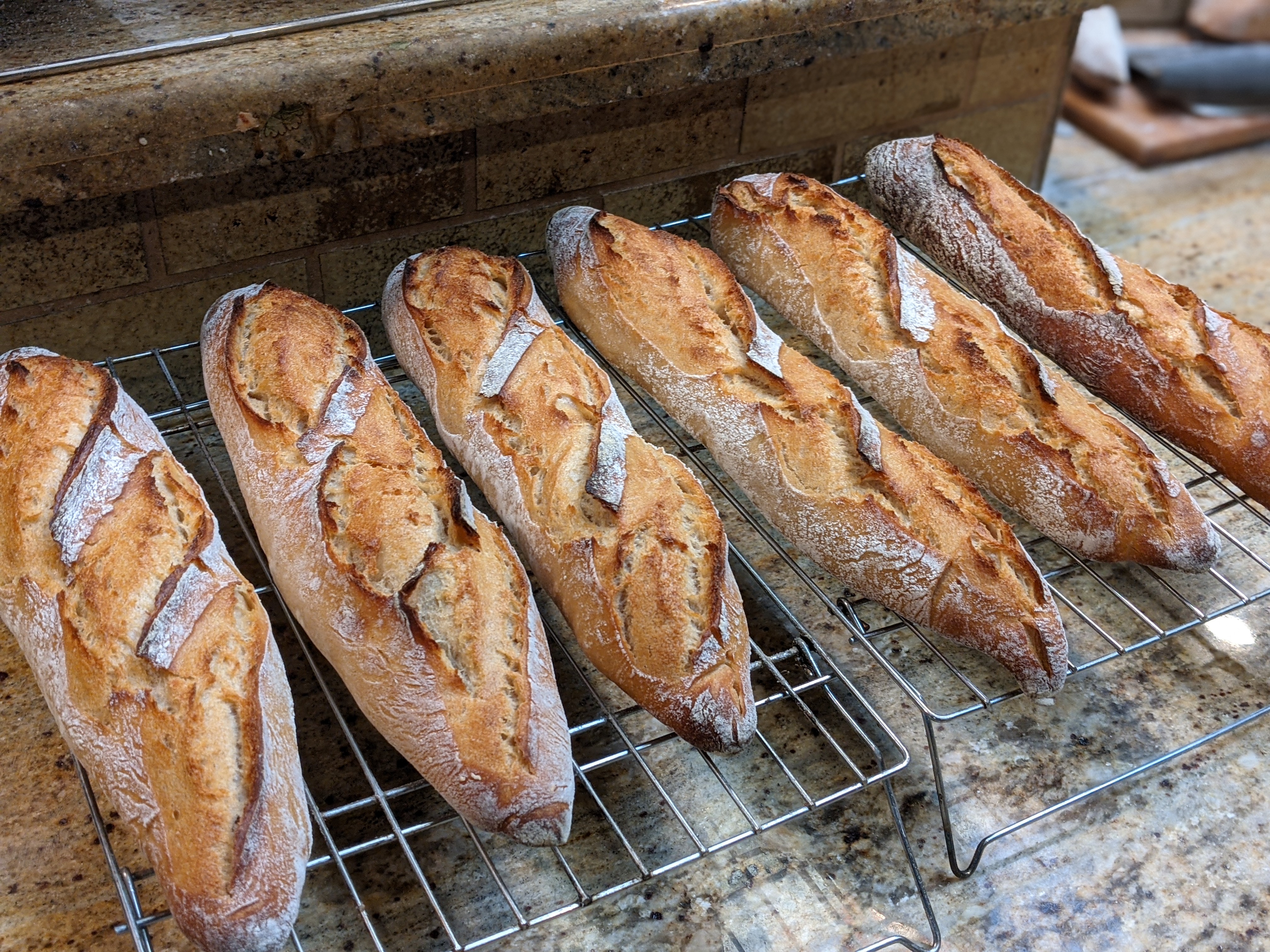
I allowed these demis to get a bit of a skin, thus they formed ears.

Notes

  1. You might be wondering where I got the 380g of poolish. That represents 50% of the total flour, including the poolish flour. To calculate total flour for any formula, take the the Total Dough Weight divided by the Total Formula %, so 1353 / 177.43% = 762. Technically, 50% of that is 381, but I like nice, round numbers.
  2. You can replace the poolish with sourdough starter. But make sure it’s at peak activity (passes the float test) and is nice and bubbly. The process will slow a bit because the yeast density of starter is not nearly as high as with commercial yeast.
  3. The pre-shape step is absolutely critical, not just in starting to orient the gluten strands but it also acts as an intermediate fermentation stage, however short.
  4. When shaping baguettes, make sure your hands are lightly floured lest the dough sticks to your palms and tears the skin. You need to avoid that! And remove any rings!
  5. Having made hundreds of baguettes, I’ve learned not to put too much importance on forming ears on the loaves as you can see with the loaves above. I actually cold-fermented the shaped loaves before I baked them because I had other loaves in the oven. They kind of formed a skin even though I had them covered. And though they were delicious, they were pretty crunchy. The aesthetic that I go for now is to get a moderately crunchy crust, but not to go overboard.
  6. It is ULTRA-important that you don’t take the final fermentation all the way to the finish. You actually want to get to about 85-90% fermentation, then bake. This’ll ensure that you get great oven spring. Otherwise, the loaves will be flat.
  7. As mentioned above, if you want to do a longer cold bulk fermentation, use less yeast. I’d start out by using half the yeast. But you could treat the bulk like pizza dough and use even less and take a couple of days for bulk fermentation. If you do that, use less than a gram of yeast.

What If I Can Only Bake Half the Shaped Loaves at a Time?

If you don’t have room to bake all the loaves at once, then pop the other loaves into your refrigerator while the other loaves bake. Once your oven comes back up to temp after the first batch, remove the extra loaves from the fridge and place them on your board.

You could also pop them in the freezer, but I don’t recommend doing that for more than 30 minutes.

Bassinage Is Really the Way to Go

The more I use the bassinage method, the more convinced I am that it’s the way to go with building great dough structure. For those that are unfamiliar with bassinage, it’s a process of adding water to the dough during bulk fermentation – bathing the dough as the word translates from French.

Mind you, what you’re doing is actually holding back a bit of the total water during mixing to promote the formation of gluten. While it requires water to form gluten, it forms more readily in a relatively drier environment. For the loaves above, my final hydration was 75%. But I only hydrated the initial dough to 70%, reserving that small amount of water to be added once I built up the gluten. I added the rest of the water – less than 40g – during my first fold about 10-15 minutes after mixing.

What is apparently happening with bassinage is your initial mix allows gluten strands to form (as I stated gluten forms more readily in lower hydrations which is why low hydration dough is stiffer). Then when you add more water later to get to your final hydration, some of that water combines with stray flour to form more gluten and some water molecules get trapped in between gluten strands. So conceivably, you’re going to get better oven spring because of the trapped water.

The effect of holding back some of the water was pretty incredible. If you look at the loaves in the picture above, they look like they absolutely exploded. But see how sharply the extreme ends of the loaves rise up and how the loaves haven’t filled the basket to the edges? I believe that is a function of dough strength that I built up in before bassinage and the loaves holding their shape after shaping, not rising action.

Before I started using the bassinage technique, my dough would fill the baskets to the edges, then rise above the rim. But by employing the bassinage technique, I was able to build lots of strength in the dough first, then get it to its final hydration. I’ll tell you, that dough was absolutely magnificent to work with!

When I made baguettes this past weekend, I used the Baguette de Tradition method, which is a same-day, 76% hydration dough. I applied the bassinage technique when making this dough, and thank goodness I did! Truth be told, I actually slightly over-proofed the shaped loaves as it was a pretty hot day. But if you look at the picture to right, they puffed up rather nicely in spite of being a little over-proofed. I owe that to the strength I built into the dough before getting to my final hydration. There was enough strength left in it that the loaves maintained their structure.

When I put the loaves in the oven, I was worried they’d come out flat. But when I pulled them out of the oven, I was SO jazzed. They came out nice and puffy!

As I mentioned in a previous article, I actually stumbled upon this technique before I even found out that it’s actually a formal technique and had been using it for months before I heard Jonathan at Proof Bread on YouTube talk about it. For me, it really is the way to go!

Bathing Your Dough – Bassinage

It’s funny how we sometimes stumble upon a technique, not really knowing it was a technique in the first place! One of the things that I started to do a few months ago to fine tune the hydration and temperature of my dough was to hold back a small amount of the total water in my formula (about 50g – 100g, depending on the bread I was making), then add it in during folding. I had no idea that this was technique called bassinage.

When I started doing this, my thinking was that with high-hydration dough, gluten development was challenging when the dough was really wet. So I’d hold back some of the water and let bulk fermentation start with the lower amount of water to promote the formation of gluten as I had read somewhere that a drier environment helps gluten form much more easily.

Now as I write this, I’m laughing because it never even occurred to me to include this in the formulas I share. And I didn’t think anything of it because formulas I’d learn from prominent bakers such as Jeffrey Hamelman never even mention this in their formulas! But it’s an actual technique that the French call eau de bassinage, or bathing water.

I looked up the term in Hamelman’s “Bread” book and as he explains:

It is often difficult to mix wetter doughs to adequate gluten development when using a planetary mixer (such as a Hobart or KitchenAid). One tactic that is effective is the following: When mixing the final dough, hold back a portion of the liquid (hold back more or less liquid depening upon the total hydration of the dough). This technique (called bassinage in French) can also be used with spiral mixers for wet doughs. The gluten will develop more readily in this drier environment. When the dough has attained the degree of strength you seek, turn off the mixer. Make an opening the place where the dough hook enters the both of the dough. Pour the rest of the liqui into this hold, turn the mixer back on, and mix just until the liquid is incorporated. I find this to be an effective technique when I mix at home, not just for notoriously we doughs like ciabatta, but for many other doughs as wel, especially those whose hydration is abouve about 70 percent.

Hamelman does this during mixing, but when I started researching this technique for this article, I found that different people do it at different stages. For instance, one baker I found does it to incorporate the salt and yeast after autolyse. Another does it as I do during the first fold, adding a little water at a time to the bottom of the container and folding the dough over it. No matter what stage bassinage is performed, one thing is common: Gluten formation takes place beforehand.

I have to do a bit more research into this as I’m interested in the food science behind the technique. But from what I’ve been able to gather thus far, as the gluten has already formed, the added water acts as a lube of sorts to help the dough become more extensible as the water molecules penetrate the dough and get in between the gluten strands. Pretty cool.

All that said, I don’t do this will all my bread – not even all the high-hydration bread I make. But if I know I’m coil folding a dough, I usually fold in water during the first folding session, or when I feel that sufficient gluten development has taken place.