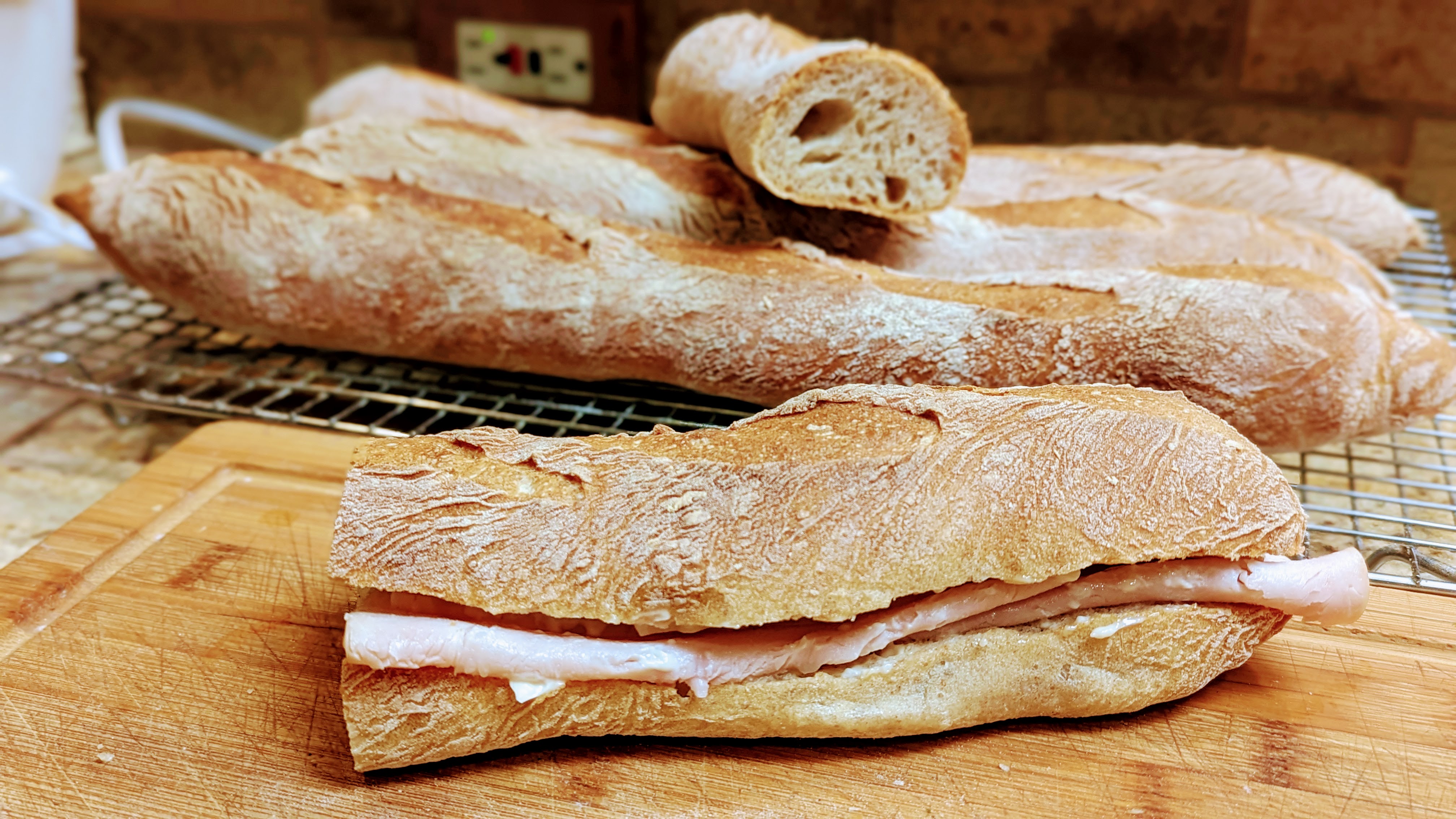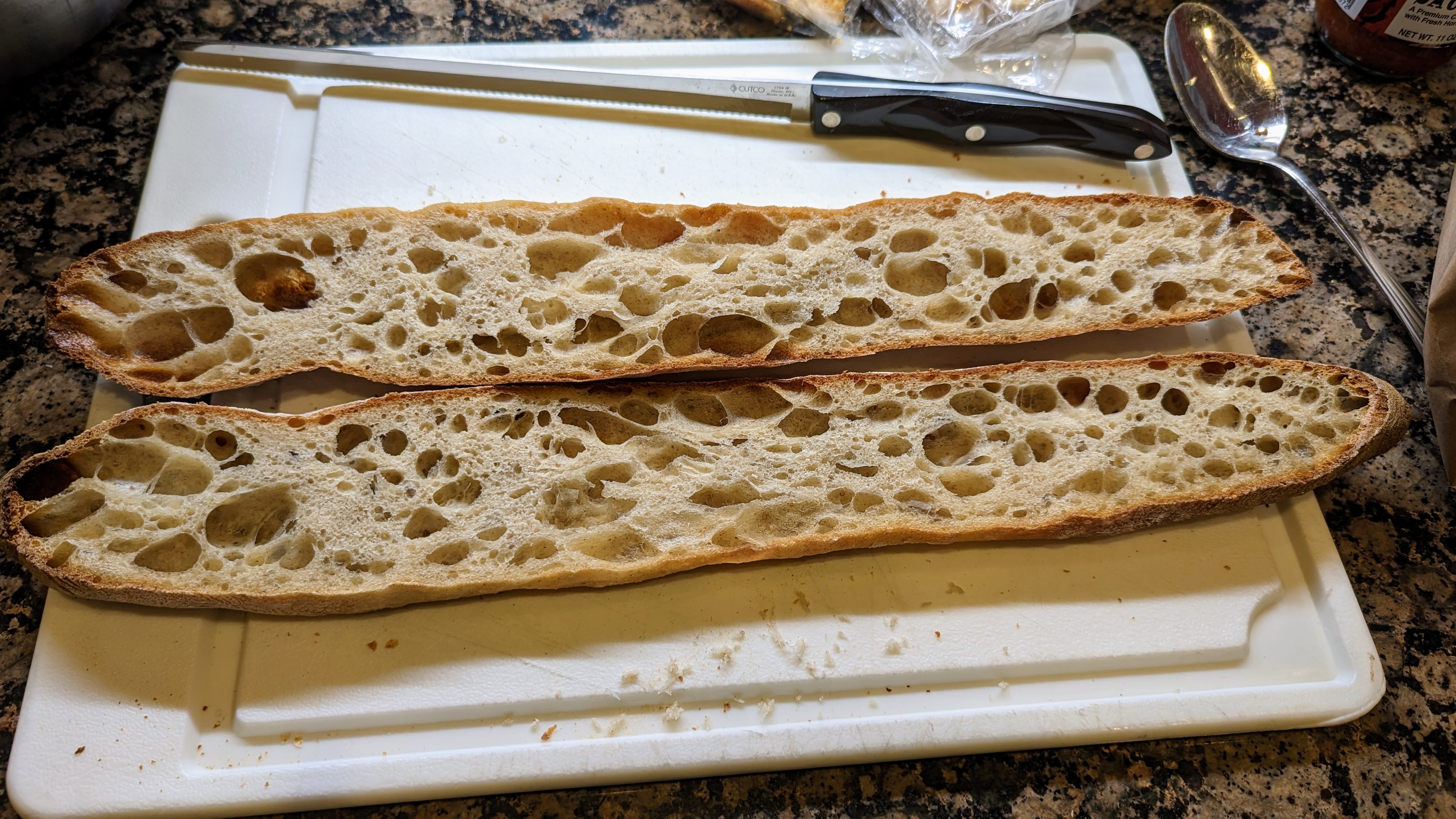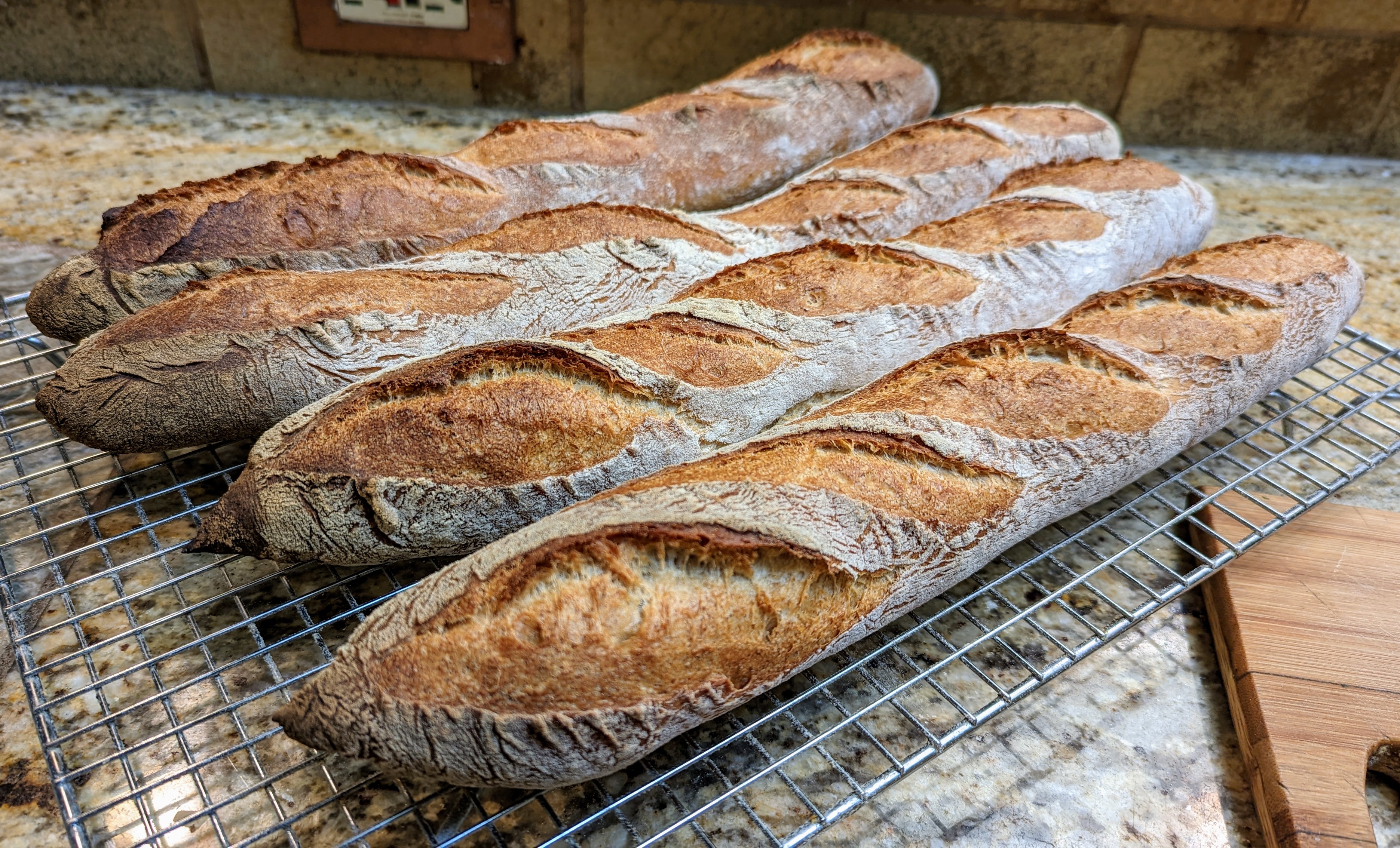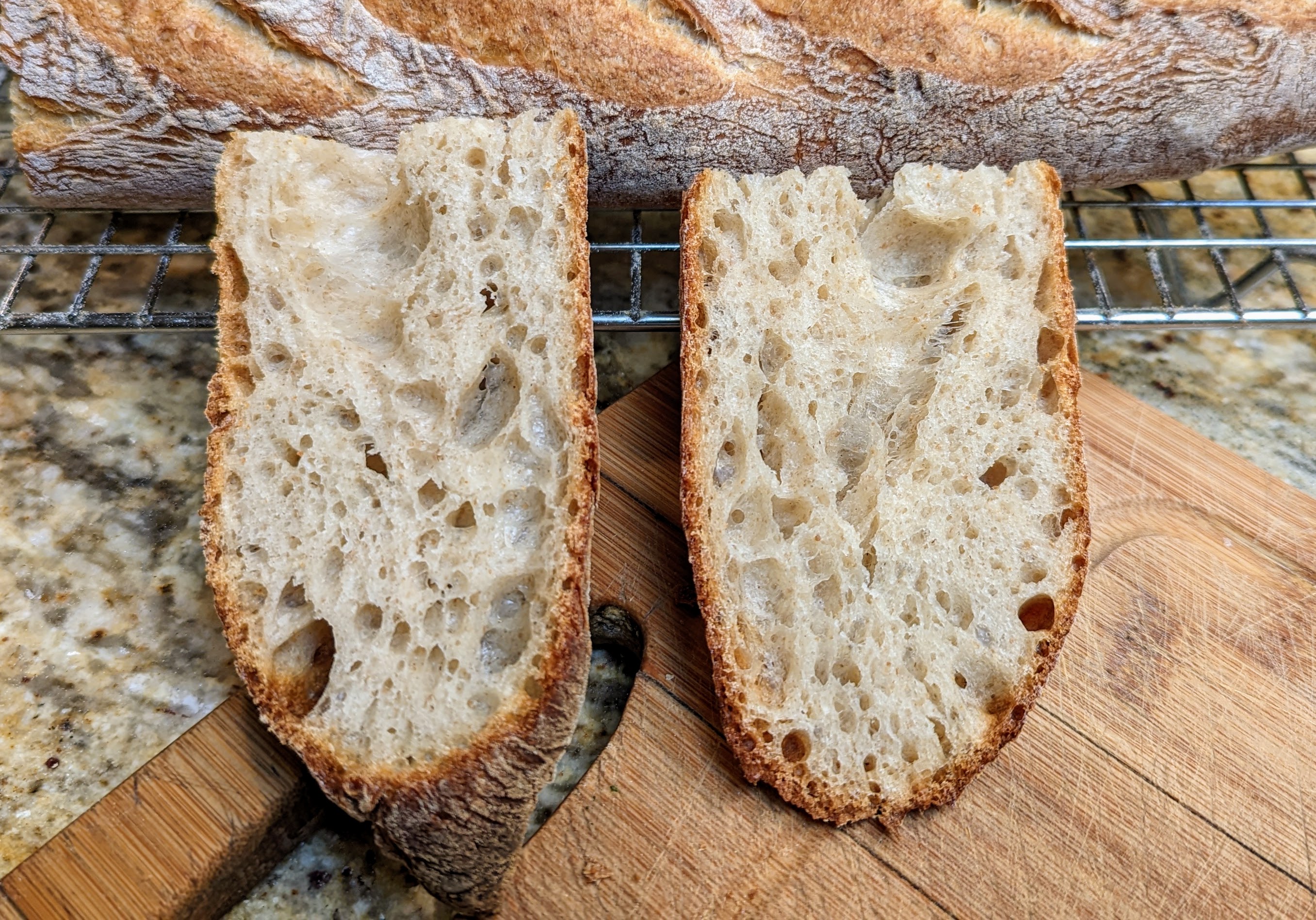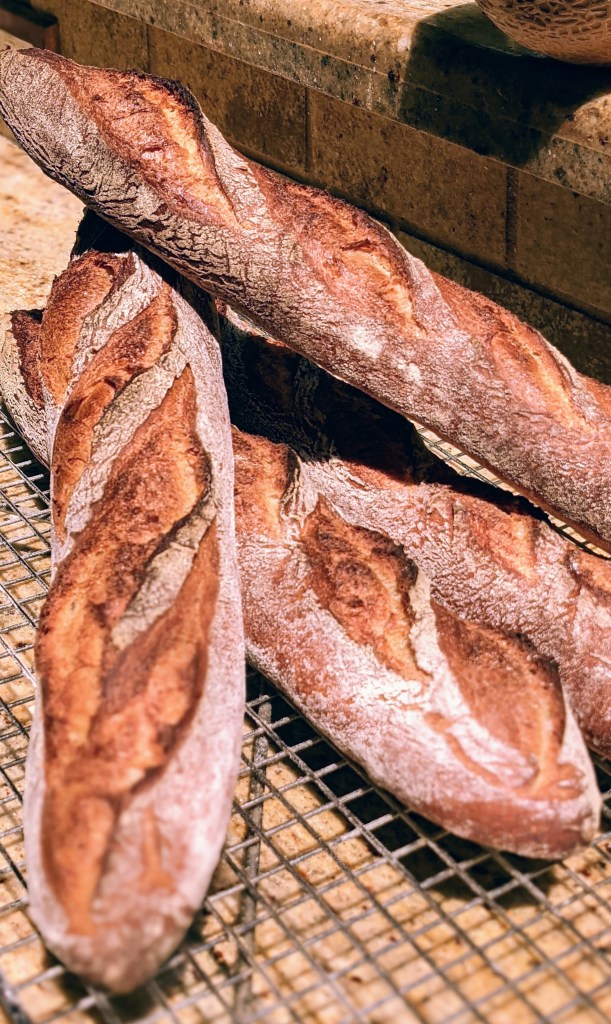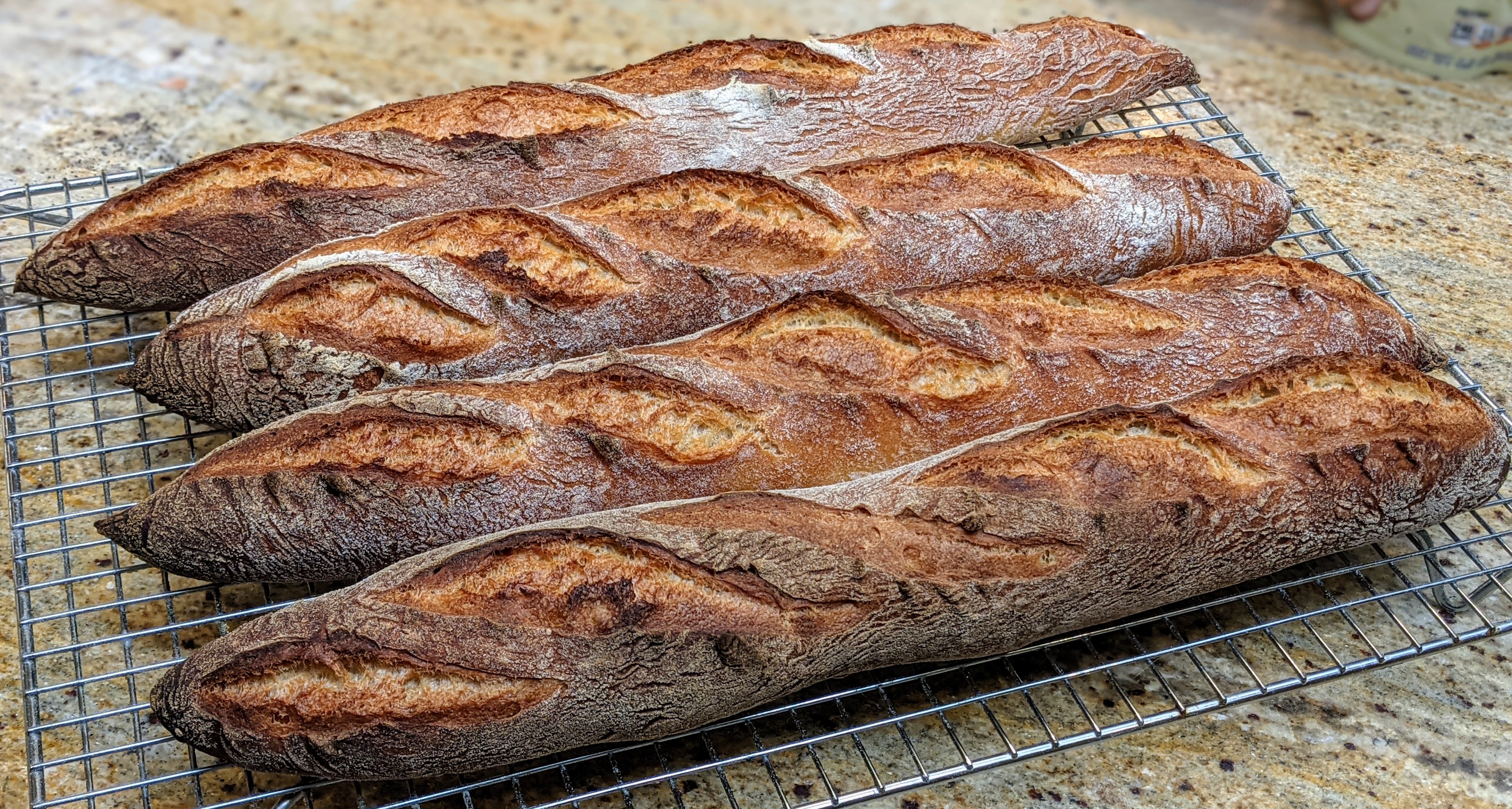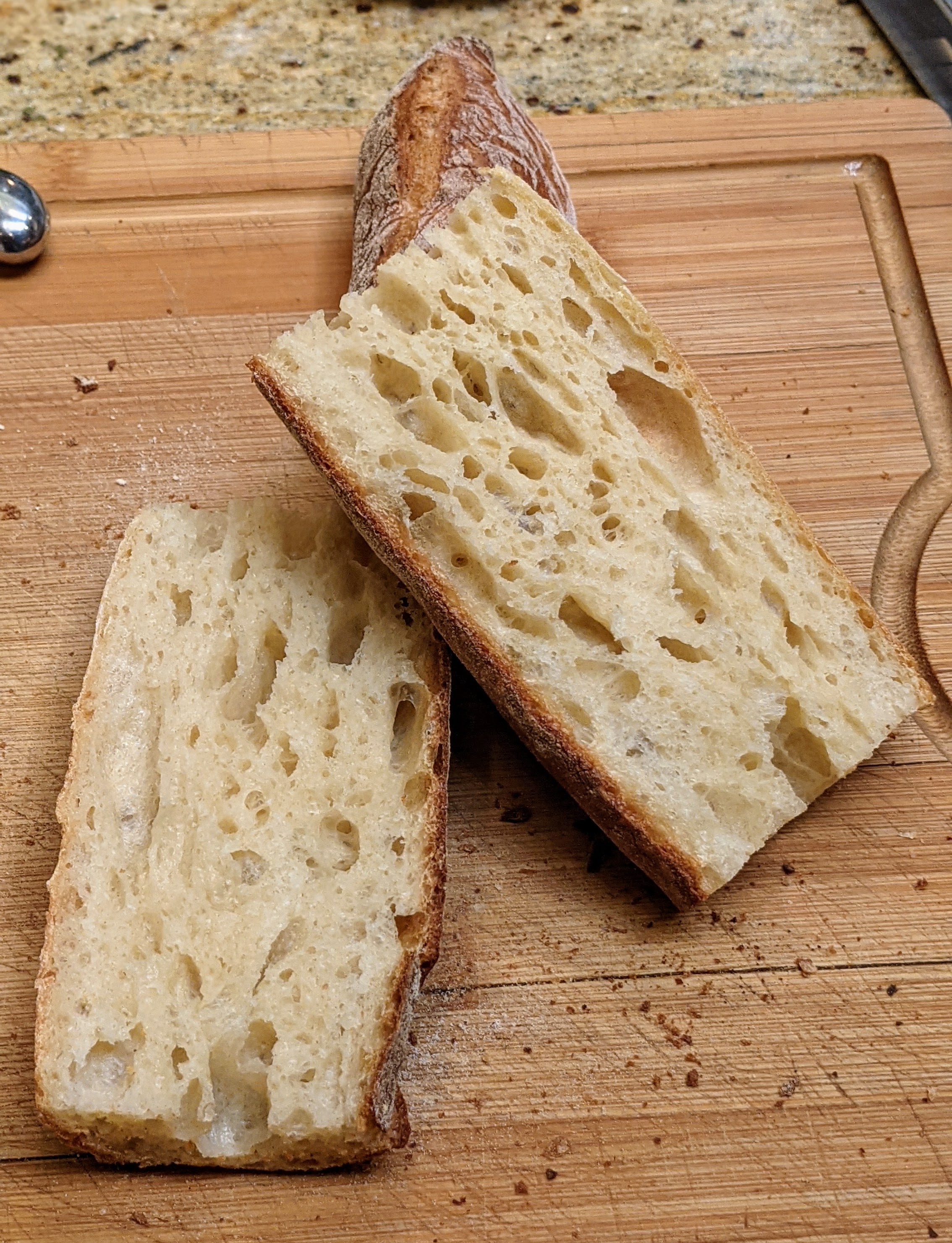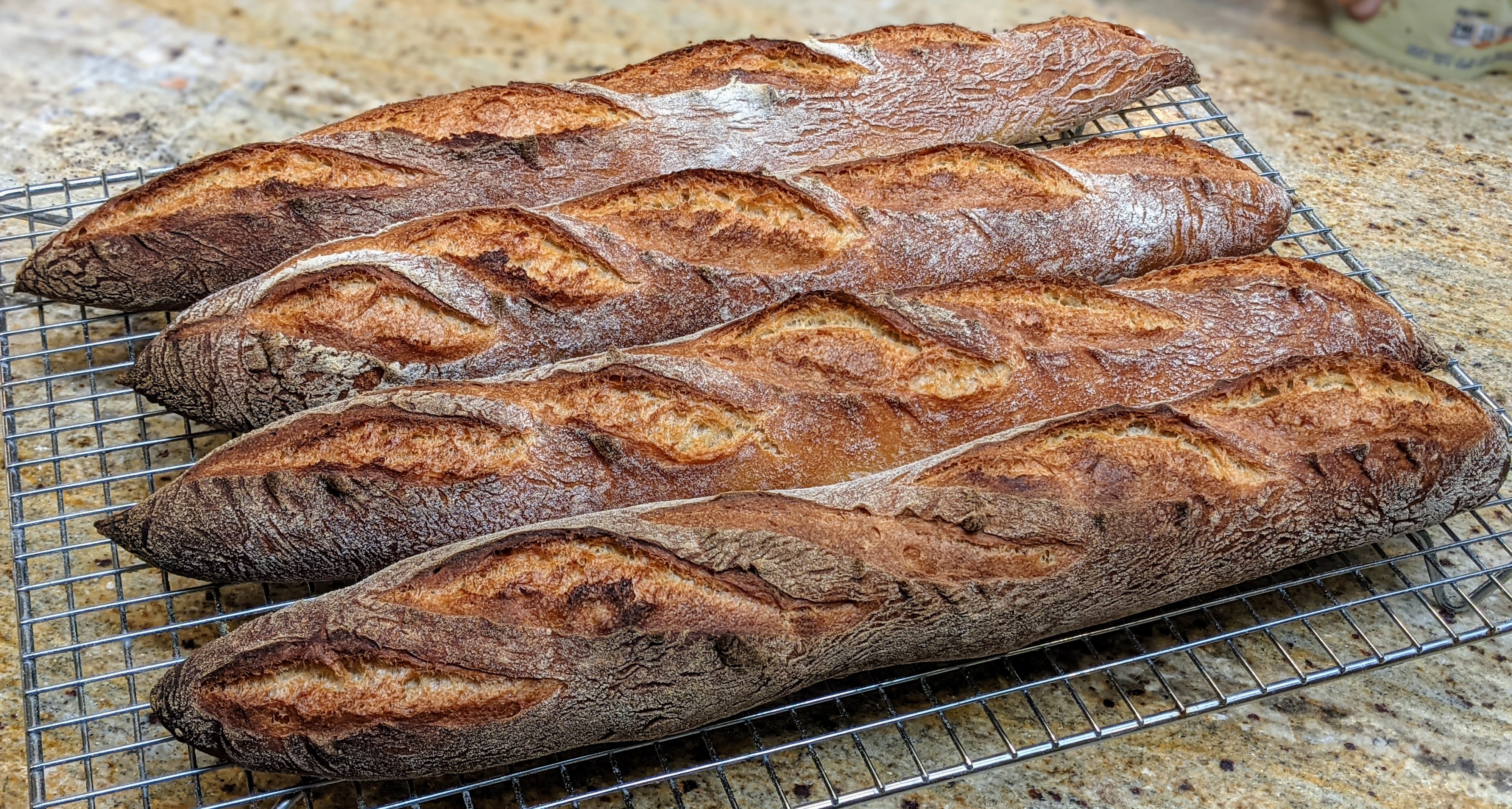
A Sourdough Riff on Baguettes de Tradition

When I’m pinched for time and want baguettes, I turn to Baguettes de Tradition that are a same-day baguette that I learned how to make a few years ago from reading Jeffrey Hamelman’s book, “Bread.” This simple baguette recipe only requires a few hours from mix to bake and is perfect for when I want baguettes for dinner. My only complaint about these is that since they’re baked on the same day, they don’t have nearly the amount of flavor as when I use the Pointage en Bac method of slow rising the dough overnight. Still, they’re perfect for dipping or using as sandwhich loaves.

This afternoon I was trying to figure out what I wanted for dinner and remembered that I had some BBQ pulled pork in the freezer, then realized that I didn’t have any sandwich loaves. Not that I needed an excuse to bake some bread, I thought I’d make some baguettes.

At first, I was going to make Baguettes de Tradition, but then I also remembered the starter in my fridge and that I had just fed it a few days ago! So, I pulled it out and it looked like it had peaked, but only recently. What luck! I was excited because I knew that the starter would add tons of flavor to the dough! And yes, I used it right out of the fridge but dissolved it in 90°F to wake it up. Here’s the formula and recipe:

Formula

Flour100.00%
Water76%
Salt2.00%
Yeast0.25%
Total %177.33%

Final Dough

Bread Flour154g
Kamut Flour205g
AP Flour564g
Water666g
Salt21g
Yeast2g
Unfed Starter (weight is 20% of the total flour)205g
Total Yield1818
6 X 300g Baguettes

It can be a little dicey using unfed starter. My experience is that it should not be so old where it smells cheesy and sour. At that point, it’s very acidic and the bacteria have essentially taken over. A telltale is that’s it’s fine to use if the level of the starter in my container is still well above the original line and hasn’t subsided all the way back and the starter itself is still bubbly. That means there’s still plenty of yeast activity.


I used a flour blend that was as follows:

Flour from the starter10.00%
Bread Flour15.00%
Kamut Flour20.00%
AP Flour55.00%
Total %100.00%

I used a tiny bit of commercial yeast to boost the yeast activity as I want to favor rising. With the amount of starter I use, there’s going to be plenty of flavor. But you can certainly skip it.

Using a sourdough starter alters my normal process for Baguette de Tradition because I follow the Tartine Basic Country Loaf process which includes a fermentolyse and a bassinage when I add the salt. Here’s the process:

Mix. Sift then thoroughly mix the flour in a large bowl and set aside. In another bowl, measure out the starter then add all but 50g of water and break up the starter till it’s completely dissolved. If you’re using starter fresh out of the fridge, make sure the water temperature is warm (85°F-90°F). Mix the flour and the liquid until everything is together and forms a shaggy mass.

Autolyse. Since we’ve included the starter, it’s colloquially called “fermentolyse.” Rest the mixture for 30 minutes to an hour.

Yeast, and Salted Bassinage. Sprinkle the yeast all over the top of the mixture. Dissolve the salt in the reserved water, then pour it over the top of the dough (make sure you use a spatula to get all the salt). Using your hands or a mixer on low spead, fold the new ingredients into the dough until they are fully incorporated.

Bulk Fermentation. You can transfer the dough to another container for bulk fermentation or just let it sit in the mixing bowl. During the first hour, fold the dough three times, every 20 minutes, then let the dough bulk ferment to about 75% expansion. With baguettes, you don’t want to go to double and in fact, you want to bake them just a little short of fully fermented. I know it sounds a little bass-ackwards, but this was a technique I learned about from the baker who won the annual Best Baguette in Paris. He claimed the slightly under-fermented dough springs better in the oven.
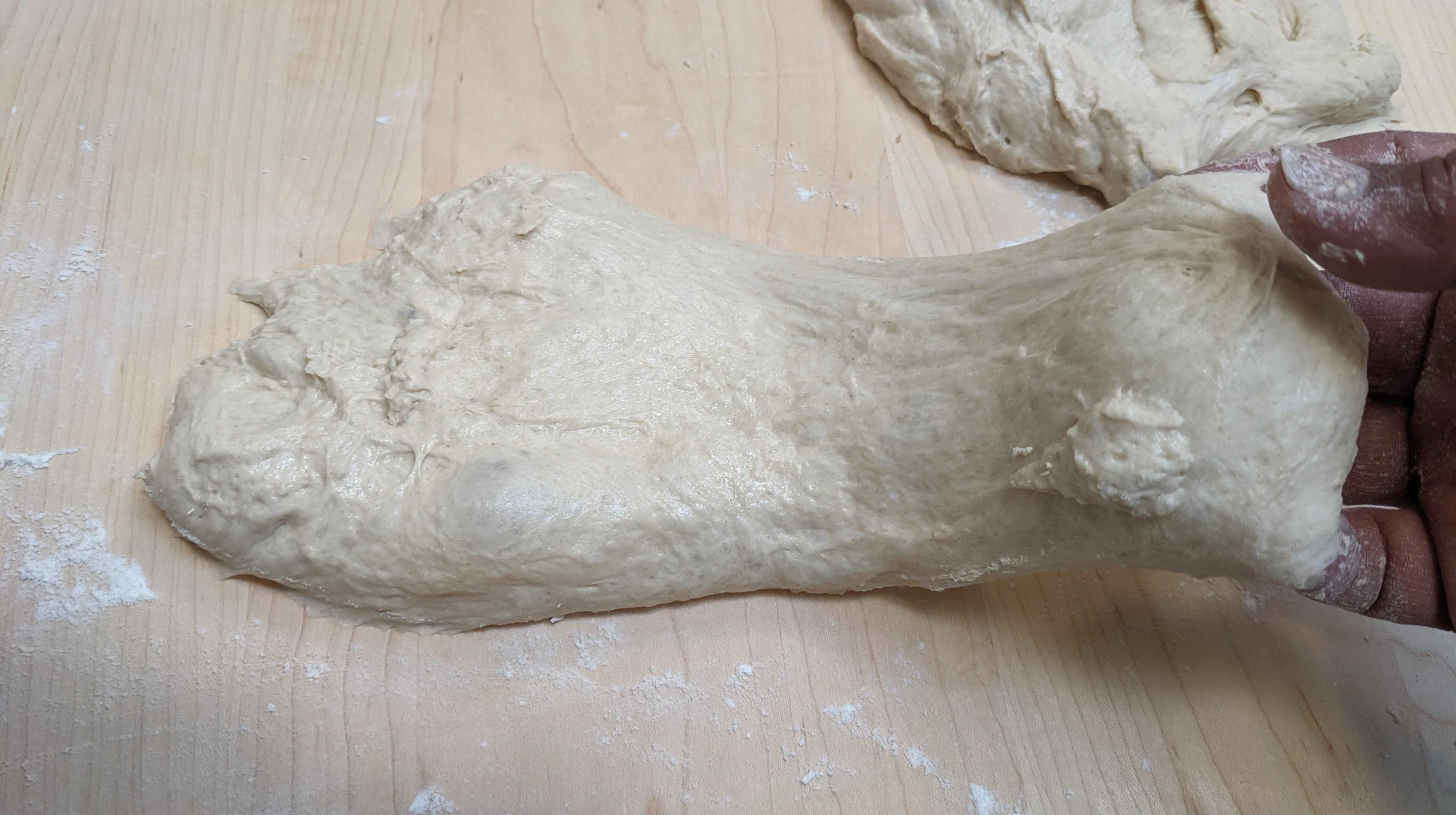
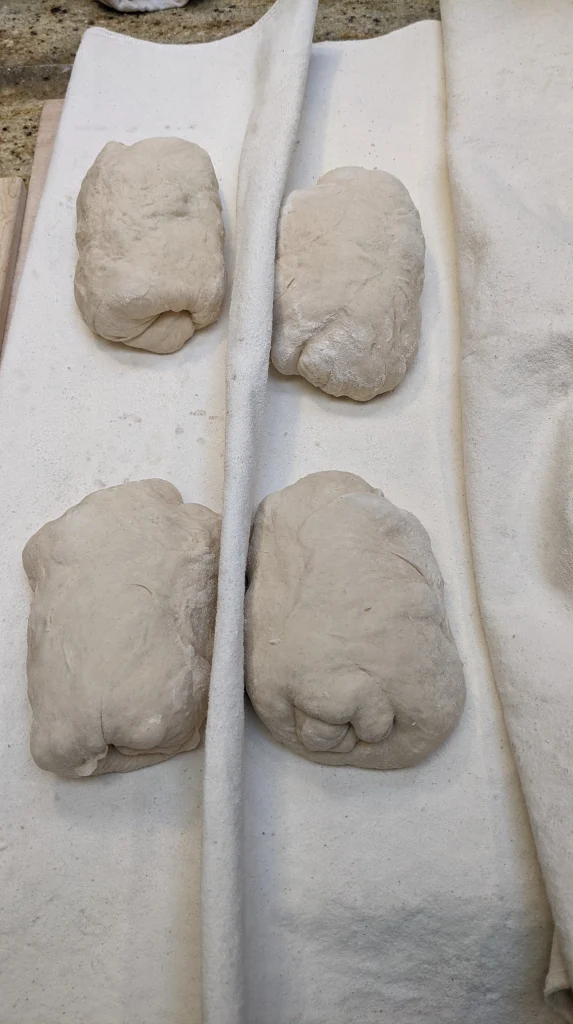
To letter-fold, pull sides of the piece and

Divide and Pre-Shape. Once bulk fermentation is complete, pour out the dough onto a lightly flour workspace. Pull it into a rough rectangle, then divide the dough into six even pieces. The recipe here calls for the pieces to be 300g. Letter-fold the pieces and roll them up like a jelly roll. Bench rest for 15 minutes.

Shape and Final Fermentation. Shape the pieces into long logs, then transfer to a couch or baguette pan for final fermentation. Poke test the loaves and if the indent comes up and immediately, it’s too soon. If it comes up slowly, but a small indent remains, then they’re ready to bake.

Bake. Score the baguettes then bake at 450°F. Bake with steam the first 10 minutes, then remove the steaming containers and bake until the crust is a deep golden brown. Mine took about 22 minutes to get to that point.

Cool for at least 30 minutes before cutting. Or you can do the Chad Robertson way and just cut it fresh out of the oven. 🙂
I’m BACK!!!

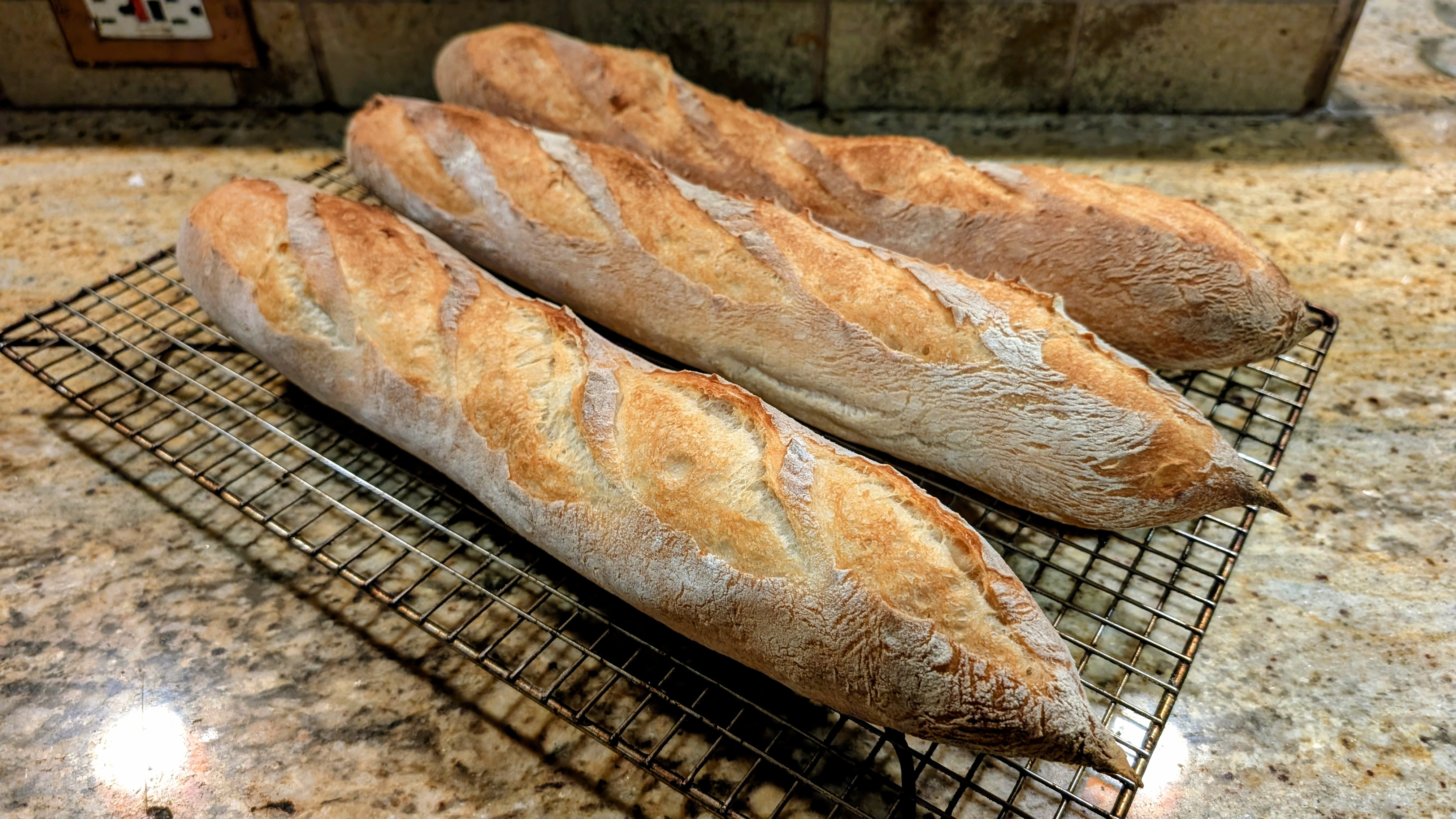
Baguettes de Tradition. These are typically same-day loaves. They naturally don’t have the depth of flavor of ones made from a long fermentation, but they are excellent for sandwiches and for dipping! Notice the shallow ears. This is a trait of this style. Fermentation is fast with these and when they bake, they spring quickly, usually blowing through the ears.

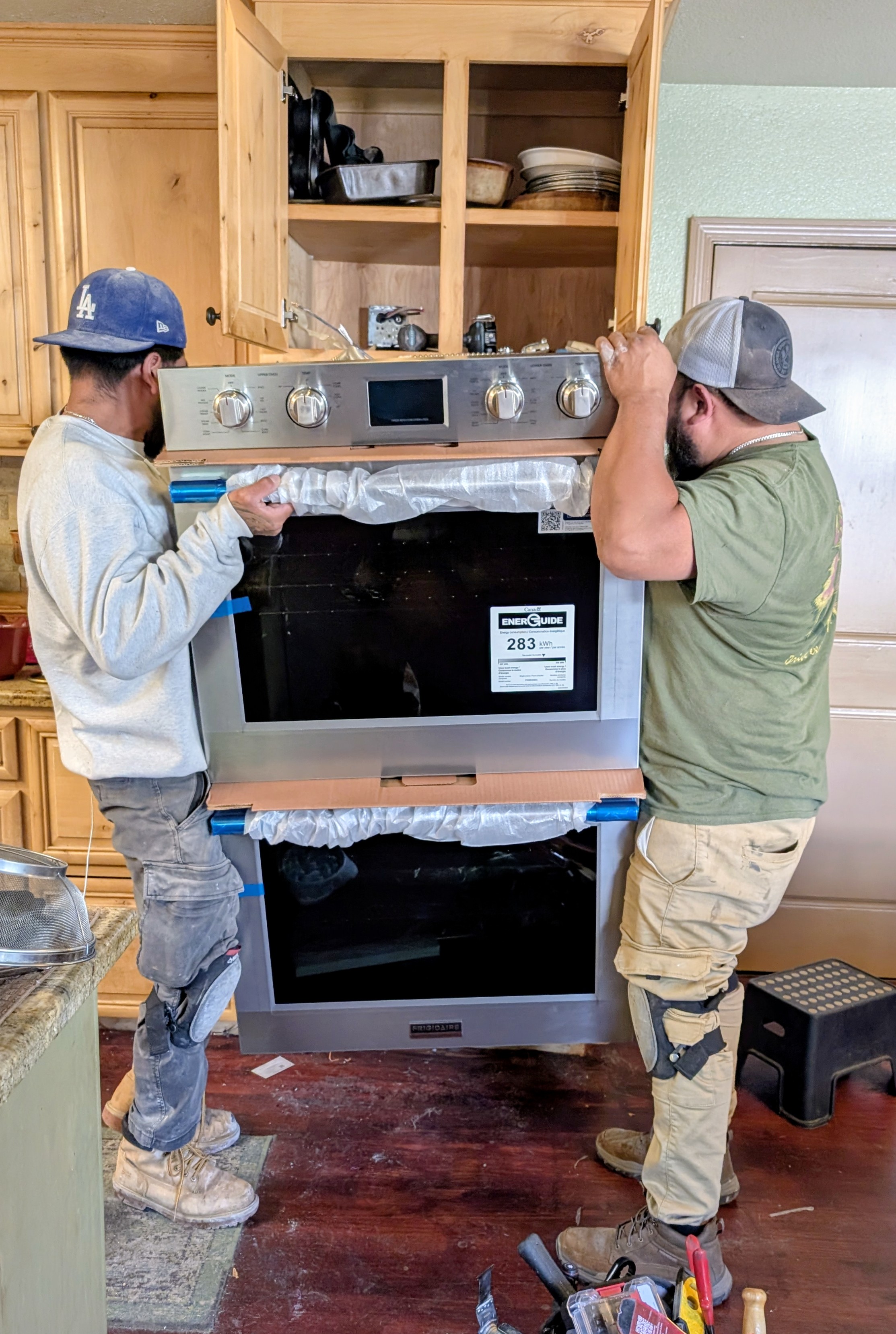
OMFG! It has been a long time since I’ve baked anything meaningful other than a couple of Pain au Levain in my Dutch oven on my Traeger grill. And the reason for that is because my ovens have been broken for a long time. They were still usable for some basic baking, but not for bread as they wouldn’t hold temperature consistently enough for bread baking.

But yesterday, my new double wall oven unit got delivered and installed. So, this afternoon I made baguettes! I haven’t made baguettes in a couple of years, so I was a little apprehensive. I didn’t know if I remembered the shaping technique. But I needn’t have worried because muscle memory took over and they turned out great!

The thing about baguettes is that making the dougn and going through the fermentation process is a no-brainer. Where it gets extremely difficult is in the shaping. That’s the part I was worried about. And though I was slower at shaping than in the past, I still had it!

Admittedly, I’ve lost my baker’s hands. Deftly handling dough without it sticking to my hands was a little challenging. But then I was expecting that and had a bowl of water handy to keep my hands moist. As I bake more, they’ll return. It just takes repetition.

And speaking of repetition, I recently started lurking in the bread forums again. It has been as if I never stopped reading them. Anyway, the answer to most folks’ questions is simply this: Repetition. There’s simply no substitute for getting your reps in, especially with baking. And as with any craft, repetition not only builds your skill, but it also builds your intuition and feeling for handling and processing dough.

And though I haven’t seriously baked bread in a couple of years, because I made countless loaves in the past and built up my skills through repetition, while I was a bit rusty with the mechanics, I still had the feel for the dough. It was wonderful!

Do You Really Need All That Fancy New Equipment?

As I returned to baking bread in earnest after a long hiatus, and “in earnest” that meant baking every single day, not just the same kind of bread, but many diverse kinds from French to Italian bread. For instance, I learned to make ten distinct kinds of baguette. I learned to make several traditional Italian loaves. I had four active starters that were optimized for different outcomes (sourness, fast rise, etc.). But here’s the thing: Other than buying simple implements such as a Danish dough whisk or some good scrapers or getting a baking stone. I didn’t get a new mixer or other high-end equipment. I baked everything in my standard electric oven.

I mostly mixed by hand but also used a mixer for specific kinds of dough. For that I used my trusty KitchenAid Artisan 5-quart mixer; yes, even for large batches when I had to make bread for a shelter. In those cases, I had to make several small batches of dough. And since I only had two ovens to work with, I had to work out timing. And though I was tempted to get a spiral mixer (I still dream about it) and a dedicated bread oven (I will get that in the next year or so), I still got by with what I had. And I made some incredible bread. My thought was that if I learned how to use what I had on hand, there wouldn’t be much I couldn’t do.

But I think a major reason keeping me from getting higher end equipment was that I had worked out a process and got so proficient and efficient with it that I didn’t feel a pressing need to buy new gear. Honestly, I’d forget the new stuff and would only remember when I deliberately thought about how nice it would be to have a spiral mixer or dedicated bread oven. And that leads me to the reason I wrote this post in the first place.

There’s an urban legend about the famous violinist Izthak Perlman who broke a string during a concert, then proceeded to finish the concerto playing only on three strings. At the end of the piece, he spoke to the audience and said, “You know, sometimes it is the artist’s task to find out how much music you can still make with what you have left.”

No one knows whether the story is true, but the quote is inspirational, nonetheless. And I think of it when I’m evaluating buying new equipment. Granted, there are times when there is an absolute necessity to get some new gear, especially if you’re replacing broken equipment. But for other, more aspirational items, can you still perform with what you have? I will be honest with you that that quote has saved me thousands of dollars, not just in bakery equipment, but also in guitar and golf and even home appliances.

Look, I’m not saying that you must be cheap. If you have the means to get the top-of-the-line stuff, go for it. But will those aspirational things improve your process to a significant degree? At least for me, as I had my process down, I didn’t think they’d help to a large degree. Even with my micro-bakery where I was baking more bread than most home-based bakers, the higher end gear became more “nice-to-haves” rather than “must-haves.”

And to be honest, in the end it’s all about the dough. A great mixer will help in mixing the dough, but after that, there’s no other equipment you need to develop you bread dough. A dedicated bread oven will certainly provide much more consistency than a normal home oven, but if you know your oven and you’re only baking limited quantities, the benefit of a dedicated oven will be minimal at best. Besides, if you screw up your dough, no amount of high-end gear is going to help you.

An early batch of baguette from the holidays. Whew! I was little rusty!

Over holidays, I baked quite a bit of bread; mostly baguettes, but I made other types of loaves as well. But here’s the thing: All the mileage I put on my ovens completely messed them up and one oven no longer holds temperature consistently and the hinge on my other oven broke so I couldn’t use it. I tried to make baguettes on my stone, but they turned out horrible. So I had to turn to my old metal baguette pans. Those never produce great results, but they’re what I had on hand. And I trudged forward thinking about the Izthak Perlman quote.

And I was okay with the results, even though I knew they wouldn’t be as optimal as I would normally get with a stone. I was making music with what I had left!

10% Rye Baguettes for Sandwiches

If there’s one thing I love in this world, it’s a great sandwich. And being a baker, to me, the key component of a sandwich is the bread. You get this wrong, fuggetaboutit! This past Sunday, while I was watching the 49ers rout the Cowboys, it struck me that a sandwich would be good. But… I didn’t have any bread. So, I thought to myself that I could make a sandwich for Monday Night Football.

But I didn’t want to make just any bread. I wanted a sub, and for me, that meant making baguettes! But I didn’t want to make just a straight-up dough. I wanted a bit different of a flavor. So, I decided to use just a bit of rye flour. I also decided to challenge myself a little and up the hydration to 80%, plus use a poolish to add some extra complexity. Here’s the formula:

Overall Formula

Flour100.00%
Water80.00%
Salt1.80%
Yeast0.50%

Poolish

Flour122g
Water122g
Yeast %0.25%
Yeast0.31g

Final Dough

AP Flour557g
Rye74g
Water483g
Salt13g
Yeast3.41g
Preferment223g
Total Yield1353g
4 X 335g loaves

Make the Poolish. The night before you bake, make the poolish. Dissolve the yeast in the water then add the flour. Mix well. Cover with plastic wrap, and leave on the counter until morning. The poolish should be ready withing 8 hours. But don’t fret if you go over. That’ll just add more organic acids (read: flavor).

Mix. Combine the flours and mix well until you get a homogenous mix. A stand mixer with the paddle attachment works excellent for this. Add the yeast and the salt and continue mixing to ensure an even distribution of both. In a separate bowl, dissolve the poolish in warm water until it completely liquifies. Add that to the dry ingredients then mix until you create a shaggy mass and there are no dry ingredients. I used a Danish dough whisk for this instead of a mixer.

Bulk Fermentation. 1 1/2 to 2 1/2 hours depending on your ambient temp. This requires only two folds. Do the first after 20 minutes, then do the second an hour after that. I did the first fold in the bowl, then I did the second fold on my work surface, doing an N-S-E-W fold, then flipped the mass onto the seams and rounded it with my hands. I then sprayed some oil into my bowl, then set the dough seam-side-down in it to finish fermenting. I eyeballed the dough to just under double in volume, if not a little earlier because I wanted to give plenty of time for final fermenation.

Divide and Pre-Shape and Shape. Divide the dough into four 335g pieces. If there’s any leftover, just distribute it between the four pieces. From here, please refer to my Baguette Dough Development Process (will open a new tab).

Bake. Bake at 475°F for 12 minutes with steam. Remove your steaming container, then bake for another 20 minutes at 425°F. When you remove the baguettes from the oven, they should feel lighter than they look. If they feel a little heavy, that means there’s still water in the dough that needs to be evaporated. Pop them into the oven for another 10 minutes if this happens. I had to do this with the batch above.

Notes

  1. Even with this small amount of rye, bear in mind that rye contains absolutely no gluten, so folding is going to be a challenge. This is why I did the second fold on the bench, much like I’d handle a ciabatta.
  2. Also, because this dough is so wet, don’t be afraid to use a bit more flour on your bench than you normally would.
  3. Shaping at this high of a hydration is challenging. I suggest using Martin Philip’s shaping technique. The important thing with his technique is that the fingertips and heel of the hands maintain contact with your work surface. With this dough, you will use more flour on the board.

100% Sourdough Baguettes Using a Rye Starter

As I’ve mentioned many times in previous posts, the bread I love to bake the most is the baguette. The reason is that what makes a great baguette boils down to technique. Whether you use yeast or a starter to raise the dough, the dough itself is simple and straightforward. But the dough development and shaping techniques – for lack of a better word – are unforgiving. And on top of that, I’ve found that making baguettes requires using quite a bit of intuition and feel, much more than other types of bread I bake.

With more standard loaves like rounds and ovals, I tend to focus on building dough strength during fermentation. As long as I do that, shaping is pretty easy. Baguettes, on the other hand, are a different animal altogether. Dough strength is important, but timing and observing certain telltales with the dough are critical to getting a good result. And when using a sourdough starter, the process is a little slower than with commercial yeast, so the telltales are important. I’ll discuss those below.

As for these particular baguettes, the rye flour adds incredible flavors that really enhance the taste of the bread. You get the rye grain flavor as about 12-15% of the total flour comes from the rye. But I’ve also found that a rye starter creates a nice sour tang. It’s not really strong, but it’s noticeable.

And at least in the case of my mother starter, the yeast absolutely loves rye flour. In fact, if I add my mother starter cold from fridge into the rye flour and water mix, it will peak in less than 3 hours! I don’t know what that may be due to, but there must be something in the rye that makes my yeast go wild!

Overall Formula

Flour100.00%
Water76.00%
Salt2.00%
Levain30%

Levain

Rye Flour125g
Water @ about 100℉125g
Mature Starter50g

Final Dough

Bread Flour418g
AP Flour228g
Water @ about 95-100℉ to get a 78-82℉ dough temp464g
Salt15g
Levain (30% of total flour)228g
Total Yield4 X 40cm-335g loaves

Initial Mix. Reserve 50g of the water. We’re going to do a Tartine-style autolyse by combining the flour, levain and water. Mix well and make sure all dry ingredients are incorporated with no large lumps. Personally, I do the initial mix with a mixer with the dough hook. Let rest in a warm place for 20 to 30 minutes. We don’t want fermentation to really get going.

Incorporate the salt. Dissolve the salt into the reserved water, then mix it into the dough. You can use a mixer for this, but salt will tighten up the dough and it will quickly climb up the hook. So I just mix the salt in by hand. If you do it this way, wet your hand often. Transfer dough to another container to do your bulk fermentation (I use a 6L Cambro).

Bulk Fermentation. No time on this. You’re looking for a 30%-50% rise from the original dough mass. Using my active starter, this usually takes about 2 – 2 1/2 hours total with a dough temp of 80℉.

Folding. This only needs two folds within the first hour and a half. In each session, stretch and fold until you can pick up the entire mass. After the second fold, just let the dough ferment until you achieve 30-50% rise from the dough.

Telltale: Before you start folding, check the dough. You want to get good extensibility out of the dough. It should stretch very well but not tear. By the time bulk fermentation is complete. your dough should feel velvety smooth and luxurious.

Divide and Pre-Shape. Divide the dough into 335g pieces. You can refer to my baguette dough development process. Let rest for 20 minutes or until the dough as relaxed.

Shape. Roll pieces into logs, then transfer each to a well-floured couche.

Final Fermentation. Especially with sourdough baguettes, it is critical to leave them alone once you start final fermentation. You want the shaped dough to expand to almost double in volume or until the indentation of the poke test comes back very slowly. You’re taking the dough out to almost full fermentation.

Bake. Bake a 475℉ for 12 minutes with steam, then 425℉ for 12-15 minute or until the crust is the desired color. I prefer a slightly darker crust without getting too crunchy.

25% Dark Rye Poolish Baguettes

During the pandemic lockdown, I discovered just how wonderful KamutTM flour was. But now, for some reason, it has become a little scarce. So I started searching for different kinds of flour to replace the Kamut, and I discovered dark rye flour. Yeah, yeah, there are lots of folks who’ve been baking with rye for a long time, but truth be told, I kind of stayed away from it because of that traditional rye bread taste. Little did I know that that particular bitter, almost nutmeg-like taste comes from the caraway seed that’s often added to traditional rye bread dough.

Plus, up until I started baking with it, my primary experience with rye bread was that marbled rye that you get with Reuben sandwiches. But after doing a bit of research on rye flour and baking with it regularly, I was soon corrected, and I have to say that I absolutely LOVE baking with rye flour!

Part of the reason why I love it so much is that it behaves very much like Kamut flour in that doesn’t form gluten. Like Kamut, the proteins that are formed when water is added to the flour don’t at all contribute to the structure of the dough. So you either have to be super, super-gentle with the dough, or use a smaller percentage, just as I’m using with these baguettes.

But even at this lower percentage of 25% (technically 12.5% rye flour to the total flour), the flavor that the rye flour contributes is incredible. Plus, being whole-grain flour, it contributes a nice textural element that contrasts nicely with the white flour.

Overall Formula

Flour100.00%
Water75.00%
Salt2.00%
Yeast0.57%

Poolish

My advice is to make the poolish the night before you mix the dough, giving it at least 10-12 hours to ferment. Whole-grain flour has lots of great bacteria that will produce organic acids that will add to the overall flavor profile of the bread.

Dark Rye Flour105g
Water105g
Yeast @ 0.33%0.35g

Final Dough

Bread Flour286g
AP Flour381g
Water477g
Salt15g
Yeast4g
Poolish191g

Process

As opposed to writing it all out again, please see My Baguette Dough Development Process for processing the dough.

The Many Faces of Baguettes

Click on a picture to see its recipe. The baking method described in the recipes may differ from what I discuss here. That’s because those were the ways I baked them initially. But in the last 6 months, I’ve taken to standardizing my flour blend(s) and formulas. I vary the technique to achieve different results.

I’ve been very open that my favorite bread to make is the baguette. But as you can see, I bake several different types. But with just a few minor exceptions, I bake all my baguettes pretty much the same way: 12 minutes with steam @ 475°F, 15 minutes @ 425°F. The only difference is with sourdough baguettes that go both longer on steam (20 minutes) and a little longer – 25 minutes – at 400°F for curing. As for the other types, as you can see from the pictures of some of the batches I’ve baked just in the past few months, they show different crust colors, almost as if they were baked differently. I can guarantee you that they weren’t.

And to drive the point home further, except for the Tartine baguettes, the rest of them obeyed the same, basic formula:

Flour100.00%
Water76.00%
Salt2.00%

So what differs between all the different types of baguettes are the dough development and fermentation techniques employed for each different type. The most significant effect on crust color comes from fermentation. The darker crust baguettes are not the result of longer bake times, but rather the amount of sugar released into the dough due to the longer fermentation times of either the whole dough or preferment.

For instance, the Baguettes a l’Ancienne, Sourdough, Pointage en Bac baguettes all undergo very long and cold bulk fermentation times. This allows more sugar to be released into the dough than can be metabolized by the yeast. Those crusts caramelize nicely and hence have the darkest crusts. The Tartine-Style baguettes are a little lighter as less sugar is released as the combined preferments only account for 28% of the total flour. The Poolish baguettes are fairly close in color to the Tartine-style, but they’re just a bit lighter as the preferment accounts for only 25% of the total flour. And finally, the Baguettes de Tradition are the lightest as very little sugar is released into the dough. This stuff is SO very cool!

To be honest, seeing how dough can be affected by so many different variables never ceases to amaze me and keeps me completely obsessed with dough; pushing me to try different things to see their effect on the finished bread.

As far as baguettes are concerned, I used to think that a baguette was a baguette. And though intuitively and intellectually I knew there were differences, it wasn’t until I started baking different kinds that I really knew just how different they could be – even from the same formula! It’s stuff like this that keeps me baking!

Delayed-Fermentation Baguettes Using Pain à L’Ancienne Technique

When I first started making baguettes, I learned the pointage en bac method of making my baguette dough. To date, this is my most-used method for making baguettes. The slow rise significantly slows the yeast activity and allows the amylase enzymes to break down the starches in the flour and release more sugars into the dough than can be processed by the yeast that would otherwise be converted to alcohol and CO2. Plus it allows the lactobacillus and acetobacillus bacteria to release organic acids into the dough as well. With that method, I start with a dough temperature that is about 76℉-78℉, so when I finally put the dough into the fridge, fermentation has already started then gradually slows as the dough temp equalizes with the fridge temp.

But there is a bread called pain à l’ancienne whose fermentation is retarded at mixing using ice-cold water. Once mixed, the dough is then put into the fridge overnight. The dough is then removed from the fridge in the morning and allowed to come to room temp; thus, delaying fermentation and benefitting from the other microbes not having to compete with the yeast. But the two techniques differ in that with the pointage en bac method, the dough is immediately shaped out of the fridge as opposed to the pain à l’ancienne that is allowed to wake up for a period of time before shaping.

It actually makes a bit of sense to allow the dough to wake up because fermentation was delayed from the start. The cool thing is that when fermentation is allowed to proceed in earnest, the yeast have plenty of sugars on which to feed since the amylase enzymes had time to break down the starches overnight. Plus, the organic acids released into the dough will make it much more extensible. All good!

I did a riff on the pain à l’ancienne technique with my latest batch of baguettes and they turned out fabulous!

Formula

Flour100.00%
Water76.00%
Salt2.00%
Yeast (instant)0.38%
Total %178.38%

Final Dough

Kamut Flour (sifted)190g
AP Flour569g
Water (35℉ – 40℉)577g
Salt15g
Yeast3g
1353g
4 X ~335g loaves
As you can see above, I used a blend of sifted Kamut and AP flour. This is a 25% Kamut/75% AP blend.

Mix. Thoroughly mix ALL dry ingredients together until fully combined. For the ice water, I just filled a bowl with ice water then used a strainer when adding it to the dry ingredients. Mix until you have a shaggy mass with no large lumps. Cover the mixing bowl, then place it in the fridge for 30 minutes to maintain the dough temp. After 30 minutes, take the bowl out, then stretch and fold the dough until smooth.

Retard. Return the dough to the fridge and let it sit for at least 8 hours. There will be yeast activity during this time, but it will minimal.

Bulk Fermentation. Remove the dough from the fridge and allow it to wake up for 1-1 1/2 hr. During this time you still won’t see much expansion of the dough mass, but that’s okay. There’s actually a lot that has happened overnight. All in all, you should see about a 50% expansion of the dough from its original size.

Divide and Preshape. Divide the dough into 335g pieces. Letterfold each piece, then roll up the piece perpendicular to the seams like a jelly roll. Alternatively, you can create rounds. After preshaping, place the piece on a well-floured couche and let the pieces rest for 30 minutes. This is an important step because the dough is still cool at this point and needs time to relax. After that time, if you pick up a piece, it should feel billowy and the dough should give.

Shape. Rather than write down the process, here’s a GREAT shaping method that Martin goes into in detail.

Final Fermentation. This last part is a little tricky in that it really require a bit of feel. But because the dough started out cold, the minimum final fermentation would probably be one hour. But when I baked these today, my kitchen was 72℉ and it took a little over two hours to finish final fermentation. Use the poke test to determine readiness. With this dough, the indentation should remain, but still eventually fill in. If your poke disappears completely, the dough isn’t ready. It’s really critical that you give final fermentation plenty of time as shaping will have degassed the dough slightly. Final fermentation will allow the holes to reform.

Bake. Bake at 475℉ with steam for 12 minutes or until the crust is set and you start seeing color. Remove steam, then finish baking at 425℉ for 15-20 minutes. This bread really benefits from a full bake.

If you’re wondering what the difference between this type of baguette is and a standard baguette, look at the pictures below:

On the left are the baguettes made using the pain à l’ancienne technique and to the right are a recent batch of Baguettes de Tradition. They were both baked in pretty much the same way, at the same temperatures. But notice how the pain à l’ancienne style baguettes are darker. This is because of the carmelization of the sugars that were released into the dough overnight. Baguettes de Tradition, on the other hand, are processed all within a few hours time; not enough time for sugars to be released.

Recipe: 25% Kamut Baguettes With Kamut Poolish

Kamut flour has become a staple in my flour blends. It adds a nuttiness to the flavor of the bread and as it has a different kind of gluten than wheat gluten, provides a softness to the crumb that is very pleasing. You don’t get a really open crumb with Kamut since it is a whole-grain flour, but as it has under 12% protein, you’ll still get some very nice oven spring and expansion.

For baguettes, my flour blend is as follows: 50% AP Flour, 25% Bread Flour, and 25% Kamut. I use half of the Kamut (unsifted) to make a poolish and I sift the other half for the final dough. Let’s get to the recipe!

Formula

Flour100.00%
Water75.00%
Salt2.00%
Yeast0.38%
Total %177.38%

Poolish

Kamut Flour (unsifted)105g
Water105g
Yeast @ 0.3%0.31g
Note: This is more than what’s needed just to make sure there’s enough.

Final Dough

Kamut95g
Bread Flour191g
AP Flour381g
Water @ 95°-100°F477g
Salt15g
Yeast (instant)3g
Poolish @ 25% of Total Flour191g
Total Yield1353
4 X 335g loaves
Total Flour763
Total Water572

Make the Poolish. Combine the ingredients and mix well, then cover and set aside, until poolish about doubles. It’ll be ready when it passes the float test. This can take up to 6 hours on cool days. With a Kamut poolish, you won’t see a lot of bubbles on top, but you will see lots of bubbles on the sides and bottom of your container.

You can also make the poolish the day before and stick it in the fridge. This will allow the organic acids to really develop. Not only will you get lots of flavor from this, but it will also add extensibility to the dough.

Mix. In a separate bowl, combine all the dry ingredients (yes, even the yeast and salt) and mix well until everything is nicely distributed. Add all but about 50g of water and make a shaggy mass that has no dry ingredients. Cover and rest for 15 minutes, add the reserved water, and work it into the mass. Once all the reserved water has been incorporated, mix until you have no large lumps in the dough.

Bulk Fermentation. About 1 1/2 – 2 hours. Look for about 50-75% expansion (not doubling)

Folding. Fold the dough twice within the first hour.

Divide and Preshape. Scale-out 335g pieces. Shape either into taut balls or roll into jelly rolls, then set aside on a well-floured couche. Rest for 20 minutes.

Preheat your oven to 500°F

Shape and Final Fermentation. Shape into baguettes and place onto a well-floured couche. Check the loaves at 45 minutes. When you poke test, the hole should fill in slowly.

Bake. Bake with steam at 460°F for 12 minutes. Remove the steaming container, and reduce oven temp to 400°F. Bake for 15-20 minutes to harden the crust and bake out most of the water from the crumb.

Baguettes Using Ken Forkish’ White Bread with Poolish Recipe

Last night, my wife told she was going to be attending a potluck dinner party this evening and asked me if I could bake something for her to bring. Of course, any excuse to bake bread is just fine by me so I told her I’d make baguettes. I was going to make my standard pointage en bac baguettes where I mix everything together then cold retard the bulk fermentation but decided instead to make poolish baguettes.

But I didn’t want to do my standard poolish baguettes where the poolish flour was only 25% of the total flour. I wanted to challenge myself a little. Then I remembered the white bread with poolish recipe from Ken Forkish’ Flour Water Salt Yeast book that uses 50% of the total flour for the poolish! That’s a challenging dough because it is SO easy to get the poolish wrong; that is, over-ferment it, as it calls for an overnight ferment at room temp. And as ambient temperatures vary wildly, I’ve had some real poolish fails in the past.

But luckily the weather is turning cooler and Ken’s requirement of a 65°-70°F temp is now possible. In fact, the temp in my house dropped even below 65°F overnight, so when I woke up this morning to check the poolish, it wasn’t yet ready. Whew! I could catch it at its peak!

To be honest, I hadn’t made baguettes with this dough yet. But at 75% hydration, I had a feeling this would be perfect dough for making baguettes! I wasn’t wrong. They turned out beautifully, with a crisp, golden crust, and a light, airy, and buttery crumb! Here’s the recipe!

Overall Formula

Flour100.00%
Water75.00%
Salt2.00%
Yeast0.43%

Poolish

Bread Flour 25% (96g)
AP Flour 75% (286g)
382g
Preferment Water382g
Yeast Weight0.3g

As I always recommend, make a little more poolish than you need because you will lose some weight due to processing and evaporation. In this case, I’d do 400g flour water each.

Final Dough

Bread Flour 25% (96g)
AP Flour 75% (286g)
382g
Water (~100°F)191g
Salt15g
Yeast3g
Preferment763g
Total Yield1353g
4 X 335g, 60cm loaves
6 X 225g, 40cm loaves

Make the Poolish. The night before you bake, make the poolish and place it in a cool place where you can maintain about 65°-70°F. At that temp, it’ll take about 10-12 hours to be ready. Just like with a levain, the poolish will be ready when it passes the float test. Visually the poolish should be a bit more than doubled, its top mottled with bubbles, and the top surface slightly domed.

Mix. Thoroughly mix all the dry ingredients together in a large bowl. Pour the water around the edges of the poolish to help release it from its container. The poolish will then slip right out of its container. Add the poolish to the dry ingredients then mix thoroughly until you form a shaggy mass with no dry ingredients remaining.

Bulk Fermentation. 1 1/2 to 2 1/2 hours depending on ambient temp. My kitchen was pretty cool this morning, and even though I put the dough in my oven with the light on and door slightly cracked, it still took 2 1/2 hours. Bulk fermentation is done when the dough has expanded 50%-75% its original size.

Ken Forkish has his dough go out to 2 1/2 to three times volume. But he has a VERY short final fermentation at 30 minutes. I prefer to take the dough only as far as 50% and having a longer final fermentation to let the dough recover from shaping.

Folding. Fold three times in the first hour after mixing at 20-minute intervals.

Divide and Preshape. Pour the dough onto a lightly floured surface, then gently tug it into a nice, even rectangle. Divide the dough into four equal pieces. For this recipe, scale each piece to 335g for 60cm loaves. Alternatively, you can make six 40cm loaves. Scale those out to 225g. If you have any leftover dough, just cut it into pieces and distribute to the pieces. Preshape the loaves into small logs by letter folding them, then rolling them up like a jelly roll. Rest the logs seam-side-up on a well-floured couche for 20-30 minutes or until the dough has relaxed.

Shape. Shape each piece into a baguette, then place each shaped loaf onto a well-floured couche for final fermentation.

Final Fermenation. 45 minutes to 1 1/2 hour, depending on ambient temp. As I mentioned above, my kitchen temp this morning was pretty cool, and it took and hour and a half for the loaves to be ready to bake. The loaves will be ready when you do the finger dent test and the hole fills in very slowly.

Bake. Bake at 480°F with steam for 15 minutes. Remove steaming container, reduce oven temp to 425°F, then bake another 15-20 minutes or until the crust becomes a deep, golden-brown. These really benefit from a full bake!