10% Rye Baguettes for Sandwiches

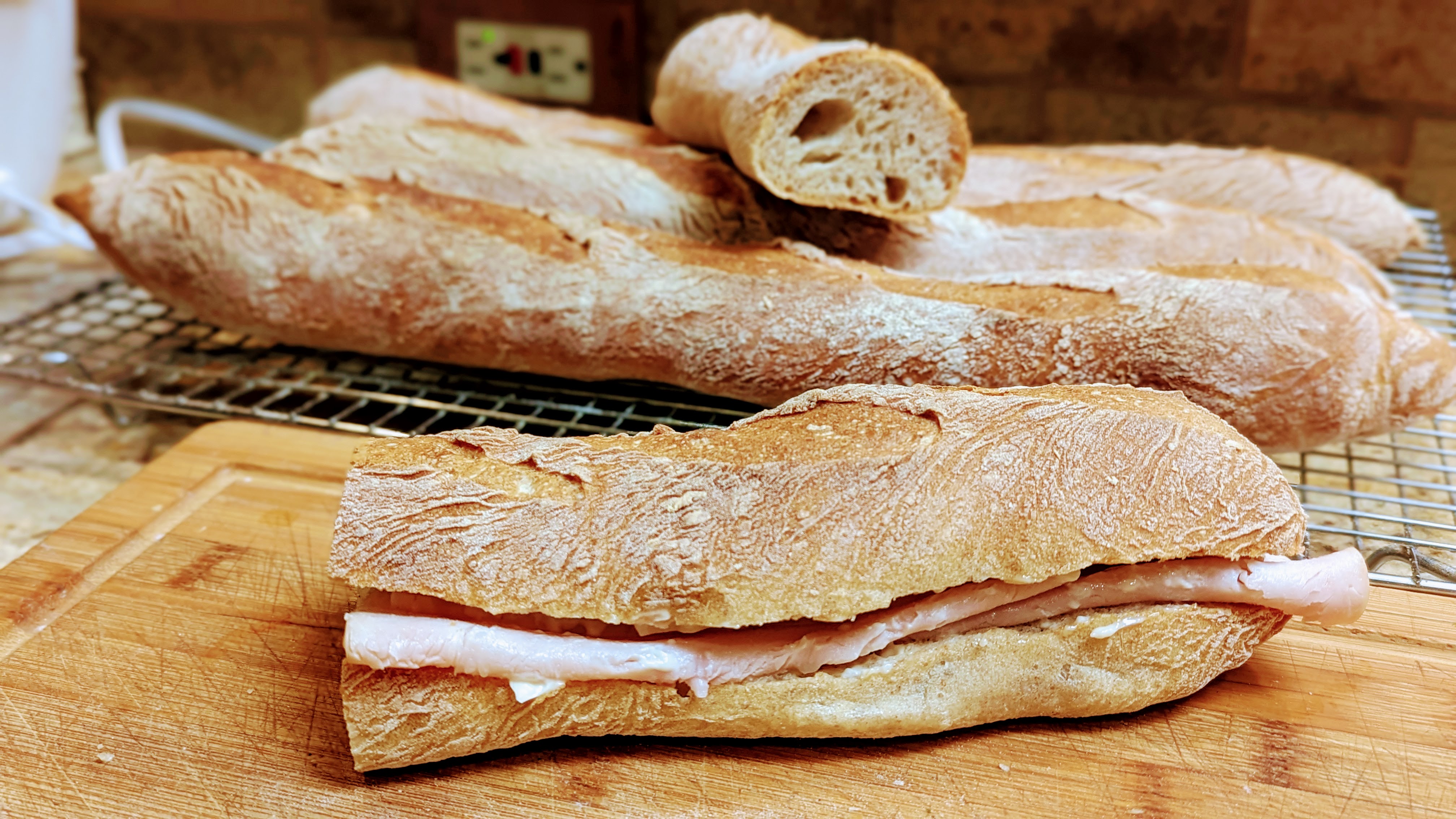
If there’s one thing I love in this world, it’s a great sandwich. And being a baker, to me, the key component of a sandwich is the bread. You get this wrong, fuggetaboutit! This past Sunday, while I was watching the 49ers rout the Cowboys, it struck me that a sandwich would be good. But… I didn’t have any bread. So, I thought to myself that I could make a sandwich for Monday Night Football.

But I didn’t want to make just any bread. I wanted a sub, and for me, that meant making baguettes! But I didn’t want to make just a straight-up dough. I wanted a bit different of a flavor. So, I decided to use just a bit of rye flour. I also decided to challenge myself a little and up the hydration to 80%, plus use a poolish to add some extra complexity. Here’s the formula:

Overall Formula

Flour100.00%
Water80.00%
Salt1.80%
Yeast0.50%

Poolish

Flour122g
Water122g
Yeast %0.25%
Yeast0.31g

Final Dough

AP Flour557g
Rye74g
Water483g
Salt13g
Yeast3.41g
Preferment223g
Total Yield1353g
4 X 335g loaves

Make the Poolish. The night before you bake, make the poolish. Dissolve the yeast in the water then add the flour. Mix well. Cover with plastic wrap, and leave on the counter until morning. The poolish should be ready withing 8 hours. But don’t fret if you go over. That’ll just add more organic acids (read: flavor).

Mix. Combine the flours and mix well until you get a homogenous mix. A stand mixer with the paddle attachment works excellent for this. Add the yeast and the salt and continue mixing to ensure an even distribution of both. In a separate bowl, dissolve the poolish in warm water until it completely liquifies. Add that to the dry ingredients then mix until you create a shaggy mass and there are no dry ingredients. I used a Danish dough whisk for this instead of a mixer.

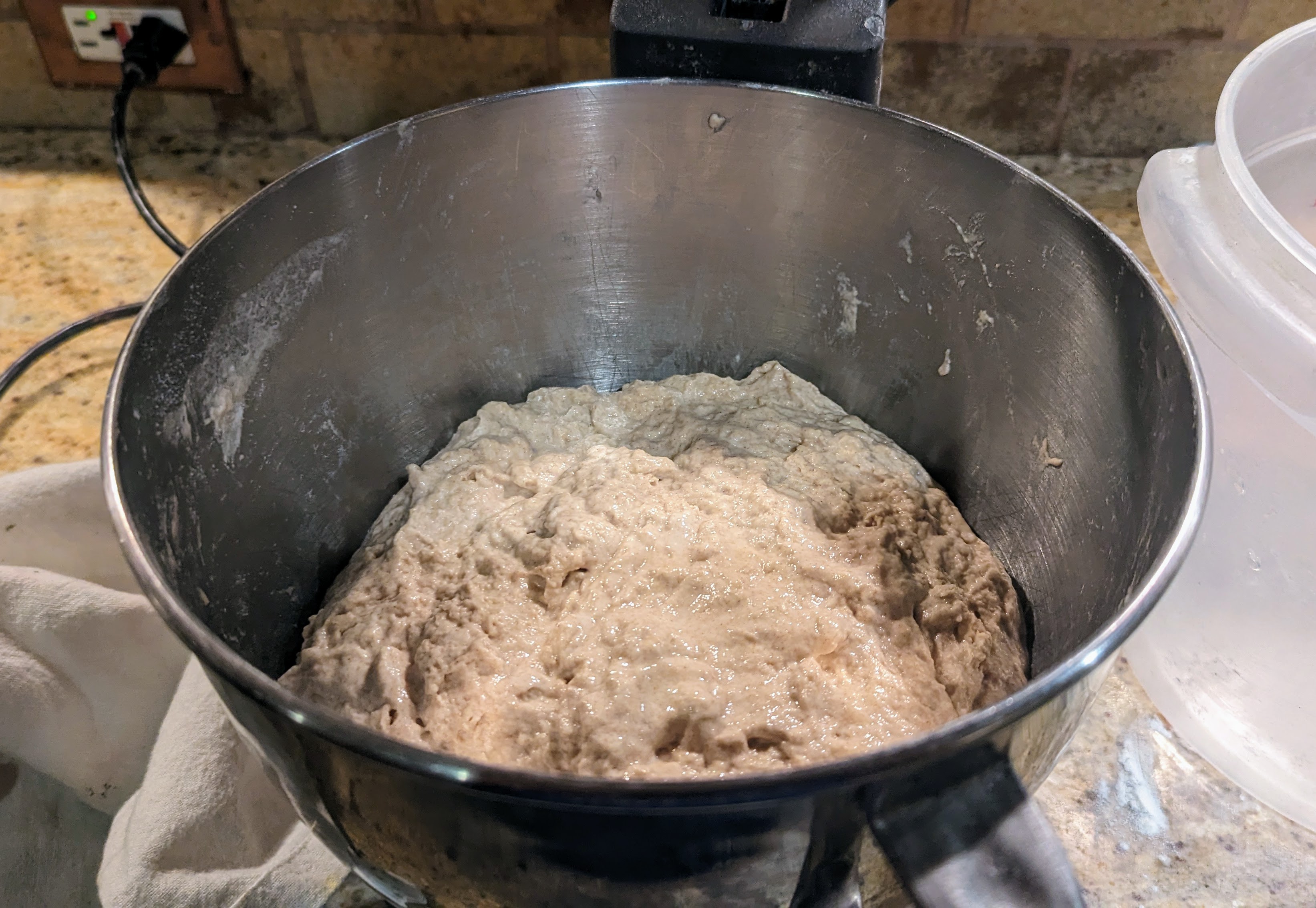
Bulk Fermentation. 1 1/2 to 2 1/2 hours depending on your ambient temp. This requires only two folds. Do the first after 20 minutes, then do the second an hour after that. I did the first fold in the bowl, then I did the second fold on my work surface, doing an N-S-E-W fold, then flipped the mass onto the seams and rounded it with my hands. I then sprayed some oil into my bowl, then set the dough seam-side-down in it to finish fermenting. I eyeballed the dough to just under double in volume, if not a little earlier because I wanted to give plenty of time for final fermenation.

Divide and Pre-Shape and Shape. Divide the dough into four 335g pieces. If there’s any leftover, just distribute it between the four pieces. From here, please refer to my Baguette Dough Development Process (will open a new tab).

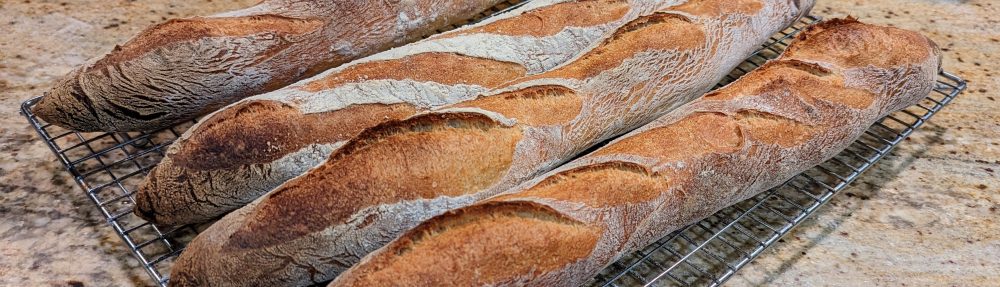
Bake. Bake at 475°F for 12 minutes with steam. Remove your steaming container, then bake for another 20 minutes at 425°F. When you remove the baguettes from the oven, they should feel lighter than they look. If they feel a little heavy, that means there’s still water in the dough that needs to be evaporated. Pop them into the oven for another 10 minutes if this happens. I had to do this with the batch above.

Notes

  1. Even with this small amount of rye, bear in mind that rye contains absolutely no gluten, so folding is going to be a challenge. This is why I did the second fold on the bench, much like I’d handle a ciabatta.
  2. Also, because this dough is so wet, don’t be afraid to use a bit more flour on your bench than you normally would.
  3. Shaping at this high of a hydration is challenging. I suggest using Martin Philip’s shaping technique. The important thing with his technique is that the fingertips and heel of the hands maintain contact with your work surface. With this dough, you will use more flour on the board.

Why Would You Hamper Yourself?

I was perusing a bread forum last night when I ran across a post of someone showing off the baguettes they had made. They were okay looking but a little mishapen. When I read the proceeding threads, in one post the baker mentioned – actually kind of boasted – that they didn’t have all the tools such as a couche or a lame or a transfer board. Once I read that post, I immediately asked out loud, “Why the hell would you purposely hamper yourself.”

Then I looked back on when I first started baking artisan bread and how proud I was that I was able to make something edible. I didn’t have a digital scale. I used an old analog food scale. I didn’t have a proper couche and instead used dish towels. I fashioned a lame out of hanger wire (I still use it). I did make a transfer board that I use to this day that’s made of 3/8″ sanded, untreated plywood that I sealed with beeswax. I also didn’t have a baking stone and instead used a loaf tray, which was fine, but the bottoms turned out round – not really what I’d call ideal.

Then I realized that I was working WAY TOO HARD to make baguettes and that’s when I decided to make a small investment in some crucial equipment. I got a digital food scale with 1-gram accuracy for $15. To measure out my yeast and salt precisely, I got a great precision scale (.01 gram accuracy) for $12. I bought a linen couche for $15. I already had the transfer board, but that piece of wood only cost me $6.

That small investment of less than $50 completely changed the game for me. It made the entire process so much easier; especially having the couche and the transfer board. Now I could manipulate my dough with ease and not worry about screwing them up with my hands. The transfer board could be used to straighten my loaves before I popped them into the oven.

The scale allowed me to create loaves that were all the same size. But also, with the loaves being the same size and weight, I could ensure a consistent quality for all my loaves.

It’s these kinds of things that I didn’t get when I first started. But it wasn’t until I got them that I truly understood just how important they were to making beautiful loaves of bread.

Time for Some Kamut Sourdough!

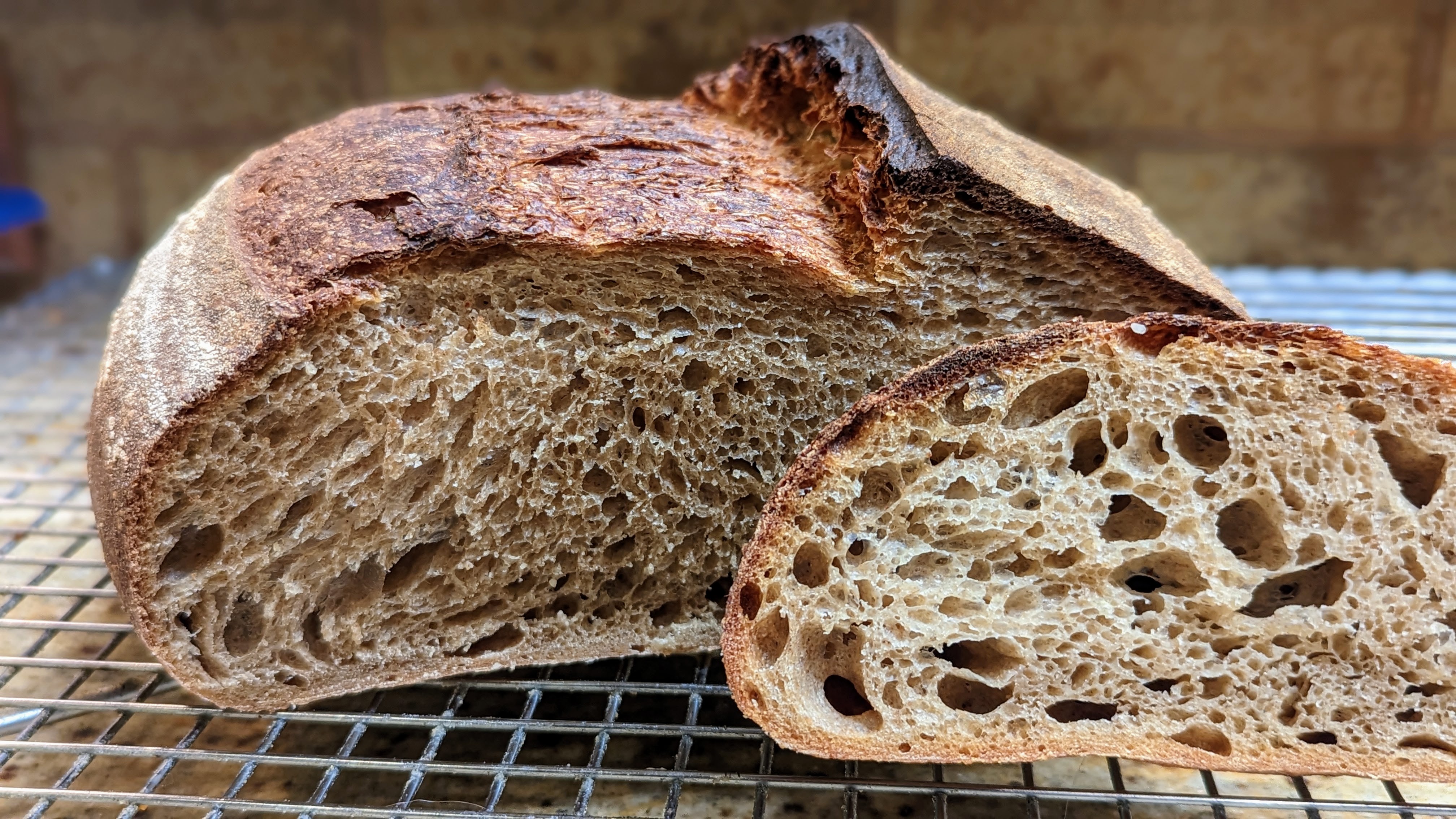
I just finished the second feeding of my mother starter to make some sourdough dough this morning. Afterward, I asked myself, what kind of flour blend do I want to use? Then it occurred to me that I hadn’t used a Kamut blend in a while. I love bread that has Kamut in it. It’s my favorite flour as it brings a nuttiness and a hint of sweetness to the flavor profile. Plus, if you’ve read this blog previously, you’d know that Kamut has some incredible nutritional benefits as well. But that aside, any bread I’ve made with Kamut has an incredible flavor! For this bake, I’m using the following formula/recipe:

Formula

Flour100.00%
Water75.00%
Salt1.80%
Total176.80%

Final Dough

Flour 1628g
Flour 2343g
Water686g
Salt21g
Levain343g
Levain weight is 30% of total flour

This is a straight-forward dough and frankly, the formula is a master formula I use as a master formula for most of my bread. If I use predominantly whole-grain flour, I will up the percentage to 85% or more depending on the flour.

As for processing, it’s straight-forward as well:

  1. Mix the flour, starter, and water, reserving 100g of the water.
  2. “Fermento-lyse” for up an hour.
  3. Dissolve salt into the reserved water, then do the final mix to incorporate the salt.
  4. 2-4 stretch and folds on the bench at 45 minute intervals. I always play it by ear with the folds because Kamut’s gluten is very delicate, and it is easy to tear, so I try not to do any more than I need to. Also, the windowpane test is reliable with this flour, especially if I’m using a large amount of kamut. What I’m looking for is the folded dough to maintain its shape for several seconds after folding.
  5. Shape into batards or boules and usually do an 18-24 hour final fermentation.
  6. For my oven, I bake at 460° for 35-40 minutes with the first 15 minutes with steam.

Has It Really Been That Long?

The other day, my fridge went on the fritz, and I had to remove all the perishable stuff and put it in a cooler. What didn’t make it was my starter. But that didn’t bother me because I literally hadn’t used it for months, and I was planning to throw it out and start anew…

But looking at my starter, I got a little sentimental and decided to feed it. And in that moment, I remember a recent conversation that I had with a friend who mentioned that she missed my sourdough. Yikes! So, I dumped out the hooch, then mixed in some flour and water, then let it sit overnight. By morning, it was clear that it had peaked and declined, so I dumped out half and re-fed it. Damn! It doubled in just three hours!

Normally, with that kind of doubling rate, I’d set out to make dough. But I wanted to be sure it was ready, so I re-fed it after 4 hours’ time as I had to cook dinner. I couldn’t believe that it tripled in an hour-and-a-half! It was ready.

Since I feel a little rusty, I went to a tried-and-true formula that I’ve used for years. Here it is:

Formula

Flour100.00%
Water75.00%
Salt1.80%
Total %176.80%

Final Dough

High-Extraction Bread Flour571g
100% Certified Organic AP Flour400g
Water686g
Salt21g
Starter (levain)343g
Total Yield2020g
2 X 1000g loaves + 1% for processing

Quick Process

This is a riff on the Tartine Country Loaf. It’s about as straight-forward as can be. I do a 30-minute fermentolyse to hydrate the flour, then I only do two folding sessions separated by 45 minutes as opposed to the six folds at 30-minute intervals that Chad Robertson does. This is because the flour I use develops gluten FAST. It’s also a reason I use about 35% AP Flour. It helps lighten the dough and produces a lighter and loftier crumb. As for total bulk fermentation, I’m expecting it to last about 3-4 hours at most, especially with how active my starter is.

For folding, I used to do stretches and folds directly in my 6L Cambro container. But before I had to curtail my baking, I started folding my dough on my workspace. I feel that I could more effectively stretch it that way and not de-gas the dough as much.

Once bulk fermentation has completed, I’ll shape batards and place them in my 14″ batard baskets. I love these baskets as the finished product always creates a nice oval shape. Plus, because the dough isn’t as constrained in

As I sit here writing, I’m incredibly excited to be baking sourdough again. I forgot how much I love the process.

Recipe: All-Purpose Dough for Rolls, Sandwich Bread, and Pizza Crust!

For years, I’ve occasionally experimented with creating a dough that I could use for both pizza crust and bread, and I finally produced a formula that works wonderfully for both! As you’ll see in the formula below, there’s not much to it. But the kicker for me was using a much lower hydration than I’ve been experimenting with in the past.

My earlier experiments employed hydration 75% and above. I was also using a combination of high-gluten bread flour and AP flour, and sometimes mixed with some Kamut™️ flour. But yesterday afternoon, I thought about an episode of Diners, Drive-ins, and Dives where Guy Fieri visited this pizza place and the chef used AP flour only. That got me thinking that if I used just AP flour and lowered the hydration, I could still achieve decent gluten formation, and the small amount of olive oil would help to create a soft crumb if I used it for bread.

As far as bread is concerned, this dough produces a closed but airy crumb that is perfect for rolls, but placed in loaf pans, is perfect for sandwich loaves! For pizza, the lower hydration creates a nice, strong dough that can easily be spread out into a pizza crust. And here’s the kicker: The long, cold fermentation takes place during bulk fermentation. This means you can create the dough the day before, and let it sit in the fridge for 12-24 hours. If you’re making pizza, you can divide the dough immediately after kneading, then let it rise in the fridge. More details below. For now, here’s formula and the final dough to make 6 buns.

Formula

AP Flour100.00%
Water65.00%
Salt2.00%
Yeast0.60%
Olive Oil1.30%

Final Dough

AP Flour825g
Water (lukewarm)536g
Salt17g
Yeast5g*
Olive Oil11g
Total Yield1394g
6 X 230g buns
12 X 115g rolls
*Use half the yeast for a 24-hour bulk ferment

I must come clean. I experimented with making longer buns as you can see in the pictures above. They turned out great, but they’re a little too heavy to be used for sandwich rolls. Based on those results, I’d lengthen them to make bread sticks for dipping. And if I’m going to use it for sandwiches, I’d definitely make loaves for loaf pans.

Process

Mix. Combine all the dry ingredients together. Then add the oil and water and mix thoroughly. Knead the dough until smooth (you can use a mixer or do it by hand).

Bulk Fermentation. If you’re making bread or rolls, place the dough into a container (I use a 6-liter Cambro container). If you’re making pizza dough, divide the dough into two or three equal pieces, depending on the crust size you want, form into balls, then place on a sheet and cover with plastic wrap. In either case, place the dough in your fridge with a temperature in the range of 39℉-42℉. Ferment for 12-16 hours. The dough may triple or quadruple in volume during this time. But it’ll be okay if it’s domed in the middle.

If you want to go for a long bulk fermentation, use half the yeast. With that amount, the dough should expand to its fullest in about 24 hours.

Divide and Shape. If you made pizza crusts, there’s no need to divide. Simply gently press out the balls to about 1cm-thick discs, then cover and set aside. For rolls, divide into twelve pieces, then form balls and place on a baking sheet covered with parchment paper. For sandwich bread, divide into two equal portions, then form each into logs and place them into loaf pans. For breadsticks, form into long logs then set on a well-floured couche.

Final Fermentation. Let the dough proof for an hour at room temperature or until it doubles in volume.

Bake. For bread, lightly brush the tops of the loaves or rolls with a little water, then score if you want. Bake at 425℉ for 30 minutes. Use steam for the first 10-15 minutes of the bake to help rise. For pizza, shape, top, and bake as you normally would.

Mexican Telera Bread: The Soul of the Torta

Having been to Mexico several times over the years and being born and bred in California, I have a deep appreciation for Mexican food. But I have a special place in my heart for the Torta, the Mexican version of a sandwich. In the US, when we think of a “sandwich,” what typically comes to mind is a flat piece of meat with some condiments like mayo or mustard, and maybe some lettuce, onion, and tomato.

But the Torta… Ah, the torta. Like a sandwich, it’s meat between some bread, but that’s where the commonalities end, especially with the meat. The meat can be carne or pollo asada (grilled steak or chicken), or puerco (pork), camaron (shrimp), polpo (octopus), and my favorite: arrachera (marinated, grilled skirt steak). Heck! You can use any type of meat – yes, cold cuts as well. But instead of mayo, there will invariably be avocado. As for vegetables, you might get some grilled onion or diced tomato. In the states, shredded lettuce or lighly pickled cabbage are often added as well.

What I love so much about the Torta – and I suppose sandwiches in general – is that there are no rules. It’s a wide-open playing field! But that said, there is a type of bread that is commonly used for Tortas, and that is the Telera roll.

The Telera is an oval or rounded rectangle roll that is neither too wide nor long. The crumb is soft and fluffy with a firm but slightly chewy crust, making it perfect to soak up the juices of the various meats that are used. Visually, it is marked by two indentation lines across the top (we’ll get into that later). As for taste, technically, the Telera is a savory roll, but there is a slight sweetness as the dough contains a small amount of sugar.

As you can see in the picture to the left, it’s much like a hamburger bun that is ever-so-slightly longer on one side. This makes it a perfect platform for the grilled meats or seafood that are usually put on it.

Being a baker, after having a few Tortas on my last trip to Mexico just recently, I wanted to learn how to make them. And after a bit of research, and a bit of trial and error, I finally got a formula and recipe that’s both easy and delicious!

Overall Formula

Flour100.00%
Water60.00%
Butter (Softened)5.00%
Yeast1.40%
Salt2.00%
Sugar4.00%
Total Percentage172.40%

Final Dough

Flour516g
Water309g
Butter (Softened)26g
Yeast7g
Salt10g
Sugar21g
Total Weight889g*
8 X 110g rolls
78ºF/26ºC
*The extra 9g is factored in to allow for process loss.

Mix. Combine all the dry ingredients together in a large mixing bowl and mix to evenly distribute. If you use a mixer, use the paddle at lowest speed. Cut butter into the dry ingredients much like you’d do with biscuits (butter should be soft). Add the water in 3-4 batches, making sure it’s well-incorporated. If using a mixer, switch to the dough hook and slowly add the water until everything has been incorporated together.

Knead. Even though I use a mixer to mix, I enjoy kneading simply because I don’t do it that often as most of my bread is “no-knead” bread. Turn out the dough onto a clean work surface and knead it for 5 minutes or until the dough is smooth. Richard Bertinet’s slap and fold works great too! Work the dough into a ball, then place it in a greased bowl (I use olive oil), seam side up. Flip the dough over onto the seams so the whole ball is covered. Cover the bowl with a cloth.

Bulk Fermentation. Place the bowl in a warm place and let the dough rise and expand to almost double in volume. 45 minutes – 1.5 hours. Remember, watch the dough and not the clock!

Divide and Shape. Punch down the dough to release the gas (no, you don’t want an open crumb), then divide the dough into 110g pieces. Roll each piece into a tight ball, then set aside to relax for about 15 minutes.

On a lightly floured surface, press each ball out into an oval of about 1 -1.5 cm thick. Sprinkle a little flour on top of the oval, then about a 1/3 of the way from the long side of the oval, press a straw or chopstick down to the board, being careful not to tear the dough, but really work it down into the dough. Repeat on the other side, then place on a baking sheet covered with parchment paper. BTW, you’ll want to move the sections together when you place them on your baking sheet. This is a method of scoring without a blade. And if you find that your dough sticks to your work surface, just use a bench scraper to lift it up.

Final Fermentation. Once all the rolls have been shaped, cover the baking sheet with a damp cloth (you don’t want to form a skin), and allow the rolls to double in volume. This could take 30 minutes to an hour depending on your ambient temperature. Preheat oven to 400ºF/200ºC.

Bake. Before baking, lightly brush the tops of the rolls with water, then bake for 15 minutes at 400ºF/200ºC or until golden-brown on top. Don’t let these overcook as the sugar – even though there’s just a little – will caramelize easily so be watchful!

Making a Torta

There are no hard and fast rules when making a torta. Even in Mexico, tortas vary from region to region. And while it’s generally accepted that the Telera roll is the common roll to use, even in Mexico, depending on the region, different bread may be used. For instance, in Guadalajara, there is the Torta Ahogada or “drowned” torta that uses a sourdough bread called “Bilote Saldado.” But for our purposes, we’ll just stick with the basic torta.

If you want something really basic, just put some grilled meat between the halved bread, top it with avocado, then close the bun. This is the way it is normally served in Cozumel. But if you want to get fancier (and I like to get fancier), coat the halves with smashed avocado, spread some shredded lettuce or cabbage (I prefer cabbage), add some sliced tomato, then top that with the grilled meat. Add lime juice for a little zest.

As for meats, you can use pretty much any meat or even seafood. Cold cuts are fine as well. My favorites are:

  • Carne or Pollo Asada
  • Arrachera (skirt steak)
  • Grilled Octopus
  • Shrimp (Grilled, Sauteed)
  • Grilled Fish

My two big favorites are Arrachera and Octopus. But truth be told, I’ve only had octopus in Mexico. Not sure how it’s prepared, but it ROCKS!

Here’s my Carne Asada recipe, if you want to give it a try!

What’s So Special about Kamut Flour and Why I Love to Bake with It So Much

Last week, I finally was able to procure a 25 lb. bag of KamutTM flour. For months, so many producers were out of it, and those that did have it, like Whole Foods, sold it in much smaller quantities than I needed and for a premium price. So, as soon as I saw that Azure Standard had it back in stock, I immediately put in an order!

Since I discovered it, KamutTM flour has been an integral component in most of my flour blends. I’ve mentioned using it several times since I started this blog, but when I baked my first loaves of it after many months of not having it, I sat down and asked myself, “Why do I love this flour so much?” I realized that there are lots of reasons, so I thought I’d share them here.

Before I go on, let me answer the obvious question for those who don’t know what it is: What is KamutTM? KamutTM isn’t a type of wheat but a trademark name for the Khorasan strain of wheat. It is an ancient grain that was discovered in an ancient Egyptian burial chamber after World War II and the grains ended up in the hands of a Montana wheat farmer who cultivated them. The trademark name is important because:

  1. It ensures that the grain comes from the original seed stock and is both unmodified and unhybridized and completely non-GMO.
  2. It is also 100% certified organic.

These are important distinctions as they provide a guarantee of origin, purity, and quality.

Nutritionally, unlike regular wheat, Kamut has a high intrinsic energy as it has a higher lipid content than regular wheat. But it is also high in both protein and fiber and contains several essential minerals and vitamins such as niacin and manganese that contribute to its overall high nutritional value.

But the science-y stuff aside, another thing I love about this flour is the romance behind its history. As I mentioned above, the grain was found in an ancient burial chamber in Egypt after World War II, and though classified as Khorasan wheat, it has also been called “King Tut’s Wheat” or Pharoah’s Wheat” based on its origin.

And baking with flour that comes from wheat that has a provenance dating back thousands of years makes me think of what it was like baking back then. Sourdough was discovered in ancient Egypt around 3000 BC, and it’s cool to me to bake with grain whose origins date back that far. I admit it. I’m a hopeless romantic, dreaming of the “old days” and what it was like baking with those ancient hearth ovens with that original grain.

Plus, historians believe the discovery of sourdough was purely accidental. Accidental or not, it changed the world! Up to that point, bread was flat and dense. But the addition of yeast literally gave rise to a completely new form of bread that was then adopted by the Greeks and Romans, then spread to the rest of the world. Did it start with Khorasan wheat? Maybe. I have no idea. But who cares? It was used back then and that was all I needed to know to want bake with that ancient grain.

But other than the romantic history, I love KamutTM flour for what it brings to the loaves that I make with it. When combined with a high-extraction or whole-grain flour, it helps soften the crumb. This is because even though it forms gluten when mixed with water, its gluten is much more delicate than regular wheat.

And that delicateness was a challenge to work with at first as it introduced a trade-off with the soft crumb: The dough also became prone to tearing. It forced me to learn how to handle the dough more gently. Until then, I hadn’t realized how ham-handed I was with my dough. My stretch and fold sessions were relatively rough affairs compared to how I stretch and fold now; not that I’d completely rip the dough apart, but it certainly wasn’t with the deliberate care I take now. And that skill has carried over to other dough made with different flour blends.

Of course, as KamutTM is flour, and flour is food, what about its taste and texture? As I mentioned above, its gluten provides a smooth, almost velvety feel to the crumb. It also has a nutty flavor that contributes to the overall complexity of the flavor profile.

Working with KamutTM Flour

If you want to work with KamutTM, I recommend starting with a smaller quantity first to try it out. Whole Foods usually carries 1-pound bags from Bob’s Red Mill. That’s enough to make two 1-kg 60% Bread Flour/40% Kamut loaves @ about 85% hydration.

Other than that, here are a few things to keep in mind when working with Kamut:

  1. I’ve found that Kamut’s starches break down pretty easily. So, if you use a rye-based starter, be extremely watchful of your bulk fermentation. The loaves I made above used a 25% rye starter inoculation and bulk fermentation happened a lot faster than with normal bread flour. That amount of starter is going to speed things up anyway, but it was about twice as fast as normal with the Kamut present. I had to turn down the temperature on the fridge I use for cold final fermentation to about 39℉, where I normally have it set around 42-44℉ to favor lacto-fermentation. Of course, an alternative is to use less starter, but I really wanted a more pronounced tang.
  2. And since Kamut’s starches break down pretty easily, I do not recommend using a real high temperature for baking. The loaves I baked above were baked at 460℉ for 20 minutes with steam, then 425℉ for another 22 minutes dry. Because of all the released sugars, that bread finished with a dark crust!
  3. As I mentioned above, the type of gluten that is formed with Kamut is a lot more delicate than with the hard red wheat that’s normally used in baking. When you’re folding your dough, be very mindful of the extent to which you pull the dough. My advice is to only pull to the point where you feel some resistance, then fold the dough over. You may have to fold more times than you normally would during a session to ensure you’re building structure, but you’ll also ensure that you’re not tearing your dough.
  4. Kamut is a “thirsty” flour, so I recommend a healthy autolyse or fermento-lyse of at least 45 minutes. This will ensure that your flour is well-hydrated.
  5. As far as hydration percentage is concerned, you’ll have to experiment. The bread flour I use is particularly high in protein at around 15%, and though the Kamut from Azure Standard is about 11.7% protein, I can still push my hydration way past 80%, though I typically don’t exceed 85%. Even then, it still handles like a 72% hydration dough with regular bread flour.
  6. If you make bread with 100% Kamut, best treat it like rye and bake it in a pan or a Dutch oven to prevent it from spreading out. It won’t spread out nearly as much as rye, but its gluten is not very strong.
  7. And speaking of strength, bear in mind that most Kamut flour is whole-grain flour, so don’t expect to get big holes. You’ll get plenty of spring, but just not a lot of voids in your crumb.
  8. You might consider sifting the flour through a fine mesh to capture the germ and husk. These are like little knives that will cut the gluten strands. And with Kamut’s weaker protein bonds, removing that stuff will help with your rise. I usually sprinkle the germ on top of the loaves before I place them in the oven.

Stiff vs. Liquid Starter? Which One Creates a Sourer Taste – It Depends

If you follow baking blogs or participate in online baking forums, you’ve probably heard this: The stiffer – lower hydration – the starter the sourer the taste. The thinking is that a stiffer starter promotes aerobic metabolism, thus creating more acetic acid, while a more liquid starter promotes anerobic metabolism which favors the creation of lactic acid. The difference is that acetic acid tastes more sour than lactic acid.

That’s all well and good. But as with so many things in making sourdough, there are several variables that can affect the sourness of your bread. For instance, with the loaf at the top, I used a 100% hydration starter to ferment the bread. It was 20% inoculation relative to the flour (BTW, I hate using that word with respect to bread because it has a specific scientific meaning). But at that hydration level, the yeast density was low, and it took 24 hours for final fermentation in my fridge. That loaf was nice and tart!

On the other hand, with the loaves immediately above, I used a 60% hydration starter, with the same inoculation level of 20%. But the yeast density was so much greater than the liquid starter, that final fermentation was barely 10 hours and I was pushing it, which accounts for the less open crumb. It hardly has any sour taste.

Myself, I’ve never bought into that rule of thumb that a stiffer starter will make a more a sour tasting loaf of bread. I’m quite familiar with the food science behind that and agree that aerobic metabolism promotes the production of acetic acid which will be perceived as more sour. But baking as long and as much I have, the best way I know that making a sour loaf involves a lot more than just the starter. The stiff starter gives you a head start as it favors the production of acetic acid. But other factors such as the environment, fermentation time, type of flour, and amount of starter also affect sourness.

As far as a long, cold fermentation is concerned, while yeast metabolizes, it creates inhibitors that block bacterial activity, effectively mitigating or eliminating competition. So, using a lower inoculation level will ensure a lower relative yeast density and will help mitigate fungal activity, and in turn, allow the bacteria to flourish during bulk fermentation. Then when bulk fermentation is complete, doing a cold fermentation of around 38℉ (and no higher than 40℉) will slow down yeast activity even further and let the bacteria continue do their thing. These principles apply to using all sorts of starters, from pure liquid fruit-based starters to high hydration starters, to super-stiff starters. So, at least for me, the type of starter isn’t as relevant as the dough fermentation techniques I employ.

That said, I could be completely full of it, and there are folks who will disagree with me vehemently. I get that. But for me, it’s time and technique that will dictate how sour my bread is, not my starter.

Loving My Flour!

The other day, I got a shipment of my favorite flour, Azure Market Organics Unbleached Bread Flour. I’ve written about it several times, so I won’t go into detail about it. But if you’ve read this blog, you know I love this flour! It’s so flavorful and wonderful to work with, but until recently, it was out of stock at Azure. They finally got it back in stock and I immediately ordered it. I feel like a kid in a candy store!

I’m excited because this flour has been integral to my flour blends, and with it unavailable, I’ve had to use alternatives. That hasn’t been too much of an issue, but any time you change things up, you need to adjust to the change, and sometimes it takes a few times to get comparable results to what you’re used to, as you tweak hydration, preferment amount, fermentation times, etc. But baking with this flour? It’s like putting on a pair of broken-in shoes. It’s just comfortable, which in turn makes my dough development process comfortable and familiar.

And I’ve realized that a very large part of my progression as a baker has been getting familiar with my ingredients. When you’re used to working with different ingredients, you just know how they’ll react and you can execute your process without having to apply too much conscious thought. Things just become automatic.

I once got in a great conversation with a professional chef. He said that the fundamental difference between him and a home chef is that he knows his ingredients so well that he doesn’t have to think about what he’s cooking. He can just focus entirely on creating his dishes. But more importantly, he said he gets the reps in that build that familiarity. It’s the same way with baking. When you’ve put in the reps, you just know, and as they say, when you know, you know.

As soon as I got my flour, I made the dough for the loaf above. With that loaf, I used a 500% hydration starter (yes you read that right) to ferment a 75-25 Bread/AP flour blend. Final hydration was around 75%. That’s just a basic loaf. But this was a bit of a challenge because I couldn’t do as long a bulk fermentation as I normally do because of time constraints. But knowing this blend and recipe so well, I knew that I could make up for it by doing an extra-long final fermentation. So, this loaf spent about 18 hours in my fridge.

When I checked it baking through my oven’s window, I just smiled and gave a sigh of pure satisfaction. I just nodded and said, “Mm-mm-mm, how sweet it is!” Then when I removed it from the oven, I was giddy. I saw how much the loaf had expanded, and I knew it was going to turn out great. Yes, it has a nice, open crumb, but more importantly, the dough was fully fermented and in no place was dense. So satisfying…

Like many other bloggers, I often talk about experimenting with different ingredients. I think that’s part of the process of developing skill. And while experimentation is great, getting reps in and learning what ingredients work best for you is just as important.

There’s Nothing More Satisfying…

…than pulling baguettes out of the oven, picking one up, and immediately noticing that it weighs far less than how it looks. That goes for any bread, but for baguettes, it’s a crucial quality because it’s an indicator that the loaves had great oven spring which, in turn, means that the crumb will be light and airy.

I baked the loaves in the picture above yesterday. For those, I used a rye poolish, with the flour of the rye accounting for 25% of the total flour. I knew that even with 25%, the bran in the dark rye flour that I use can cut up gluten strands. But I handled the dough much more gently, making sure I didn’t tear it, and only folded it once as the bread flour I use has over 14% protein – gluten forms up fast.

I still took a hit on the overall openness of the crumb, but the crumb still came out light despite the lack of numerous large holes. I knew when I pulled them out just by looking at them, that they had sprung up quite a bit. And though I didn’t expect a super-open crumb due to the whole-grain rye, with that kind of volume expansion, I didn’t have to worry about the crumb being dense and chewy.

Then picking that first one up… I just smiled in satisfaction. It was a good bake.