Wrapping Your Head Around Baker’s Percentages

When I first started baking bread 40 years ago, I riffed on a recipe that listed the exact amounts I’d need for each ingredient, like 4 cups of bread flour, etc.. Then when I started getting into artisan bread, recipes became formulas, showing the relative amounts of the ingredients expressed as percentages. For instance:

Flour100.00%
Water76.00%
Salt1.80%
Yeast0.75%
Total178.55%

The first time I saw that, my immediate reaction was, “WTF?” And my heart raced with anxiety. Nowadays, when I’m either recalling a recipe/formula, or even developing a new one, the percentages are all I think about.

As was explained to me, the percentages in a formula represent the ingredient amounts relative to the flour, which is always at 100%. So if we take the formula above, if I have 1000g of flour, then the amount of water I’ll need is 76% of that or, 760g. Easy, right?

But what about that “Total” item?

To be honest, I really didn’t pay too much attention to that figure until I started thinking about actual dough production and yields. At the time, I was starting to make bread to fulfill orders for luncheons and such. For instance, to feed a 200-person luncheon, I’d have to make 8 loaves scaled out to 1200g apiece, which mean that I needed to produce 9.6kg of dough.

The way I’d calculate how much I’d need was kind of a crapshoot. I’d start out with 5 kilos flour, then I’d apply the bakers percentages to get a weight. If we use that formula above, this would get me close to 9kg. So I’d go to 5.5kg and recalculate… It was tedious to say the least.

Thinking that there had to be a better way, I started doing some research and discovered that the total percentage in a formula is probably the most important number. This is because it is a representation of the total dough. Here’s a simple way to visualize what that means:

If you take the total percentage from the formula above, as Jeffrey Hamelman puts it in his book, “Bread,” (paraphrasing) that no matter what weight of dough we’re producing, there are 178.55 units that make up the dough. 100 of those units are flour, 76 of those units are the water, etc.

Without getting too technical about it, with that number, we can easily calculate the ingredient amounts we need for any given amount of dough we want to produce. In “Bread,” Hamelman talks about the conversion factor and using it to finding the amount for each ingredient.

Conversion Factor = Target Dough Weight / Total Percentage

So if I want to create a dough that weighs 1200g, given the formula above, the conversion factor would be:

Conversion Factor = 1200 / 178.55 which would be about 6.72

Multiplying each item percentage as a whole number by the conversion factor would give me the needed weight. For example, my flour weight would be 6.72 X 100 or 672g.

I have a simpler approach which basically accomplishes the same thing, but it’s more direct as I calculate the flour directly. Instead of coming up with the conversion factor, I just divide my target dough weight by the percentage, but expressed as a regular number. In this case,

Flour Weight = 1200 / 1.7855 = 672

From there, I just multiply the formula percentage relative to the flour weight. So the water I need would be:

Water = 672 X 76% = 511

Both methods will get you to the same place, but I like to shortcut my calculations as much as possible.

Let’s calculate the amounts we’ll need:

Target Dough Weight 1200g

PercentagesAmounts
Flour100.00%672
Water76.00%511
Salt1.80%12
Yeast0.75%5
Total178.55%1200

With this method in hand, I now completely focus on how much dough I will need for a given bake, be it a single loaf or several. As long as I have an accurate formula, I will always be able to get the exact amount of ingredients I’ll need.

But that said, I usually add about a 0.5%-1% fudge factor to my total dough weight because weight will always be lost during processing, so if I need 1200 grams to make 4 X 300 gram loaves, I’ll usually calculate my dough weight to 1210 grams. You’ll have loss due to evaporation or dough sticking to tools, etc. With this fudge factor, you can be guaranteed that you’ll get the exact dough weights you’ll need for each loaf.

My Poolish French Bread

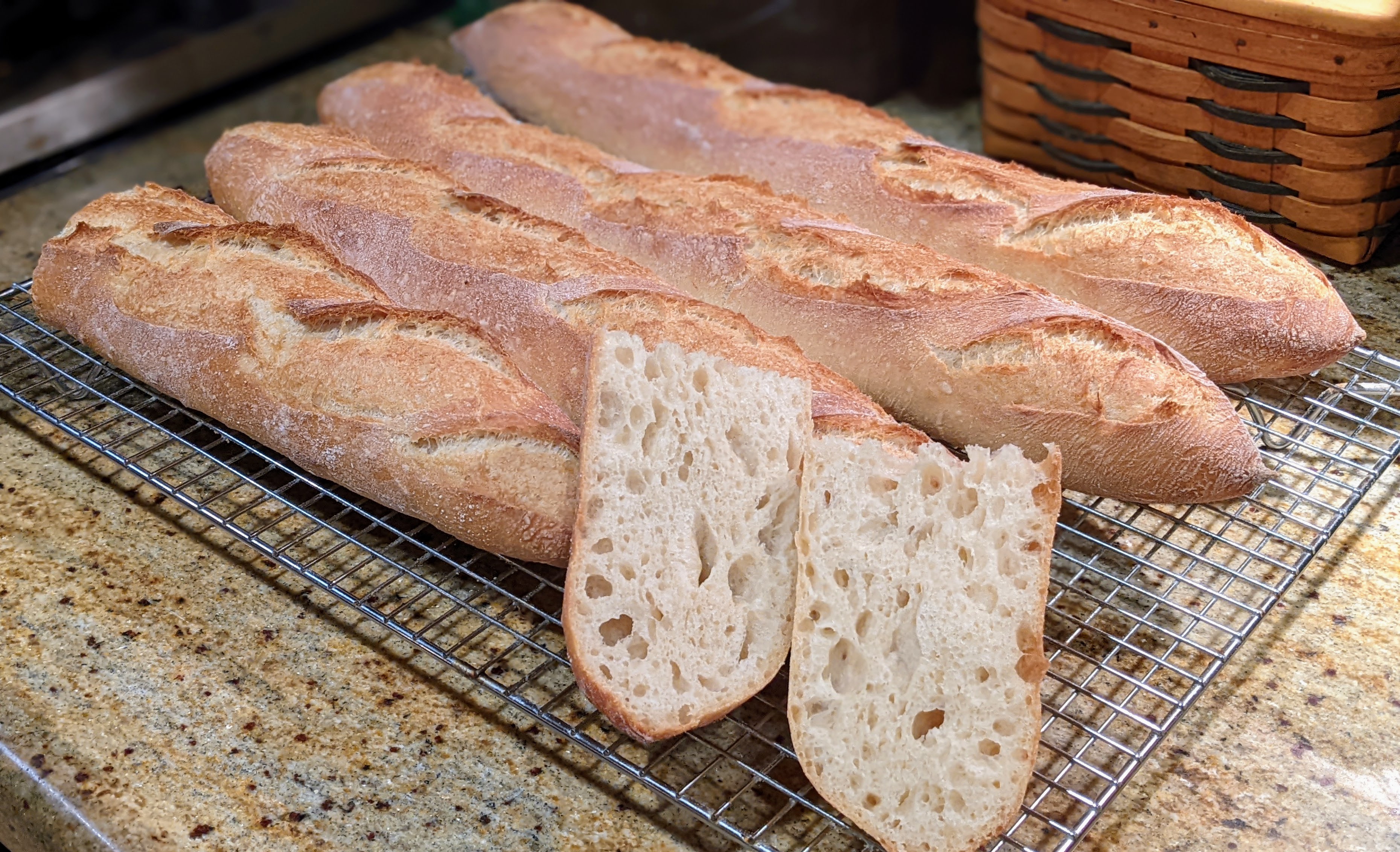
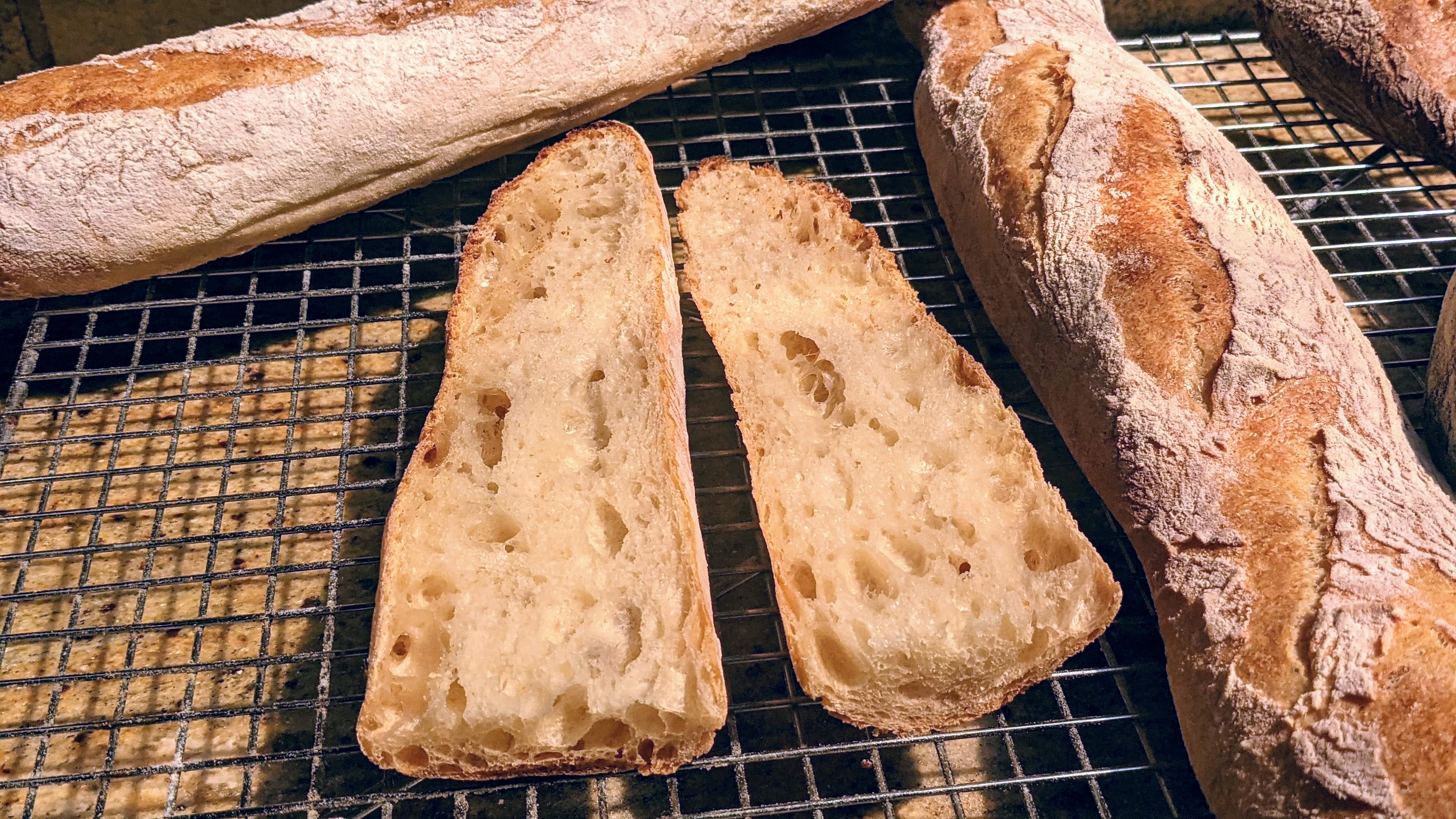
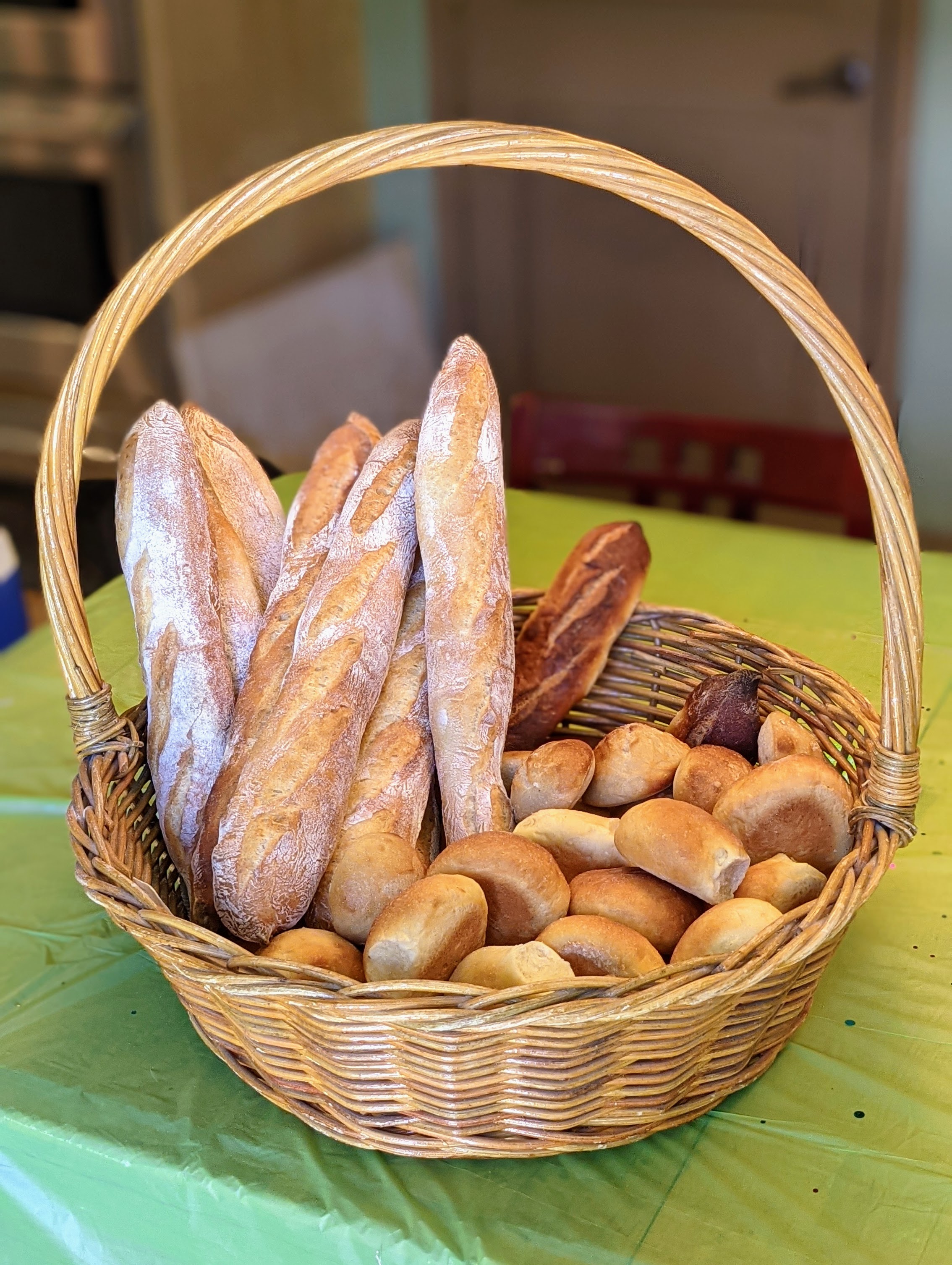
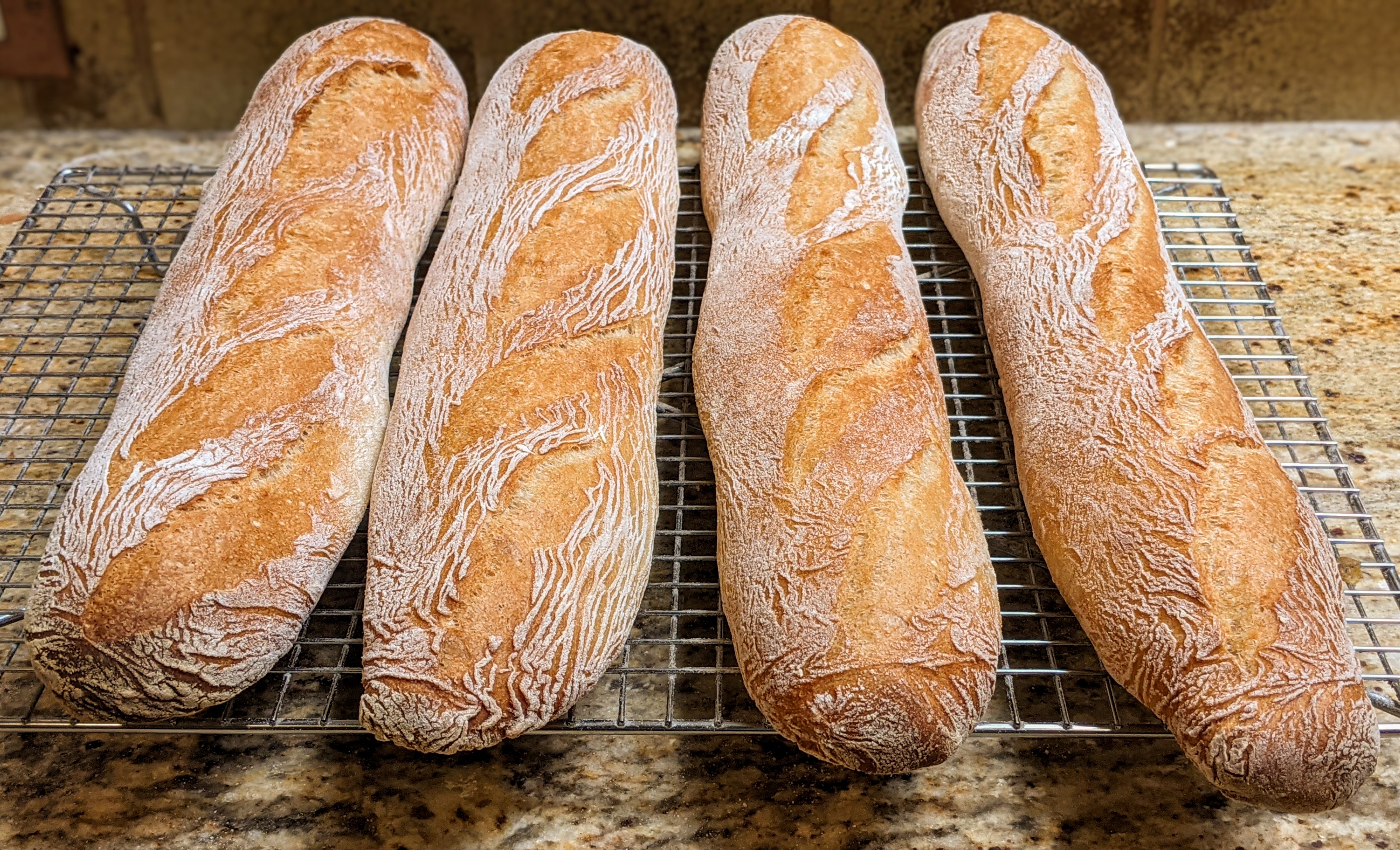
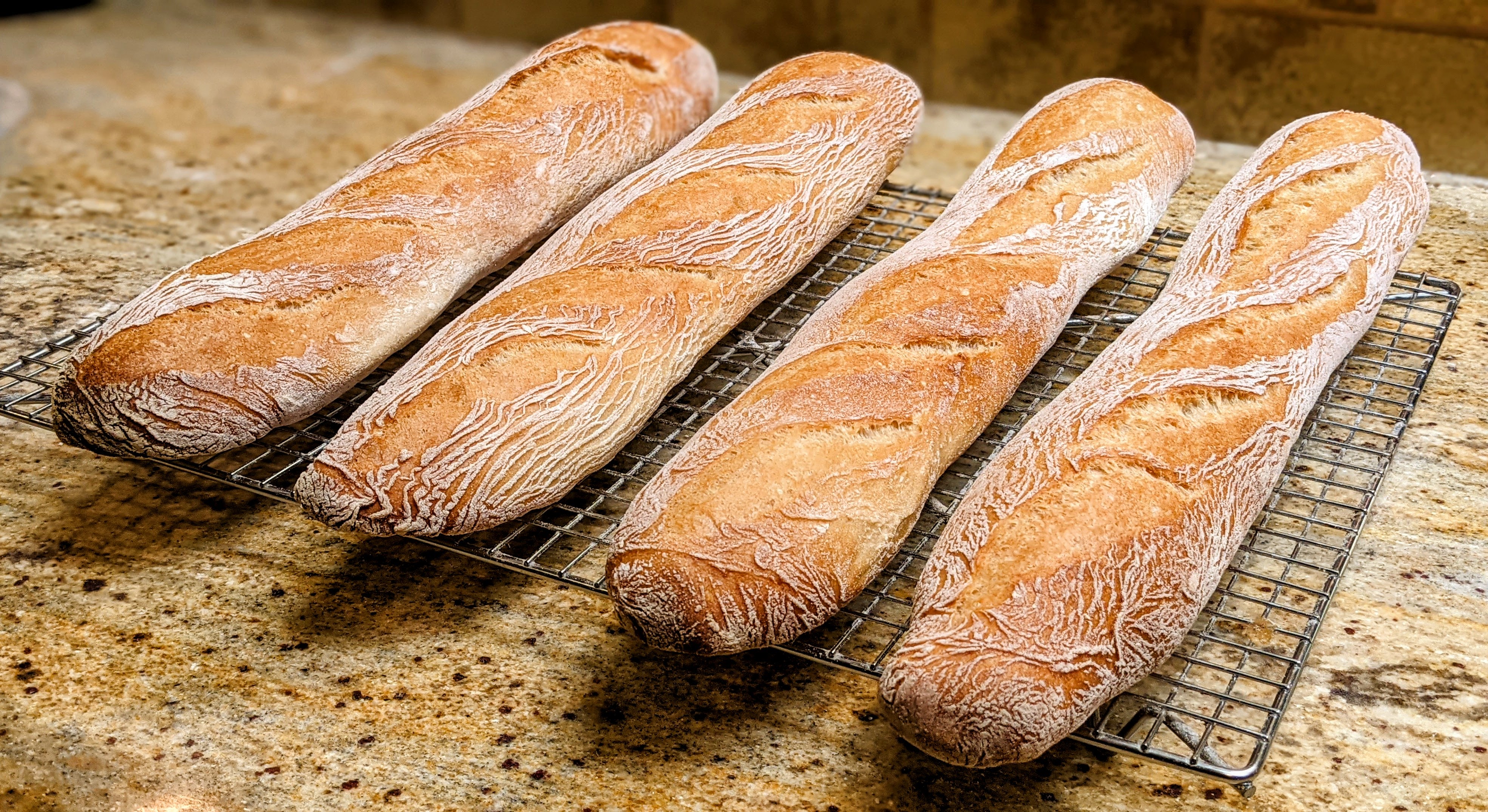
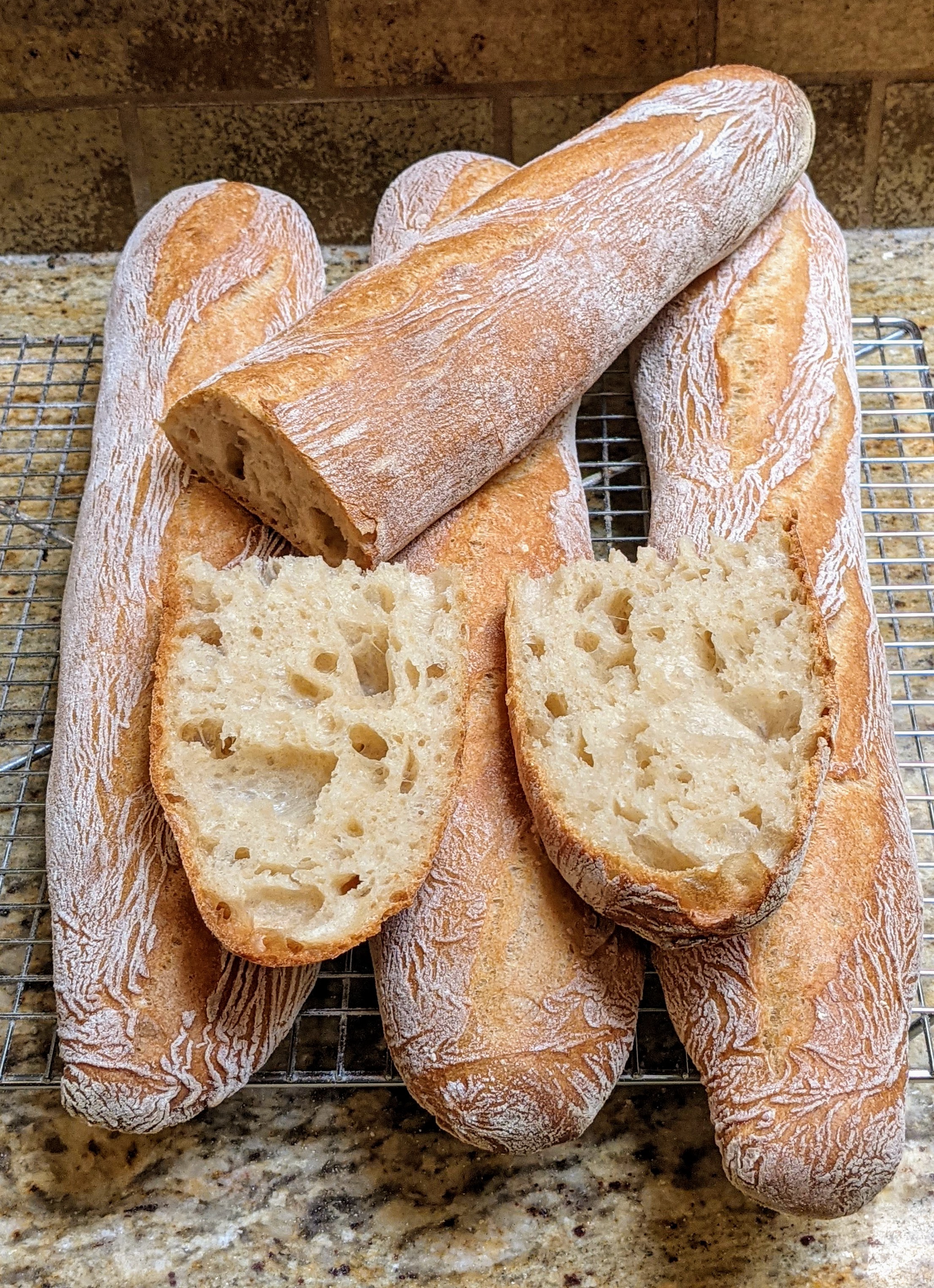
This is yet another versatile dough that can be used for different kinds of bread. I’ve made baguettes from this dough, mini cheese-filled boules, dinner rolls – and it’s also one of my favorite formulas for making hand-shaped batards! But it really shines for making French bread, producing a thin, crispy crust and a light, airy, pillowy crumb riddled with holes that is the perfect platform for sandwiches, or eaten warm, to hold little pools of butter. Gluten development with this dough is relatively light as compared other loaves; a little more than baguettes and a whole lot less than boules and batards. So somewhere in the middle.

As the title says, this bread uses a poolish which, truth be told, is my favorite ferment with which to work. Done right, a poolish imparts a distinct nuttiness and just a bit of tang upon the flavor profile of the bread. But it also adds extensibility to the dough. When I work with a poolish-based dough, it feels so luxurious. I jokingly call it a “sexy dough.”

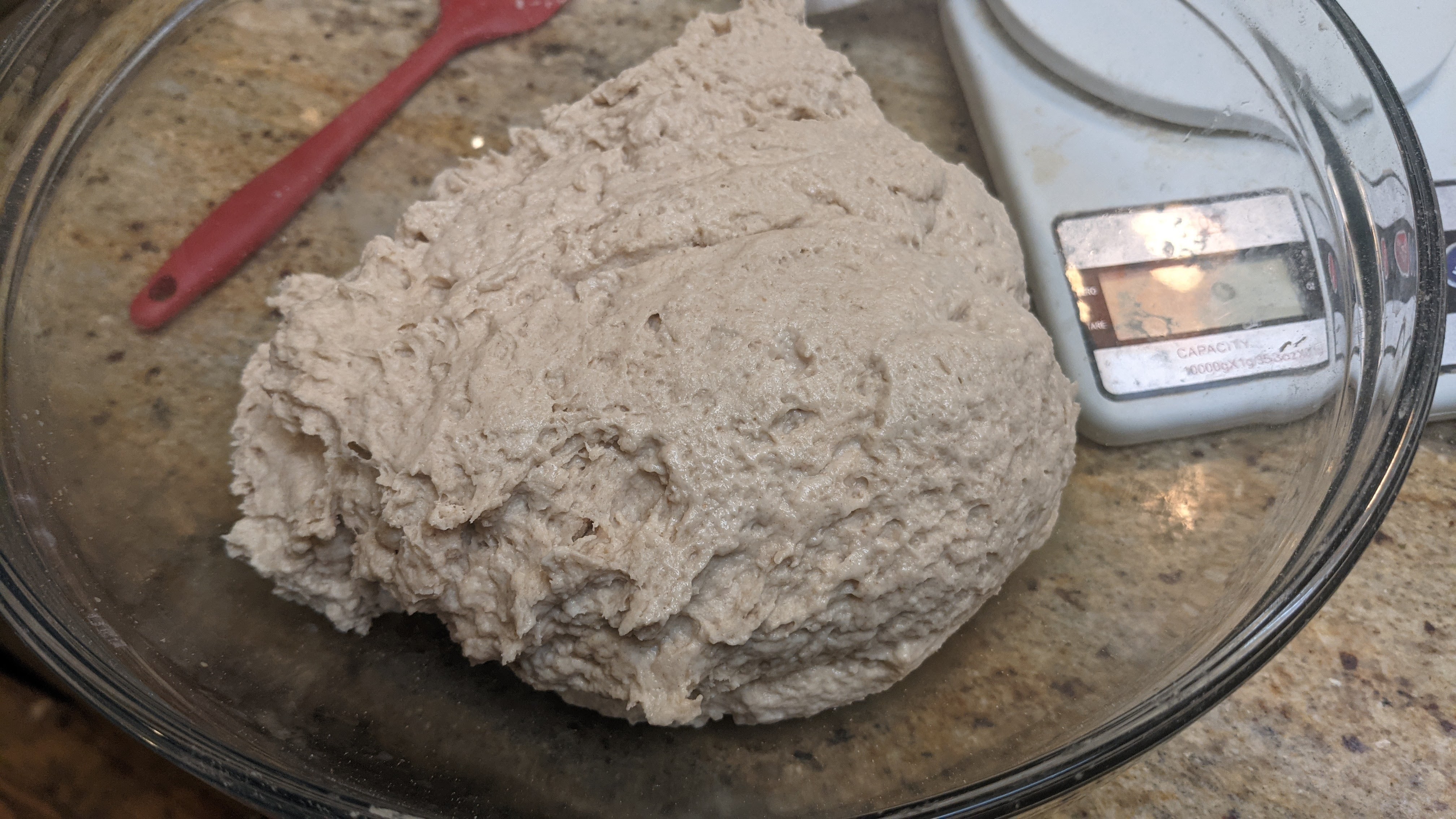
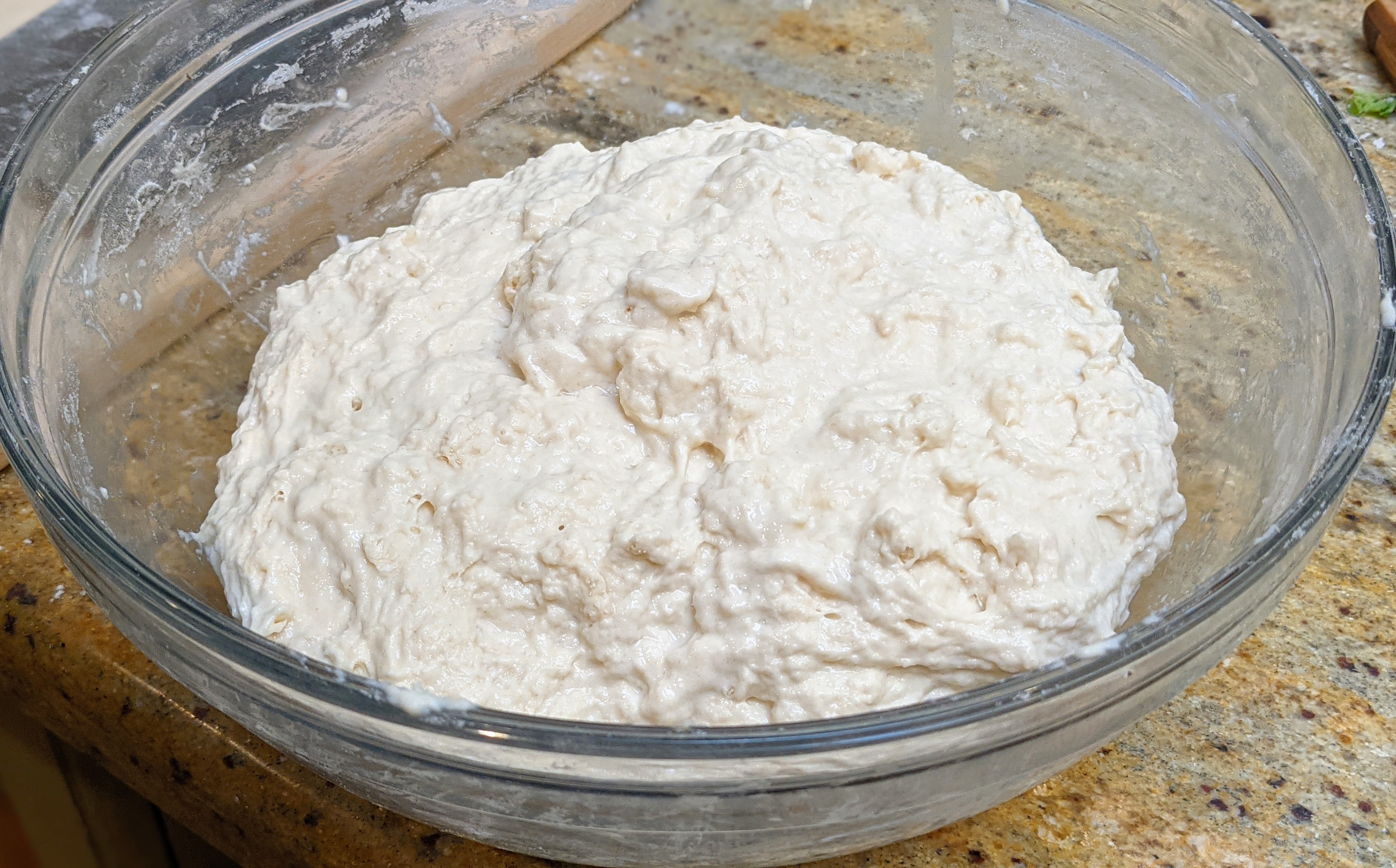
But sexy as this dough may be, to be fair, I should offer up a bit of a caveat. This is NOT a dough you want to work with if you haven’t worked with high-hydration dough yet. At 76% hydration and using predominantly bread flour, it’s slack and sticky. Any manipulation of the dough needs be done precisely and with quick movements, lest you find your hands covered in muck. This is further exacerbated by the moderate – and perhaps by others’ standards minimal – gluten development. But though I issued that warning, don’t let that intimidate you. As with anything, practice makes perfect. Let’s get to the formula:

Overall Formula

Bread Flour (unbleached)100%907g
Water76%689g
Salt1.8%16g
Yeast (Instant)0.4%3.6g
Total Yield1616g
Optimal Dough Temp76°F

Poolish

Bread Flour* (unbleached)100%302g
Water100%302g
Yeast (instant and relative to the poolish flour)0.2%0.6g
*The amount of flour you use for the poolish should be 33% of the total flour of the recipe.

Final Dough

Bread Flour* (unbleached)605g
Water387g
Salt16g
Yeast3.4g
Poolish604g
*I use my standard 75-25% Bread / High-Extraction flour blend

Make the Poolish

You’ll make the poolish 12 to 16 hours before you mix the final dough. Since I’m an early riser, I usually make it between 4pm and 6pm, so I can start mixing the dough at aroun 6am the next morning. I will make it later as the weather warms up. You’ll know the poolish is ripe and ready when its surface is riddled with bubbles – and you can actually see bubbles actively forming plus, when you uncover it, you get a nice whiff of alcohol.

To make the poolish, simply combine the flour, water, and yeast into an appropriate size bowl and mix until smooth. It’s better to use a larger container rather than a small one as the poolish will expand. I’ve woken up to a container whose lid literally exploded and spewed dough all over my counter. In any case, let the poolish sit at room temperature on your counter.

Dough Development

Mixing. You can mix by hand or with a mixer. First, pour your water into the poolish container, then with a spatula loosen the poolish from the sides of the container. Then dump the water and poolish in your mixing bowl. It will slide right out! Add the flour, salt and yeast then mix until all dry ingredients have been incorporated and you form a shaggy mass with no large lumps. If you use a mixer, mix for no more than 3 minutes on low speed. You want little to no gluten development.

Bulk Fermentation: 2 1/2 to 3 hours.

Folding. Let the dough rest for the first hour, then fold it until you start feeling tension building in the dough. Rest for another hour and then fold again. You should start feeling plenty of tension by this time. Let the dough rest another half hour, then you’ll be ready to scale. However, if, after several folds, the dough still feels a little too slack, rest it for 45 minutes, do another set of folds, then take the fermentation out to the full 3 hours.

Technically, you could do the folding in half-hour intervals right after mixing and reduce the bulk fermentation to 1 1/2 hours. But there’s a lot to be said about the flavor development that takes place in the full 2 1/2 hours.

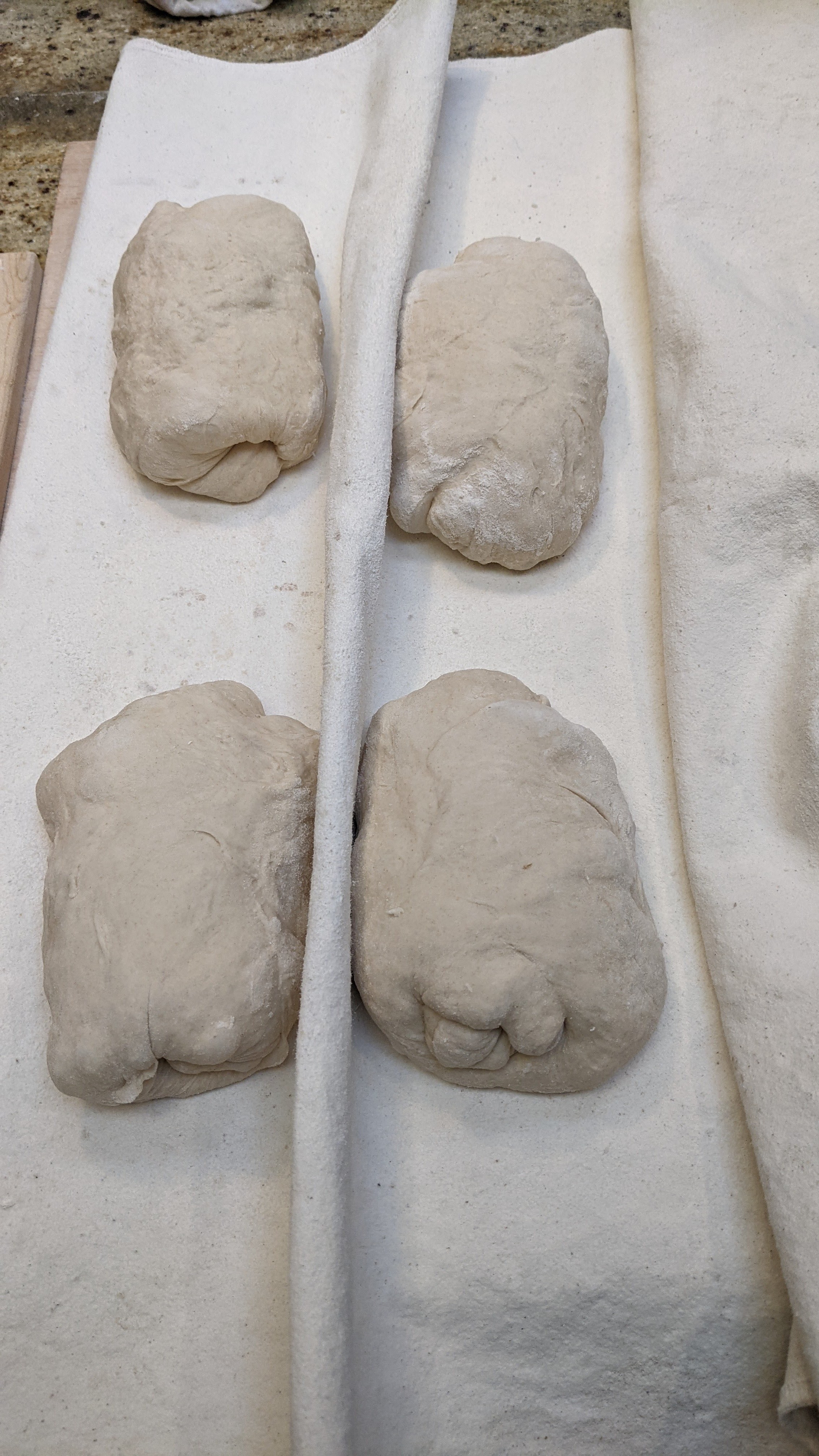
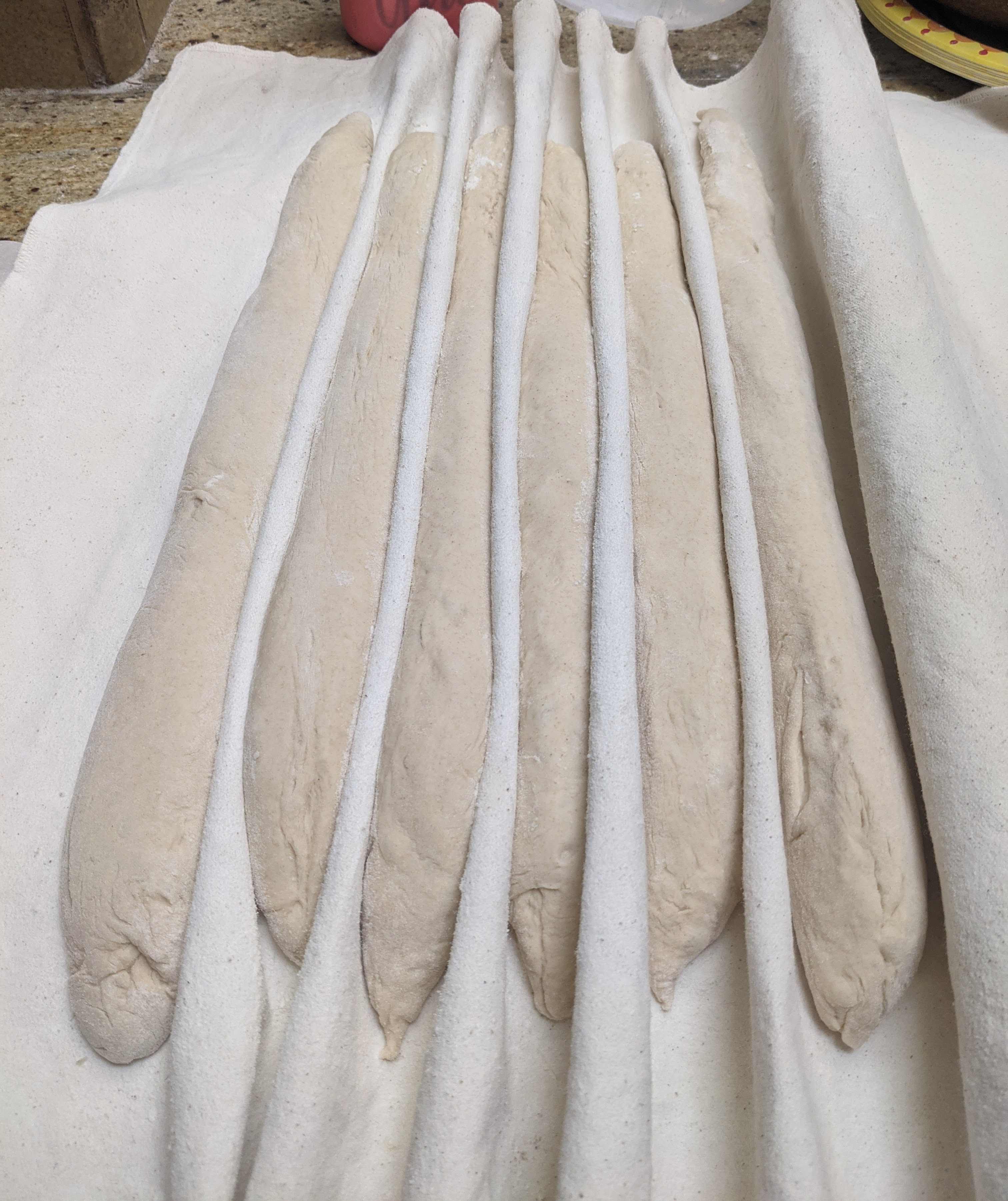
Divide and Shape. Pour the dough out onto a well-floured surface. With this wet dough, you want to be generous with the flour. I normally don’t recommend this, but this is a slack dough! Divide the dough into 400g pieces, then preshape into blunt, compact logs, rolling them up like jelly rolls. Rest the rolls for 20 minutes on a well-floured couche, seam-side-up. Once the rolls have sufficiently relaxed, shape them as you would baguettes, but be as gentle as possilbe when rolling them out – you want to shape and not degas. Place each shaped loaf seam-side-up onto a couche, providing a generous fold between each loaf to allow plenty of room for proofing.

Final Fermentation. 1 – 1 1/2 hour. Note: On warmer days, check the loaves after 30 minutes. This is a bread that I will take out to about 90% full-fermentation. It’s cutting it close, but the flavor development and bubble development in this last phase makes it worth the risk. Admittedly, the first few times I made this bread, I over-fermented the loaves and they came out pretty flat, but once I found the sweet spot – yowza! They were incredible!

Bake. Transfer the loaves to a loading peel and score as you would a baguette though perhaps not quite as deep. I personally don’t like pronounced ears on these fatties. 🙂 Bake at 500°F with steam for 12 minutes. Remove steaming container, then reduce oven temp to 425°F and bake for another 12-15 minutes or until the crust is a deep golden brown. You don’t want to take this bread out to chocolate as it will create too thick of a crust.

Notes:

  1. When shaping, even though you’re rolling the dough out with your hands to form a cylinder, do your best to not press too hard. Be firm, yet gentle in your motions and coax the dough into shape. Because it’s so wet and also due to the moderate gluten development, the dough will tear if you try to muscle it into shape.
  2. When scoring, be absolutely quick and assertive with your blade. It’s not necessary to create an ear and besides, even with a super sharp blade, with this slack of a dough, you won’t be able to dig in. After you score, don’t worry if the loaves appear to deflate. As long as you didn’t beat the shit out of them during shaping, they’ll pop right back up in the oven. 🙂

My Basic Daily Levain Bread

Though I make lots of different bread, this is my foundational sourdough formula. The flour in the levain represents 20% of the total flour in the formula. This gives me a lot of flexibility with how mellow or how sour I want the bread as I adjust the sourness by the length of the proof. If I want a sharper tang, I will retard the finished dough for up to 36 hours. If I want just a slight tang, I’ll do a same-day bake. As I mentioned, this is my foundational formula in that it provides a platform on which I will add different add-ins or just bake it plain. I love the versatility of this dough!

But not only that, because of the hydration of the dough, I’ve even made baguettes from this dough, adding 0.75% yeast in the final dough to give it some extra oomph during final proofing. Or, I’ve even added some sugar (about 3%) to the final dough to make rolls. Like I said… versatile!

Overall Formula

Bread Flour80%
High-Extraction Flour20%
Water75%*
Salt1.8%
*If I replace the high-extraction flour with whole-wheat flour, I will up the hydration to 77% and for baguettes, I will up the hydration to 76%.

Levain Build

Bread Flour100%
Water100%
Mature Starter20%

Final Dough

Bread Flour546g
High-Extraction Flour182g
Water500g
Salt16g
Levain364g
Total Yield1608g
Optimal Dough Temp78°F
This will yield two 800g loaves with a little to spare for loss and evaporation during dough development.

Make the Levain

Build a 100% hydration levain several hours before you build the final dough using some mature starter and equal parts flour and water (such as 1:5:5 ratio starter to flour and water). You’ll know the levain is ready when you see lots of bubbles on the surface of the culture – much like the bubbles that form with pancakes on griddle. This could take up to 12-16 hours to mature.

I personally use a mother culture that I keep in my fridge alongside a botanical water starter. The cool thing about using both my mother culture and the botanical water to build my starter is that the microbe density is so great, my levain is usually ready in less than 4 hours depending on the weather!

Final Dough Development

Mixing. Sift the flour and salt together and thoroughly combine. Dissolve the levain in water to make a slurry, then add it to flour-salt mixture, then mix thoroughly by hand or in a mixer on low speed until all ingredients have come together and you form a shaggy mass with no large lumps.

Bulk Fermentation: 2 1/2 to 3 hours (or more or less depending on the weather). Fold the dough twice within the first hour making sure you build good strength in the dough – it should fight you a little by the time you’re done folding. Then let it rest (covered) until it has almost doubled but don’t take it much further than that. You’ll want to leave plenty of runway for the final fermentation. For home bakers, I don’t recommend using the proof setting on your oven as it is normally too warm and things happen a bit too fast – at least for my liking.

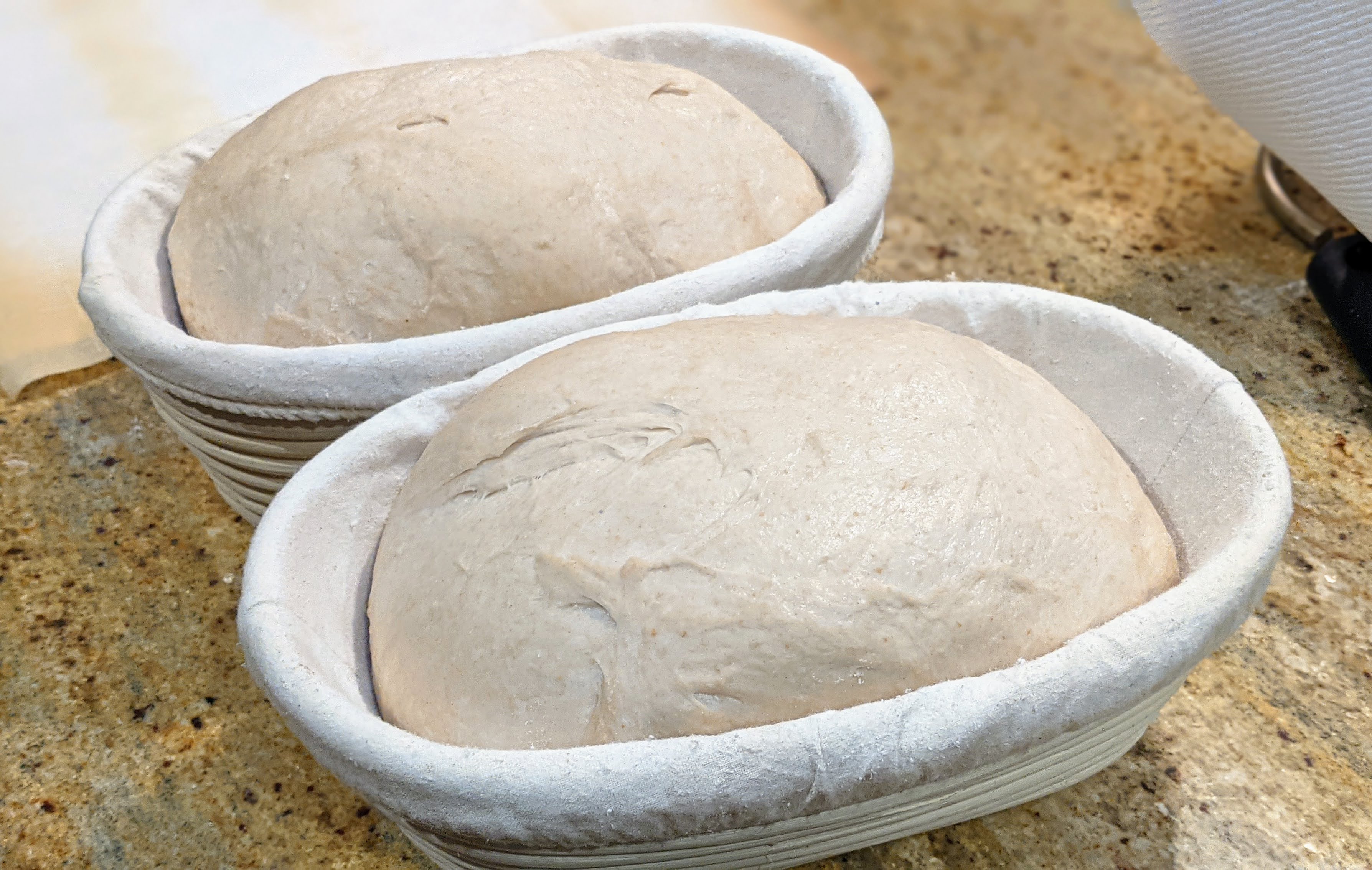
Dividing and Shaping. Divide the dough into 800g pieces then preshape into rounds then cover and bench rest seam-side-down for 15-20 minutes until the dough has sufficiently relaxed. Shape into boules or batards and place into appropriate proofing containers.

Final Fermenation. If you want to do a same-day bake, final fermentation should be about 1 1/2-2 hours depending on the weather. The finger dent test will tell you when the loaves are ready to bake. Otherwise, let the final fermentation get started for about 30 minutes, then cover the containers and pop them in the fridge. My last batch (shown in the pictures above) took about 30 hours to get to bake-ready. But whether you do a same-day or retarded proof, you really need to have patience in this step and allow the fermentation to get to 85-90% to ensure optimum flavor development.

Bake. Score your loaves as you see fit. I use a baking stone to kind of mimic a hearth, so I bake at 500°F for 15 minutes with steam, then 425°F dry using convection for 25-30 minutes until I get a milk chocolate-brown bottom and deep-golden brown top with dark chocolate edges on the ears. If you’re using a Dutch oven, preheat your oven to 500°F, then turn it down to 475°F. Bake covered for 20 minutes, then uncovered for another 20-30 depending on how dark you want the crust.

Make Your Baguettes LOOK Professional

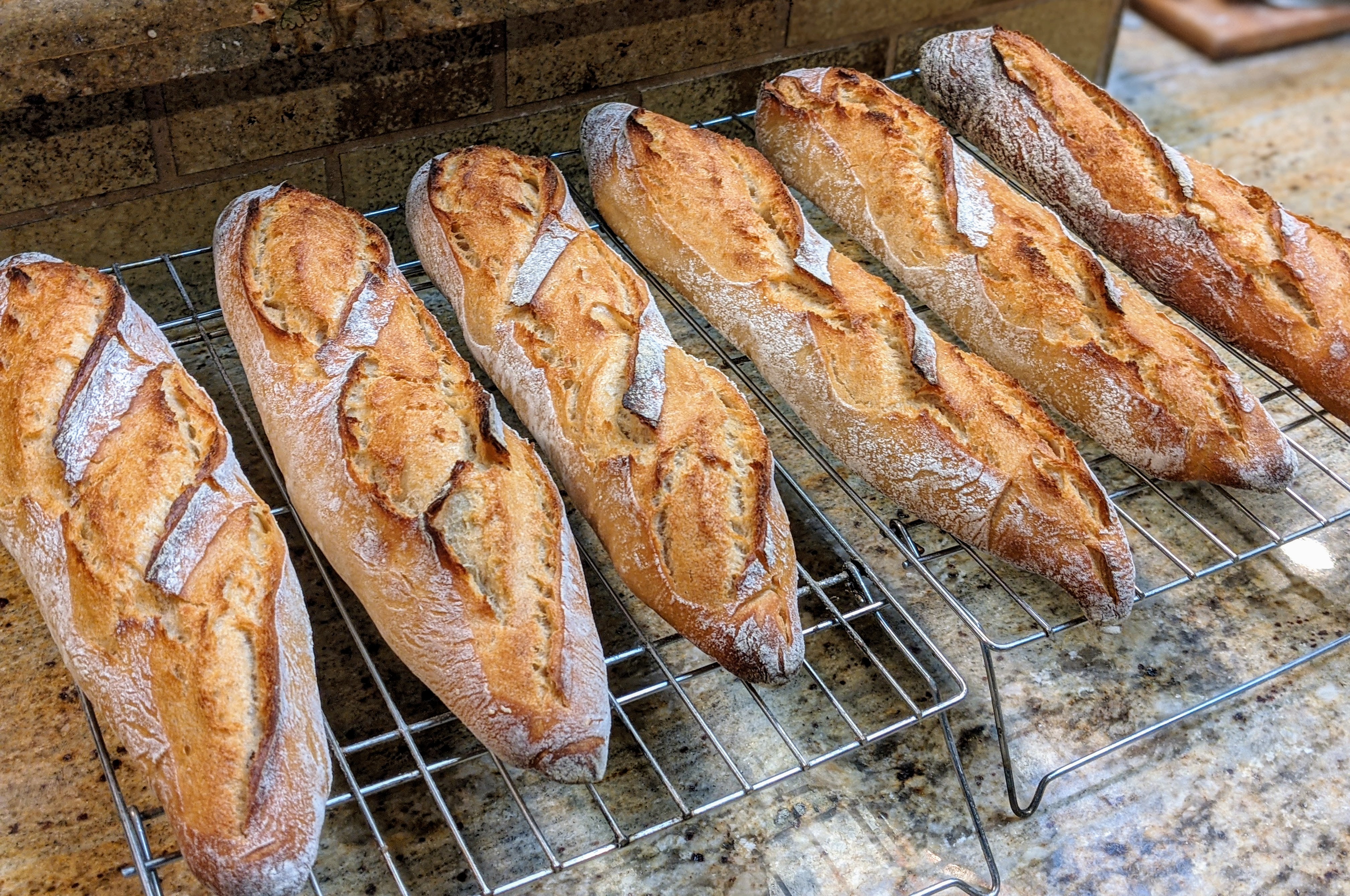
Demi-baguettes

One of the greatest compliments I ever received was from a friend’s mom who excitedly remarked when I brought her a few baguettes, “Wow! What bakery did you get these from?!” I told her they were from Dawg House Bakery. She replied, “Hmm… I’ve never heard of it,” to which I replied, “You’re looking at it and I’m the head baker.” She giggled then said, “They look SO professional!” She couldn’t have said anything nicer! But I did tell her that as with anything you build, if you have the right tools combined with good technique, it’s not hard to achieve a professional look.

Just to set things straight from the get-go, I’m not going to cover a recipe here or any dough development or shaping techniques. I’ve written lots of articles on making baguettes already. But what I am going to cover is what you do and what you need to have after you’ve done all the dough development and shaping; things that I’ve found tend to be glossed over in most articles – or even many books that I’ve read!

Tools

There are three critical items you’ll need: 1) A decent lame; 2) A baker’s couche; 3) A transfter/flip board. While I’ll discuss the importance of these items individually, you can purchase all of them at the San Francisco Baking Institute. The prices are fantastic – I wish I had known about their shop a lot earlier. I would’ve saved quite a bit of money.

Lame

I use a UFO lame from Wire Monkey (www.wiremonkey.com). But there are others out there that are far less expensive. A lame is essentially a mounted razor blade used to score loaves. More than any other bread, I’ve found this to be a critical tool for scoring baguettes.

Couche

You’ll read some articles that say you can use a large tea towel or a couche. I myself prefer a linen couche because I’ve found that it holds flour much better than a tea towel. It has become an invaluable tool for proofing long and free-form loaves.

Transfer Board

Out of all the three tools I’ve mentioned, a transfer board is the most important. With the lame and the couche, you can get away using alternatives, but having a tranfer board took my baguettes over the top. The reason is that I can flip the loaves onto the board at once, and not risk stretching or tearing my loaves.

Also, and perhaps even more importantly, I can use it to straighten my loaves once I’ve transferred them to my loading board. That’s a trick I learned from observing professional bakers. I was wondering how they straightened their loaves so nicely. I found that they do with a transfter board! For me, it was a total game-changer in the visual presentation quality of my baguettes.

If you don’t get the other two items, definitely get one of these. I made my own by cutting a sanded/finished quarter-inch birch plywood board to about 24″ X 5″. I used the remainder as my loading peel. With both, I regularly treat them with food-safe beeswax to keep them smooth and protected from moisture.

Properly Scoring Baguettes

I included this section in a previous article, but it deserved to be placed in this.

An earmark of a good-looking baguette is the scoring. It may or may not have ears, but it’s distinctive with what appear to be diagonal slashes across the top. When you’re new to making baguettes – this included me when I first started making them – there’s a mistaken belief with scoring that the loaves are scored in a diagonal fashion. Technically, they are, but not nearly at the extreme angles that many beginners score them. I’ve seen otherwise gorgeous, straight loaves online whose aesthetics were essentially ruined by improper scoring.

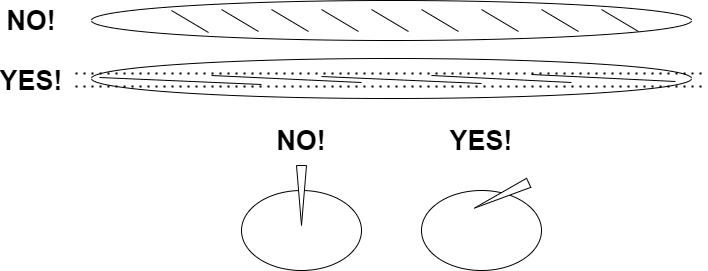
To be honest, there’s no big secret or special technique to score baguettes. Just remember this: Use shallow angles! The diagram below illustrates the angles you should be using:

In both the top and the cross-sectional views, the proper scoring and blade angles are much more shallow that what most might think. From the top, the lines are long, starting from the center of the loaf, and deflecting just a few degrees. The blade angle from the cross-section is absolutely critical as it creates a flap which will produce that distinctive ear that you see in the picture immediately above.

Especially with baguette scoring, you need to be assertive in your strokes. Avoid making choppy motions with your scoring and do your best to be as smooth as possible. Also, aesthetically – and according to Master Chef Jeffrey Hamelman – an odd number of scores is much more appealing to the eye than an even number.

As I mentioned above, with the right tools, getting that professional look is not at all that difficult to achieve!

Recipe: Roasted Garlic and Rosemary Sourdough

This is an absolutely wonderful bread that I learned to make from Jeffrey Hamelman’s book, “Bread.” The garlic, rosemary, and levain combine together to create an incredibly complex and delicious flavor profile that can be enjoyed alone, with a little butter, or as a dipping platform into olive oil or a savory sauce. It’s one of my family’s favorite kinds of bread that I make and a loaf never lasts more than a day – it’s that addictive.

When you see the formula, don’t be fooled by the low hyration rate. The mashed, roasted garlic and oil more than make up for the lack of water to make the dough more slack than its hydration will indicate. Also, you’ll notice that in addition to a levain, the formula calls for yeast. I will provide a short discussion on making the bread with little to no yeast.

Here’s the formula:

Baker’s %Example (g)
Flour100.00%713
Hydration %65.00%472
Salt2.00%18
Yeast0.90%8
Olive Oil5.00%45
Garlic7.00%62
Rosemary0.50%4
Stiff Levain40%285
Totals180.4%1608
Optimal Dough Temp75°F
Though I listed the levain as 40% in the formula, its flour represents 20% of the total flour in the recipe.

For the numbers that I provided, this will yield two 800g loaves with about 8g of extra dough for loss during processing.

Make the Stiff Levain

A stiff levain is simply a low-hydration levain. This one is 60% hydration. To make it, I just converted 100%-hydration mature starter culture to a 60% levain. I did this by taking 100g of mature culture, added 200g of flour and 100g water.

Hamelman says to do the final build of the levain 12 hours before making the final dough. However, in my case, my culture is extremely healthy and it literally almost tripled in volume in 3 hours! But I wasn’t prepared to bake late at night, so I just popped the levain in the fridge to completely slow it down.

Roast the Garlic

If you use whole bulbs of garlic, cut off 1/2″ from the top to expose the cloves then sprinkle olive oil on top to keep them moist, then wrap in foil. I normally just have loose cloves on hand, so I just measure out what I need then place them in some foil with a little olive oil. In either case, roast the garlic at 400°F for 30-40 minutes.

Mix the Final Dough

Once the garlic has cooled, mash it and set it aside. Measure out the amount of levain you’ll need, then in your mixing bowl, break it up into the water until it’s fully dissolved. If you’re using a stand mixer, just use the dough hook on the 2 speed.

Once you’ve created a smooth slurry with the levain and water, add all the ingredients together and mix until everything is incorporated forming a shaggy mass that has both the garlic and rosemary reasonably evenly distributed.

For this small amount of dough, I just mix by hand using a Danish dough whisk. It saves me from having to clean my mixer. 🙂

Bulk Ferment

Hamelman says bulk fermentation is 1-2 hours. But in my experience – at least in my kitchen – it takes more like 2-3 hours. In any case, after an hour, give the dough a fold. Personally, I’ve found it valuable to gently knead the dough in the bowl at this point, being careful not to tear it while I press into the dough.

Let rise until nearly doubled. This may take a little while, especially on a cool day.

Divide and Shape

Having made this bread many times, I’ve found that the optimal scaling weight for these loaves is 800g. This will produce loaves with a finished baked weight of approximately 1 1/2 pounds. After scaling, pre-shape into rounds and bench rest the balls for 20-30 minutes until the dough has sufficiently relaxed.

Final Fermenation

Shape the loaves into boules or batards. At this point, you have a couple of alternatives:

  1. Ferment at room temp for 1 – 1 1/2 hours (or until they pass the finger dent test).
  2. Rest for 20-30 minutes, then pop them in the fridge for 8-12 hours.

The second option is more of a timing thing rather than a flavor development thing. The garlic and rosemary are already intensely flavorful and the a long rest, while allowing for the development of organic acids will not have that much of an affect on the overall flavor. So I just normally bake the loaves the same day I make the final dough.

Bake

Hamelman recommends baking the loaves at 460°F under normal steam for 30-40 minutes. But I just bake the loaves the same way I bake boules and batards at 500°F for 20 minutes with steam, then 425°F for 25-30 convection. If you’re using a Dutch oven, just bake the loaves as you normally would for boules and batards.

Cool for at least 3 hours before cutting!

Pure Sourdough Method

If you don’t want to use commercial yeast, things will take a much longer time. At 65% hydration, fermentation will take a while – at least twice as long. To be honest, I don’t have exact timings on this because they vary based on the weather. But in general, I’ve found that it takes double the time. Your best bet is to use standard telltales (windowpain, finger dent tests, etc.).

I know that’s not much instruction, but truth be told, this is a bit more advanced of a recipe than just simple sourdough or straight dough, which is why I didn’t include my normal step-by-step instructions. I’ve assumed a certain experience in baking.

A Bit More Sour Sourdough Baguette

I know, I know… I have several baguette recipes on here already. Despite that, I mostly use one dough development method no matter the type of baguette I happen to be making: pointage en bac, or the slow rise method, and I only vary it by the type of leavening agent I use. And whether I use yeast or starter, the process is exactly the same.

Of course, there is the exception (when isn’t there) of Baguettes de Tradition which is a straight-dough, same-day bake with no preferment. But I don’t make those too often and only when I’m pressed for time.

As for all the different recipes I have for baguettes, I’ve always been compelled to experiment. In Jeffrey Hamelman’s book, Bread, he has several recipes for baguettes and I’ve baked them all and shared those recipes here. But for my own baguettes, I riff on the original method I learned from Master Chef Markus Farbinger. It’s straight-forward and invariably yields me GREAT results.

Historically, baguettes were developed as a welcome change from sour breads. Leading up to the creation of the baguette – and other bread made with commercial yeast – all bread was sour because they were risen with natural starters. And we’re talking centuries here, folks! Baguettes offered up a different flavor profile; frankly, a neutral one, and based on the popularity of baguettes through the years, it was a welcome change.

Technically, there’s nothing wrong with making baguettes from sourdough starter as the French Decrét Pain states – however vaguely – that bread must be risen with a leavening agent suitable for bread. But, given how parochial the French are about food, using a natural starter isn’t quite de riguer.

Plus, the whole purpose behind the baguette was to create a neutral flavor platform, and sourdough is anything but neutral – and here I have to agree with the French: A baguette isn’t defined by its shape, but by its dough. But that doesn’t mean that you can’t do it, and dammit! These “baguettes” taste great!

Now the interesting thing about these baguettes is that the acid in the starter acts as both a dough conditioner and a preservative. Even after a couple days, the crumb is still supple and pliable – even if left in the open at room temp!

So here’s the basic formula for the baguettes:

Baker’s %Example
Flour*100%644
Water76%462
Salt1.8%14
Yeast0.07%.53
Preferment35%227
Optimal Dough Temp75°-78°FYield: 1346
*I use a blend of flour which is basically 40% unbleached high-extaction flour and 60% AP flour.

I deliberately used the word preferment instead of sourdough starter or levain because you can use a poolish for this formula as well, which I have done. But for this discussion, we’ll focus on a levain.

Using the example numbers above, this will yield 4 baguettes scaled at 335g apiece, leaving a few extra grams of dough for loss during processing, which almost always happens, so I always calculate a few grams more than I actually need so I can scale my loaves to the exact weight I want them.

Make the Levain

Though I listed the levain as being 35% of the flour, I need to clarify where I got this number. I didn’t just pull it out of thin air. Assuming I’m using a 100% hydration levain, it turns out that if the flour of the levain represents 15% of the total flour of the recipe, the levain’s total weight comes out to be just a smal fraction over 35% of the flour weight.

I factor in the flour of the levain as part of the overall flour because a levain is simply part of the overall dough development. I do this to calculate my yield as I now bake according to the amount of dough I need for a particular bake. This keeps my loaf weights absolutely consistent.

In any case, using a mature starter, make a liquid (100% hydration) levain (like a 1:3:3 or 1:5:5) and let it activate until it passes the float test. I’m not putting a time on this because it can vary wildly based on the microbe density in starters. For example, when I make a levain using botanical starter water and a mother I maintain based on the botanical starter, my levain will be ready in about 3 hours. And it’s super-active.

Make the Dough

  1. Dissolve the levain and yeast in the water. The water should be at the appropriate temp to get the dough to the optimal temp. At this time of the year, that’ll probably be around 90°-95°F.
    1. You can actually eliminate the yeast altogether. The resultant bread will be a bit more chewy. And depending on how long you let it ferment, the acid in the dough will keep the crust lighter in color.
  2. Add the salt to the flour and mix well, then gradually add the liquid to the flour and mix until you form a shaggy mass with no dry ingredients.
  3. Scrape down the sides of your mixing bowl and let the dough rest.
  4. Initial Fermentation: 1 1/2 hour. During this first hour, fold the dough every 30 minutes, making sure to pay attention to building up the gluten. After the second fold, rest the dough for another 30 minutes, cover and put in the fridge for 12-16 hours, or until the dough has at least doubled in size. For the sourdough baguettes, the dough may seem a bit slack. This is due to the acid in the starter which breaks down gluten.
  5. FROM THIS POINT ON, BE ABSOLUTELY GENTLE WITH THE DOUGH!
  6. Divide and scale the dough. For demi-baguettes, weight should be around 250g. I make 20″ baguettes scaled at 335g. Roll each piece up like a jelly roll and rest for 30 minutes seam-side-up on a well-floured couche or tea towel.
  7. Preheat your oven to 500°F.
  8. Once the dough has relaxed sufficiently (it’s normally 20-30 minutes for me, but sometimes it takes longer if I pre-shaped them tight, remove the pieces from the couche and place on a well-floured surface, then shape into baguettes, moving them back to the couche to do their final fermentation from 30-60 minutes. This step is important. You want to do a finger-dent test after 30 minutes. If it’s still really springy; that is, your dent essentially disappears right away, let it go another 20-30 minutes. But if your dent springs back quickly but some of it still remains, it’s ready to bake. Note that that partial spring is ultra-important. That means that there’s still life in yeast.
  9. Score the loaves (see below).
  10. Bake with steam at 500°F for 12 minutes, then 12-15 more minutes at 450°F dry.

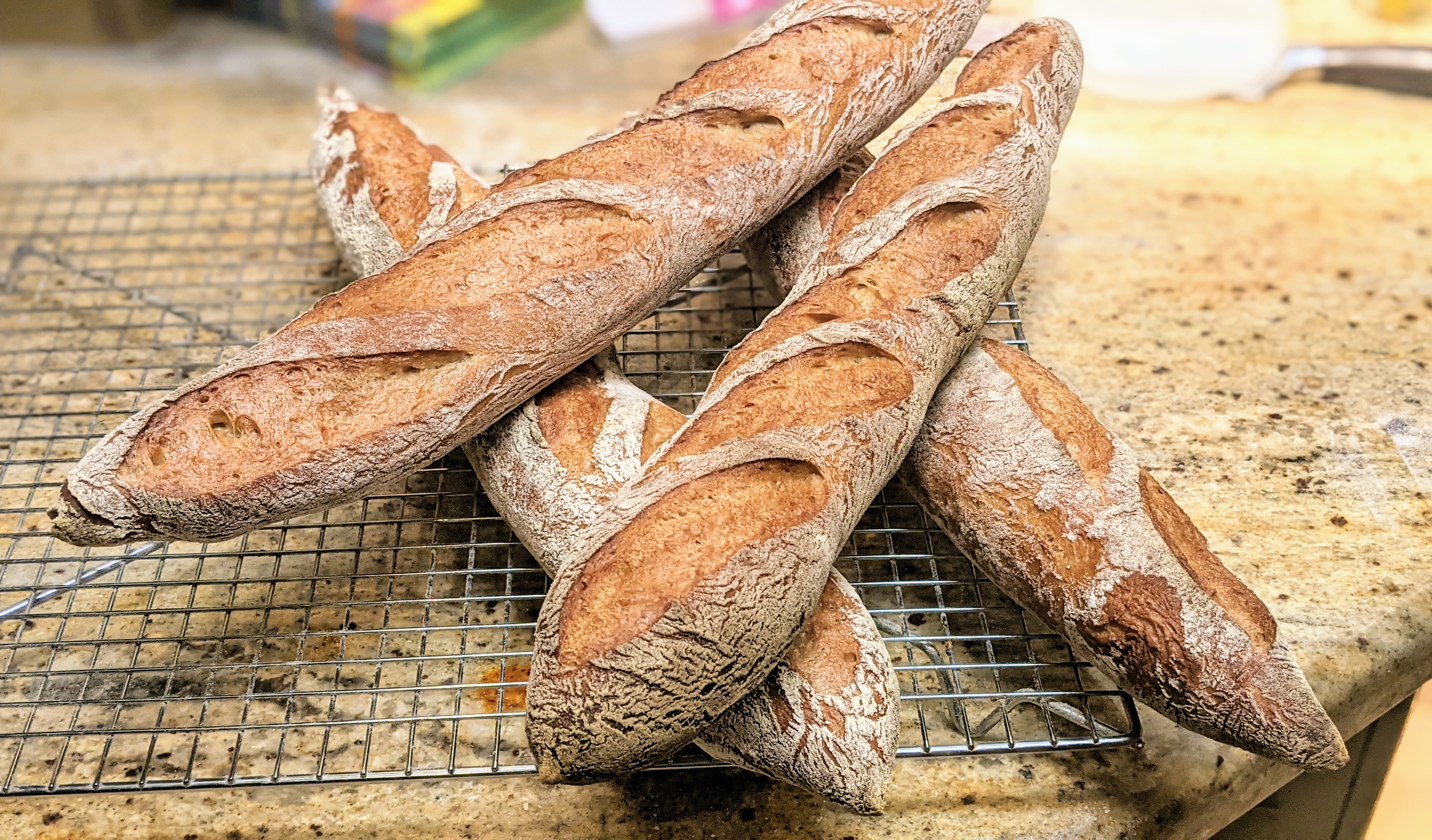
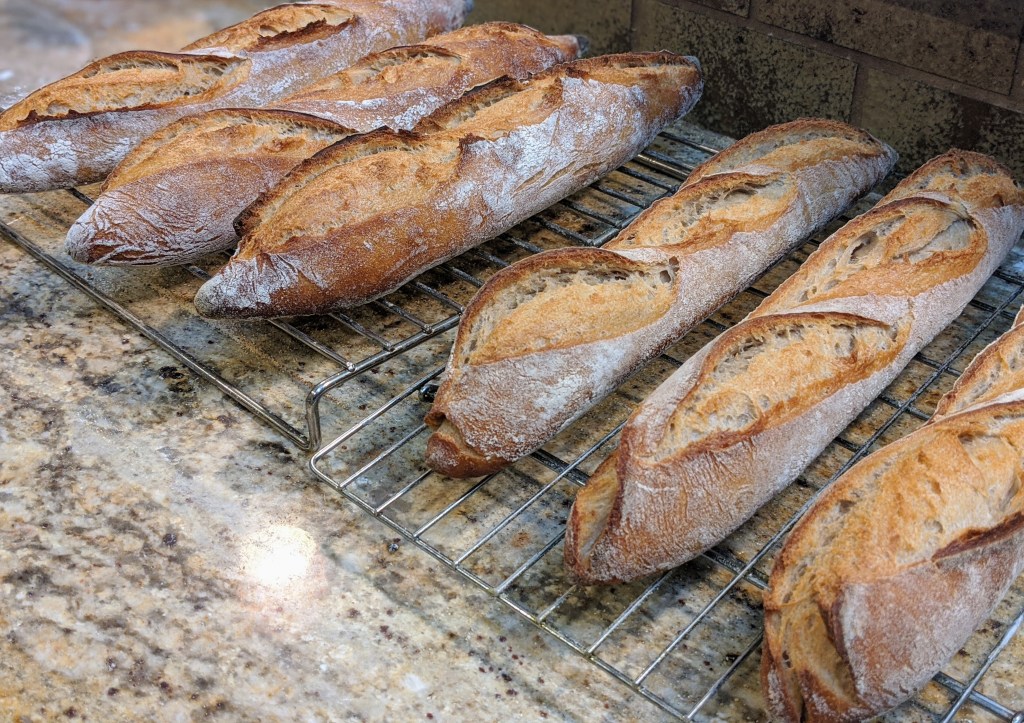
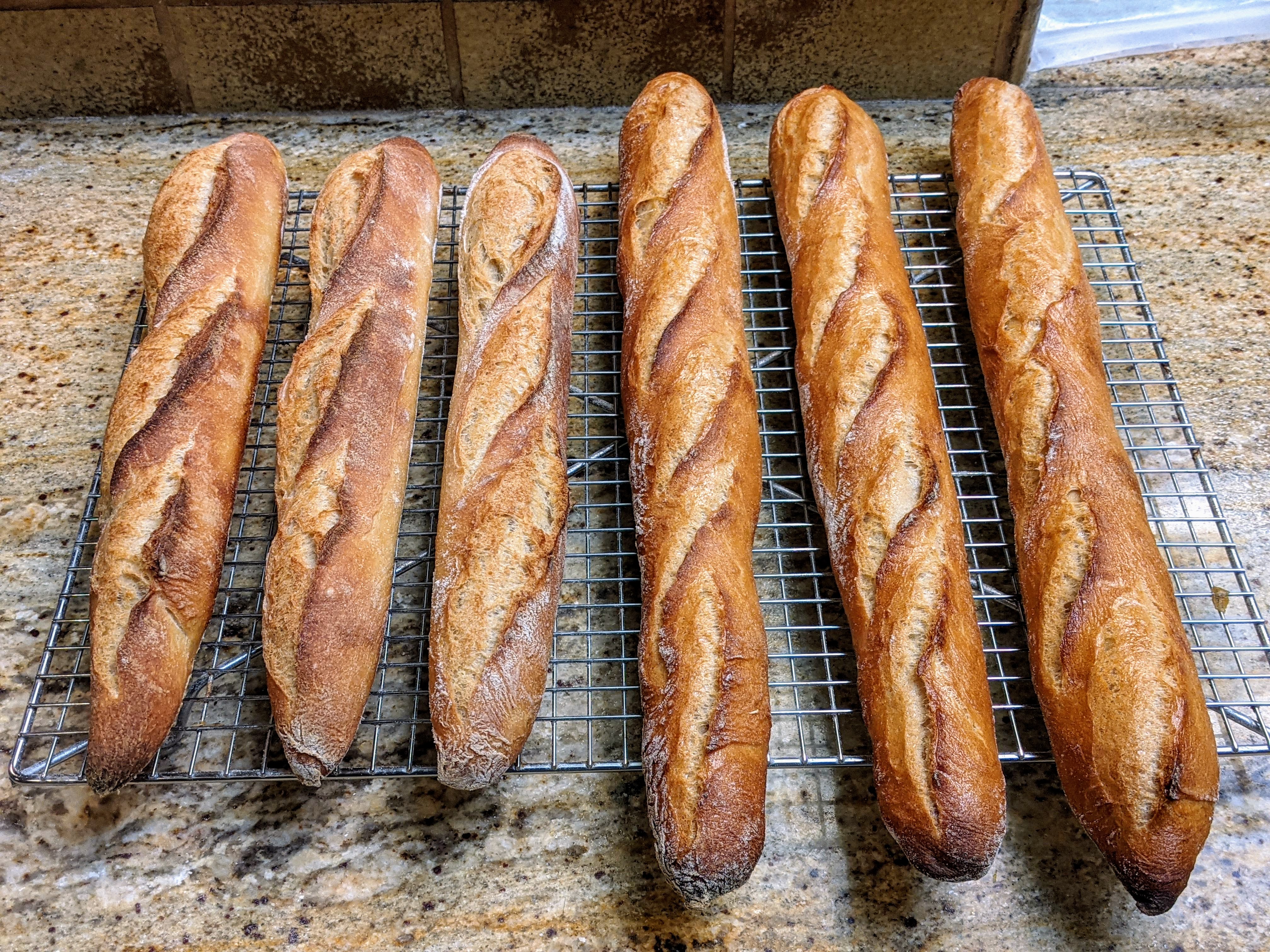
These baguettes really benefit from a full bake to ensure a nice, crisp crust. I’m not a big believer in taking the crust out to chocolate as I do with my boules and batards. But a deep, golden-brown like the loaves above yields a delicious crust.

If you’ve baked traditional baguettes, you’ll immediately notice that once you bake these, the sourdough crust will not get as dark within the given times. You could bake them longer to get a darker crust, but you just might dry out the insides if you bake them for too long. I have a feeling that it has a lot to do with the amount acid in the starter which, at least for my very sour starter, is a clear indicator that there wasn’t much available sugar for browning.

But the other thing about these baguettes is that they stay fresh longer because of that acid. While they won’t remain as crisp as long as traditional baguettes, they will continue to be pliable for several days after the bake!

Scoring Baguettes

When you’re new to making baguettes – this included me when I first started making them – there’s a mistaken belief with scoring that the loaves are scored in a diagonal fashion. Technically, they are, but not nearly at the extreme angles that many beginners score them. I’ve seen otherwise gorgeous, straight loaves online whose aesthetics were essentially ruined by improper scoring.

To be honest, there’s no big secret or special technique to score baguettes. Just remember this: Use shallow angles! The diagram below illustrates the angles you should be using:

In both the top and the cross-sectional views, the proper scoring and blade angles are much more shallow that what most might think. From the top, the lines are long, starting from the center of the loaf, and deflecting just a few degrees. The blade angle from the cross-section is absolutely critical as it creates a flap which will produce that distinctive ear that you see in the picture immediately above.

Especially with baguette scoring, you need to be assertive in your strokes. Avoid making choppy motions with your scoring and do your best to be as smooth as possible. Also, aesthetically – and according to Master Chef Jeffrey Hamelman – an odd number of scores is much more appealing to the eye than an even number.

Why Haven’t I Gotten One of These Until Now?!!

After waffling on getting a Danish dough whisk, I finally pulled the trigger on one yesterday and it landed on my doorstep this afternoon. To be honest, I thought it was just a bit of a gimmick, but now that I’ve got one and having used it to mix up a batch of baguette dough for tomorrow, I’m kicking myself!

It’s truly an ingenious contraption. The large loop acts as a scraper and lifts the flour up, while the inner loop and its smaller loops and their “arms” break up lumps and provide the mixing action. And this simple-looking contraption makes absolute quick work of mixing dough and not only that, where using a scraper or my hand to mix, I’d invariably catch some flour in a scooping motion and it would fly out of the bowl and onto the counter – or my clothes! But this didn’t happen once while I used this whisk to mix my dough and I was being fairly vigorous.

The one I got was a larger one: About 13″ in total length. I’ve seen some smaller ones, but I can see how this will work great with a variety of dough amounts. This really is one of those things that look like it shouldn’t work, but it just does.

And why I waited so long to get one is beyond me… No more dough-covered hands! Full stop.

You Gotta Love Happy Accidents

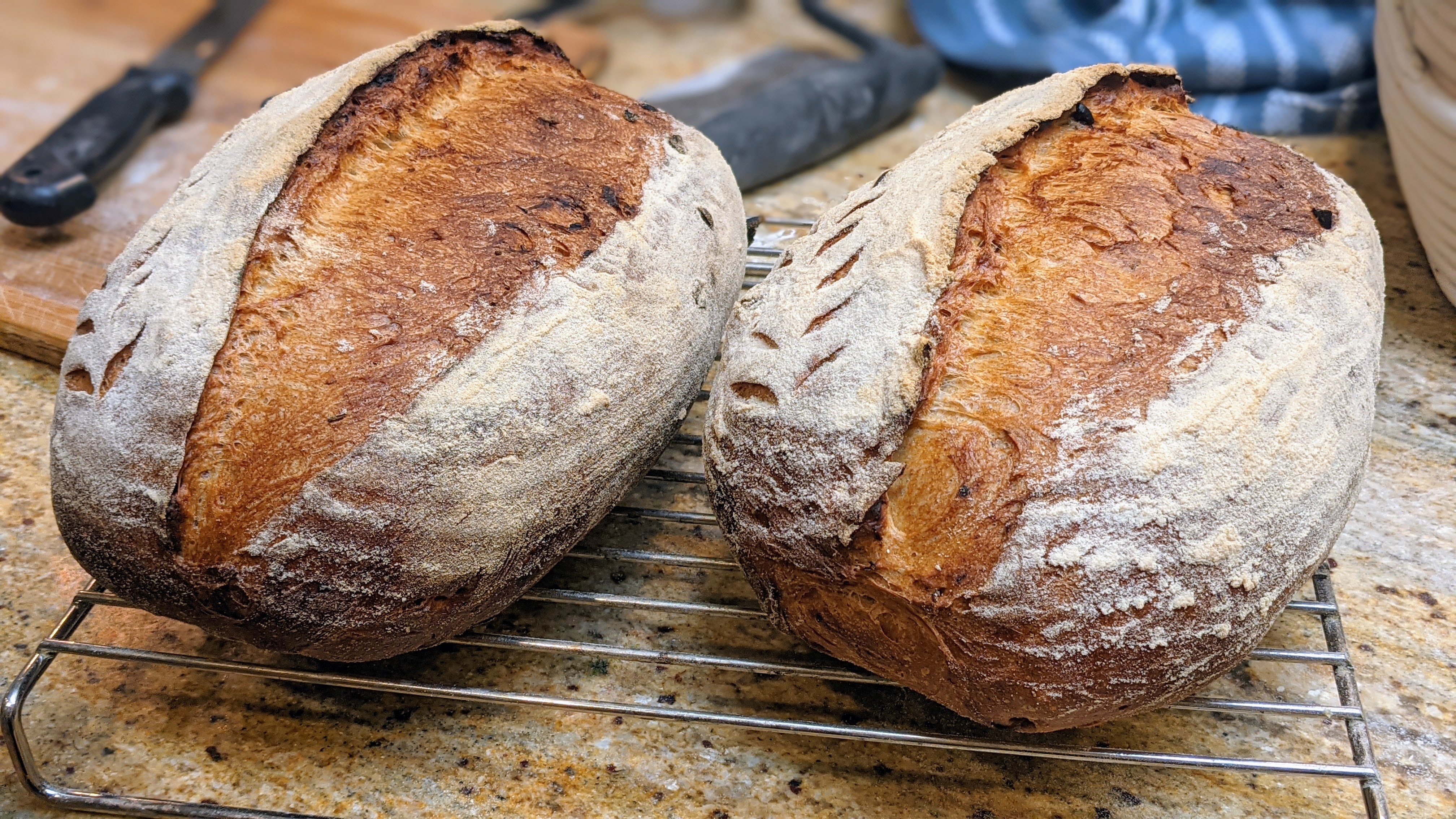
Shown above are the remnants of my latest bake. I made three batches of dough yesterday for baguettes, 3 rustic sourdough loaves and two Poillane-style “hugs,” which are the two loaves in front. They’re about a foot in diameter!

The first two dough batches went without incident, but when it came to the hugs, while the dough was mixing, I noticed that it wasn’t coming off the sides. Then I realized that I used the wrong calculation for water! I used way too much for that formulation and the dough – if you could call it that – was like a thick pancake batter.

Now I could’ve added flour to thicken the dough to the right consistency. But to tell the truth, that has never worked out very well for me. So I decided to go with it and challenge myself to work with a super-high hydration dough. By my calculation, the hydration only got bumped up to 80%. But because the flour blend I used was 60% AP flour, it felt more like the consistency of an 85%+ hydration dough. So given that, I knew that developing the gluten was going to make or break that bake.

Initially, I resolved to employ a 6-fold folding schedule over three hours ala Tartine. But after the first fold, which was more like running my hands through batter, I realized that I’d probably have to do more folding sessions. In the end, I only had to fold the dough 8 times over the course of three hours, doing the last four folds in 20-minute intervals for the back half of the three hours. I then let the dough rest for another hour to let the starter yeasts do their thing, then I popped my container into the fridge for an overnight rest.

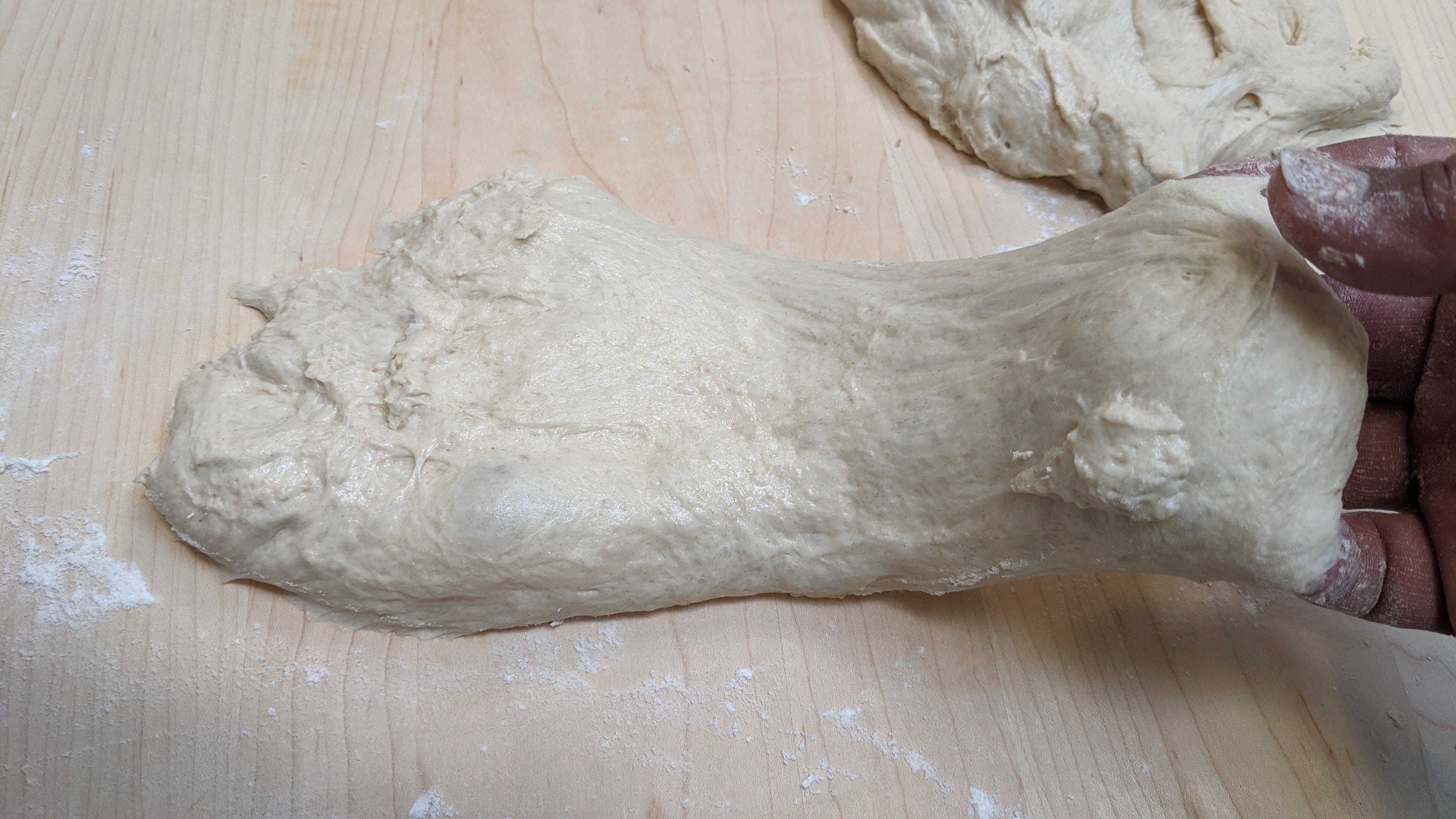
What was truly amazing was witnessing first-hand the dough transform from a batter to a well-formed, well-structured dough! As I performed my folding sessions, I could feel how the gluten was developing. At this hydration, it was never going to be stiff, but I could tell that it was strong by the time I finished the last fold. I was able to stretch the dough with the window-pane test with nary a tear!

Twelve hours later, I removed the dough from my retarder fridge and saw that it had more than doubled, with nice, large pockets of fermentation. Preshaping was a bit of a challenge because the yeast was pretty active as you can see in the photo below.

But what was truly incredible was how the dough balls maintained their structure while they rested. Yes, they spread out a bit, which was to be expected, but they didn’t become pancakes. Mind you, with the dough being predominantly AP flour, had I not spent that time developing the gluten, they would’ve collapsed easily.

I could tell that I was getting close to full fermentation, so I did a cold final fermentation for another 4 hours. I’m glad I did this because had I let the final fermentation go at room temperature, I would definitely over-ferment the loaves. In the end, the loaves were very close to full fermentation, but despite that, I still got pretty good oven spring.

The thing that concerned me the most was with the size of the loaves – which I knew would bake out to about a foot in diameter – was that at that hydration, they’d collapse under their own weight. And within the first few minutes of baking, I was horrified to see how they had pancaked out on my stone. But I trusted the steam to do its work and the yeasts to play out – besides, at that point, what the hell could I do?

But the loaves sprung up nicely despite my initial concerns and while I wasn’t expecting a super-open crumb with huge holes, the crumb opened up nicely; looking very much like a Poillane-style loaf inside.

As far as taste is concerned, these loaves are nicely sour, though not overpoweringly so, despite the starter being about 35% of the final dough flour. The crust is thin and crispy and the crumb is light, chewy and moist. With 40% of the flour being a mix of white whole wheat and high-extraction flour, you can taste the nuttiness of the grain as well. Overall, this is a flavor profile that I really enjoy.

So… all in all,

Here’s the original formula, in case you’re curious:

Baker’s %Example (g)
Flour100%1153
Water76%828*
Salt1.8%24
Starter35%407
Total2412
*The “mistake” I made was that I used 928g of water that pushed hydration over 80%. Damn! I wasn’t even drunk! 🙂 Even for experienced bakers, that hydration level with AP flour is a real challenge!

I know… 2412 seems like a weird number, but I always add a process loss fudge factor of 1% to my calculations because I know that I’ll lose dough in the process. My idea was to be able to scale out 1200g portions. With this particular bake, I only lost 4 grams, so the portions were 1204g apiece.

For folding, as I mentioned above, I did 8 folds in a 3-hour period. Because the dough was so delicate, I did nothing but coil folds. But as opposed to folding one side, turning 90-degrees, then doing the other side and letting it rest after that, I’d coil fold at least 3 times, carefully stretching the dough. After the final folding session, the dough held up quite nicely. I knew it was going to spread out eventually, but it more or less held its shape for several minutes. It was a real feel thing.

Luckily for me, the loaves turned out great. It truly was a happy accident!

I Love Baking with Kamut Flour!

I love working with ancient grain flour. To me, there’s a certain romance to working with grain that bread makers have used for thousands of years. To think that I’d be working with flour made from grain that bakers from ancient civilizations used makes my mind wander back to those ancient times and what it would have been like to bake back then.

Kamut, which is the commercial name for Khorasan wheat is an ancient grain that I discovered several months, but with which I only started recently baking. Its exact origin is unclear, but it is named after a historical area called “Khorasan” which was a region in what is known as the Fertile Crescent in the Middle East. The predominant civilizations that occupied that area were the Mesopotamians and Sumerians. If they were cultivating and using that grain, we’re talking about a grain that was used thousands of years ago! And we’re talking about 5,000+ years ago. I don’t know about you, but to me at least, that’s incredibly exciting!

But other than the romanticism I’ve assigned to the grain, baking with Kamut flour is incredible. Similar to durum flour, it absorbs water slowly, so it requires an autolyse period. And like durum flour, once hydrated, it forms a luxurious, highly pliable dough. And again, like durum or other whole grain flour, it absorbs a lot of water. Most of the bread I make with it is in the 78-82% hydration rate range. Even at those levels, the dough is very workable and not too tacky.

Interestingly enough, Kamut has a lower protein content than durum and whole wheat. The Kamut flour I use from Azure Standard, is rated at 11.7% protein, which is along the lines of King Arthur or Bob’s AP flour. So I often mix it with a little vital wheat gluten to get the protein content to around 14%. The reason for this is that even though it is milled to a super-smooth consistency, it still is a whole grain and will tend to cut the gluten strands. Admittedly, I’m still experimenting with how much vital wheat gluten I add.

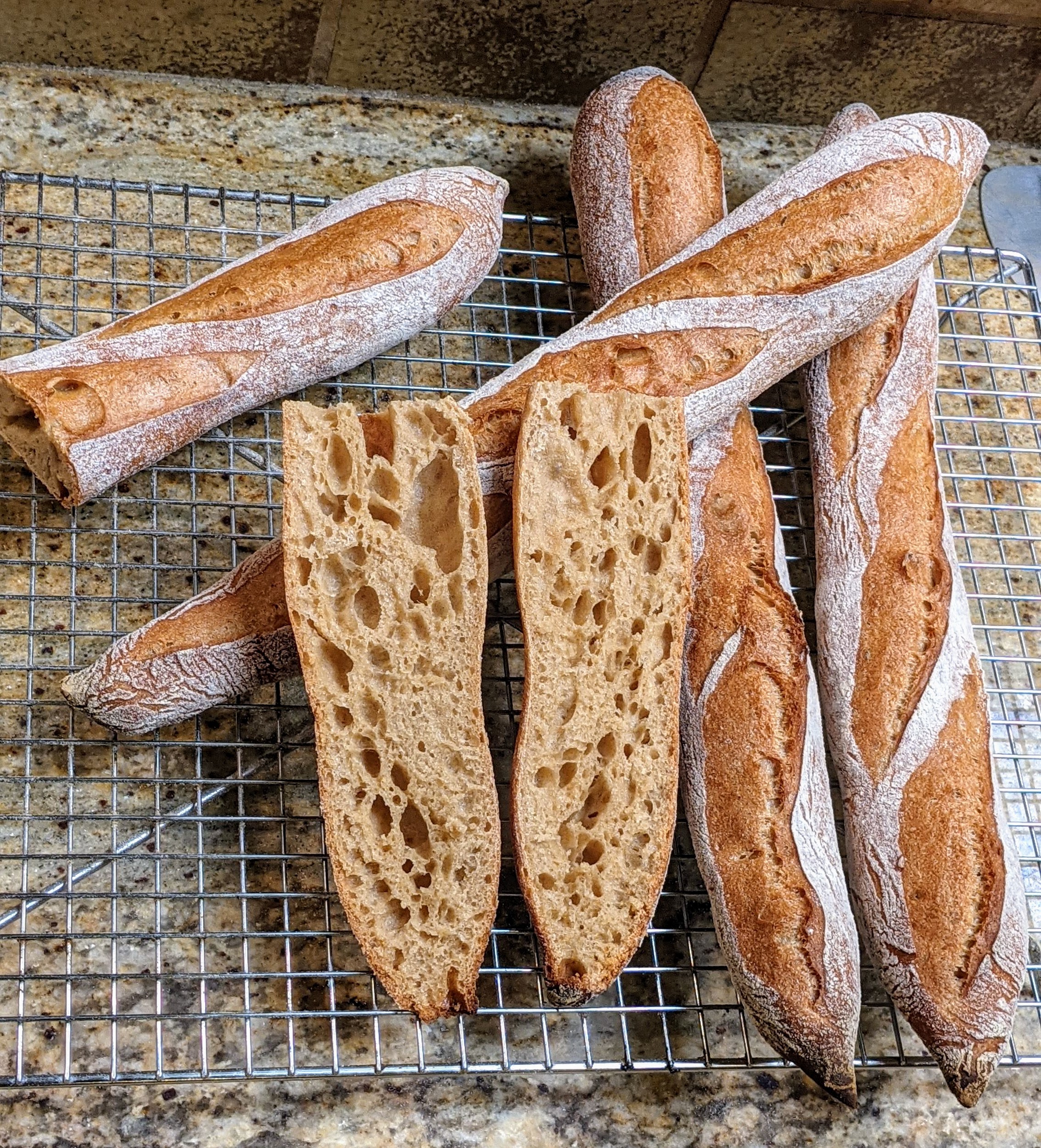
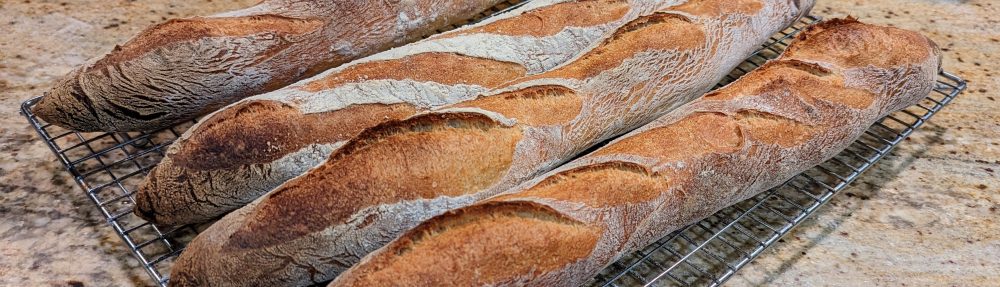
As far as baking is concerned, see the loaves in the picture above? They were all made with 40% Kamut flour. The baguettes used 20% high-extraction and 40% AP Flour, whereas the batards used 10% whole wheat (from the starter), 30% high-extraction, and 20% AP Flour. For the batards, with that much bran in the dough, I wasn’t expecting large holes. But look at the oven spring of those loaves! It’s absolutely incredible. The batards exploded in the oven. The crumb, though not possessed of big holes was still really light and airy. And the texture – OMG, the texture – was absolutely fabulous!

And don’t get me started on the taste. Kamut flour adds a slight sweetness and a definite nuttiness to the flavor of the bread. Even though it’s whole grain flour, you don’t get that grain-forward taste. The taste is akin to macadamia nuts, and it’s addictive. I gave one of the loaves to a friend who brought it over to her aunt’s for a small luncheon. The ladies loved it so much they ate over half of it at lunchtime, then according to my friend, they polished it off at dinner. That loave was not small, weighing in at over 2 1/2 pounds.

It also helped that the sourdough was made from a nectarine botanical starter I had just cultivated. The fruity notes in the starter definitely integrated well Kamut’s nuttiness. Even my family who has gotten pretty used to having artisan bread around loved that loaf. Many sandwiches and avocado toasts were made.

Along with durum, Kamut flour will most likely be a regular blending flour for me. Technically, I could do 100% Kamut, but it’s relatively expensive at $1.57/pound. Contrast that to Durum, which is $0.94/pound. I’ve got to stretch it to make it last. Plus, I can only get it in 25-lb bags, which is a bummer. I’d love to be able to get 50-lb bags. But Kamut has limited cultivation in the US, so it’s definitely not as available as other flour.

I’m so glad I discovered Kamut. Like I said, It’ll be part of my regular flour blend from here on out!

Still Splitting Hairs

In my previous post, I quoted the following originally from a New York Times article:

Mitchell Davis of the Beard Foundation believes that the bagel, like ketchup, is a product ill served by current food trends. ‘‘The effect of artisanship does not always produce a better result…’

While that article focused on bagels, the same can be applied to bread. Having done a real deep-dive into ancient bread making techniques over the last several months, I’ve developed a sensitivity to innovating too much. As I mentioned in my article, when I bake bread based on traditional recipes, I do my best to stick to the traditional ingredients and techniques.

Take, for instance, the humble baguette. While technically, it has only been recognized as a specific loaf called a “baguette” for only a couple of hundred years, it is steeped in a tradition of French long loaves that date back a few hundred years. And in 1993, the French government ratified into law (known as the Décret Pain) the ingredients that define the class “pain de tradition Française” of which baguettes are a part, as being made of flour, water, salt, and yeast.

That said, there is a little grey area with the leavening agent as Article 2, Section 2 states:

Fermented with yeast suitable for breads (Saccharomyces cerevisiae) and a starter, in the sense of article 4 of this Decree, or either yeast or a starter;

That kind of opens the door to using a sourdough starter to leaven the bread. But the general interpretation of a “starter” seems to be more along the lines of using a poolish, which is a yeasted starter.

Now, why does this even matter to me at all? Simply because what I’ve learned about baguettes is that they’re not defined by their shape, but by their dough. I know, you see a long, thin loaf of bread with diagonal scoring along the length, and you immediately say, “baguette.” And I suppose that to the consumer, it doesn’t matter. But now, when I see “sour” or “sourdough” preceding “baguette,” I know, based on my research, that loaf is technically “pain au levain” or bread risen with a levain.

Furthermore, circling back to “the effect of artisanship does not always produce a better product,” I’ve often found myself innovating for innovation’s sake. It’s not that the end product is bad by any means. But at least for me now, when I call a certain bread a particular type, I want to make sure that I’m not coloring outside the lines.

One of the things I was concerned about when making my baguettes was the mix of flours I was using. I typically use a combination of 60% high-extraction flour and 40% AP flour – both unbleached, so the crumb of my bread tends to be on the brown side. Luckily, the Decret Pain states in Article 2, Section 1:

Made only from a mix of wheat flours suitable for making bread, safe water and cooking salt.

I admit that I’m being a bit parochial. It’s actually a little out of character for me to so strictly observe tradition. If you knew me as a contemporary Catholic liturgical musician, you’d know that I’m not much of a traditionalist. Even in my career as a software engineer, I forged my path in technology as a visionary and innovator.

But with bread, it’s a completely different story. Don’t get me wrong, I have a few different types of bread that I make that are innovations on traditional recipes. But when it comes to making traditional bread, I’m pretty parochial. I have a real “if it ain’t broke, don’t fix it” attitude.

Some might say it’s limiting. But there’s a lot to be said about mastering the traditional techniques. As I journey forward in bread making (and yes, I have aspirations of eventually doing this professionally), I want to make sure that my technique is steeped in tradition.

Plus, some of the techniques are just downright difficult to master. Take the ancient Italian bread, Pane di Altamura, for instance (shown to the left). This is 100% durum wheat bread from the Altamura region of Italy. It is a very distinct-looking loaf, sporting a pompadour of sorts. The dough itself, like pretty much all Italian bread, is uncomplicated, as is the dough processing. But learning to shape that bread is a different story altogether. It has taken me several bakes to even approach what it should look like.

There are no instructional videos that teach how to shape Pane di Altamura, so I’ve had to watch slowed-down videos, of which there aren’t very many. And though the bread is distinguished by the region where it comes from, different bakers achieve the pompadour in slightly different ways. But luckily I did run across a video that had a close-up view of how one baker shapes his bread and I’ve been using that.

The point to this is that with this particular bread, there’s really no room for innovation. I suppose I could eventually tweak things here and there, but before I can do that, I need to master the basics first.

Speaking of tweaking, a few months ago I had a realization that I got to the point where I was innovating so much that I wasn’t getting consistent results. I was making tweaks everywhere. But it wasn’t until I stopped myself and stuck with a method that I started getting consistent results.

This was evident in my baguettes. I was trying a lot of different techniques and my results, while tasty, weren’t consistent at all. I now focus on two production methods depending on when I want to bake. I use a pointage en bac or slow rise method for flavor development that I learned from Chef Markus Farbinger (which is also my normal two-day method) or, if I want a same-day bake and a more grain-forward taste, I use the baguettes de tradition method that Jeffrey Hamelman presents in his book “Bread.”

But in both cases, I use the same shaping technique that I learned from Chef Farbinger. Now, no matter what dough development technique I use, my baguettes come out looking the same. It’s comforting because as simple as the ingredients are in baguettes, they’re probably the most challenging bread to get right. And shaping is absolutely critical, which is why I use the same technique for both dough production methods. Besides, if it’s good for a master chef, it’s certainly good for me. 🙂

Don’t get me wrong. I’m not at all against innovation. But as with anything in life, you have to be well-versed in the foundational aspects of different bread before you can branch out. But here in America, it’s almost expected to “do your own thing” and there’s this seemingly pervasive attitude to innovate for innovation’s sake. And I think that’s where many people run into the proverbial brick wall or worse – they come up with some pretty funky creations (the funkiest I’ve seen are blue croissants).

At least for me, I do heed those words Mitchell Davis wrote: The effect of artisanship does not always produce a better result.