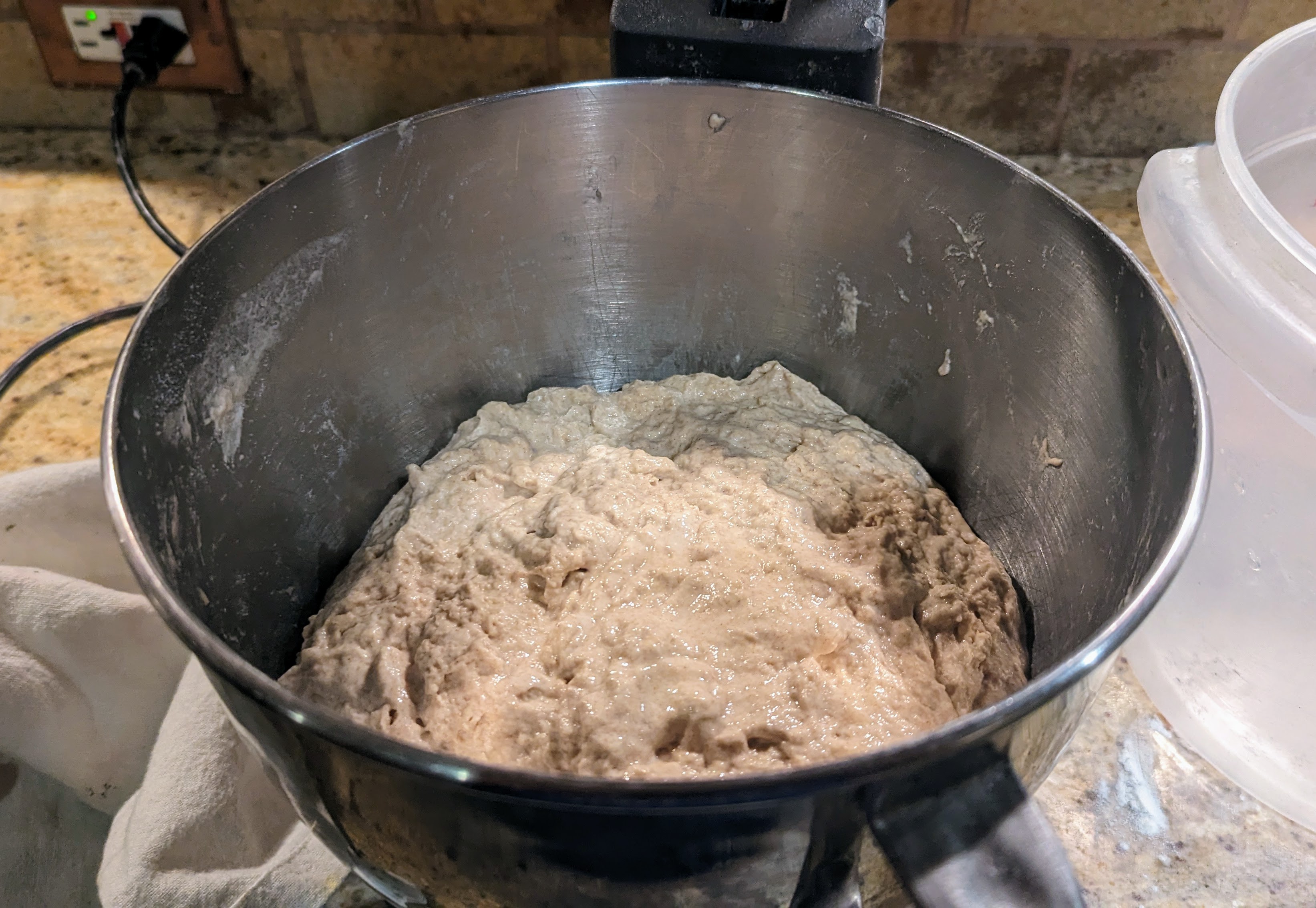
A Sourdough Riff on Baguettes de Tradition

When I’m pinched for time and want baguettes, I turn to Baguettes de Tradition that are a same-day baguette that I learned how to make a few years ago from reading Jeffrey Hamelman’s book, “Bread.” This simple baguette recipe only requires a few hours from mix to bake and is perfect for when I want baguettes for dinner. My only complaint about these is that since they’re baked on the same day, they don’t have nearly the amount of flavor as when I use the Pointage en Bac method of slow rising the dough overnight. Still, they’re perfect for dipping or using as sandwhich loaves.

This afternoon I was trying to figure out what I wanted for dinner and remembered that I had some BBQ pulled pork in the freezer, then realized that I didn’t have any sandwich loaves. Not that I needed an excuse to bake some bread, I thought I’d make some baguettes.

At first, I was going to make Baguettes de Tradition, but then I also remembered the starter in my fridge and that I had just fed it a few days ago! So, I pulled it out and it looked like it had peaked, but only recently. What luck! I was excited because I knew that the starter would add tons of flavor to the dough! And yes, I used it right out of the fridge but dissolved it in 90°F to wake it up. Here’s the formula and recipe:

Formula

Flour100.00%
Water76%
Salt2.00%
Yeast0.25%
Total %177.33%

Final Dough

Bread Flour154g
Kamut Flour205g
AP Flour564g
Water666g
Salt21g
Yeast2g
Unfed Starter (weight is 20% of the total flour)205g
Total Yield1818
6 X 300g Baguettes

It can be a little dicey using unfed starter. My experience is that it should not be so old where it smells cheesy and sour. At that point, it’s very acidic and the bacteria have essentially taken over. A telltale is that’s it’s fine to use if the level of the starter in my container is still well above the original line and hasn’t subsided all the way back and the starter itself is still bubbly. That means there’s still plenty of yeast activity.


I used a flour blend that was as follows:

Flour from the starter10.00%
Bread Flour15.00%
Kamut Flour20.00%
AP Flour55.00%
Total %100.00%

I used a tiny bit of commercial yeast to boost the yeast activity as I want to favor rising. With the amount of starter I use, there’s going to be plenty of flavor. But you can certainly skip it.

Using a sourdough starter alters my normal process for Baguette de Tradition because I follow the Tartine Basic Country Loaf process which includes a fermentolyse and a bassinage when I add the salt. Here’s the process:

Mix. Sift then thoroughly mix the flour in a large bowl and set aside. In another bowl, measure out the starter then add all but 50g of water and break up the starter till it’s completely dissolved. If you’re using starter fresh out of the fridge, make sure the water temperature is warm (85°F-90°F). Mix the flour and the liquid until everything is together and forms a shaggy mass.

Autolyse. Since we’ve included the starter, it’s colloquially called “fermentolyse.” Rest the mixture for 30 minutes to an hour.

Yeast, and Salted Bassinage. Sprinkle the yeast all over the top of the mixture. Dissolve the salt in the reserved water, then pour it over the top of the dough (make sure you use a spatula to get all the salt). Using your hands or a mixer on low spead, fold the new ingredients into the dough until they are fully incorporated.

Bulk Fermentation. You can transfer the dough to another container for bulk fermentation or just let it sit in the mixing bowl. During the first hour, fold the dough three times, every 20 minutes, then let the dough bulk ferment to about 75% expansion. With baguettes, you don’t want to go to double and in fact, you want to bake them just a little short of fully fermented. I know it sounds a little bass-ackwards, but this was a technique I learned about from the baker who won the annual Best Baguette in Paris. He claimed the slightly under-fermented dough springs better in the oven.
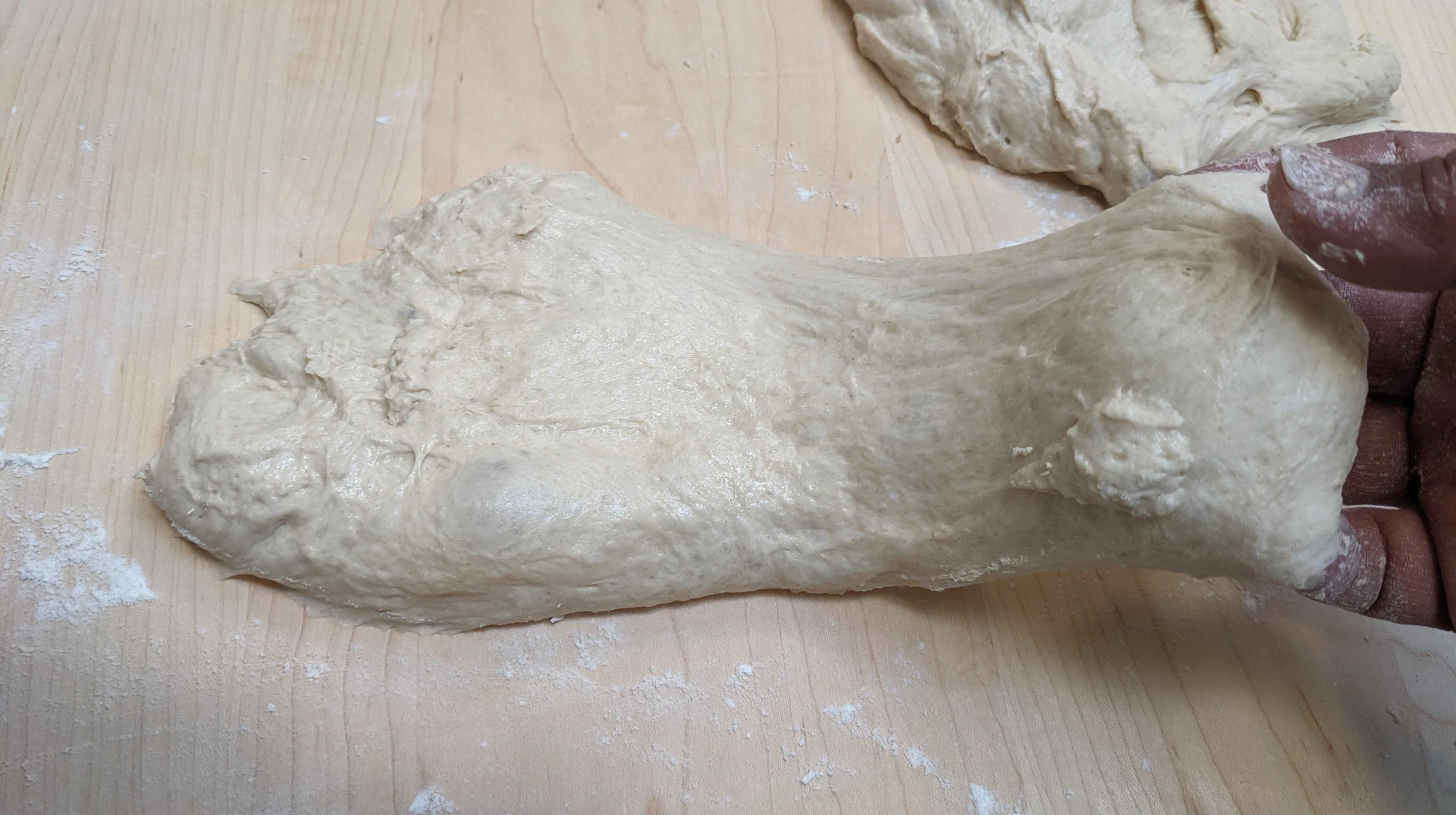
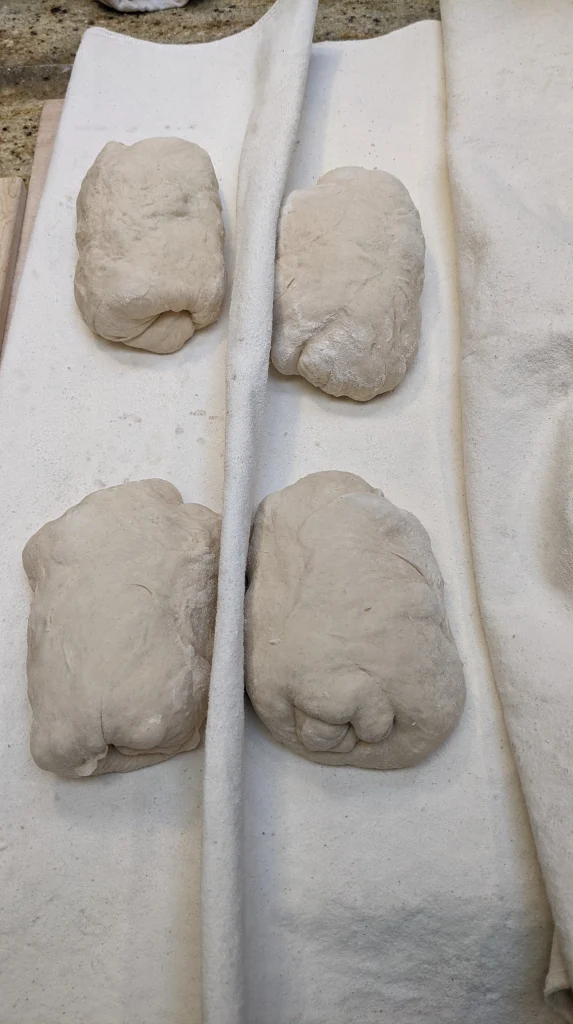
To letter-fold, pull sides of the piece and

Divide and Pre-Shape. Once bulk fermentation is complete, pour out the dough onto a lightly flour workspace. Pull it into a rough rectangle, then divide the dough into six even pieces. The recipe here calls for the pieces to be 300g. Letter-fold the pieces and roll them up like a jelly roll. Bench rest for 15 minutes.

Shape and Final Fermentation. Shape the pieces into long logs, then transfer to a couch or baguette pan for final fermentation. Poke test the loaves and if the indent comes up and immediately, it’s too soon. If it comes up slowly, but a small indent remains, then they’re ready to bake.

Bake. Score the baguettes then bake at 450°F. Bake with steam the first 10 minutes, then remove the steaming containers and bake until the crust is a deep golden brown. Mine took about 22 minutes to get to that point.

Cool for at least 30 minutes before cutting. Or you can do the Chad Robertson way and just cut it fresh out of the oven. 🙂

When in Doubt, Go Back to Basics

Now that I’m back to baking on a regular basis, I realized something after my last bake of sourdough baguettes: I’m really rusty! It’s not that the baguettes turned out bad; in fact, they turned out pretty good, though I do have to say that my scoring technique needs some practice. But where I was really rusty was in dough and starter development.

First of all, I let my starter go too long without feeding it, and even though I revived it and it doubled in less than four hours, part of me knew that it wasn’t very strong but I made dough with it anyway. It took forever to ferment! We’re talking 12 hours at room temperature on a warm day where were my kitchen was 80°F for most of the day! That was concerning to me because I knew that that length of time would favor bacteria and protease enzymes and would lower the pH of my dough.

And it did. By the time the dough doubled (I shouldn’t have waited so long), it was sour. And though it still had a bit of structure, I could tell from its extreme extensibility that it was at the very edge of being ruined. From a flavor perspective, that might’ve seemed like a good thing, but I knew that I’d have some challenges in handling the dough. So, instead of giving a couple of hours to final fermentation, I only let it happen for 20 minutes. And it’s a good thing I did because the loaves were seriously slack sitting in the baguette pan.

After I finished baking them, I got the feeling that I dodged a bullet. That is never a good feeling. I didn’t have the confidence that I normally have after a good bake. I knew there were problems and though the end result turned out reasonably good, I knew I could do so much better. I needed to up my game. But instead of trying to make drastic changes in my methods and processes, I instead decided to go back to basics. And that meant going back to the Tartine Basic Country Bread.

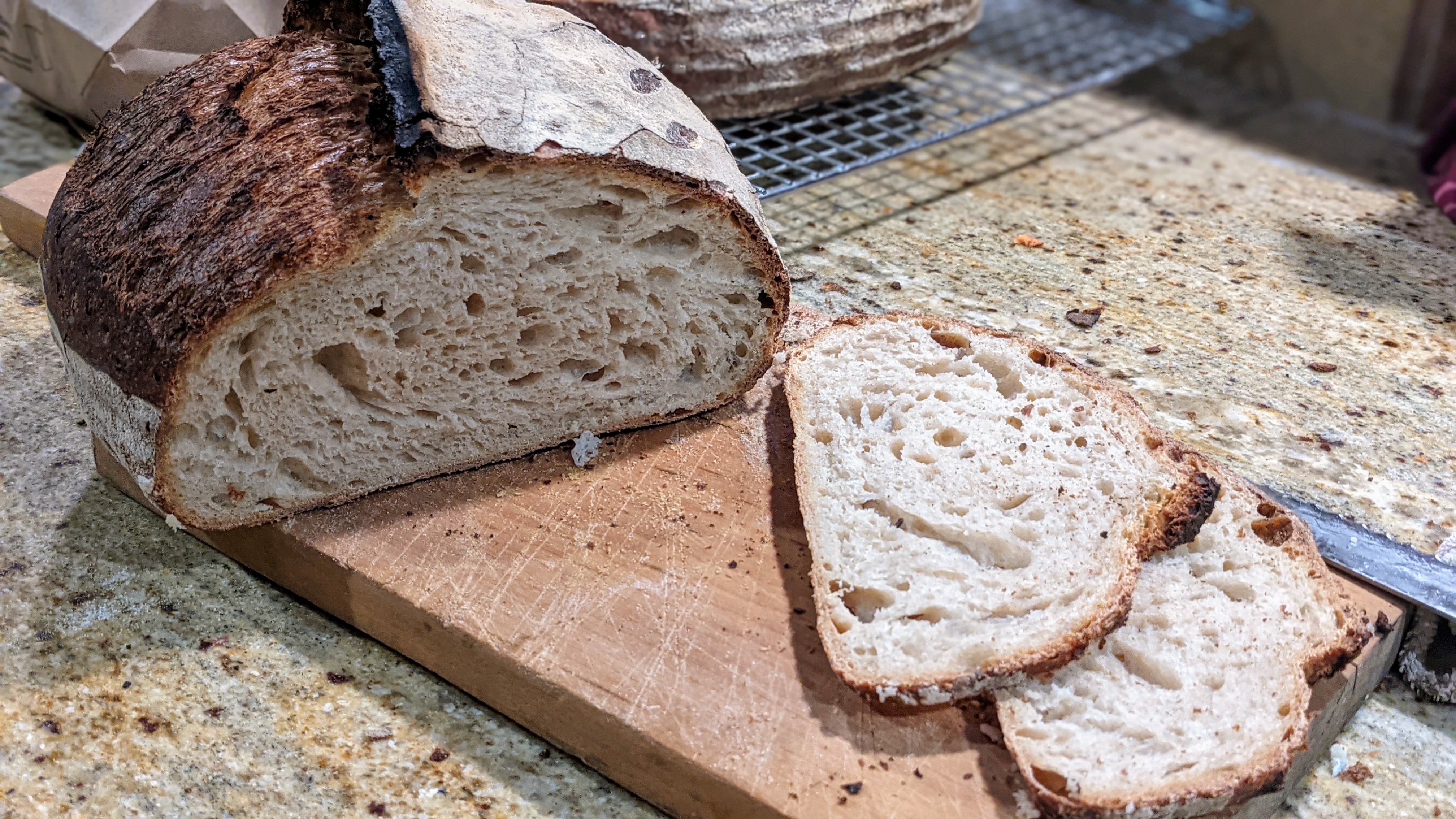
The result of going back to the basics!

So, a couple of evenings ago, I opened up the “Tartine Bread” book, and re-read (probably for the 100th time) the section on Basic Country Bread (aka Pain de Campagne). To me, that section isn’t just a step-by-step guide. It’s a repeatable process that all of Tartine’s bread are based. Chad Robertson often refers back to the Basic Country Bread throughout the book, emphasizing that his recipes are merely riffs on the original process.

Every time I read it, it puts me in the proper mindset for baking sourdough, bringing me back to and reminding me of the fundamentals and especially the things I need to be aware of and watch for. And even though I’ve internalized that knowledge over the years, doing that review helps me re-organize my thoughts.

What I found myself doing in my previous bakes was overthinking the process and second-guessing myself. I had so many conflicting thoughts bouncing around in my head! Did I shape it properly? Was bulk fermentation long enough? Was my hydration too much? Quite frankly, it was rather unsettling. But in going back to the basics, I slowed down and focused on methodically executing the steps. And lo and behold, my loaves turned out amazing!

What better way to enjoy some sourdough than with Croque Monsieur!

And that’s the lesson I wanted to share here. In this day and age where we’re all online and practically any information we want is just a mouse click away, it’s easy to get inundated and overwhelmed by the sheer mass of information out there. And with bread, there are so many diverse types of bread recipes that it’s easy to get distracted jumping from one recipe to another. And for many home bakers I’ve met, they often get frustrated when their bread doesn’t turn out as they expect. Some have shared with me that they gave up baking entirely.

For instance, I once worked with a friend who was discouraged with her baking. She shared with me that all the bread she makes never comes out how it looks in the pictures. I told her to take a step back and master just one type of bread and to learn the ins and outs of the process for that single bread.

I shared that when I started baking seriously, I only did yeasted loaves; not because I didn’t know how to make sourdough. I wanted to learn how to work with dough and to develop a feel for it. This is because so much of working with dough is tactile by nature. I figured that no matter what type of leavening agent I used, dough is dough.

And though I shared my recent experience here, it’s not the first time I’ve gone back to basics. I’ve done this very thing several times over the years. So, as the title says, when in doubt, go back to the basics!

Happy Baking!

Pain de Campagne: More Than Just Country Bread

Pain de Campagne or literally “country bread,” originated in France going back to medieval times. Baked in communal ovens and meant to last for several days or even weeks, it was made from a blend of different flour, usually white, wheat, and rye, and always fermented with a natural starter. It was literally the daily bread of common folk.

But with the introduction of commercial yeast, the making of the traditional country bread declined in favor of the convenience commercial yeast brought with it. Baguettes and other types of bread took precedence over the lowly country bread. But in the 1970s, naturally fermented bread saw a renaissance among home bakers, not just in France, but all over the world.

The Tartine Basic Country Loaf formula from “Tartine Bread” by Chad Robertson

Then Chad Robertson published “Tartine Bread” in 2010, and it transformed bread baking across the US, providing the inspiration for both professional and home bakers to return to their roots and rediscover the beauty of artisan bread baking. His in-depth discussion of his Basic Country Loaf (which is simpy Pain de Campagne) captured the care and passion that went into creating a finely crafted loaf of bread.

But at least for me, Tartine Bread wasn’t just a recipe book. It articulated and affirmed a belief I had formulated since I made my first loaf of bread over 40 years ago: that making bread by hand was so much more than mixing ingredients to produce a loaf. It was a lifestyle choice. Like Jeff Spicoli said in “Fast Times at Ridgemont High,” “Surfing’s not a sport, it’s a way of life, it’s no hobby.” So it goes with baking artisan bread.

Think about the time and devotion to the task that making even a single loaf requires. Think of the investment of time and resources spent on developing the skills to consistently produce bread. There’s nothing casual about it, even for someone who wants to casually make a loaf or two. I think this is where most people new to baking artisan bread get discouraged. They peruse online forums and read books like “Tartine Bread” and think, “Holy s$%t! That takes dedication. Maybe it’s more than I’m willing – or able – to commit!”

Of course, one can take a casual approach to baking and still make delicious bread. For thirty years, my only aim with baking bread was to create something delicious with little attention paid to aesthetics. My family and friends loved the taste of my bread and that was all that mattered to me. But when I started baking in earnest, I had an archetype in mind that I wanted to aspire to.

And to get to that point meant going down a lot of rabbit holes, experimenting with different techniques and ingredients, taking courses, researching the science behind yeast and bacterial metabolism, and most importantly, baking a lot of bread to hone my skills as a baker. And I realize that I’ve gone off on a tangent. But as the title of this entry says, at least for me, making Pain de Campagne is so much more than just making country bread.

Speaking of experimenting, the beauty of Pain de Campagne lies in its roots where it was produced out of necessity. As I mentioned above, different blends of flour were used, white flour for structure, wheat for taste, and rye to boost fermentation. I have no idea what the ratios were, but I imagine they varied based on what was on hand. Plus, considering that recipes and starters were handed down from generation to generation, I’d imagine that the makeup of the loaves varied considerably from bake to bake. And that variability is why country bread is such a great bread to learn to bake sourdough with. It’s easy to experiment with different things.

One thing I’m experimenting with right now is a technique I learned from a blog post called, “Don’t Be a Bread Hostage” by Martin Philip of King Arthur describing how he used unfed starter – or discard – right out of the fridge as opposed to building a levain. He learned the technique from a friend of his and in this video, says that is how he makes his sourdough at home.

I was a little incredulous about this when I first read it, but it makes a lot of sense. Even if a starter is way past its peak, it doesn’t mean that the yeast has died. It’s just dormant until it’s introduced to a new source of food. Normally we wake up the yeast in a culture by creating a levain, then using the levain at the peak of the yeast’s activity. All we’re doing with a levain is introducing a food source.

When we use a starter right out of the fridge, and mix it into a dough, all we’re doing is introducing the yeast to a new food source. So, instead of waiting for the yeast to wake up and get to peak activity, we just let it wake up within the final dough. What I found with this technique is that bulk fermentation is much slower than if I use a peaked levain – lasting from twelve to sixteen hours. But the advantage of this is that I just mix everything together, do three folds every fifteen minutes in the first forty-five minutes, then let the dough rise until it has doubled.1

Here are the formula and final dough:

Yield: 2 X 1 kilo loaves

Formula

Flour100.00%
Water80%
Salt2.00%

Starter will be 10% of total flour

Final Dough

Bread Flour (I recommend at least 12% protein content)824g
Whole Grain Flour (I use Kamut)220g
Water824g
Salt22g
Unfed Starter110g
Total Yield2000g
2 X 1000g loaves

You can do the calculations above by copying this Google sheet into your own account.

Mix. Mix all the dry ingredients in a separate bowl, including the salt. In a separate bowl, dissolve the starter into all the water, then add to the dry ingredients and mix until you form a shaggy mass with no large lumps. If you used a stand mixer mix your dough, transfer the dough to a suitable container.

Bulk Fermentation. Overnight. In the first 45 minutes, do three sets of stretch and folds every fifteen minutes. Don’t freak out when you’re folding the dough, especially with the first set. This is a high-hydration dough. By the third fold, the dough will have developed a lot of strength – you will feel it.2

Divide and Pre-shape. Once the dough has almost doubled (see footnote below), pour it out onto a well-floured work surface. This is a high-hydration dough, so you don’t want it to be sticking. Divide into two equal pieces about a kilogram each and pre-shape into boules. Place the boules seam side down, sprinkle a little flour on top of each, then cover them with a tea towel and let them bench rest for 15-20 minutes.

Shape and Final Fermentation. Shape the boules into whatever shape you want then place them in bannetons. Cover them and put them into the fridge for 8-12 hours. My advice is to check them at six hours to see how they’re progressing. When you do the poke test, the dough shouldn’t spring back too quickly, and the indentation shouldn’t fade all the way.

Bake. Bake at 450°F for 20 minutes with steam (if using a Dutch oven, cook covered for 20 minutes), remove steaming container or uncover if using a Dutch oven, then bake for another 20-25 minutes uncovered or until the crust is a deep golden brown. Personally, I take it to brown as I like a well-caramelized crust. Cool for at least 30 minutes before cutting (though it’s better to let the bread cool for a couple of hours.


  1. In Martin Philip’s video, he mentioned letting the dough double. But if you use a very mature starter, be VERY careful to monitor the progress of your dough because a mature starter is highly acidic, and acid will break down gluten. The first time I used this technique, I let the dough get to double and it was overproofed! Also, he mentioned that he let his dough go for 12 hours. Bear in mind that that’s just a guideline. Expansion is more important. I’ve learned to check at about 8 hours, and I will divide and shape when the dough reaches about 70%-75% expansion just to be safe. ↩︎
  2. If the dough hasn’t done much by the time you wake up, don’t worry. Give it another stretch and fold to move the yeast to a new food source. You will soon see progress. ↩︎

Making Bread Sour

Yesterday afternoon, my family was enjoying subs that my kids made from the baguettes I had baked the day before. I asked them how they liked the bread and they all said it was great. But one of my daughters asked said, “Dad, we love your baguettes, but can you make a real sour loaf like you used to?” Of course I agreed because any excuse to bake some bread is fine with me.

So, last night, I worked out my formula, then fed my starter in preparation for making the dough early this morning. While I was reviewing the formula, I thought of numerous ways to make bread sourer. But I have a tried-and-true method that will ensure my bread comes out sour. Actually, it’s a combination of things. Here they are:

First, I use mature, unfed starter straight out of my fridge that has hooch formed. I mix the hooch back into the starter, measure out what I need for my recipe, then I feed the starter and put it back into the fridge. I know, it seems counterintuitive, but at the stage I use it, even though there’s still live yeast in the culture, the bacteria have taken over.

Second, the starter is made entirely from whole grain flour or at a minimum T85 flour that still has a substantial amount of germ and husk in it. That’s where the little beasties (bacteria) reside. I will sometimes use a mature rye levain – and always past its peak.

Thirdly, I make a flour blend that is at least 20% whole grain flour. Today I used unsifted 100% organic whole grain Kamut™ flour. In addition to introducing bacteria, it adds a nice nutty component to the flavor profile along with a tiny bit of sweetness. Yum!

I also use a more standard hydration of 70%. This is a little low for the flour that I use which has high protein content. But the lower hydration promotes anerobic metabolism which favors the bacteria.

Next, I use significantly less starter than I normally would for other loaves. Usually, the amount of starter I use is 20% of the total flour, but when I want sourer bread, I reduce the amount down to 12%. This lower amount of starter lengthens fermentation time forcing the yeast to compete more with the bacteria during bulk fermentation. This also promotes bacterial fermentation over yeast fermentation.

Then finally I do a long final fermentation in the fridge for a minimum of twelve hours. This slows down the yeast but lets the bacteria continue doing their thing. Importantly, I didn’t want to completely stop yeast production because it was already slow to start with. So I turned up my fridge temp to 42°F (don’t worry, I have a small dedicated fridge for cold fermentation.

With the smaller amount of starter, bulk fermentation is SLOW. I mixed my dough at 7am this morning and didn’t shape until 6pm! And it was a hot day today. That got me a little worried because with my kitchen ambient temperature at 85°F, I thought it would speed up yeast fermentation. But it looks like there was enough competition from the bacteria to attenuate the yeast activity even at that temperature.

With a lower hydration dough combined with the different ways to promote bacterial fermentation, I had to be extra gentle with shaping. Normally I don’t have a problem degassing the dough because I tend to make loaves that favor yeast production. But with such low yeast activity, I handled the dough much gentler to avoid popping as few bubbles as possible.

This may seem complicated because I explained each item, but it’s not. Here’s everything I talked about in summary:

  • Use unfed starter
  • Use a whole grain flour starter
  • Use a flour blend that includes some whole grain flour
  • Use a lower hydration (68%-70%) to promote anerobic metabolism
  • Use less starter
  • Do final fermentation in the fridge for at least twelve hours

As I said, it’s not complicated. You can even skip some of these things. But from experience, I know doing those things above will create a sour loaf of bread!

How Sour Is Sour?

All that said, my technique above favors lactic acid production rather than acetic acid production. Lactic acid is sour, but it doesn’t have a bite, like acetic acid. The loaf above is high in lactic acid. Its sourness comes off as nutty and fruity as opposed to vinegary. I prefer this kind of sourness because there’s a complexity in the flavor profile. If I want a tangier loaf, I’d use a stiff starter that favors acetic acid production, but I’d use a bit more than a liquid starter.

It’s Simple as 1:2:3

A little overproofed and a bit mishapen due to the loaf being longer than my Dutch oven, but it still turned out great with a nice, fluffy crumb.

When you get into any hobby or craft, it so easy to dive down deep into the minutiae and explore every aspect of the craft down to the nitty-gritty. I can’t tell you how many rabbit holes I’ve gone down in my pursuit of bread baking knowledge. I’ve read countless books, blogs, and academic papers. I’ve experimented with a bunch of different techniqes and even taken classes.

All that knowledge is great and I encourage everyone to learn about different techniques and methods. Even delve into the food science part of it. All it does is help you become a better, more adaptable baker.

And speaking of techniques, I finally tried a technique that I kept forgetting to try, and that’s the 1:2:3 method. Basically, it’s measuring the amount of starter, multiplying that by two to get your water, then multiplying the starter amount by three to get your flour amount. For salt, multiply the flour amount by 1.8% (0.018).

This is what it looks like in real numbers:

Starter165g
Water (2x starter weight)330g
Flour (3x starter weight)495g
Salt9g
Total Loaf Weight999
Assuming you’re using a 100% hydration starter, the recipe above will create a 71% hydration loaf.

BTW, I have a calculator available for this. I know, it’s just 1-2-3, but the cool thing about the calculator is that you can set different starter amounts to achieve the loaf weight you want without having to work it out on paper.

As for processing, we don’t need no stinkin’ processing. Just kidding… Once you have your ingredients measured, throw them all together in a bowl and mix them. That’s right, no autolyse. You can if you want, but it’s really not necessary. I used a stand mixer and mixed until the dough started climbing my hook (about 4 minutes).

Bulk ferment until the dough has expanded about 50%-75%. For me, that took about three hours in an oven with the light on. Fold every hour until the dough has built up strength. It only took two folds for my dough to develop good strength. After that, I gently shaped the loaf (no preshape) into a batard, then put it in a banneton and let it rest overnight. Bake it like you normally would.

That’s the process I used in a nutshell. But honestly you can use whatever method you want. For me, I wanted to keep it as simple as possible.


Circling back to education, as I mentioned above, acquiring knowledge makes you better. The more you know, the better you can adapt to different conditions and situations; the better you can recognize and identify issues that may come along. Especially with baking bread, as they say, there’s more than one way to skin a cat, and it’s important to at least be aware of the different approaches available.

The reason I’m saying this is because I’ve seen so many folks who’ll latch onto a particular method or technique or belief and become so parochial and dogmatic about it that they close themselves off from learning anything else. But bear in mind that bread has been baked for thousands of years and in all sorts of conditions and environments. Don’t get so fixed on a particular method. Try different things out.

What I love about this 1:2:3 method is its simplicity. I’ve got my own recipes that I just know by heart, but a method like this makes it super-easy for anyone, especially new bakers, to execute. And think about this: You can apply this method with a poolish or biga. Those are just preferments, but prepared in a different way. The link to the calculator I made for this also allows you to specify the hydration of your starter. So, for instance, if you’re using a 75% hydration biga, it’ll calculate the correct amount of salt. You can still use the 1.8%, but the calculator, does it more accurately, considering all the flour that’s used in the recipe and not just the starter X 3.

Baking on Vacation. No, I Don’t Bring My Starter.

I’ve gone to my house in Hawaii and so far, I’ve already baked a couple of times and will bake bread yet again for a Labor Day party in couple of days. I got a special request for Labor Day by the host of the party, and my wife’s friend invited us to dinner tonight and asked if I could bake some bread to bring to the dinner. Then my daughter asked me to bake some bread for her because she hadn’t had any of my bread for a year.

It is never a problem for me to bake. I love it and enjoy baking when I have the time; yes, even on vacation. But one thing I haven’t done is bring my starter with me. I suppose could bring a little starter and grow a levain if someone specifically wanted sourdough, but my thinking is that I can make so many diverse types of bread that it seems almost pointless to bring a starter.

Plus, I refuse to let my starter rule my life. Holy crap! I’ve seen people proudly post pictures of themselves in their hotel rooms proudly holding up their jars of sourdough starter that they took on vacation with them so they can feed it. To each their own, but if I’m on vacation, I don’t want my activities limited by my freakin’ starter feeding schedule! I feed my starters (yes, I have anywhere from two to four) before I leave then put them in the fridge. They’ll keep for weeks.

So what did I bake? I made two batches of ciabatta, one for us and one for the dinner party with our friends. For the Labor Day party, I baked two dozen Hawaiian rolls that went perfect with the BBQ short ribs we had. Both of those types of bread just required regular old yeast. For the ciabatta, I made an overnight biga preferment. Wow! Were they delicious.

And the Hawaiian rolls were the hit of the party! They didn’t last at all! They were rich with butter and soft and pillowy. I’m going to have to make more!

Anyway, the point to this is that if you want to bake on vacation and have the means to, go for it. But just remember this: It doesn’t have to be sourdough.

Time for Some Kamut Sourdough!

I just finished the second feeding of my mother starter to make some sourdough dough this morning. Afterward, I asked myself, what kind of flour blend do I want to use? Then it occurred to me that I hadn’t used a Kamut blend in a while. I love bread that has Kamut in it. It’s my favorite flour as it brings a nuttiness and a hint of sweetness to the flavor profile. Plus, if you’ve read this blog previously, you’d know that Kamut has some incredible nutritional benefits as well. But that aside, any bread I’ve made with Kamut has an incredible flavor! For this bake, I’m using the following formula/recipe:

Formula

Flour100.00%
Water75.00%
Salt1.80%
Total176.80%

Final Dough

Flour 1628g
Flour 2343g
Water686g
Salt21g
Levain343g
Levain weight is 30% of total flour

This is a straight-forward dough and frankly, the formula is a master formula I use as a master formula for most of my bread. If I use predominantly whole-grain flour, I will up the percentage to 85% or more depending on the flour.

As for processing, it’s straight-forward as well:

  1. Mix the flour, starter, and water, reserving 100g of the water.
  2. “Fermento-lyse” for up an hour.
  3. Dissolve salt into the reserved water, then do the final mix to incorporate the salt.
  4. 2-4 stretch and folds on the bench at 45 minute intervals. I always play it by ear with the folds because Kamut’s gluten is very delicate, and it is easy to tear, so I try not to do any more than I need to. Also, the windowpane test is reliable with this flour, especially if I’m using a large amount of kamut. What I’m looking for is the folded dough to maintain its shape for several seconds after folding.
  5. Shape into batards or boules and usually do an 18-24 hour final fermentation.
  6. For my oven, I bake at 460° for 35-40 minutes with the first 15 minutes with steam.

Has It Really Been That Long?

The other day, my fridge went on the fritz, and I had to remove all the perishable stuff and put it in a cooler. What didn’t make it was my starter. But that didn’t bother me because I literally hadn’t used it for months, and I was planning to throw it out and start anew…

But looking at my starter, I got a little sentimental and decided to feed it. And in that moment, I remember a recent conversation that I had with a friend who mentioned that she missed my sourdough. Yikes! So, I dumped out the hooch, then mixed in some flour and water, then let it sit overnight. By morning, it was clear that it had peaked and declined, so I dumped out half and re-fed it. Damn! It doubled in just three hours!

Normally, with that kind of doubling rate, I’d set out to make dough. But I wanted to be sure it was ready, so I re-fed it after 4 hours’ time as I had to cook dinner. I couldn’t believe that it tripled in an hour-and-a-half! It was ready.

Since I feel a little rusty, I went to a tried-and-true formula that I’ve used for years. Here it is:

Formula

Flour100.00%
Water75.00%
Salt1.80%
Total %176.80%

Final Dough

High-Extraction Bread Flour571g
100% Certified Organic AP Flour400g
Water686g
Salt21g
Starter (levain)343g
Total Yield2020g
2 X 1000g loaves + 1% for processing

Quick Process

This is a riff on the Tartine Country Loaf. It’s about as straight-forward as can be. I do a 30-minute fermentolyse to hydrate the flour, then I only do two folding sessions separated by 45 minutes as opposed to the six folds at 30-minute intervals that Chad Robertson does. This is because the flour I use develops gluten FAST. It’s also a reason I use about 35% AP Flour. It helps lighten the dough and produces a lighter and loftier crumb. As for total bulk fermentation, I’m expecting it to last about 3-4 hours at most, especially with how active my starter is.

For folding, I used to do stretches and folds directly in my 6L Cambro container. But before I had to curtail my baking, I started folding my dough on my workspace. I feel that I could more effectively stretch it that way and not de-gas the dough as much.

Once bulk fermentation has completed, I’ll shape batards and place them in my 14″ batard baskets. I love these baskets as the finished product always creates a nice oval shape. Plus, because the dough isn’t as constrained in

As I sit here writing, I’m incredibly excited to be baking sourdough again. I forgot how much I love the process.

What’s So Special about Kamut Flour and Why I Love to Bake with It So Much

Last week, I finally was able to procure a 25 lb. bag of KamutTM flour. For months, so many producers were out of it, and those that did have it, like Whole Foods, sold it in much smaller quantities than I needed and for a premium price. So, as soon as I saw that Azure Standard had it back in stock, I immediately put in an order!

Since I discovered it, KamutTM flour has been an integral component in most of my flour blends. I’ve mentioned using it several times since I started this blog, but when I baked my first loaves of it after many months of not having it, I sat down and asked myself, “Why do I love this flour so much?” I realized that there are lots of reasons, so I thought I’d share them here.

Before I go on, let me answer the obvious question for those who don’t know what it is: What is KamutTM? KamutTM isn’t a type of wheat but a trademark name for the Khorasan strain of wheat. It is an ancient grain that was discovered in an ancient Egyptian burial chamber after World War II and the grains ended up in the hands of a Montana wheat farmer who cultivated them. The trademark name is important because:

  1. It ensures that the grain comes from the original seed stock and is both unmodified and unhybridized and completely non-GMO.
  2. It is also 100% certified organic.

These are important distinctions as they provide a guarantee of origin, purity, and quality.

Nutritionally, unlike regular wheat, Kamut has a high intrinsic energy as it has a higher lipid content than regular wheat. But it is also high in both protein and fiber and contains several essential minerals and vitamins such as niacin and manganese that contribute to its overall high nutritional value.

But the science-y stuff aside, another thing I love about this flour is the romance behind its history. As I mentioned above, the grain was found in an ancient burial chamber in Egypt after World War II, and though classified as Khorasan wheat, it has also been called “King Tut’s Wheat” or Pharoah’s Wheat” based on its origin.

And baking with flour that comes from wheat that has a provenance dating back thousands of years makes me think of what it was like baking back then. Sourdough was discovered in ancient Egypt around 3000 BC, and it’s cool to me to bake with grain whose origins date back that far. I admit it. I’m a hopeless romantic, dreaming of the “old days” and what it was like baking with those ancient hearth ovens with that original grain.

Plus, historians believe the discovery of sourdough was purely accidental. Accidental or not, it changed the world! Up to that point, bread was flat and dense. But the addition of yeast literally gave rise to a completely new form of bread that was then adopted by the Greeks and Romans, then spread to the rest of the world. Did it start with Khorasan wheat? Maybe. I have no idea. But who cares? It was used back then and that was all I needed to know to want bake with that ancient grain.

But other than the romantic history, I love KamutTM flour for what it brings to the loaves that I make with it. When combined with a high-extraction or whole-grain flour, it helps soften the crumb. This is because even though it forms gluten when mixed with water, its gluten is much more delicate than regular wheat.

And that delicateness was a challenge to work with at first as it introduced a trade-off with the soft crumb: The dough also became prone to tearing. It forced me to learn how to handle the dough more gently. Until then, I hadn’t realized how ham-handed I was with my dough. My stretch and fold sessions were relatively rough affairs compared to how I stretch and fold now; not that I’d completely rip the dough apart, but it certainly wasn’t with the deliberate care I take now. And that skill has carried over to other dough made with different flour blends.

Of course, as KamutTM is flour, and flour is food, what about its taste and texture? As I mentioned above, its gluten provides a smooth, almost velvety feel to the crumb. It also has a nutty flavor that contributes to the overall complexity of the flavor profile.

Working with KamutTM Flour

If you want to work with KamutTM, I recommend starting with a smaller quantity first to try it out. Whole Foods usually carries 1-pound bags from Bob’s Red Mill. That’s enough to make two 1-kg 60% Bread Flour/40% Kamut loaves @ about 85% hydration.

Other than that, here are a few things to keep in mind when working with Kamut:

  1. I’ve found that Kamut’s starches break down pretty easily. So, if you use a rye-based starter, be extremely watchful of your bulk fermentation. The loaves I made above used a 25% rye starter inoculation and bulk fermentation happened a lot faster than with normal bread flour. That amount of starter is going to speed things up anyway, but it was about twice as fast as normal with the Kamut present. I had to turn down the temperature on the fridge I use for cold final fermentation to about 39℉, where I normally have it set around 42-44℉ to favor lacto-fermentation. Of course, an alternative is to use less starter, but I really wanted a more pronounced tang.
  2. And since Kamut’s starches break down pretty easily, I do not recommend using a real high temperature for baking. The loaves I baked above were baked at 460℉ for 20 minutes with steam, then 425℉ for another 22 minutes dry. Because of all the released sugars, that bread finished with a dark crust!
  3. As I mentioned above, the type of gluten that is formed with Kamut is a lot more delicate than with the hard red wheat that’s normally used in baking. When you’re folding your dough, be very mindful of the extent to which you pull the dough. My advice is to only pull to the point where you feel some resistance, then fold the dough over. You may have to fold more times than you normally would during a session to ensure you’re building structure, but you’ll also ensure that you’re not tearing your dough.
  4. Kamut is a “thirsty” flour, so I recommend a healthy autolyse or fermento-lyse of at least 45 minutes. This will ensure that your flour is well-hydrated.
  5. As far as hydration percentage is concerned, you’ll have to experiment. The bread flour I use is particularly high in protein at around 15%, and though the Kamut from Azure Standard is about 11.7% protein, I can still push my hydration way past 80%, though I typically don’t exceed 85%. Even then, it still handles like a 72% hydration dough with regular bread flour.
  6. If you make bread with 100% Kamut, best treat it like rye and bake it in a pan or a Dutch oven to prevent it from spreading out. It won’t spread out nearly as much as rye, but its gluten is not very strong.
  7. And speaking of strength, bear in mind that most Kamut flour is whole-grain flour, so don’t expect to get big holes. You’ll get plenty of spring, but just not a lot of voids in your crumb.
  8. You might consider sifting the flour through a fine mesh to capture the germ and husk. These are like little knives that will cut the gluten strands. And with Kamut’s weaker protein bonds, removing that stuff will help with your rise. I usually sprinkle the germ on top of the loaves before I place them in the oven.

Recipe: 25% Rye Sourdough

As much as I love baking with KamutTM, my normal supplier has been out of it for some months now. But what they have had in stock is dark rye flour. So for the past few months I’ve been experimenting with it and trying to find a good ratio. Like KamutTM, rye flour doesn’t form gluten. They’re both high in protein, but their proteins are more gelatinous in the presence of water as opposed to forming chains. Needless to say, they don’t add to the structure of the dough.

While you certainly could do a 100% rye or KamutTM loaf, you’d have to keep the hydration pretty low or bake your bread in a pan. As for myself, while I’ve made bread using 100% rye or KamutTM, I have to admit I’m not a fan. But I love what they contribute to the bread when used in a flour blend.

For this recipe, the final blend is a 75% bread flour / 25% rye flour blend. 15% of the flour comes from the rye-based starter. The other 10% blended with the bread flour for the final dough.

Here’s the recipe:

Overall Formula

Flour100.00%
Water76.00%
Salt1.50%
Total %177.50%

Flour Blend

Rye Flour from Preferment15.00%
Bread Flour75.00%
Rye Flour10.00%
Total %100.00%

Final Dough

Bread Flour854g
Rye Flour114g
Warm Water694g
Salt17g
Levain341g
Total Yield2020g
2 X 1000g loaves
Total Flour1138g
Total Water865g
Optimal Dough Temp78°-82°F / 25° -27°C

Prepare the Levain. Make a levain that will yield about 350g or a bit more from a mature starter and equal parts of rye flour and water. The mother culture I use for this is 100% rye flour, but if yours isn’t, don’t sweat it. Once the levain passes the float test, it’s ready.

Initial Mix. In a separate bowl, mix the levain with all the water and make sure to break up the levain. The water should be very warm to increase the yeast activity. Blend the bread and rye flour together well, then add the liquid to it. You can mix by hand, but I use a mixer on the lowest setting. Mix until you achieve a shaggy mass and there are no dry ingredients. You don’t want much gluten development at this point. Cover and let the dough rest in a warm place for 30 minutes to ensure the flour is well-hydrated.

Final Mix. Sprinkle the salt over the top of the dough, then fold it into the dough. I do this with a wet hand, scrunching the dough together, then folding it. I do this until I can’t feel salt granules. This also serves as a bit of a stretch and fold session.

Bulk Fermentation. I’m not going to give a time for this as it varies wildly. But the telltale you’ll look for is 75-100% volume expansion – almost double. With the amount and type of starter I use (it’s from an ancient Italian culture that I got from Sourdoughs International), my bulk fermentation is about 2 1/4 hours! It’s fast. Make sure your dough temp is within the optimal range I listed above!

Folding. Fold once after the first hour of bulk fermentation. I realize this seems counterintuitive, especially if you’ve followed the dogma of 6 folds over a 3-hour period. But we’re baking with rye flour and even though it represents only 25% of the total flour, it’s still delicate. So don’t want to keep punching it down. When you fold, make sure you’re getting a really good stretch from the dough and fold it until the mass no longer wants to be folded and the whole mass comes up when you stretch. When you’re done, turn the mass onto the folds and LET IT SIT!

Divide and Shape. Gently transfer the dough to an unfloured work surface. Divide it into two equal piece weighing a kilo each. Shape into rounds and bench rest for 15-20 minutes, or until the dough has relaxed. Finally, shape them into rounds or ovals, then place them in bannetons.

Final Fermentation. Pop your bannetons into your fridge and let the dough ferment for 12 – 18 hours. I went up to 24 hours with my previous batch as an experiment, and though flavorful, there wasn’t much energy left in the yeast for oven spring.

Bake. Bake at 460°F/240°C for 15 minutes with steam. After this, remove your steaming container, then turn your oven down to 425°F/220°C and bake for 25 minutes. You can go longer if you want a darker crust.