A Bit More Sour Sourdough Baguette

I know, I know… I have several baguette recipes on here already. Despite that, I mostly use one dough development method no matter the type of baguette I happen to be making: pointage en bac, or the slow rise method, and I only vary it by the type of leavening agent I use. And whether I use yeast or starter, the process is exactly the same.

Of course, there is the exception (when isn’t there) of Baguettes de Tradition which is a straight-dough, same-day bake with no preferment. But I don’t make those too often and only when I’m pressed for time.

As for all the different recipes I have for baguettes, I’ve always been compelled to experiment. In Jeffrey Hamelman’s book, Bread, he has several recipes for baguettes and I’ve baked them all and shared those recipes here. But for my own baguettes, I riff on the original method I learned from Master Chef Markus Farbinger. It’s straight-forward and invariably yields me GREAT results.

Historically, baguettes were developed as a welcome change from sour breads. Leading up to the creation of the baguette – and other bread made with commercial yeast – all bread was sour because they were risen with natural starters. And we’re talking centuries here, folks! Baguettes offered up a different flavor profile; frankly, a neutral one, and based on the popularity of baguettes through the years, it was a welcome change.

Technically, there’s nothing wrong with making baguettes from sourdough starter as the French Decrét Pain states – however vaguely – that bread must be risen with a leavening agent suitable for bread. But, given how parochial the French are about food, using a natural starter isn’t quite de riguer.

Plus, the whole purpose behind the baguette was to create a neutral flavor platform, and sourdough is anything but neutral – and here I have to agree with the French: A baguette isn’t defined by its shape, but by its dough. But that doesn’t mean that you can’t do it, and dammit! These “baguettes” taste great!

Now the interesting thing about these baguettes is that the acid in the starter acts as both a dough conditioner and a preservative. Even after a couple days, the crumb is still supple and pliable – even if left in the open at room temp!

So here’s the basic formula for the baguettes:

Baker’s %Example
Flour*100%644
Water76%462
Salt1.8%14
Yeast0.07%.53
Preferment35%227
Optimal Dough Temp75°-78°FYield: 1346
*I use a blend of flour which is basically 40% unbleached high-extaction flour and 60% AP flour.

I deliberately used the word preferment instead of sourdough starter or levain because you can use a poolish for this formula as well, which I have done. But for this discussion, we’ll focus on a levain.

Using the example numbers above, this will yield 4 baguettes scaled at 335g apiece, leaving a few extra grams of dough for loss during processing, which almost always happens, so I always calculate a few grams more than I actually need so I can scale my loaves to the exact weight I want them.

Make the Levain

Though I listed the levain as being 35% of the flour, I need to clarify where I got this number. I didn’t just pull it out of thin air. Assuming I’m using a 100% hydration levain, it turns out that if the flour of the levain represents 15% of the total flour of the recipe, the levain’s total weight comes out to be just a smal fraction over 35% of the flour weight.

I factor in the flour of the levain as part of the overall flour because a levain is simply part of the overall dough development. I do this to calculate my yield as I now bake according to the amount of dough I need for a particular bake. This keeps my loaf weights absolutely consistent.

In any case, using a mature starter, make a liquid (100% hydration) levain (like a 1:3:3 or 1:5:5) and let it activate until it passes the float test. I’m not putting a time on this because it can vary wildly based on the microbe density in starters. For example, when I make a levain using botanical starter water and a mother I maintain based on the botanical starter, my levain will be ready in about 3 hours. And it’s super-active.

Make the Dough

  1. Dissolve the levain and yeast in the water. The water should be at the appropriate temp to get the dough to the optimal temp. At this time of the year, that’ll probably be around 90°-95°F.
    1. You can actually eliminate the yeast altogether. The resultant bread will be a bit more chewy. And depending on how long you let it ferment, the acid in the dough will keep the crust lighter in color.
  2. Add the salt to the flour and mix well, then gradually add the liquid to the flour and mix until you form a shaggy mass with no dry ingredients.
  3. Scrape down the sides of your mixing bowl and let the dough rest.
  4. Initial Fermentation: 1 1/2 hour. During this first hour, fold the dough every 30 minutes, making sure to pay attention to building up the gluten. After the second fold, rest the dough for another 30 minutes, cover and put in the fridge for 12-16 hours, or until the dough has at least doubled in size. For the sourdough baguettes, the dough may seem a bit slack. This is due to the acid in the starter which breaks down gluten.
  5. FROM THIS POINT ON, BE ABSOLUTELY GENTLE WITH THE DOUGH!
  6. Divide and scale the dough. For demi-baguettes, weight should be around 250g. I make 20″ baguettes scaled at 335g. Roll each piece up like a jelly roll and rest for 30 minutes seam-side-up on a well-floured couche or tea towel.
  7. Preheat your oven to 500°F.
  8. Once the dough has relaxed sufficiently (it’s normally 20-30 minutes for me, but sometimes it takes longer if I pre-shaped them tight, remove the pieces from the couche and place on a well-floured surface, then shape into baguettes, moving them back to the couche to do their final fermentation from 30-60 minutes. This step is important. You want to do a finger-dent test after 30 minutes. If it’s still really springy; that is, your dent essentially disappears right away, let it go another 20-30 minutes. But if your dent springs back quickly but some of it still remains, it’s ready to bake. Note that that partial spring is ultra-important. That means that there’s still life in yeast.
  9. Score the loaves (see below).
  10. Bake with steam at 500°F for 12 minutes, then 12-15 more minutes at 450°F dry.

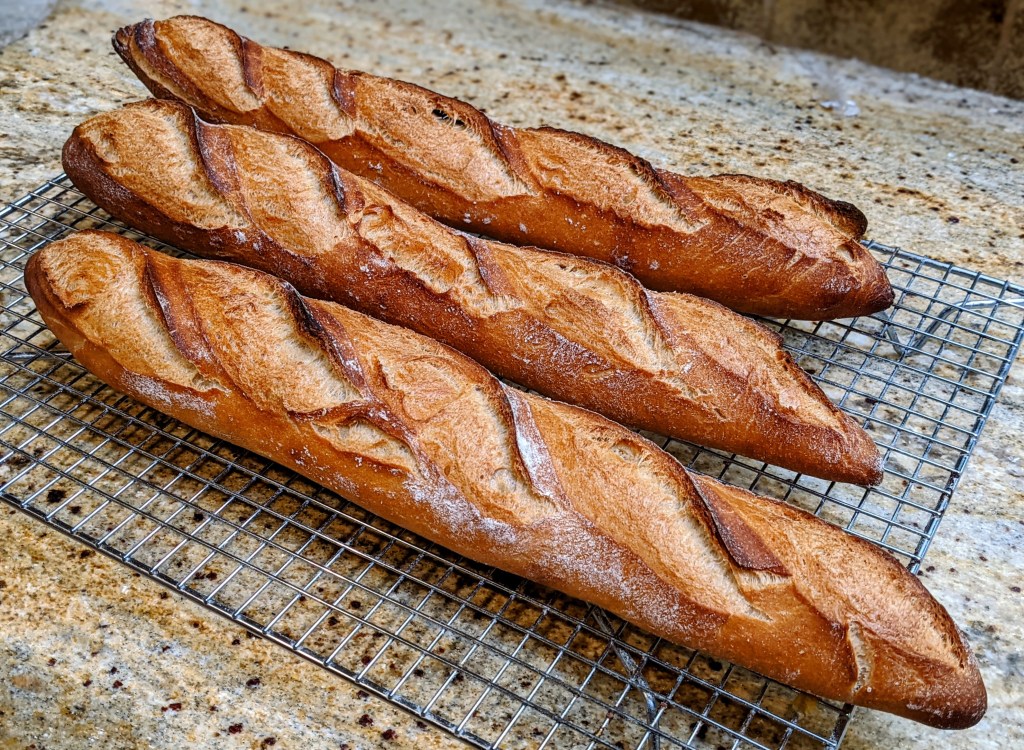
These baguettes really benefit from a full bake to ensure a nice, crisp crust. I’m not a big believer in taking the crust out to chocolate as I do with my boules and batards. But a deep, golden-brown like the loaves above yields a delicious crust.

If you’ve baked traditional baguettes, you’ll immediately notice that once you bake these, the sourdough crust will not get as dark within the given times. You could bake them longer to get a darker crust, but you just might dry out the insides if you bake them for too long. I have a feeling that it has a lot to do with the amount acid in the starter which, at least for my very sour starter, is a clear indicator that there wasn’t much available sugar for browning.

But the other thing about these baguettes is that they stay fresh longer because of that acid. While they won’t remain as crisp as long as traditional baguettes, they will continue to be pliable for several days after the bake!

Scoring Baguettes
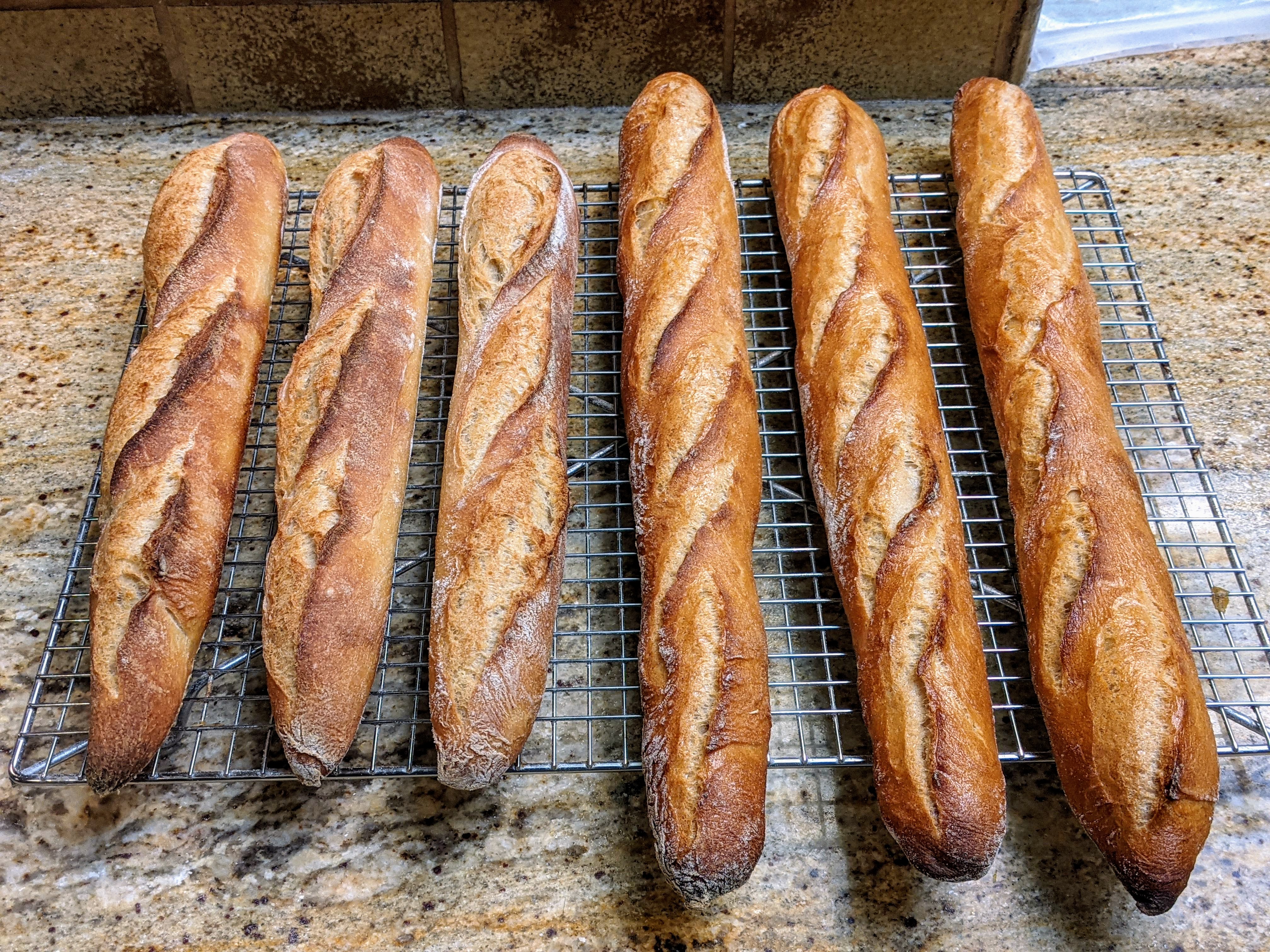
When you’re new to making baguettes – this included me when I first started making them – there’s a mistaken belief with scoring that the loaves are scored in a diagonal fashion. Technically, they are, but not nearly at the extreme angles that many beginners score them. I’ve seen otherwise gorgeous, straight loaves online whose aesthetics were essentially ruined by improper scoring.

To be honest, there’s no big secret or special technique to score baguettes. Just remember this: Use shallow angles! The diagram below illustrates the angles you should be using:

In both the top and the cross-sectional views, the proper scoring and blade angles are much more shallow that what most might think. From the top, the lines are long, starting from the center of the loaf, and deflecting just a few degrees. The blade angle from the cross-section is absolutely critical as it creates a flap which will produce that distinctive ear that you see in the picture immediately above.

Especially with baguette scoring, you need to be assertive in your strokes. Avoid making choppy motions with your scoring and do your best to be as smooth as possible. Also, aesthetically – and according to Master Chef Jeffrey Hamelman – an odd number of scores is much more appealing to the eye than an even number.

Why Haven’t I Gotten One of These Until Now?!!

After waffling on getting a Danish dough whisk, I finally pulled the trigger on one yesterday and it landed on my doorstep this afternoon. To be honest, I thought it was just a bit of a gimmick, but now that I’ve got one and having used it to mix up a batch of baguette dough for tomorrow, I’m kicking myself!

It’s truly an ingenious contraption. The large loop acts as a scraper and lifts the flour up, while the inner loop and its smaller loops and their “arms” break up lumps and provide the mixing action. And this simple-looking contraption makes absolute quick work of mixing dough and not only that, where using a scraper or my hand to mix, I’d invariably catch some flour in a scooping motion and it would fly out of the bowl and onto the counter – or my clothes! But this didn’t happen once while I used this whisk to mix my dough and I was being fairly vigorous.

The one I got was a larger one: About 13″ in total length. I’ve seen some smaller ones, but I can see how this will work great with a variety of dough amounts. This really is one of those things that look like it shouldn’t work, but it just does.

And why I waited so long to get one is beyond me… No more dough-covered hands! Full stop.

You Gotta Love Happy Accidents

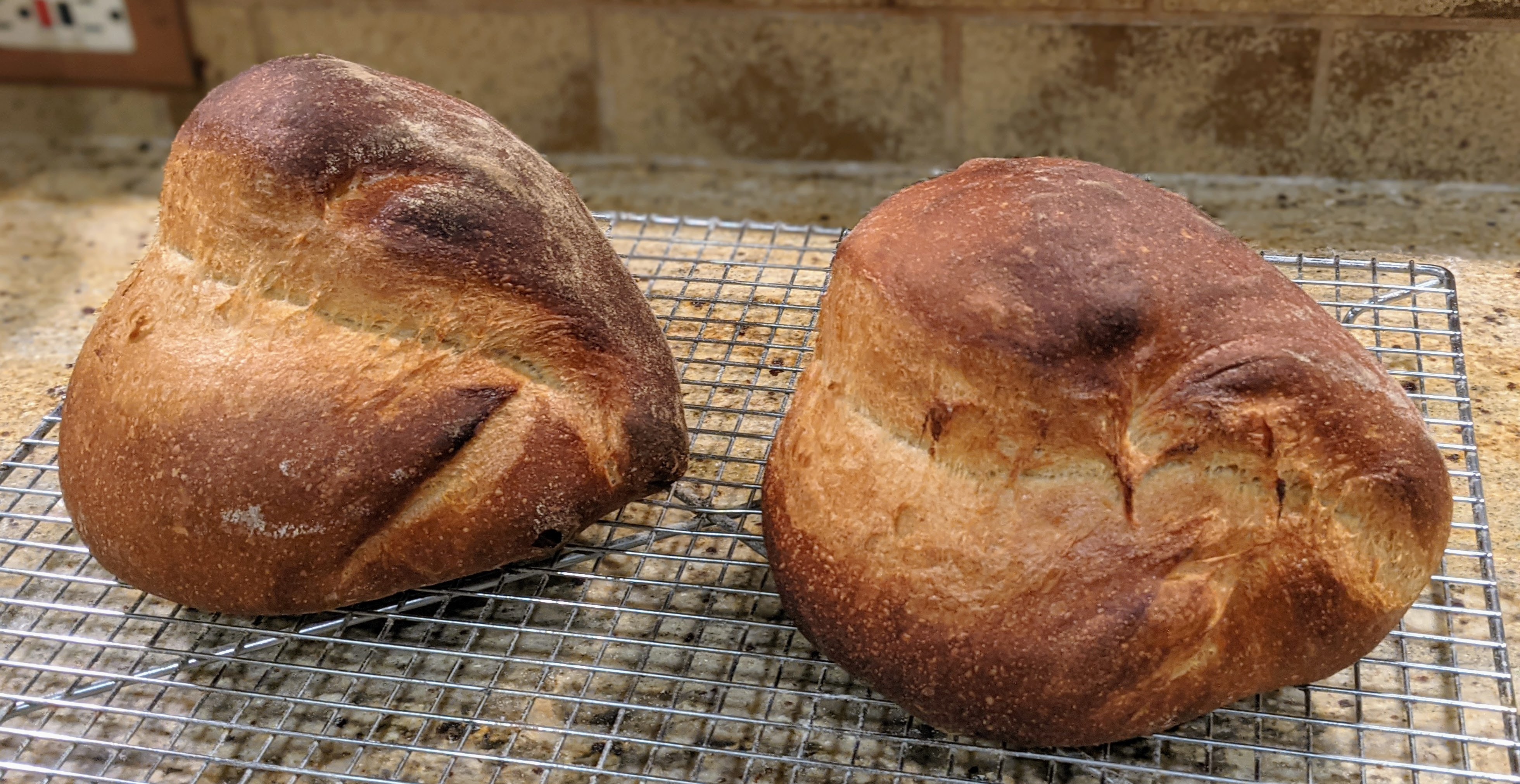
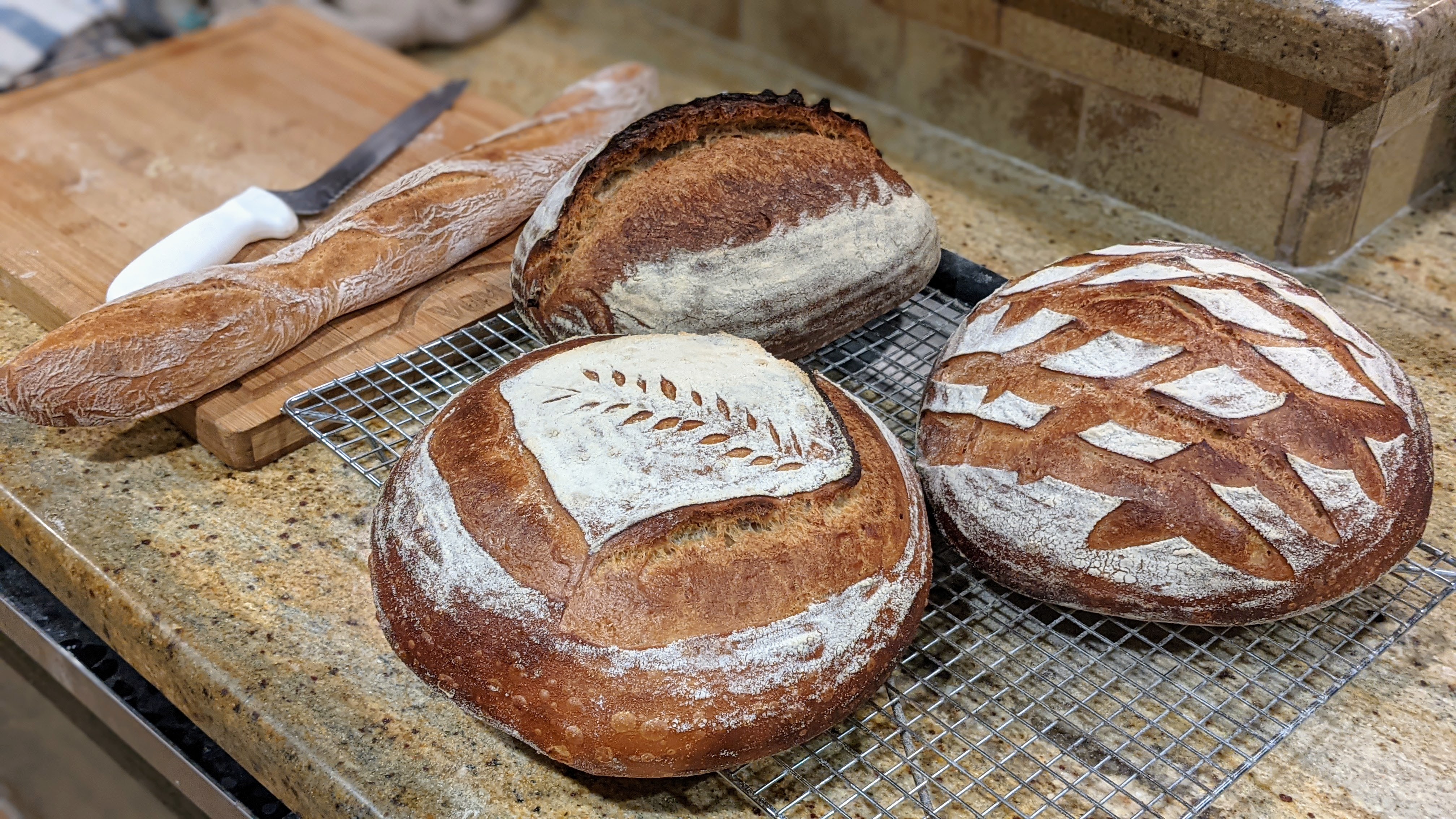
Shown above are the remnants of my latest bake. I made three batches of dough yesterday for baguettes, 3 rustic sourdough loaves and two Poillane-style “hugs,” which are the two loaves in front. They’re about a foot in diameter!

The first two dough batches went without incident, but when it came to the hugs, while the dough was mixing, I noticed that it wasn’t coming off the sides. Then I realized that I used the wrong calculation for water! I used way too much for that formulation and the dough – if you could call it that – was like a thick pancake batter.

Now I could’ve added flour to thicken the dough to the right consistency. But to tell the truth, that has never worked out very well for me. So I decided to go with it and challenge myself to work with a super-high hydration dough. By my calculation, the hydration only got bumped up to 80%. But because the flour blend I used was 60% AP flour, it felt more like the consistency of an 85%+ hydration dough. So given that, I knew that developing the gluten was going to make or break that bake.

Initially, I resolved to employ a 6-fold folding schedule over three hours ala Tartine. But after the first fold, which was more like running my hands through batter, I realized that I’d probably have to do more folding sessions. In the end, I only had to fold the dough 8 times over the course of three hours, doing the last four folds in 20-minute intervals for the back half of the three hours. I then let the dough rest for another hour to let the starter yeasts do their thing, then I popped my container into the fridge for an overnight rest.

What was truly amazing was witnessing first-hand the dough transform from a batter to a well-formed, well-structured dough! As I performed my folding sessions, I could feel how the gluten was developing. At this hydration, it was never going to be stiff, but I could tell that it was strong by the time I finished the last fold. I was able to stretch the dough with the window-pane test with nary a tear!

Twelve hours later, I removed the dough from my retarder fridge and saw that it had more than doubled, with nice, large pockets of fermentation. Preshaping was a bit of a challenge because the yeast was pretty active as you can see in the photo below.

But what was truly incredible was how the dough balls maintained their structure while they rested. Yes, they spread out a bit, which was to be expected, but they didn’t become pancakes. Mind you, with the dough being predominantly AP flour, had I not spent that time developing the gluten, they would’ve collapsed easily.

I could tell that I was getting close to full fermentation, so I did a cold final fermentation for another 4 hours. I’m glad I did this because had I let the final fermentation go at room temperature, I would definitely over-ferment the loaves. In the end, the loaves were very close to full fermentation, but despite that, I still got pretty good oven spring.

The thing that concerned me the most was with the size of the loaves – which I knew would bake out to about a foot in diameter – was that at that hydration, they’d collapse under their own weight. And within the first few minutes of baking, I was horrified to see how they had pancaked out on my stone. But I trusted the steam to do its work and the yeasts to play out – besides, at that point, what the hell could I do?

But the loaves sprung up nicely despite my initial concerns and while I wasn’t expecting a super-open crumb with huge holes, the crumb opened up nicely; looking very much like a Poillane-style loaf inside.

As far as taste is concerned, these loaves are nicely sour, though not overpoweringly so, despite the starter being about 35% of the final dough flour. The crust is thin and crispy and the crumb is light, chewy and moist. With 40% of the flour being a mix of white whole wheat and high-extraction flour, you can taste the nuttiness of the grain as well. Overall, this is a flavor profile that I really enjoy.

So… all in all,

Here’s the original formula, in case you’re curious:

Baker’s %Example (g)
Flour100%1153
Water76%828*
Salt1.8%24
Starter35%407
Total2412
*The “mistake” I made was that I used 928g of water that pushed hydration over 80%. Damn! I wasn’t even drunk! 🙂 Even for experienced bakers, that hydration level with AP flour is a real challenge!

I know… 2412 seems like a weird number, but I always add a process loss fudge factor of 1% to my calculations because I know that I’ll lose dough in the process. My idea was to be able to scale out 1200g portions. With this particular bake, I only lost 4 grams, so the portions were 1204g apiece.

For folding, as I mentioned above, I did 8 folds in a 3-hour period. Because the dough was so delicate, I did nothing but coil folds. But as opposed to folding one side, turning 90-degrees, then doing the other side and letting it rest after that, I’d coil fold at least 3 times, carefully stretching the dough. After the final folding session, the dough held up quite nicely. I knew it was going to spread out eventually, but it more or less held its shape for several minutes. It was a real feel thing.

Luckily for me, the loaves turned out great. It truly was a happy accident!

I Love Baking with Kamut Flour!

I love working with ancient grain flour. To me, there’s a certain romance to working with grain that bread makers have used for thousands of years. To think that I’d be working with flour made from grain that bakers from ancient civilizations used makes my mind wander back to those ancient times and what it would have been like to bake back then.

Kamut, which is the commercial name for Khorasan wheat is an ancient grain that I discovered several months, but with which I only started recently baking. Its exact origin is unclear, but it is named after a historical area called “Khorasan” which was a region in what is known as the Fertile Crescent in the Middle East. The predominant civilizations that occupied that area were the Mesopotamians and Sumerians. If they were cultivating and using that grain, we’re talking about a grain that was used thousands of years ago! And we’re talking about 5,000+ years ago. I don’t know about you, but to me at least, that’s incredibly exciting!

But other than the romanticism I’ve assigned to the grain, baking with Kamut flour is incredible. Similar to durum flour, it absorbs water slowly, so it requires an autolyse period. And like durum flour, once hydrated, it forms a luxurious, highly pliable dough. And again, like durum or other whole grain flour, it absorbs a lot of water. Most of the bread I make with it is in the 78-82% hydration rate range. Even at those levels, the dough is very workable and not too tacky.

Interestingly enough, Kamut has a lower protein content than durum and whole wheat. The Kamut flour I use from Azure Standard, is rated at 11.7% protein, which is along the lines of King Arthur or Bob’s AP flour. So I often mix it with a little vital wheat gluten to get the protein content to around 14%. The reason for this is that even though it is milled to a super-smooth consistency, it still is a whole grain and will tend to cut the gluten strands. Admittedly, I’m still experimenting with how much vital wheat gluten I add.

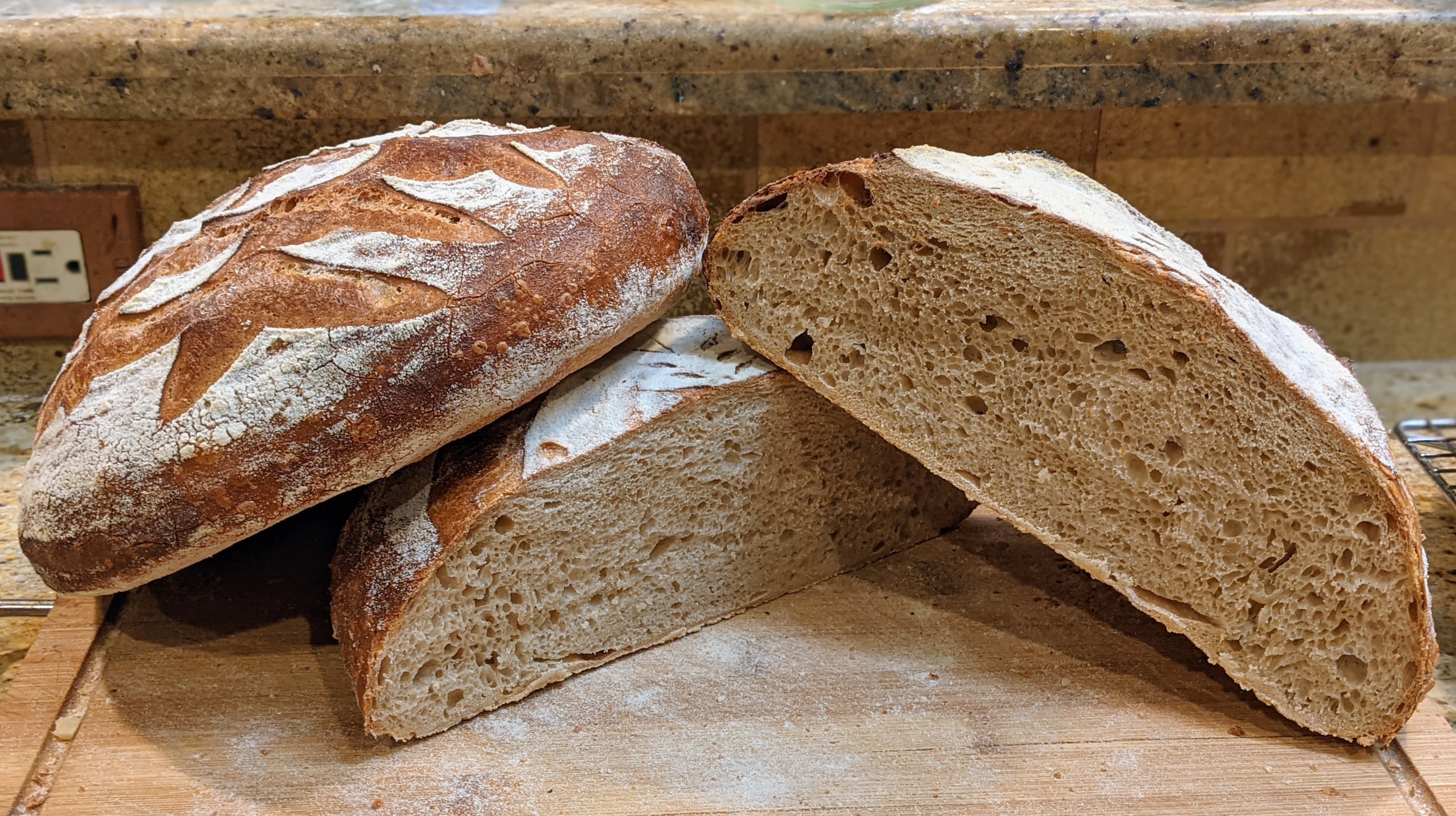
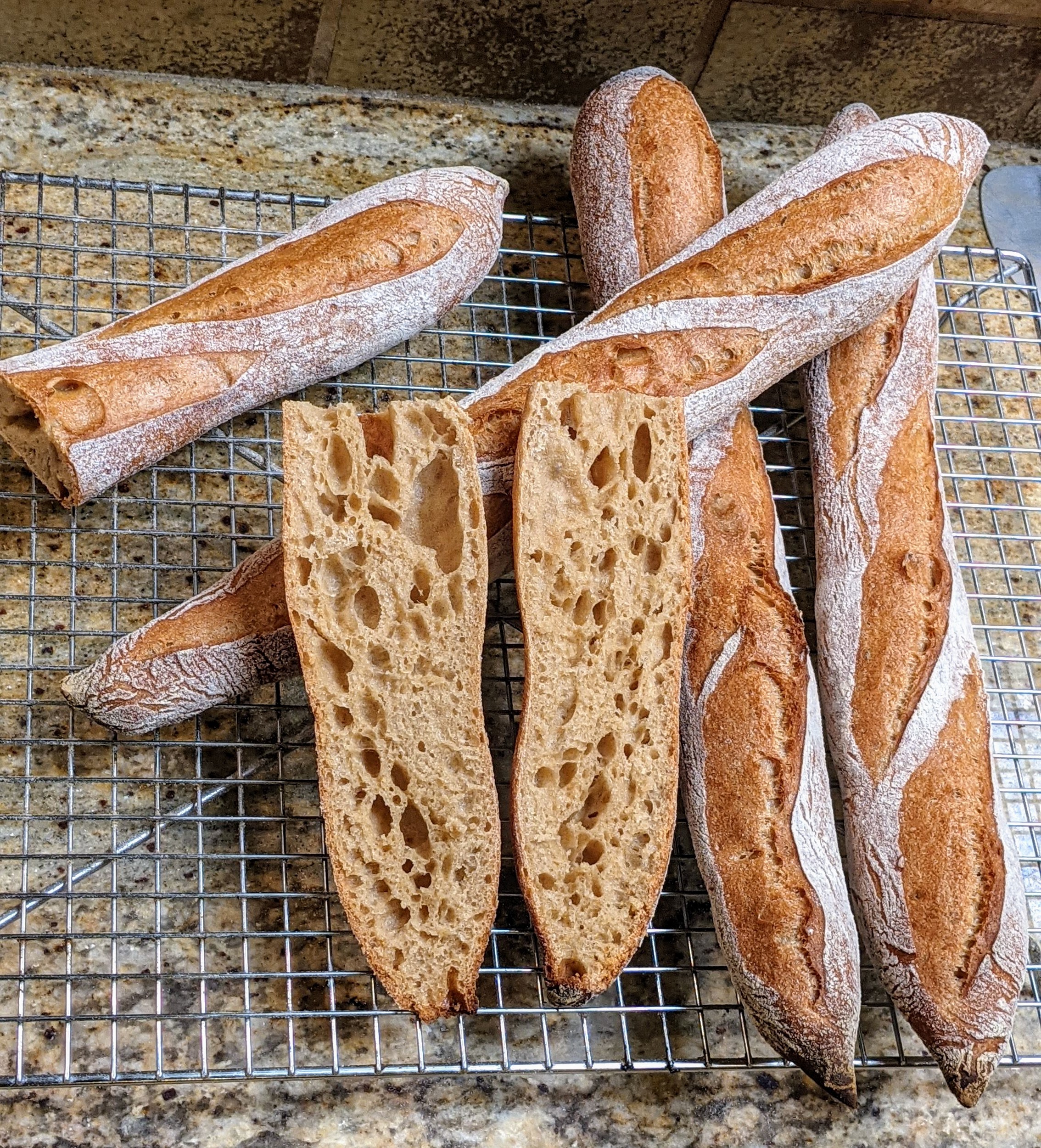
As far as baking is concerned, see the loaves in the picture above? They were all made with 40% Kamut flour. The baguettes used 20% high-extraction and 40% AP Flour, whereas the batards used 10% whole wheat (from the starter), 30% high-extraction, and 20% AP Flour. For the batards, with that much bran in the dough, I wasn’t expecting large holes. But look at the oven spring of those loaves! It’s absolutely incredible. The batards exploded in the oven. The crumb, though not possessed of big holes was still really light and airy. And the texture – OMG, the texture – was absolutely fabulous!

And don’t get me started on the taste. Kamut flour adds a slight sweetness and a definite nuttiness to the flavor of the bread. Even though it’s whole grain flour, you don’t get that grain-forward taste. The taste is akin to macadamia nuts, and it’s addictive. I gave one of the loaves to a friend who brought it over to her aunt’s for a small luncheon. The ladies loved it so much they ate over half of it at lunchtime, then according to my friend, they polished it off at dinner. That loave was not small, weighing in at over 2 1/2 pounds.

It also helped that the sourdough was made from a nectarine botanical starter I had just cultivated. The fruity notes in the starter definitely integrated well Kamut’s nuttiness. Even my family who has gotten pretty used to having artisan bread around loved that loaf. Many sandwiches and avocado toasts were made.

Along with durum, Kamut flour will most likely be a regular blending flour for me. Technically, I could do 100% Kamut, but it’s relatively expensive at $1.57/pound. Contrast that to Durum, which is $0.94/pound. I’ve got to stretch it to make it last. Plus, I can only get it in 25-lb bags, which is a bummer. I’d love to be able to get 50-lb bags. But Kamut has limited cultivation in the US, so it’s definitely not as available as other flour.

I’m so glad I discovered Kamut. Like I said, It’ll be part of my regular flour blend from here on out!

Still Splitting Hairs

In my previous post, I quoted the following originally from a New York Times article:

Mitchell Davis of the Beard Foundation believes that the bagel, like ketchup, is a product ill served by current food trends. ‘‘The effect of artisanship does not always produce a better result…’

While that article focused on bagels, the same can be applied to bread. Having done a real deep-dive into ancient bread making techniques over the last several months, I’ve developed a sensitivity to innovating too much. As I mentioned in my article, when I bake bread based on traditional recipes, I do my best to stick to the traditional ingredients and techniques.

Take, for instance, the humble baguette. While technically, it has only been recognized as a specific loaf called a “baguette” for only a couple of hundred years, it is steeped in a tradition of French long loaves that date back a few hundred years. And in 1993, the French government ratified into law (known as the Décret Pain) the ingredients that define the class “pain de tradition Française” of which baguettes are a part, as being made of flour, water, salt, and yeast.

That said, there is a little grey area with the leavening agent as Article 2, Section 2 states:

Fermented with yeast suitable for breads (Saccharomyces cerevisiae) and a starter, in the sense of article 4 of this Decree, or either yeast or a starter;

That kind of opens the door to using a sourdough starter to leaven the bread. But the general interpretation of a “starter” seems to be more along the lines of using a poolish, which is a yeasted starter.

Now, why does this even matter to me at all? Simply because what I’ve learned about baguettes is that they’re not defined by their shape, but by their dough. I know, you see a long, thin loaf of bread with diagonal scoring along the length, and you immediately say, “baguette.” And I suppose that to the consumer, it doesn’t matter. But now, when I see “sour” or “sourdough” preceding “baguette,” I know, based on my research, that loaf is technically “pain au levain” or bread risen with a levain.

Furthermore, circling back to “the effect of artisanship does not always produce a better product,” I’ve often found myself innovating for innovation’s sake. It’s not that the end product is bad by any means. But at least for me now, when I call a certain bread a particular type, I want to make sure that I’m not coloring outside the lines.

One of the things I was concerned about when making my baguettes was the mix of flours I was using. I typically use a combination of 60% high-extraction flour and 40% AP flour – both unbleached, so the crumb of my bread tends to be on the brown side. Luckily, the Decret Pain states in Article 2, Section 1:

Made only from a mix of wheat flours suitable for making bread, safe water and cooking salt.

I admit that I’m being a bit parochial. It’s actually a little out of character for me to so strictly observe tradition. If you knew me as a contemporary Catholic liturgical musician, you’d know that I’m not much of a traditionalist. Even in my career as a software engineer, I forged my path in technology as a visionary and innovator.

But with bread, it’s a completely different story. Don’t get me wrong, I have a few different types of bread that I make that are innovations on traditional recipes. But when it comes to making traditional bread, I’m pretty parochial. I have a real “if it ain’t broke, don’t fix it” attitude.

Some might say it’s limiting. But there’s a lot to be said about mastering the traditional techniques. As I journey forward in bread making (and yes, I have aspirations of eventually doing this professionally), I want to make sure that my technique is steeped in tradition.

Plus, some of the techniques are just downright difficult to master. Take the ancient Italian bread, Pane di Altamura, for instance (shown to the left). This is 100% durum wheat bread from the Altamura region of Italy. It is a very distinct-looking loaf, sporting a pompadour of sorts. The dough itself, like pretty much all Italian bread, is uncomplicated, as is the dough processing. But learning to shape that bread is a different story altogether. It has taken me several bakes to even approach what it should look like.

There are no instructional videos that teach how to shape Pane di Altamura, so I’ve had to watch slowed-down videos, of which there aren’t very many. And though the bread is distinguished by the region where it comes from, different bakers achieve the pompadour in slightly different ways. But luckily I did run across a video that had a close-up view of how one baker shapes his bread and I’ve been using that.

The point to this is that with this particular bread, there’s really no room for innovation. I suppose I could eventually tweak things here and there, but before I can do that, I need to master the basics first.

Speaking of tweaking, a few months ago I had a realization that I got to the point where I was innovating so much that I wasn’t getting consistent results. I was making tweaks everywhere. But it wasn’t until I stopped myself and stuck with a method that I started getting consistent results.

This was evident in my baguettes. I was trying a lot of different techniques and my results, while tasty, weren’t consistent at all. I now focus on two production methods depending on when I want to bake. I use a pointage en bac or slow rise method for flavor development that I learned from Chef Markus Farbinger (which is also my normal two-day method) or, if I want a same-day bake and a more grain-forward taste, I use the baguettes de tradition method that Jeffrey Hamelman presents in his book “Bread.”

But in both cases, I use the same shaping technique that I learned from Chef Farbinger. Now, no matter what dough development technique I use, my baguettes come out looking the same. It’s comforting because as simple as the ingredients are in baguettes, they’re probably the most challenging bread to get right. And shaping is absolutely critical, which is why I use the same technique for both dough production methods. Besides, if it’s good for a master chef, it’s certainly good for me. 🙂

Don’t get me wrong. I’m not at all against innovation. But as with anything in life, you have to be well-versed in the foundational aspects of different bread before you can branch out. But here in America, it’s almost expected to “do your own thing” and there’s this seemingly pervasive attitude to innovate for innovation’s sake. And I think that’s where many people run into the proverbial brick wall or worse – they come up with some pretty funky creations (the funkiest I’ve seen are blue croissants).

At least for me, I do heed those words Mitchell Davis wrote: The effect of artisanship does not always produce a better result.

Sticking with Tradition

I recently read an article on Medium discussing how Boichik Bagels in Berkeley was voted the Best Bagel in America by the New York Times. I don’t know that I’d agree as my local bagel shop that I’ve been going to for almost forty years has great bagels. But I’m not here to debate that. What struck me in the article though was the following:

…When the New York Times last considered West Coast bagels in 2015, their conclusion was that West Coasters couldn’t make a good one because they tried too hard to innovate. Rather than putting in years of practice to hone and perfect old-world techniques — and to obsess over tiny details like the alkalinity of their water — they tried to create new twists on the traditional bagel, adding in sourdough starter, cooking up gluten-free varieties, and the like.

With bagels, Mitchell Davis of the Beard Foundation told the Times in 2015, “the effect of artisanship does not always produce a better result.” A great bagel is fundamentally traditional, steeped in long-developed cultural trends and a peoples’ collective memory. It’s not something that benefits from “updating” or from the artisanship and personalization which West Coast chefs often bring to their trade.

Reading those two paragraphs above struck me like ton of bricks!

Though my return to baking started out with just wanting to make a decent loaf of bread, my journey since then has led me to doing my best to replicate old world techniques in the modern age. It harkened me back to a recent conversation where a close friend suggested that I make sourdough baguettes.

I make sourdough baguettes from time to time, but technically, baguettes are typically yeasted breads, using a poolish preferment, or a simply a straight dough as in the pointage en bac or baguettes de tradition methods. To me at least, baguettes using a levain are different. Don’t get me wrong. I love the taste, especially when I use one of my botanical starters. But I normally call the bread I make with levain Sourdough French Bread as opposed to being called a baguette. By French law, breads made with a levain are called “pain au levain.”

I realize that I’m splitting hairs, but if there’s one thing I’ve learned in my journey: I don’t like to mess with tradition with certain loaves. I may try different methods; for instance, I’ve learned 5 different approaches to make baguettes, but for the most part, I do my best to stick to the traditional methods where I can. This especially rings true for the ancient Italian bread that I make like Pane di Como Antico, or Pane di Altamura. These have literally been made for thousands of years. Who am I to tweak them?

That said, I’m not a curmudgeon. I innovate all the time, experimenting with different flour mixes or adjust protein levels or hydration or even levain amounts. But if I’m making something I intend to call by its traditional name, I pretty much follow the traditional method.

As Emily Winston, owner and chef of Boichick bagels said:

I wasn’t trying to be an innovative chef, and I wasn’t trying to make something new. I don’t have a horse in that race,” Winston said. Instead, she was “trying to make something that already existed…

That totally reverberates with me. With the traditional recipes I use, I really don’t want to be an innovator. Obviously, I can’t copy everything that was done hundreds or even thousands of years ago, and I certainly don’t have a stone hearth oven. But I do my best to observe the ingredients and processes that are in the recipes. I’m trying to make something that already existed, that has hundreds or even thousands of years of tradition behind it, not to mention bakers who have devoted their entire lives to making that bread. For me at least, I think it’s super important to carry on that legacy where I can.

Happy Baking!

Working Backwards… Or, Thank Goodness for Formulas!

Once I started getting into more advanced recipes, be they sourdough or straight dough, and especially reading books like Jeffrey Hamelman’s “Bread,” which focus heavily on production, it made me start thinking in terms of yield. That is, how much dough should I produce based on the size (weight) of the loaves I wanted to make.

For months, I kind of flailed around using a kilo of dough for pretty much everything, then dividing it up into equal portions. But frankly, that wasn’t very efficient, and it certainly lend itself to consistency from bake to bake.

Why? Simply because if you tweak anything, it changes the weight of the final dough. For instance, let’s say I always use 1 kilo of flour. If I’m making baguettes, I know that I want my hydration to be 75%. Easy enough, the final dough’s flour and water will weigh 1750g. But what if I wanted to drop the hydration to 65% using the same amount of flour. That weight would drop to 1650g! See what I mean?

So what I needed was a way to calculate the ingredient amounts I’d need based on the final weight of the dough. For instance, if I’m making baguettes, my 20-22 inch baguettes should weight 350g apiece. If I want to make 8 baguettes, then I should produce 8 X 350 or 2800g of dough. That’s all well and good, but how do I calculate how much flour, water, salt, and yeast I’d need? This is where the baker’s formula comes into play.

Basic Calculation

Let’s take a simple straight dough baguette formula. In Hamelman’s book, the overall formula would look something like this:

Flour 100%
Water 76%
Salt 1.8%
Yeast 0.25%
Total: 178.05%

When I first saw a formula listed like this, I have to admit that I was totally confused about the number that added all the percentages together. What I later found out is that number is the key to calculating the amount of flour in a recipe based on the final weight of the dough! You simply divide the final dough weight by that number, and you get the total flour in the recipe!

So taking my need for 2800g of dough, the flour I’d need would be 2800 / 1.7805 which calculates to about 1573g, rounded-up. From there, it’s easy to calculate the water, salt, and yeast.

Factoring in a Preferment

A mistake that I used to make and what I see in some books, a lot of blogs, and forum posts is treating a preferment (starter, levain, poolish, biga, etc.) as an ingredient. For instance, saying to use 10% starter. A preferment is simply not an ingredient. It’s a dough development stage; that is, it is part of the overall dough formula and thus the weight of its constituent contents is what’s meaningful, not the preferment itself.

Why is this important? Think about it this way: Let’s take the 1573g grams of flour that I’d need to make my baguettes, for example. 10% of that would be 157g. But if we add 10% of that to the recipe, treating the preferment as an ingredient, we’ll completely throw off our weights. Remember, we’re after a final weight of 2800. If we add 157g to that, we go up to 2957g. Not good.

Furthermore, different preferments will have different hydration rates. If we use a 200% hydration liquid starter, that’ll completely screw up the hydration that I want to be at 76%; not by much, but enough to make a difference in how the dough performs.

So the better approach to take is to consider the flour content in the preferment as a fraction of the total flour, then subtract the flour and water in the preferment from the overall flour and water to keep the final weight the same. With this method, we ensure that the preferment is truly a fraction of the overall dough and not an added ingredient.

The spreadsheet below is something I put together to help me calculate my ingredient amounts for pretty much any kind of bread that I make. I’ve included various other ingredients that I might use. It all goes into the calculation. It’s also available on Google Spreadsheets. Just copy all and paste it into a new sheet.

This has become an invaluable tool for me in calculating exactly what I need to bake all sorts of bread.

Baking Bread on “Staycation”

Making a biga for ciabattas this afternoon!

So… I’m sitting here in Waimanalo, Oahu, Hawaii where my wife rented a house for a couple of weeks so we could all “work from home” away from our real home for awhile. We arrived in the early evening and went out for dinner last night, but we spent WAY too much on dinner, having dined at one of Guy Fieri’s Triple D restaurants, Uahi Grill in Kailua. It was good, but nothing spectacular.

I had the poké which was pretty good, but to be honest, Fresh Catch in Kaneohe is WAY better; so is the poké at Foodland Supermarket – and they have 10 different varieties that they make fresh every day! But I digress…

Anyway, after getting over the initial shock of spending over $200 on dinner last night (it’s not that we can’t afford it, it’s just a lot to pay for okay food), since we rented a house, I promised my wife I’d go grocery shopping the next day and get provisions so I could cook dinner most of the nights we’re here.

So early this morning, I drove to the local Foodland to pick up groceries and, of course, today’s supply of poké. On the menu, at least for the next couple of days, are some traditional Filipino and Hawaiian dishes like Pork Adobo and Pancit and Spam Musubi.

While I was going down the Rice and Pasta aisle, it just happened to be the baking goods aisle as well. I was not intending to bake on this trip. I was going to take a little break. But the kids wanted to make sandwiches for lunch and I’m sorry, even though Foodland bakes their own bread and it’s pretty good as grocery store bread goes, I just can’t get myself to buy grocery store bread any longer.

As I’m writing this, I looked up at my wife who’s sitting across the kitchen table from me and said, “I ust realized that I haven’t bought a loaf of bread for over a year! There’s just been no need.”

My aversion to grocery store bread was strong enough to overcome my wanting to take a bread from baking. Yeah, I’m pretty obsessed with baking, though not so crazy as to bring a starter with me. But truth be told, baking on this particular trip is purely practical. I’d rather bake my own bread where I know exactly what goes into it, than buy bread that has additives and preservatives in it.

Luckily Foodland had some King Arthur flour and Red Start Active Dry Yeast on hand. Niether were cheap, but I’ll be making ciabattas later today (I’ve got a biga started). Technically, I probably could make baguettes as well, but I’ll see how it goes with the ciabattas first.

The challenge here is that I have no scale, so I’m going to have to pretty much eyeball everything. As I wasn’t planning on baking in the first place, I didn’t even bring my trusty, compact precision scale which I could’ve easily packed. But hey! After watching several shows of people making traditional breads by hand, and owing to the fact that I bake so much that I’ve learned to determine a dough’s consistency by look and feel, this won’t be much of a problem for me. In fact, I’m pretty excited!

Every time I bake, I get this excited feeling. At least for the past year since I’ve put a lot of energy into artisan baking, I get this anxious feeling in the pit of my stomach. But it’s a good anxious; that anxiousness of anticipation, and I just can’t help but smile. I have to admit that I’ve been the happiest I’ve ever been since I picked up baking.

Even when I’m doing my charity projects where I’m baking a bunch of loaves at once, it’s like my brain releases a flood of serotonin into my bloodstream, and my feelings of well-being and happiness go straight through the roof! Is it weird? Maybe. But I’m addicted to the feeling.

Well, I just realized that I forgot to get a small bottle of olive oil, so I need to go out to the grocery store again…

Happy Baking!

P.S. Here’s what the finished product looks like!

Recipe: Biga Baguettes

I needed to make lunch for the family tomorrow and I didn’t figure out what I was going to make until too late. I knew that I wanted to make sandwiches, but I wanted to make them on baguettes. But since it was late afternoon by the time I was going to start making them, my recipe options were a bit limited. I couldn’t make my normal Pointage en Bac baguettes which require an overnight cold fermentation (I had to have the sandwiches prepared early in the morning). That also left out making a poolish.

But what I did have on hand was some nice, ripe biga that was in my fridge. So I pulled it out of the fridge, let it warm up for an hour or so, and started preparing the dough. They turned out fantastic! They’re so good that I thought I’d share the recipe.

Biga

Make the biga the night before you bake. This will make a lot, so put the unused portion of the biga in the fridge in an airtight container. It’ll keep for over a week. It’s actually much more flavorful a few days old. The biga I used for my baguettes was five days old and had a rich and slightly sour flavor. Here’s the formula:

Flour500g100%
Water390g78%
Yeast0.25g0.05%
Biga will be ready to use when it has doubled in size and is slightly domed at the top.

Final Dough

AP Flour500g100%
Water* (warm)390g78%
Salt10g2%
Yeast4g0.8%
Biga200g40%
*Target dough temp is 78-80° F

The process we’re going to use here is loosely based on Hamelman’s Baguettes de Tradition which is a great recipe for making straight dough baguettes.

  1. Sift the dry ingredients together and set aside then mix the biga and water together until biga is broken up. Add the wet mixture to the dry ingredients and mix thoroughly, making sure there are no lumps (there’s shouldn’t be if you sifted the dry ingredients together). Mix until you form a shaggy mass. Don’t worry if it resembles more of a batter than a dough. It’ll all smooth out and come together nicely.
  2. Bulk ferment for 3 hours. During the first hour of bulk fermentation, fold the dough every 20 minutes. I recommend doing stretch and folds as opposed to coil folds as this is a fairly fast fermentation and the commercial yeast will expand the dough nicely. By the third fold, the dough will have built up plenty of strength with noticeable bubbles. Try not to degas the dough too much with the third fold. Let the dough rest for 2 hours or until it has nearly doubled.
  3. The yield will be about 1100g, which will give you 4 20″ baguettes at about 276g apiece. If you’re using a 15″ length, it will make 5 baguettes at 220g apiece. Divide and scale out the size that works for you. With each piece, lightly flatten, then letterfold it, then gently roll it into a compact log. Place each piece seam side up on a well-floured couche or tea towel. Bench rest for 20-30 minutes or until the dough has relaxed.
  4. Shape into baguettes and let rise for 1 hour or until loaves have reach about 75-80% fermentation.
  5. Bake at 485°F for 12 minutes with steam, then 425°F for 8-12 minutes. Note that the baguettes will not be very dark.

What amazed me about these baguettes is that despite the fact that I baked them for much longer than the final 12 minutes they didn’t get darker than when the time was up. But no matter, the crust on these baguettes is thin but very crisp and the crumb is super-soft. The crumb isn’t really open and pockmarked with holes, but it it’s super-light – almost like a banh mi crumb.

When I pick up a baguette and it feels as if it has very little weight, I know it’s going to be a great baguette, and these baguettes are great!

Happy Baking!

Arnold Palmer: “The Road to Success Is Always Under Construction”

Those who know me know I have kind of an obsession about golf. I learned the game kind of late – at 18 years old – but from the moment I picked up a club, I was hooked. Absolutely hooked. I even moved to Las Vegas in the hopes of eventually becoming a PGA teaching pro. That didn’t happen for me for lots of reasons but my love for the game of golf has never wavered.

One of my golf idols throughout my playing career has been Arnold Palmer. To me, he was a man of the people. Though he had four green jackets from winning The Masters four times, he was always known to be totally accessible to his fans. But not only that, he carried a wisdom with him that he readily shared.

Arnie’s words of wisdom that I shared in the title of this post have inspired me through the years. I don’t remember when he said them (and I realize this quote is also attriuted to Lily Tomlin), but I remember that when I heard them, it was during a particularly difficult time in my life where I was struggling to figure out what I wanted to do. And upon hearing those words, I was inspired; inspired to keep on charging forward, to keep on working. To never quit.

I’m at that point with my bread making right now. I’ve started working with more difficult formulations and techniques and while the bread is coming out delicious and to the untrained eye it looks fine, I’m not satisfied. I’m not getting an ear with my many of my loaves as of late and it bugs me.

But this afternoon, I sat down at the TV to watch the Arnold Palmer Invitational golf tournament and right before a commercial break, they showed a statue of Arnold Palmer with the quote right next to it. I just smiled because I knew that though I’m frustrated right now, I just have to keep on working at it.

Plus, I realized that I should know better. I’m working with much more advanced formulations and techniques and I need to practice before I get the results that I’m expecting I should get. It’s a road that’s definitely under construction!

Happy Baking!