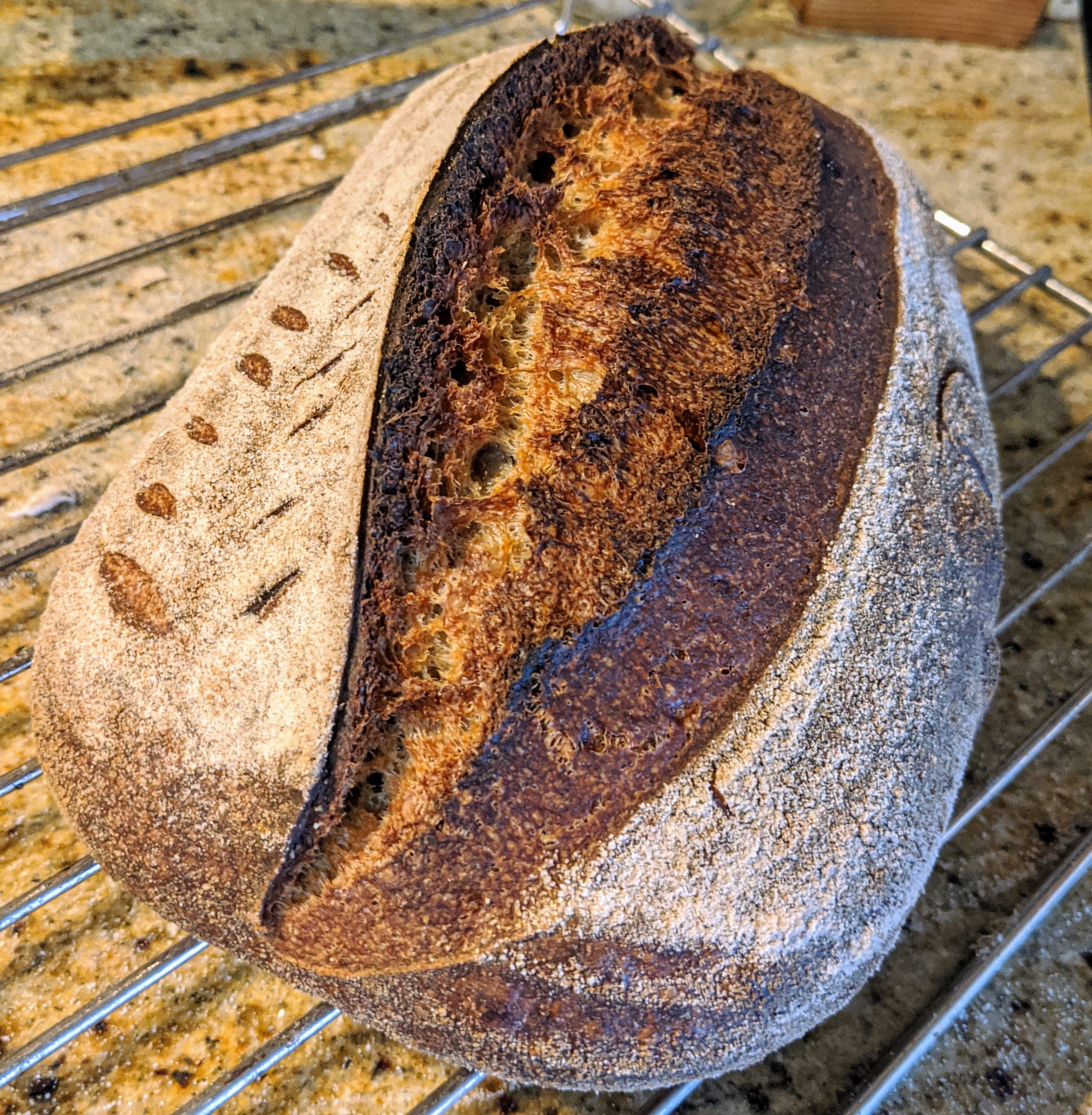
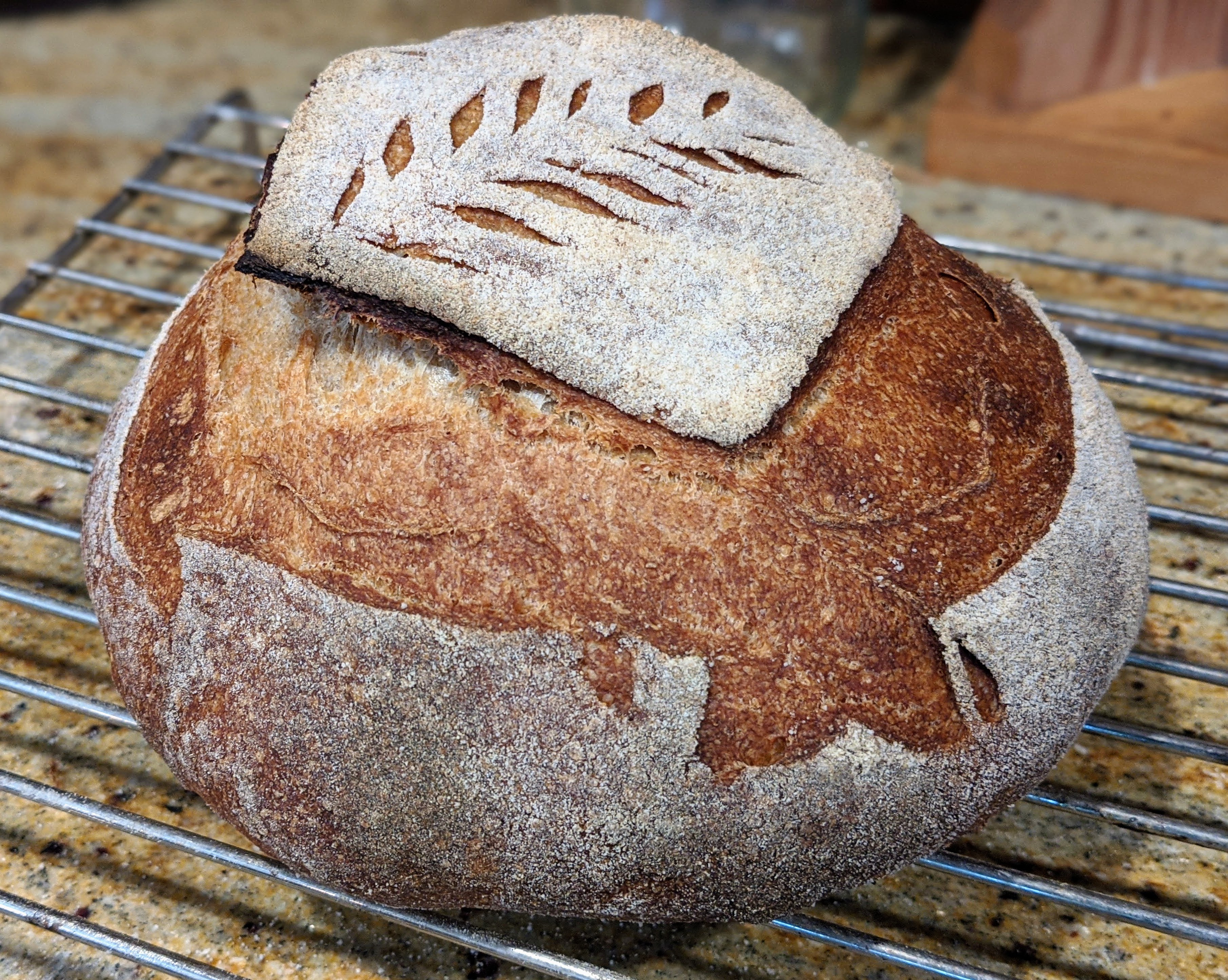
That loaf above is supposed to be a boule. And to the untrained eye it looks fine and truth be told, it’ll taste great. I’ve really gotten a handle on my sour poolish! But see the white bottom? That’s a telltale that it wasn’t proofed long enough, and the oven spring was uneven through the loaf. Here’s an extreme example of under-proofing that I’ve shared before:
With those loaves above, I was really impatient! Actually, I was over-excited. I got a great rise in my bulk fermentation, and I got a little over-zealous… 🙂
But back to my most recent fail… Rather than get mad about it, I just laughed. In fact, ever since I started making bread, I’ve really had to learn to laugh at myself and my blunders. Despite the fact that I’ve come a long way in a fairly short amount of time, I’m still a novice at this. I’ve certainly gotten to the point where I can consistently make a good loaf of bread. But I also have accepted that I haven’t experienced all the pitfalls and of this craft and there will be times when things don’t go as expected – like this time.
Admittedly, it’s a challenge for me to not freak out. As a Type 4 on the Enneagram scale, I’m highly individualistic, self-motivated, and driven to excellence, which can easily devolve into perfectionism which, in turn, can lead to self-loathing and depression. But enough of the psychoanalysis! Let’s just say that I’m driven to always do a great job, and when I fall short, it’s easy for me to get down on myself.
So to combat this, I remember that making bread is a joyful experience. After all, I’m doing it purely by choice and not for survival. And besides that, there’s always another loaf to bake! So when I screw up a loaf, I laugh at my blunder, take stock of what I could’ve done differently. Then I move on.
And this has been a valuable reminder and lesson for me in my life in general. Especially with all the stuff about image that we’re bombarded with day in and day out, it’s so easy to take ourselves way too seriously. I’ve done that in the past, but that has led to pretty dark places that I never want to visit again. So I remember the joy and I laugh at myself!
The one positive thing that has come from this pandemic lock-down is that a lot of people – myself included – have started making bread. And many like me have learned how to make bread using the traditional methods which involve manually working the dough, either through the entire process, or at least a good portion of it.
I freely admit that I’m in the latter camp. I do all my initial mixing of ingredients in my trusty stand mixer; not because I’m lazy, but because it does a better job of creating a consistent mix. I started out doing all my mixing by hand so I knew what it was like and once I felt what a good mixed dough should feel like, I switched to using my stand mixer. But I did make a promise to myself that I’ve never broken: After doing the initial mix, I would work the dough – either kneading or folding – entirely by hand.
The reason is that there’s really nothing like working a dough and seeing it transform from a shaggy mess into a smooth, pliable ball if I’m kneading it or; if I’m working with a high-hydration dough, feeling the dough transform from a wet, gooey, and sticky blob into a cohesive network of gluten strands that gradually resist my ministrations. Plus, it just FEELS good as the dough becomes smooth and luxurious. And the ONLY way to see and feel the transformation of the dough is by touching it and working with it with your hands.
What I’ve come to realize is that artisan bread is really not about creating beautiful loaves of bread. The loaves are a by-product of the artisanship and craftmanship in the process leading up to actually baking the dough. For instance, look at this antique hutch that’s sitting in my dining room:
That was handmade in the 1930’s and restored by a local artist. The door panels were hand-carved. And even after all these years, according to the artist who restored it, it was crafted so well that even after all these years, it was so structurally sound that all she had to do was clean and refinish it.
The craftsmanship of bread is similar. In order to create a beautiful loaf, you have to build the structure of the dough. Just like you don’t throw random pieces of wood together to create hutch like the one to the left, you don’t just throw ingredients together and expect to create a loaf of bread that’s aesthetically pleasing, both in taste and visually. So in essence, the craft in bread is in manipulating the dough: Working it with your hands, adjusting hydration, the type(s) of flour; even the salt and yeast. We do this to create a structurally-sound base on which our dough will bake.
And the thing about baking bread is that it’s not forgiving. Even if you’re simply following a recipe you find online, to achieve the result that you see in the pictures the author provides, you have no choice but to apply at least some craftsmanship to the process. I think that’s the reason why so many bread recipes you read are incredibly verbose.
The bakers who write them know that there is an inherent and unavoidable craftsmanship in baking bread. They provide the gotchas and pitfalls because they know that there are lots of variables that affect the structure of the dough. And invariably, almost all the recipes involve some sort of manual handling of the dough because the bakers also know that it’s difficult to understand how a dough is being affected unless you physically touch it!
But to me, as I’ve alluded throughout this post, feeling the dough is incredibly sublime and pleasing. As I write this article, I’ve been taking breaks to fold a dough I created this morning. I just popped it into my fridge to bulk ferment for 24 hours. That dough gave me the inspiration to write this article. From the first fold to the final fold, the dough went from a slightly shaggy pile to this gorgeous, velvety-smooth ball that I could stretch and stretch without it tearing. It’s so satisfying! And I wouldn’t have known this if I did use my hands.
When I first started baking bread, I followed recipes that listed ingredients by volume, and I stuck to them because that’s all I knew. But looking up recipes online and in books, the bakers always provided weights and percentages, stating that it was easier to remember the specific ratios of ingredients and more importantly, be able to scale up or scale down the recipes as needed.
But I resisted because I fashioned myself an expert in the kitchen. Cooking was and has been my lifelong passion and I just knew my way around a kitchen. Bread? Pah! I could do it, no problem! And I did do it! To make my first loaves, I followed the same basic recipe and made my bread in a Dutch oven. But like I said in a previous post, I quickly got bored of making boules.
Then on top of that, for Fathers Day, my son got me Ken Forkish’s Flour Water Salt Yeast and he wrote out all his recipes in grams. And though he provided volume equivalents, rightfully so, he did say they were approximations at best. But in my arrogance, I just followed his volume listings. And after a few loaves of not being able to make bread nearly as pretty as the loaves in the book, nor getting anything consistent from bake to bake, I knew I had to get over my ego and start measuring by weight if I was going to achieve good results.
So I made the switch and got myself a couple of digital scales. I use one for weighing my bulk ingredients and scaling dough portions, and I have a precision scale for measuring anything less than 20 grams. Life got A LOT easier after that! On top of that, all the bakers percentage listings started making sense. Because everything is measured in grams, we work with a standard decimal standard! So scaling a recipe up or down is SO much easier than Imperial volume measurements!
It literally changed my life. I now use spreadsheets to do measurement calculations. In fact, I have three Google Sheets spreadsheets for my different calculations. So convenient.
A Note on Bakers Percentages
If you’re not familiar with bakers percentages, don’t sweat it. It’s not rocket science, though if you’re new to it, it can be a bit intimidating. But it makes putting together recipes very easy. Here’s how it works:
Every ingredient’s percentage in a recipe is always relative to the amount of flour, which is 100%
That’s it. So if you hear someone talking about an 82% hydration dough, no matter what amount of flour is used, you’ll know that the water’s weight is 82% of the flour’s weight. So if the flour’s listed out at 1000 grams for an 82% hydration, you automatically know that there are 820 grams of water in the dough.
What is so powerful about this is that no matter what the amount of flour is used, all you need to do is multiply the flour’s weight by the ingredient ratio and divide by 100 to get the weight of the ingredient. So technically, a recipe can be listed only as percentages!
But given that, this is where having a large scale and a precision scale (or a scale that can do fractional grams) come in handy as some yeast measurements might come in at 0.4 gram. But no matter, scale up or scale down, and as long as you have the percentages, you can easily work out the weights!
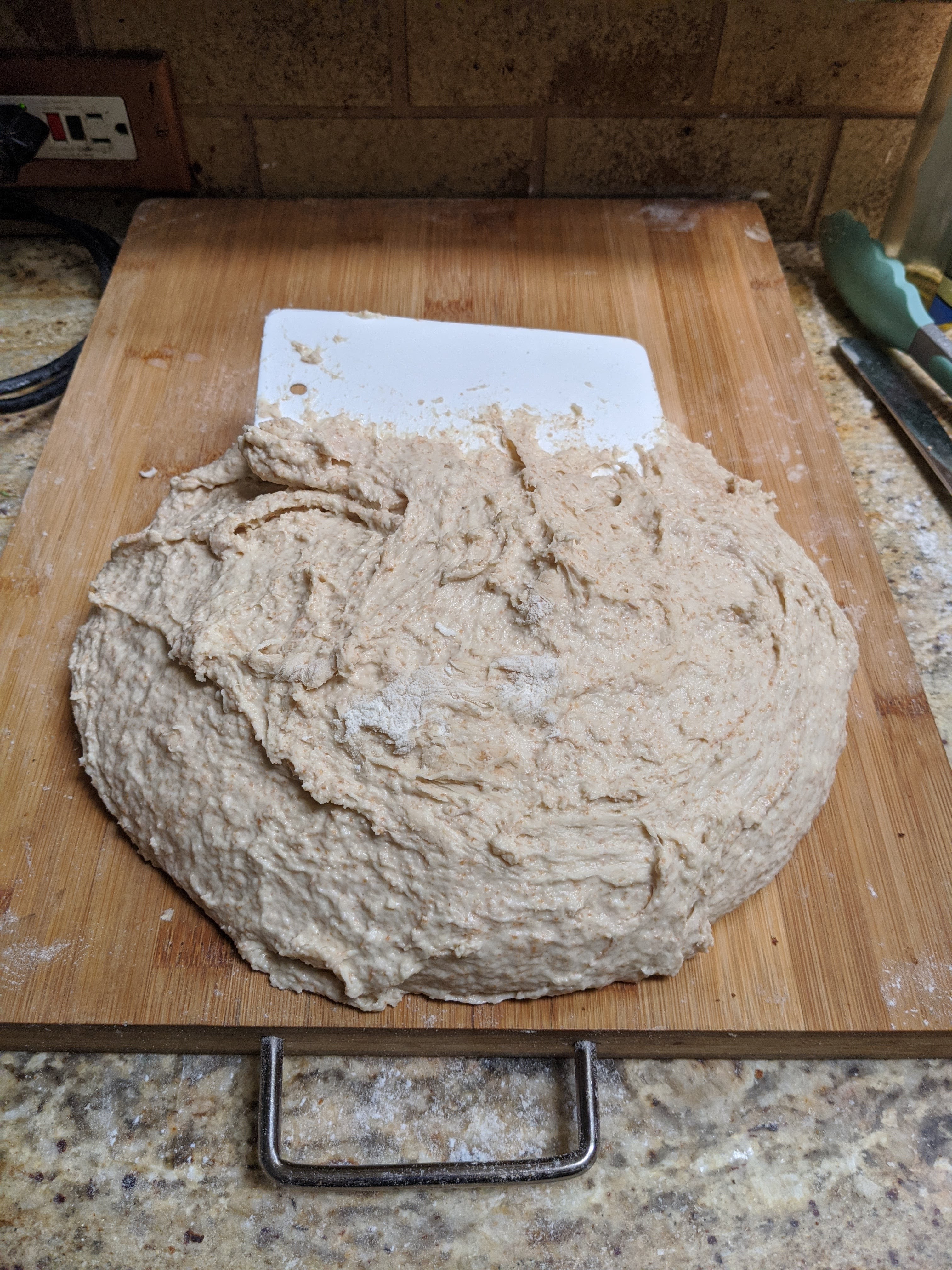
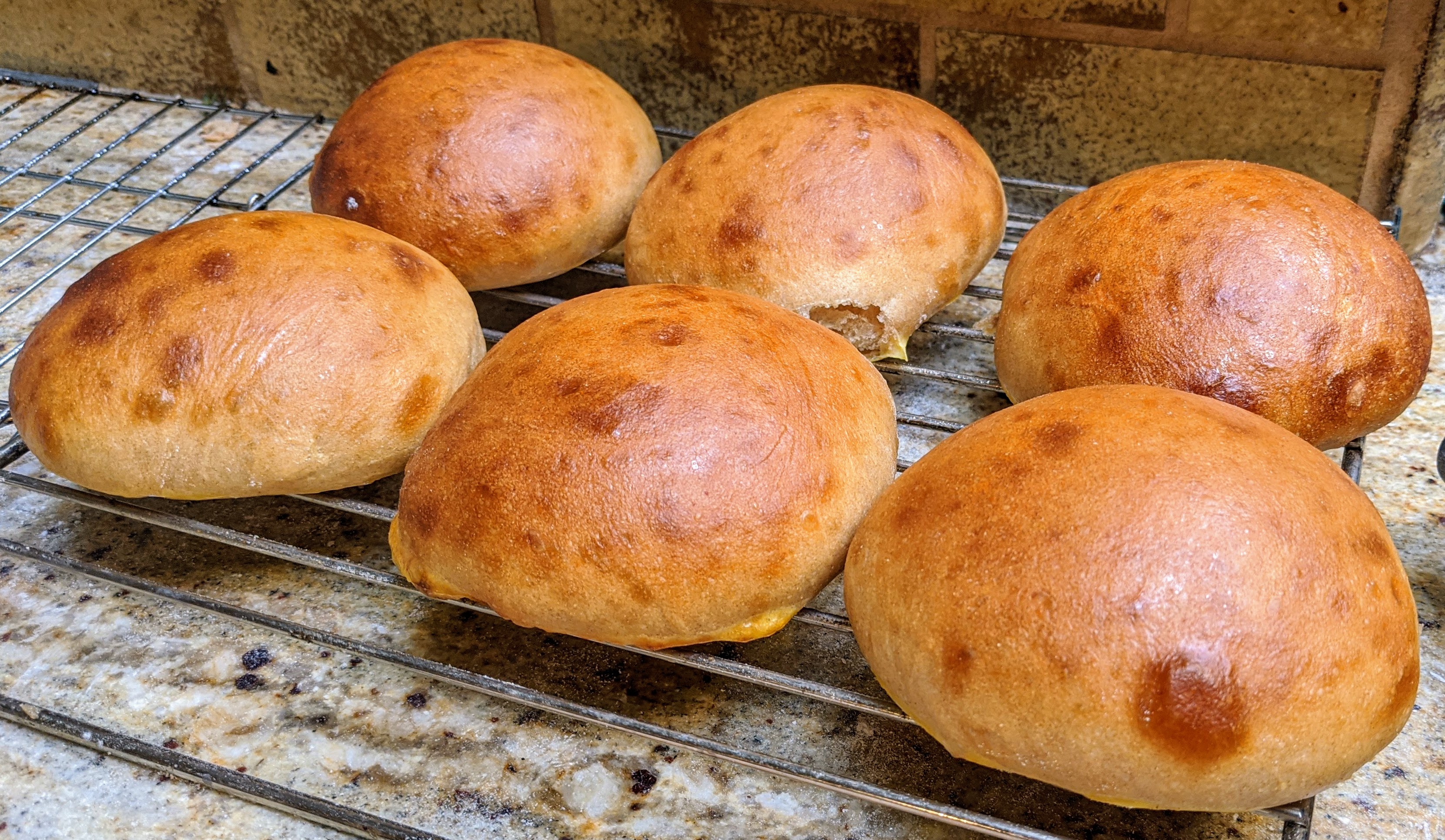
These burger buns are light, airy and fluffy, and guess what? They’re nutritious because of the whole wheat or high-extraction flour retaining the wheat’s nutrients! The dough is no-knead, but you’re still going to have to do stretch and folds for the first hour or so to help develop the gluten network and because we’re using flour with more of the bran and germ than regular flour, this dough is wet. Kneading really isn’t an option.
Tip: Though you can do the initial mix completely by hand, I’d recommend using a stand mixer if you have one.
A Note About the Flour You Use
It is critical that you use fine or extra-fine flour if you’re going to use 100% Whole Wheat. Course-ground flour has too many sharp particles in it that will literally cut the gluten strands. Myself, I use high-extraction bread flour that has about 90% of the bran and germ. It works like regular bread flour, but bakes like whole wheat flour which means it needs a really high hydration rate.
Mix the flour, butter, salt, yeast, and diastatic malt powder until fully incorporated.
Measure out the 105º water into a container, then add the honey to it and stir until the honey is completely dissolved.
Slowly add the water/honey mixture to the dry ingredients, then mix until smooth with no lumps (this is why I suggest using a stand mixer as it makes it a lot easier).
Check the dough. It will be too wet, so with your mixer running at Speed 2, add a couple of extra tablespoons of flour until the dough pulls away from the sides of the bowl, but is still pooled at the bottom. You don’t want to make a dense ball with this dough!
Transfer the dough to a large mixing bowl and cover it with a towel to rest for 10 minutes.
Stretch and fold the dough, turn the dough over onto the folds, then let it rest for another 10 minutes.
Repeat the stretch and folds every 10 minutes for the next hour for a total of 6 stretch and folds. By the last stretch and fold, you should see plenty of large bubbles forming.
Cover the bowl again and let the dough rest for an hour or until the ball doubles in size (don’t worry, with this amount of yeast and with the diastatic malt powder, the yeast will go crazy).
Once doubled, gently pour the dough out onto an unfloured bench being careful no to tear the dough and ruin all the hard work the yeast has just done.
Divide the dough into 125-gram pieces. This recipe will make about 14 buns. Only 6 will fit on a standard cookie sheet, so you can do as I did and make a baguette or mini-batard with the excess dough.
Sprinkle flour over the tops of the divided pieces. These will be the tops of your buns.
Now, lightly flour your work area.
Take a piece of dough, flip it over, gently, press it out into a circle, then shape it just like you would shape a boule, pulling an edge and bringing it to the center. If the dough sticks, add a bit of flour underneath the piece. We’re building tension on the top, so this is important!
Now, flip the ball over onto its seams, then round the ball out using a claw-like shape with your hand and rotating.
Once you’ve got a reasonably nice spherical shape, gently flatten the ball until it’s about 3-3 1/2″ in diameter, being careful not to degas it.
Place the shaped disc on a parchment-covered cookie sheet.
Repeat steps 12 – 16. But only re-flour your bench if it needs it.
Once you’ve created your discs, sprinkle flour on the top of them, then cover the cookie sheets (you’ll need 2) with a paper towel and let them proof for an hour.
At this point, pre-heat your oven to 425º. If you have double oven, then heat both so you can bake the sheets at the same tie.
After an hour, the buns will be ready to bake. If you only have a single oven, pop the other sheet into the fridge to retard the proof (don’t worry, you can bake them right out of the fridge).
Bake for 25 minutes. Hint: To help them pop up, I put some hot water (1/2 cup) in a metal pan on the bottom rack of my oven. This develops steam and helps with the oven spring in the first 15 minutes of the bake.
Once finished, immediately transfer for cooling racks! Do not let them cool on the cookie sheet as the bottoms will get all gooey!
I’m going to just be up front: The one thing you have to expect when you introduce 100% whole wheat flour into your dough, or like me, where you use a combination of high-extraction flour and whole wheat is that you will not get a big vertical oven spring; at least compared to a pure white flour loaf. The more bran and germ there are in the flour, the less vertical rise you’ll get and that’s a fact of life and there’s nothing you can do about it.
This is something I’ve had to expect once I made the move to more nutritious flour. Especially when I moved to high-extraction flour in lieu of white bread flour, I noticed a distinct lessening of the vertical rise. The fact that my bread was making nice ears meant that I was getting great oven spring (as evidenced above) and open crumb. It just hasn’t been as vertical and you know what? I’m now okay with that! But admittedly, it has taken several adjustments to achieve the crumb that I achieved with those loaves above.
Before I go on to explain what I did, I just can’t believe the flavor and texture of the final bread that this combination of flours produces. It’s chewy but with a velvety-smooth texture. I just can’t say enough about how great these Azure Standard Unifine flours are!
Adjustment Time
Lots of changes to my process… I used to pride myself on being able to make bread in a day, but with the switch to these flours, that’s no longer possible if I want to get results like I got above.
The first thing I had to do was up my hydration to 82%. I started out with 75%, 78% and 80% hydration, and while the loaves turned out pretty good, they were still a little dense. Just that extra 2% between 80 and 82 made a HUGE difference. Now you might think that at 82% the dough would be difficult to work with. I won’t lie. It’s a challenge, but it’s not nearly as bad as one might think. You just have to get used to working with a wet dough.
The next adjustment that I made was using a poolish. But instead of doing an overnight poolish, I started it at 7 AM in the morning, let it bubble up for 12 hours. then made my final dough at 7pm.
After mixing the final dough, I kneaded it until smooth, let it rest for 10 minutes, then did a stretch and fold. I then did five more stretch and folds every 10 minutes over the next hour or so.
After I did the last stretch and fold, I moved my container to the fridge where I let it bulk ferment for 14 hours. After the bulk ferment, I divided and shaped the loaves, then proofed them for 45 minutes at room temperature, then popped my bannetons in the fridge for an hour.
I then baked the loaves at 500 degrees for 30 minutes on my baking stone.
Here’s the recipe:
Flour
Water
Salt
Yeast
Poolish
250
250
0.40
Final Dough
750
570
19
3.00
Totals
1000
820
19
3.40
Bakers %
100.00%
82.00%
1.90%
0.34%
In a separate container, make the poolish and mix everything together until smooth. This wet, you don’t want any lumps. You can make this in the early morning then let it sit out all day (at least 12 hours) at room temperature, then make the final dough in the early evening – you’re going to refrigerate it for awhile. At the end of the 12 hours, it should be pretty bubbly.
Just before the poolish is finished fermenting, in large bowl, add the remaining flour.
Add the water to the remaining flour, but reserve a little bit (like 50-100 grams) to rinse out the poolish container after you’ve added the poolish.
Mix the flour and water until you get a shaggy dough, then let it rest and autolyse for 30 minutes. We just want to get it started because bulk fermentation will take place in the fridge.
After the final dough has rested, evenly sprinkle the salt and yeast over the dough, then add the poolish to it.
Rinse out the poolish container with the water you reserved and make sure you get everything in the poolish container. Add that to the final dough.
Mix well until all the ingredients are fully incorporated.
At this point, you either dump it out on your board and knead it until it’s smooth, or if you’re using a stand mixer, mix at Speed 2 until the dough is smooth.
Let the dough rest for 10 minutes, then do a stretch and fold.
Over the next hour or so, do a stretch and fold every ten minutes until you’ve done 5 or 6 folds. You’ll know you’ve done enough when you pick up a corner of the dough and the whole ball comes will try to come with it without tearing.
Cover the container with a lid or plastic wrap and let it ferment in your fridge for at least 14 hours or until the dough about doubles in size. It really depends on the temperature of your fridge. I have my mini fridge set to 49-degrees and 14 hours is the sweet spot. You should see some nice bubbles in the dough. If not, let it ferment some more. It could take up to 30 hours.
Once the dough has doubled, remove it from the fridge and divide and shape it as you normally would, but be EXTREMELY gentle with the dough. You do not want to degas it!
Once shaped, proof for 45-minutes to an hour at room temperature, then move the loaves into your fridge once again to chill for an hour.
Once chilled, remove the loaves from their proofing containers, score the loaves, then bake for 30 minutes at 500 degrees.
Yes, this is at least a 2-day process. But believe me, the results are totally worth it!
And I mean in the old days like a few thousands of years ago. Archaeological evidence has been found that people have been making some form of bread for almost 30,000 years! But I want to fast forward to Egyptian times (about 3000 years ago) as they seem to be credited with the first “mass” production of yeasted bread and generally establishing what we now know as Artisan Bread. If you look at the ancient pictograph above, what we do today to bake our bread really hasn’t changed much since those days… or has it?
The basic technique of mixing flour water and salt and adding a leavening agent really hasn’t changed much since those ancient times. But let’s make no bones about it: What we do today is MUCH easier than how they did it back then.
Think about it: The way we make Artisan Bread – whether at home or commercially – today is graced with a plethora of conveniences that our predecessors just didn’t have. Bread making has come a long way since then. Let’s look at a few things that we take for granted.
Our forefathers had to grind their flour. Though the Mesopotamians invented the grinding wheel and what we know today as milling, this was low production, highly manual intensive work to get flour. Even today, there are countries where community millers still exist. And if you think about it, the type of wheat or grain people baked with was highly regional. They basically baked with what grain crop was grown in the vicinity.
We, on the other hand, go online, and get our organic, hard red or white wheat, either stone ground or steel rolled or processed with a Unifine mill. We can get AP flour, bread flour, high-extraction flour, whole grain. We can get wheat, spelt, rye, millet, ancient grains like einkorn or durum. The variety that we have accesses to – literally at our fingertips – is mind-blowing!
Also, look at our baking apparati! At home we have our electric or gas ovens. For the more rustic-thinking, there’s the Ooni and other hearth-like ovens. Commercial bakers have deck ovens or huge stone or brick hearth ovens. For those using the traditional wood-burning ovens, sure, there’s a lot of labor that goes into maintaining a fire. But consider this: Our environments are controlled and somewhat predictable. Ancient bread makers didn’t have HVAC.
Furthermore, not everyone had a baking hearth. Most villages had a community oven. In his wonderful book, The Apprentice, chef Jacques Pepin described being a boy in a village in France where on a certain day, the whole village would bake at the community oven. Us? We preheat our oven at home and pop our bread in any damn time we choose!
Also, think about how information was passed on from baker to baker back then. It was all word of mouth. And it was truly a craft where master bakers took on apprentices, and the apprentices went on to being masters and pass that on. But today, we open up our browser and look at bread making blogs and join home baker forums. We learn in a matter weeks or months what would have taken years for an apprentice to learn.
For instance, I went from this:
To this:
…in just a matter of months. Sure, it was a lot of learn by doing, but I also had the luxury of the Internet to help diagnose issues. And mind you, that loaf above is one of my so-so loaves. I’ve been able to reach a level of consistent quality not just by doing it a lot (I do bake practically every day), but having information readily at my fingertips. And I’m not alone in this. What I’ve seen other home bakers create is absolutely amazing! And I’ll submit that it’s the quick, free-flow of information that has enabled people to get to relative mastery much sooner than in the old days.
And while there are people who have totally geeked out on creating and maintaining a sourdough culture, I’m not one of them. I generally use a poolish or a biga to get the slightly sour taste in my bread. But I can do this because of the easy availability of commercial yeast. That said, I actually do maintain three active cultures but I bake several different types of bread. My cultures are tools, not pets. 🙂
Back in the old days, people had to create and maintain their starters. But let’s take a deeper dive into that. They didn’t have refrigeration. They didn’t have convenient little tupperware or glass jars. They didn’t have high-precision gram scales to get the right proportions. They certainly didn’t have silicone spatulas to clean out their bowls! Get the picture? While there is still a definite amount of craft that goes into our baking today, our lives are SO much easier than the artisans of old!
But from the standpoint of tradition, very little has changed. If there was any good about this whole 2020 lockdown, the fact that so many turned to baking – myself included – has been a real bright spot. And based on my participation in bread making forums, there’s a widespread, renewed enthusiasm for making bread. It’s heart-warming to see so many keeping the tradition alive!
As I was watching a YouTube episode from Proof Bread in Mesa, AZ, Jonathan mentioned that Proof uses Type 85 flour, which is a high-extraction flour where 85% of the wheat kernel is retained in the milling process. At the time, I was trying to make a transition to including more whole wheat into my bread for nutritional reasons and Jonathan mentioning his flour really intrigued me. So that put me on a quest to find Type 85 flour.
I did finally find a Type 85 flour through Azure Standard, but they were sold out. Then I ran across their Ultra-Unifine Unbleached Bread Flour and got really intrigued. This is what sold me:
“We’ve taken a strong, full-bodied hard red wheat flour and refined it slightly by removing about 10% of the bran,” said Azure Mill Manager. “In the milling industry it’s known as a particle reduction processing technique. We’re taking an already fine Unifine flour, sifting out some of the bran and giving you a finished product that has softer flavor notes, rises better and adds a little lightness to your artisan breads.”
I love this flour! But I have to admit that though it kneads and folds and feels like regular bread flour when you work with it, it acts a lot like whole wheat flour when it bakes; that is, it doesn’t have the oven spring that I’m used to with white bread flour. But that is to be expected because even though 10% of the sharp bran particles have been removed from the flour, there’s still a lot of the germ and bran left over. So given that, I’ve had to make adjustments.
First of all, just like with baking with 100% whole wheat flour, I’ve upped the hydration ratio when I’m working with this flour. I experimented with 73%, then went up to 75%, and today I prepared a 78% straight dough.
The 73% hydration dough produces an okay oven spring, but has a fairly dense crumb as one would expect from a whole wheat flour. It’s not bad, and by no means does it taste bad, but it is a little dense.
The 75% hydration dough has much better oven spring with a much more open crumb than the 73%. And it amazed me how just a 2% increase in water content could have such an effect on the oven spring.
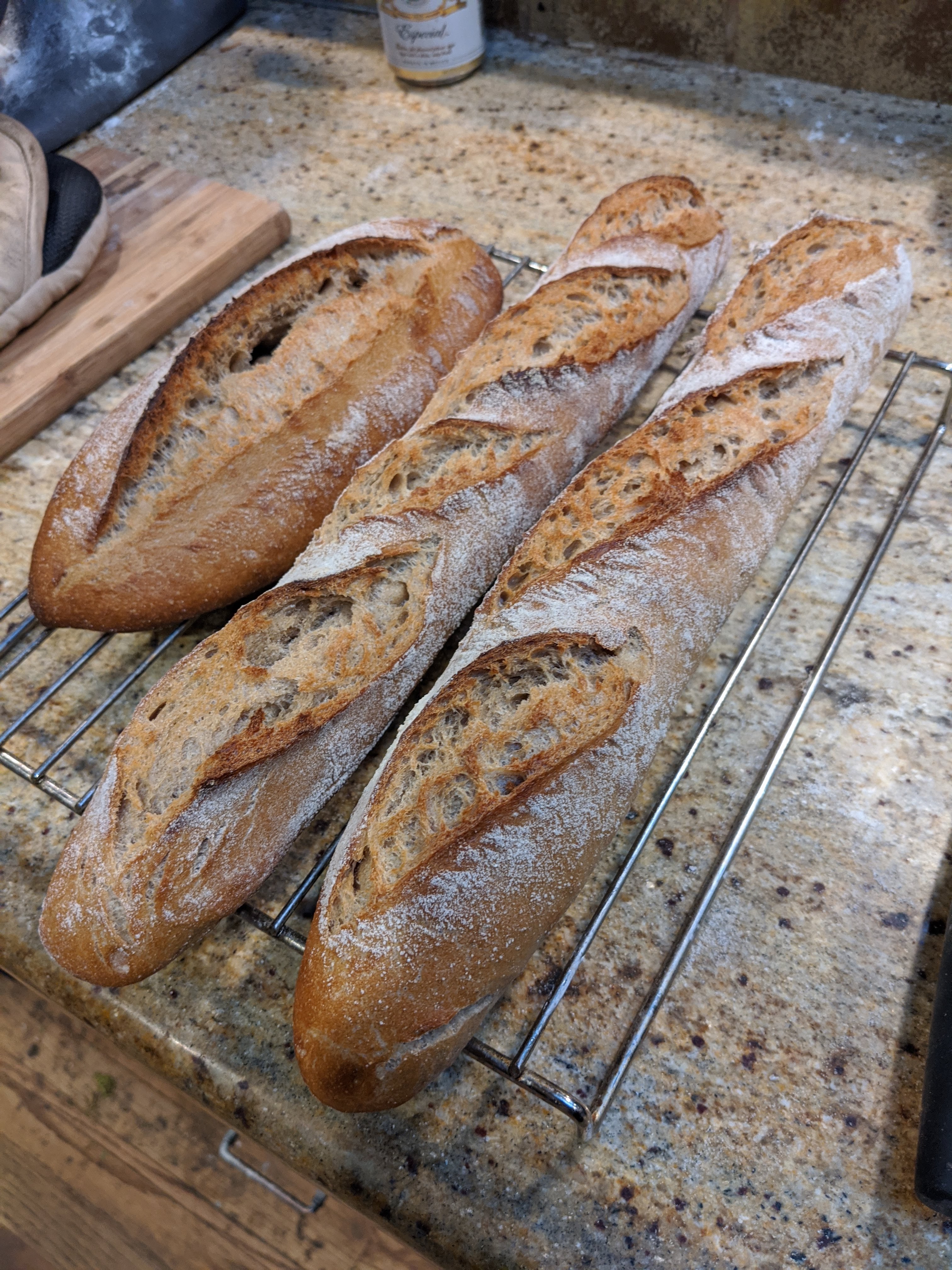
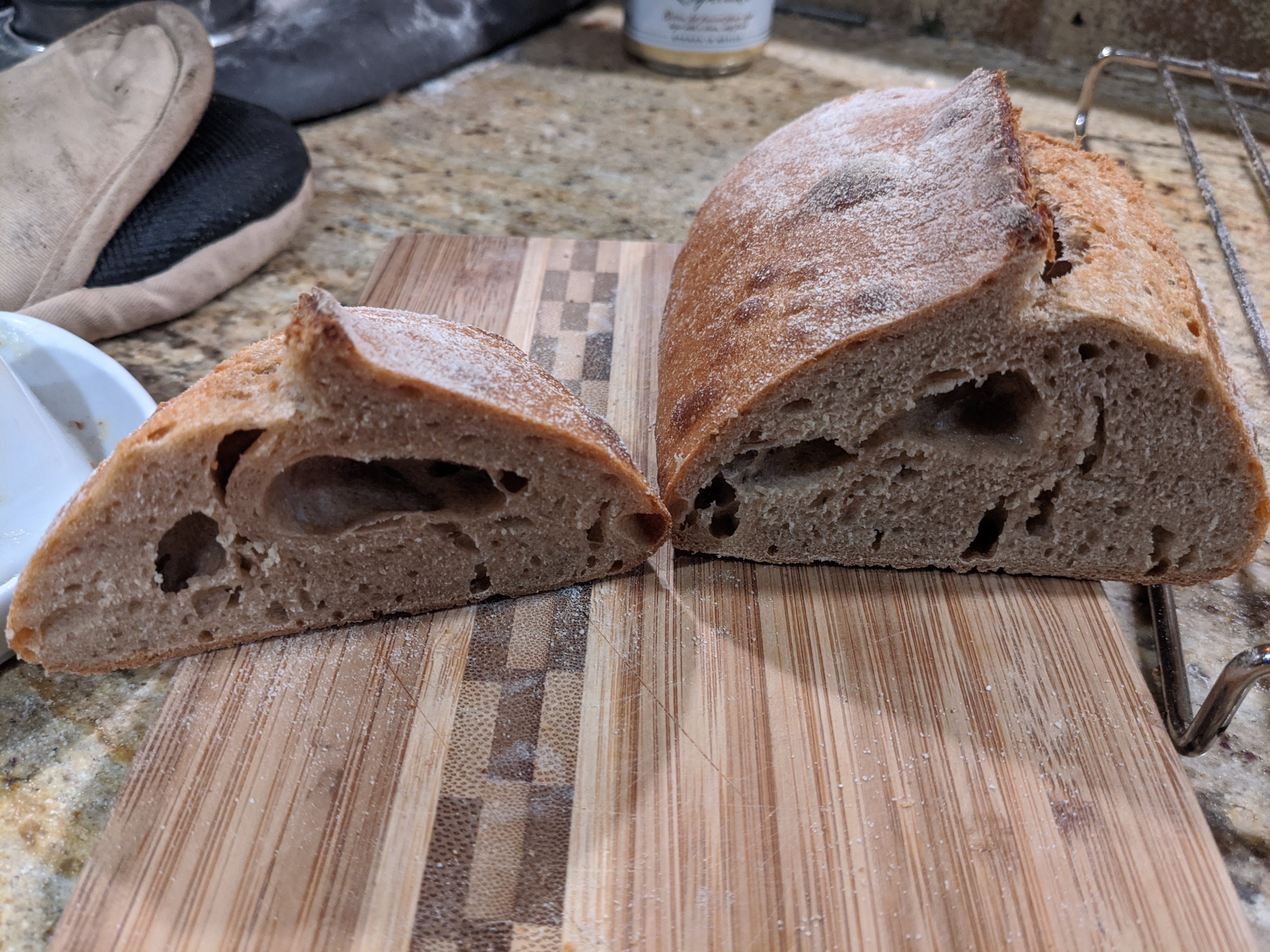
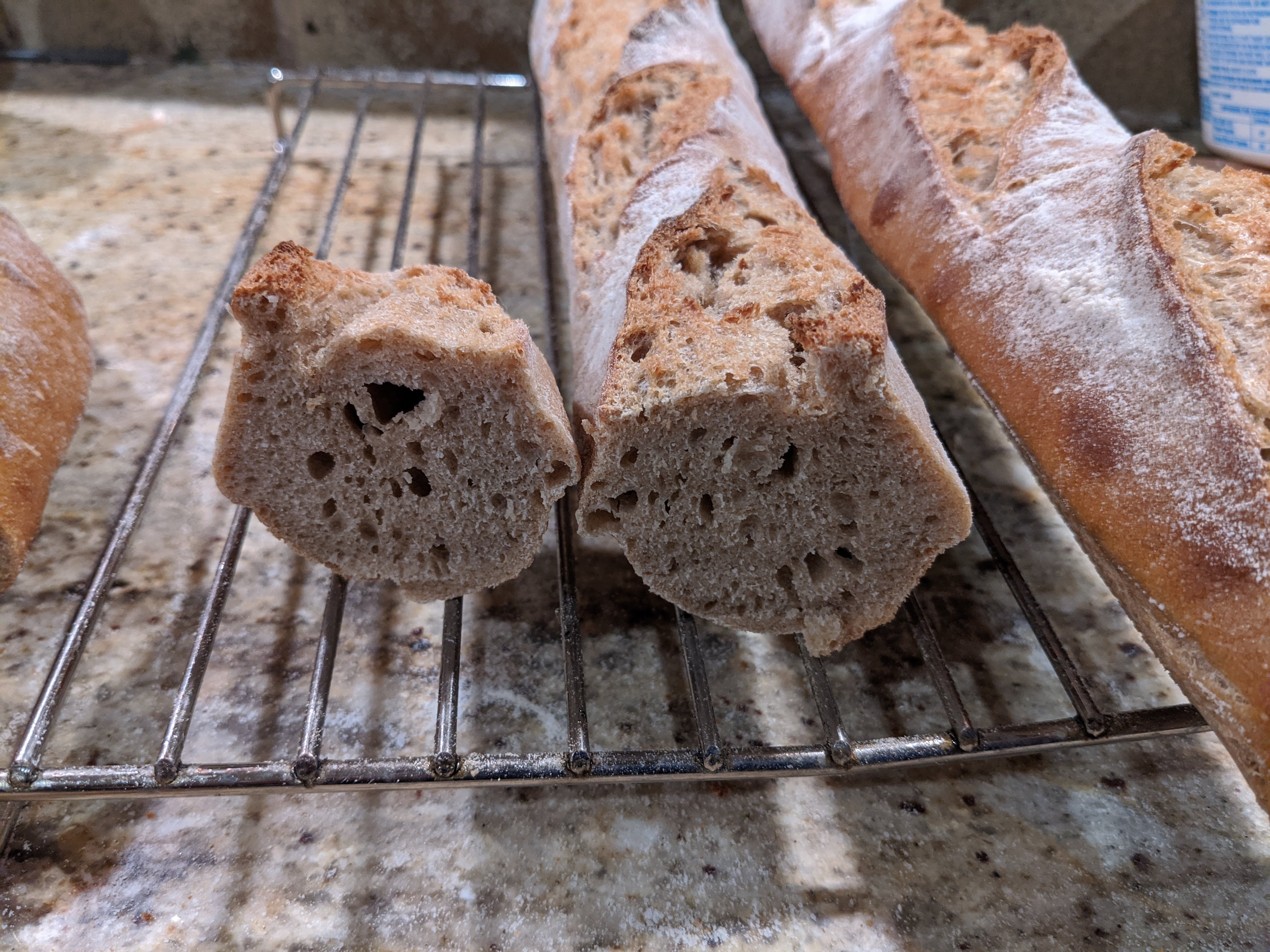
Finally, the 78% hydration dough… Well, I think I found the sweet spot. As I mentioned, I just did a straight dough today. I made two baguettes and a small batard, and they all turned out fantastic!
You’l notice that the crumb on the batard is a little wonky – not sure what that was about, and though the baguette crumb seems to be dense, it’s actually not. As opposed to big holes, there a lot of small holes. The bread is amazingly light in texture.
I didn’t change a thing with respect to how I prepared the dough. I just added a bit more water. It really made a big difference. And while I think this might be the sweet spot for hydration, I think I’m going to try a dough at 82% hydration to see how that works.
So now that I’ve got the basic sweet spot, I’ll start working with a poolish and then I’ll cold proof overnight. I’ve found with high-hydration flour, a cold-proof works best and the dough will hold its shape better when I score and put it in the oven, promoting a more vertical rise as opposed to spreading out. I’m also going to see what adding a bit of diastatic malt powder will do to open it up even more.
Stuff like this just gets me SO jazzed about baking bread! There’s a definite precision that you must observe, but at the same time, variations in the environment force you to make adjustments on the fly. It’s a lot like golf where even though you develop the basic swing, conditions like wind direction and humidity force you to make adjustments. And it’s that constant challenge of making adjustments that keep you coming back for more!
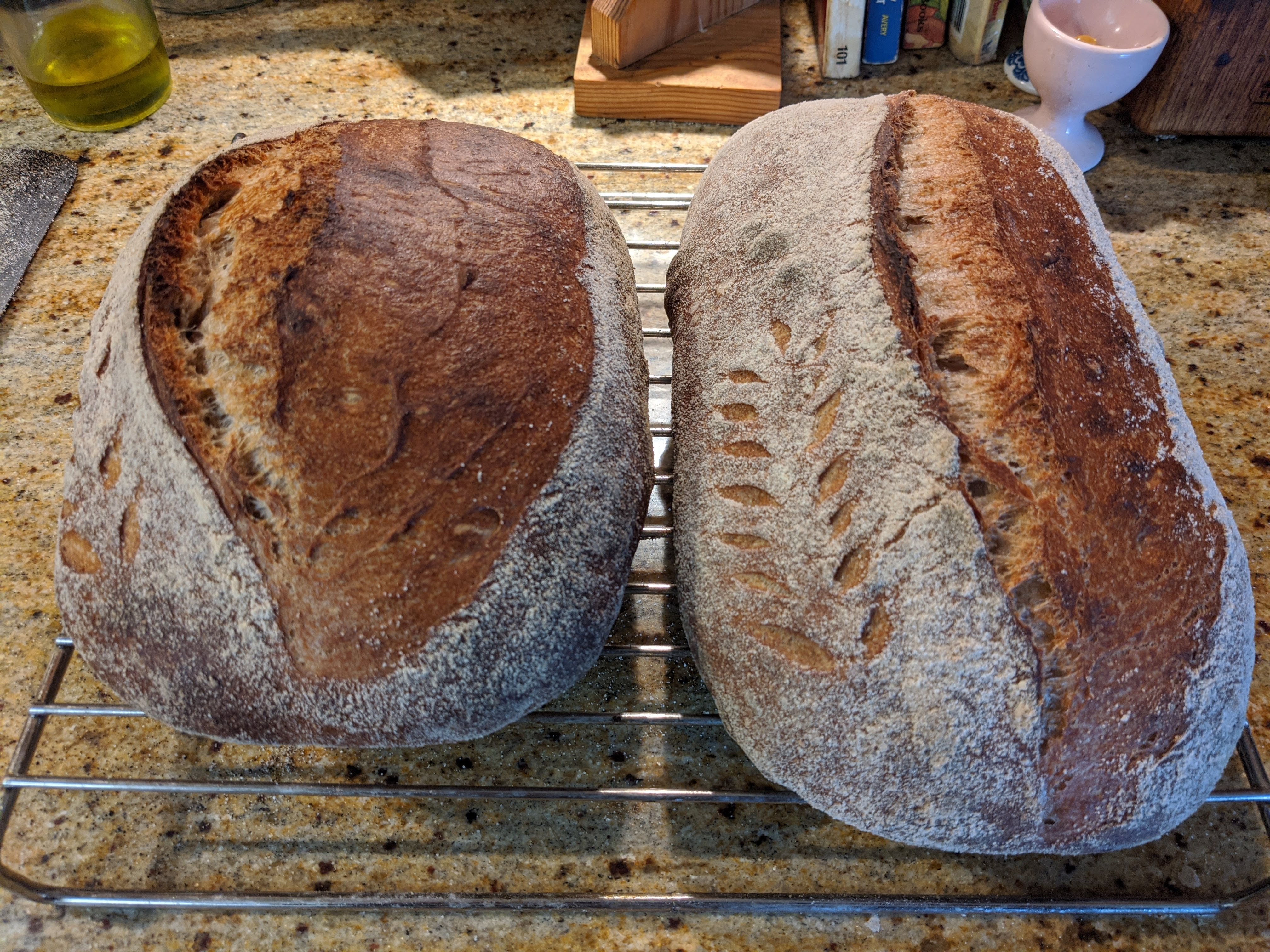
The picture above shows two loaves I created from the same base dough (77% hydration). I proofed the loaf on the right at room temp (~80-degrees), and the one on the left I proofed for 30 minutes at room temperature then popped it in my dough retarder for an hour to not just slow down the proof but to chill the dough.
Based on the final results, chilling a slack, high-hydration dough maintains the shape much better whereas not chilling that same dough will spread out. Both loaves are roughly the same height, though the left-hand loaf is just a tad taller. But the big difference is that the chilled loaf has much more consistent vertical spring throughout the entire loaf, and did not expand length-wise. It did expand a bit width-wise, but that’s okay. I expected that to happen with my scoring. As you can see, the bread really opened up where I slashed it.
To be open and honest, I didn’t come up with this idea. I happened to be reading a blog post last night where the author suggested chilling a nearly-proofed loaf for about an hour in the fridge. The thinking was that it would chill the outside skin of the loaf and be much easier to score. I had to try it today and the results speak for themselves.
While there’s plenty of oven spring – and I’m actually expecting a nice, open crumb with both loaves – there’s not as much spring as I would get with regular white bread flour. The base dough was made with that high-extraction bread flour that contains more of the wheat kernel than regular bread flour. And even though it has a high protein content at 14.7%, the fact that there is more bran and germ in the flour affects the overall structure. Given that, I’m probably going to have to fortify the flour with some vital wheat gluten. But that said, I will be chilling all my high-hydration doughs from here on out or even doing overnight proofing.
Working out things like this is what has made my bread making journey so rewarding. I have fewer and fewer outright fails now than when I did in the beginning. But now, even my less than ideal loaves are much smaller “fails.”
As Mel Gibson said in the movie The Patriot, “Aim small, miss small.” For me, improving my technique has been about making little changes. With this particular experiment it was about tweaking one little thing – temperature. And that one small thing produced tremendous results!
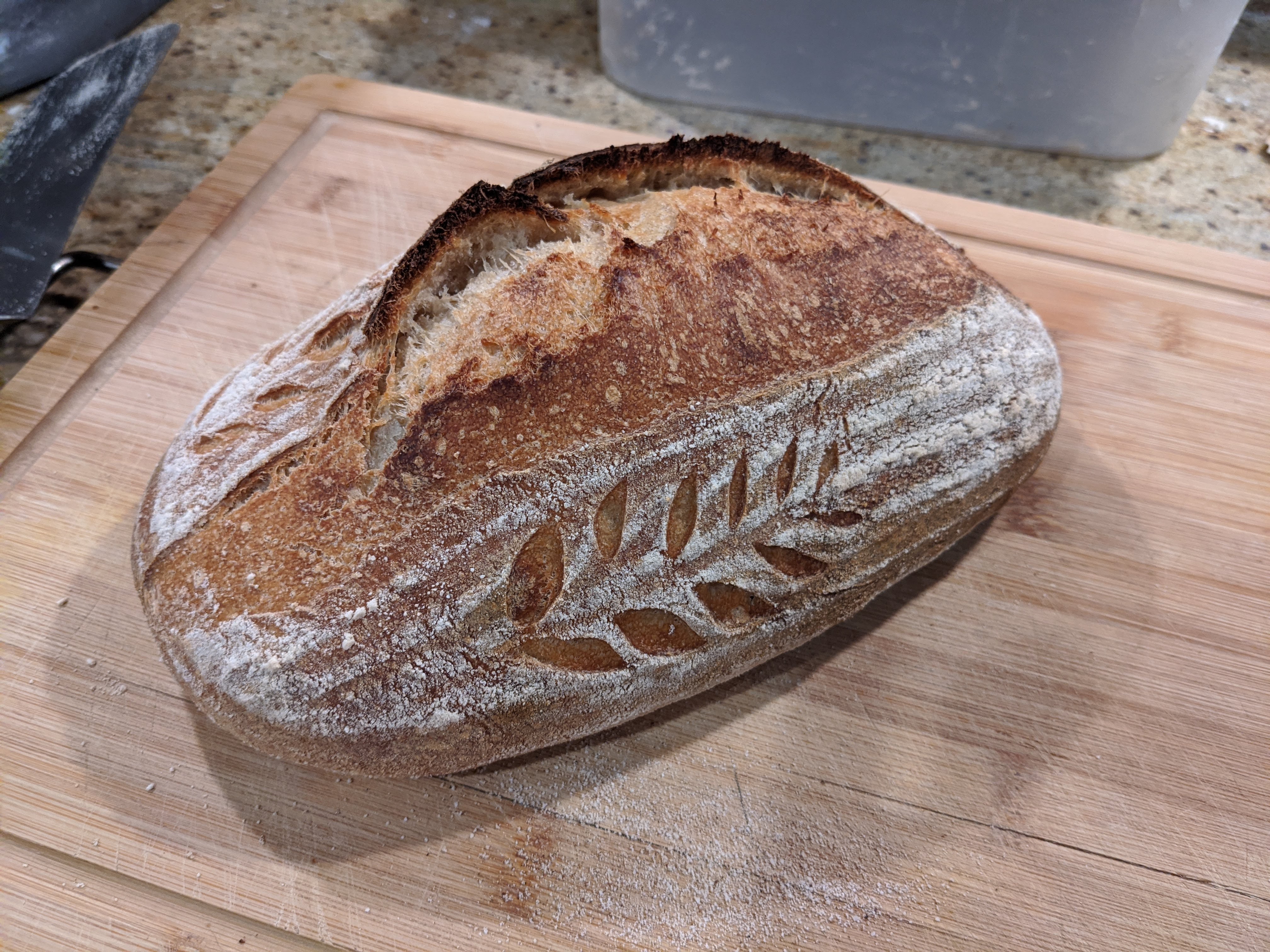
See that loaf above? Beautiful right? It has a nice, sour taste to it that’s perfectly balanced with the rest of the flavor profile. To most people who’d eat it, they’d think that it’s a loaf of sourdough bread. But it’s not. It was started with a poolish I made the previous day. So technically, based on the accepted convention, my bread really isn’t sourdough… or is it?
Traditional sourdough is made from a culture where wild yeasts and bacteria work together to leaven a dough. The result is that the bacteria produce both lactic and acetic acid which provide the sour taste. Bakers yeast, on the other hand, isn’t nearly as tolerant to acidic environments. But it can leaven a dough all by its lonesome.
So given that my poolish bread was started with bakers yeast, how does that account for the sour taste of my bread? The only thing I can think of is that since I do a long ferment of my poolish – like 18 to 24 hours – the wild yeasts and lactic acid bacteria have time to develop and make a contribution to the fermentation process. And given that I literally start my poolish with less than 1/2 gram of yeast (literally 0.4 gram), there’s plenty of room for the wild yeasts to do their thing, which in turn help to feed the bacteria.
And this is where it gets a little interesting. The bakers yeast kicks off the process, but the environment may become too acidic for it. I’m kind of wondering if it actually gets killed off when the dough becomes acidic. The reason I say this is because a notable trait of a traditional sourdough is that fermentation takes a long time. My poolish bread takes several hours to go through bulk fermentation. The dough for the loaf above took almost six hours to get through bulk fermentation! That’s right in line with using a sourdough starter.
So this gets back to the question: Is sourdough a taste, or is it a technique? Or maybe I’m just full of crap. After all, I did recently write that I just want to make great bread. I love the fact that my poolish bread imparts a distinct sour flavor to add to the overall flavor profile of the finished loaf. And I’ve done it enough now where I can reproduce it every time. But in the end, what makes it a great loaf is the process. So yeah… technique…
I know, I know… There’s all this craze about good artisan bread taking at least two days. I do it because the results are amazing. No doubt that using a 12-24 hour pre-ferment or a levain provides extra flavor complexity. But sometimes, I just want to make bread and have it ready the same day. But that doesn’t mean I have to completely sacrifice all flavor complexity.
From what I’ve been able to gather recently, one of the trends that seems to be occurring in artisan bread baking is that bakers seem to be leaning less on the leavening agent to provide flavor complexity and more on other factors such as flour. Myself, I now almost always have at least 25% whole wheat flour in my dough. I also started using high-extraction bread flour, where more of the wheat kernel is extracted than regular bread flour (think Type 85 flour). Just that change in flour has provided incredible flavor complexity to the 1-day loaves I bake.
This recipe is a riff on a poolish-based bread. It actually uses a poolish, but instead of fermenting from 12-24 hours with half a gram of yeast, I ferment it for 4 hours with 2 grams of yeast. We don’t get all the benefits of the microbes kicking and creating sourness (though there is some), but we do get the benefits of using a poolish which provides much better dough extensibility.
Also, it’s optional, but I add 1.5% diastatic malt powder to help the yeast along and promote great oven spring and crust color, especially if I use a 50-50 whole wheat to bread flour ratio. It really helps guarantee that the Maillard reaction occurs and we get the flavor benefits from a darkened crust.
With this recipe, if you start at around 8 AM in the morning, you should have bread by 4 PM. Here’s the basic recipe:
Mix dry ingredients with a whisk until well-incorporated, then add the water, making sure no there are no dry spots. Mix until there are no large lumps. The dough will be a little shaggy and super wet – it’s 100% hydration so that’s okay. Make sure to scrape down the sides of the bowl you get everything. Finish mixing until smooth.
Cover the bowl with plastic wrap and set aside in a warm place for 4 hours. I place my container in the oven with an open oven door to provide a warm environment for the yeast to do its thing.
Final Dough
500 grams bread flour 7.5 grams diastatic malt powder (optional) 16 grams salt 4 grams instant yeast (1 level teaspoon) 21 grams honey (optional) – that’s about a tablespoon
250 grams 100-degree water
Tip: If your kitchen is anywhere near 80-degrees like mine gets in the summer – I have horrible HVAC ducting in my home – drop the hydration down to 73% or even less (FYI, at 73%, you’ll add 238 grams of water). In really warm environments, it will be difficult for a dough to hold its shape. And even 73% is pushing it. The boule I made above was done at 73%, but it it was originally shaped as a batard, but no matter what I did, I couldn’t get the batard to stop laying flat, so I re-shaped the loaf into a boule where I could control the surface tension better. Another option might have been to roll out a couple of baguettes.
Mix the Poolish and Final Dough
Measure out the 250 grams of water, then if you want to use the honey, add it to the water to dissolve it. Add the water to the poolish, then mix to create a slurry.
Add all the rest of the dry ingredients to a large bowl. Mix thoroughly and set aside. If you used small container for the poolish, you should transfer it to a larger bowl. This will be your mixing bowl.
Add dry ingredients to the poolish in batches until well-incorporated and you form a shaggy dough. At this point, if you’re using a stand mixer, mix on low to medium speed until the dough pulls away from the sides of the bowl, then transfer to the container you’ll use for the bulk ferment (I don’t like to use the stand mixer bowl because of the raised bump at the bottom. If you’re mixing by hand, once everything’s incorporated, since it’s a fairly wet dough, give it several stretch folds in the bowl until you feel the gluten strands developing.
Bulk Ferment
Note that the bulk ferment comes in two phases. The first phase, which is the first hour and half to two hours involves doing gentle stretch and folds. The second phase is letting the dough rest for a couple of hours.
Let the dough rest for 10 minutes then do a stretch and fold. Stretch and fold every 30 minutes two more times. After the third stretch and fold, give the dough the windowpane test to make sure you can stretch it thin without the dough tearing. If it tears, let the dough rest for another 30 minutes, then do a stretch and fold one last time. By this time, the dough should pass the test. If not (which is probably due to temperature), lather rinse and repeat the stretch and fold.
TIP: Be extremely gentle with your stretch and folds, especially an hour into the ferment. You want to avoid tearing the dough and you also want to retain as much of the gases as possible.
Let the dough rest and finish bulk fermenting in a warm place for a couple of hours, but check it after an hour. It probably won’t be done fermenting after an hour, but it’s a good thing to check its progress. By the end of two hours, you should see at least a 50% rise. At that point, you can let it go a little longer if you want or you can start shaping.
Divide and Pre-shape
The great thing about this particular dough is that you can pretty much do what you want from here. It produces about 2 kilos of dough. And since it’s a fairly high-hydration dough, you can make boules or batards or even simple baguettes if you want.
For boules and batards, you can split the dough into two or four equal pieces. For baguettes, there’s enough for eight sandwich size baguettes or 5 or 6 larger baguettes that’ll fit in a standard oven. No matter how you divide the dough, pre-shape your loaves into tight balls, lightly flour the tops, then bench rest them for 15-20 minutes.
Shape and Proof
Tip:Since this recipe produces two ~2-lb loaves, I make one that day, then pop the other shaped loaf into my fridge to proof for 24-hours. That way the family can have a loaf of fresh bread each day. Or… you can even freeze the dough after shaping. When you’re ready to bake, let it come to close to room temp and let it finish proofing. You won’t be killing the yeast by freezing it; you’ll only force it into hibernation.
Shape the loaves then proof for 45 minutes to an hour or until your dough passes the finger dent test. In warmer weather, I usually check proofing at 30 minutes. It’s usually not done by then, but there have been times where it has finished proofing in that small amount of time.
While the loaves are proofing, set your oven to 475-degrees. If you’re using a Dutch oven, pop it in the oven to pre-heat.






 The Dawg House!