The title of this is a common Hawaiian pidgin phrase that basically means, if something’s possible, that’s great, if it’s not, then that’s okay too. In plainer terms, it means be flexible. It has been a useful thing to remember especially since I’ve gotten deep into bread-making. And admittedly, it was a hard lesson to learn. I used to totally obsess over the aesthetics of my bread. I wanted each and every loaf to fit an archetype – both inside and out – and I’d stress if it didn’t.
But bread dough is a living thing and it’s affected by all sorts of factors. And given that, working with forces you to be flexible. Look at ambient temperature for instance. When it’s warm – above 72°F – things happen fast. Dough action is significantly slower in cooler temps. But even if you adapt to different factors changing, there’s no guarantee that things will turn out as planned. You can certainly narrow the margin of error, but something will always be a little off.
Granted, as I’ve gained more and more experience, I make fewer mistakes, and quite frankly, the only person who notices an off outcome is usually me. But despite that, I’ve adjusted my thinking and usually just laugh at the little things that might happen.
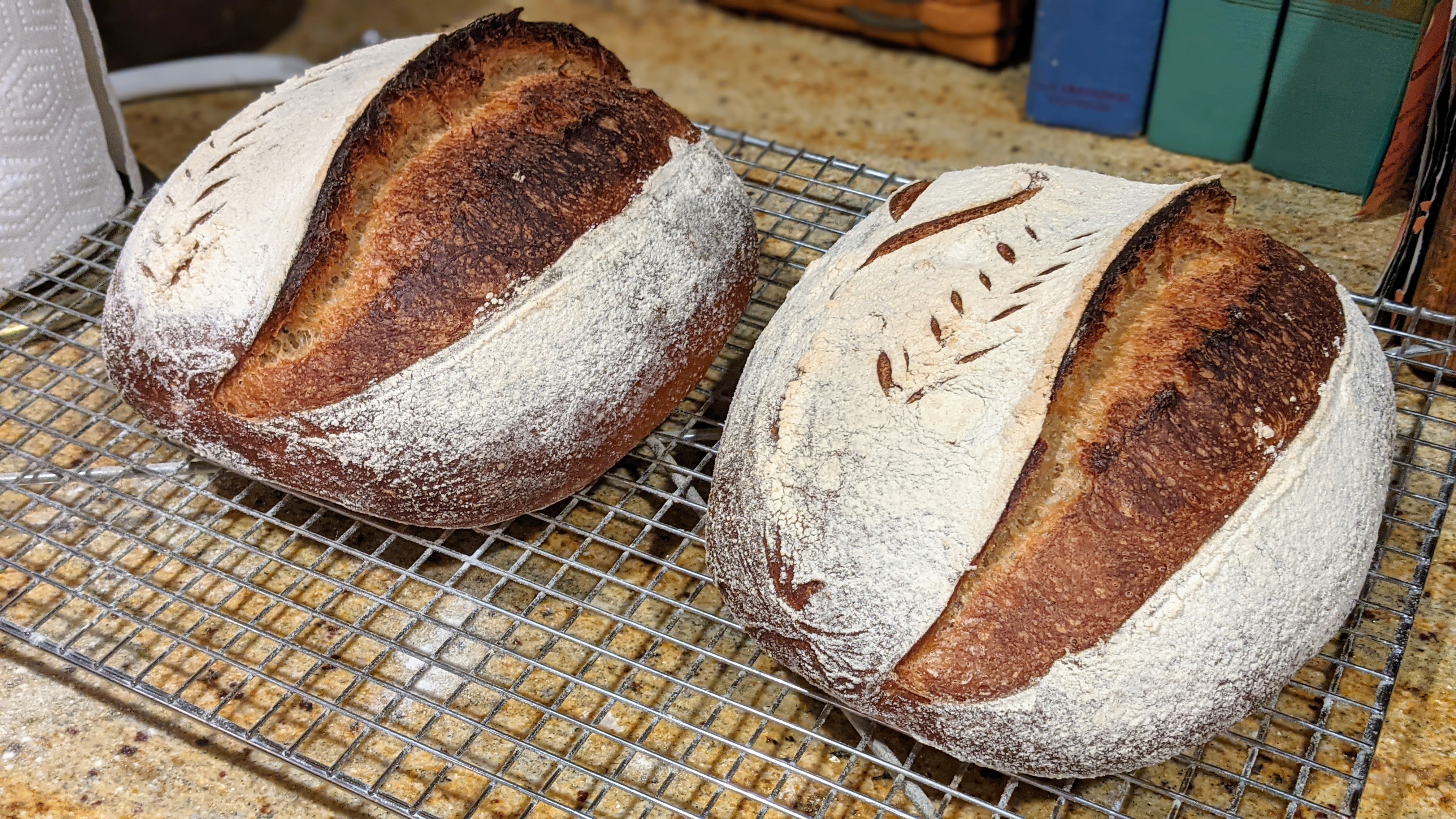
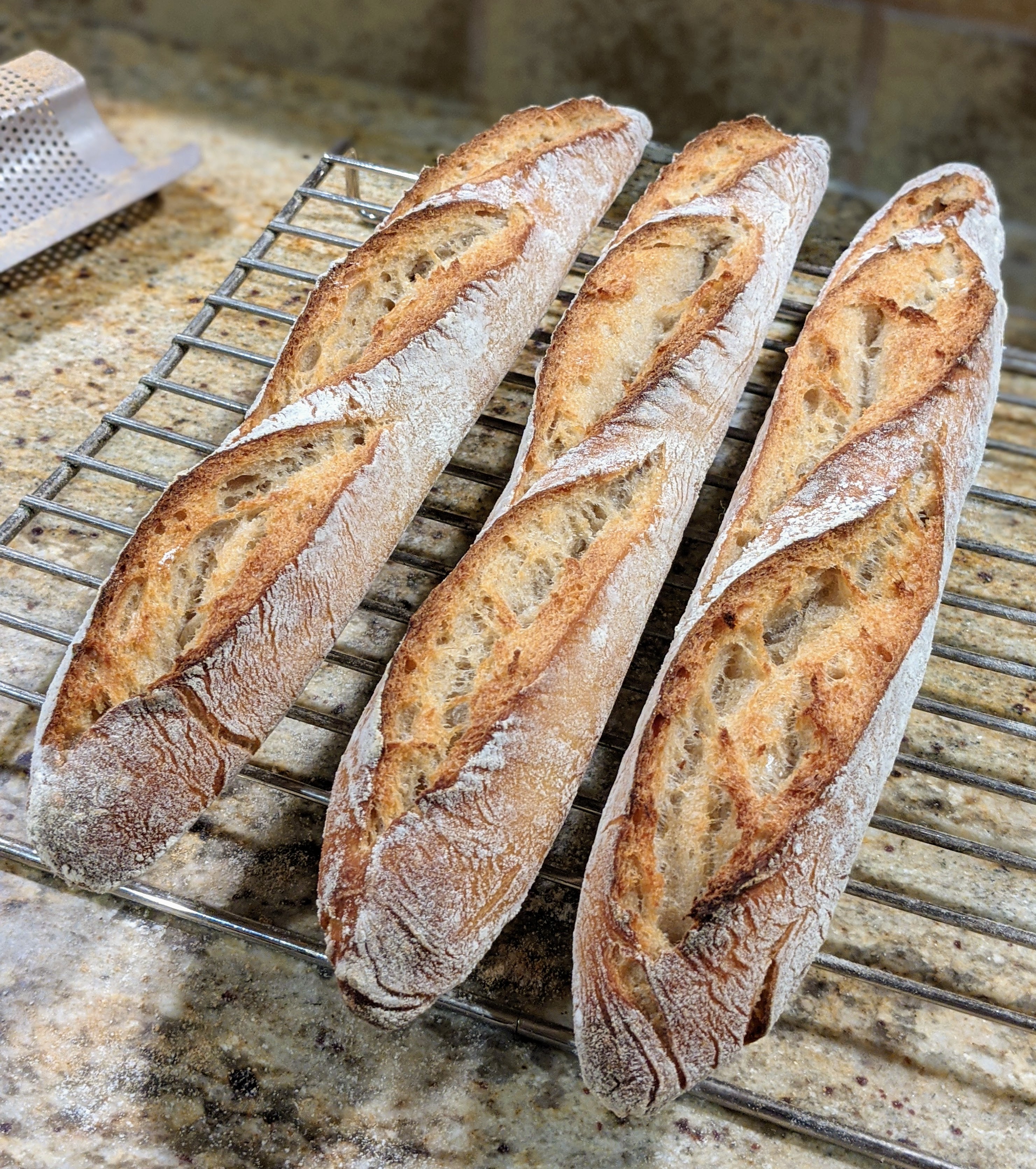
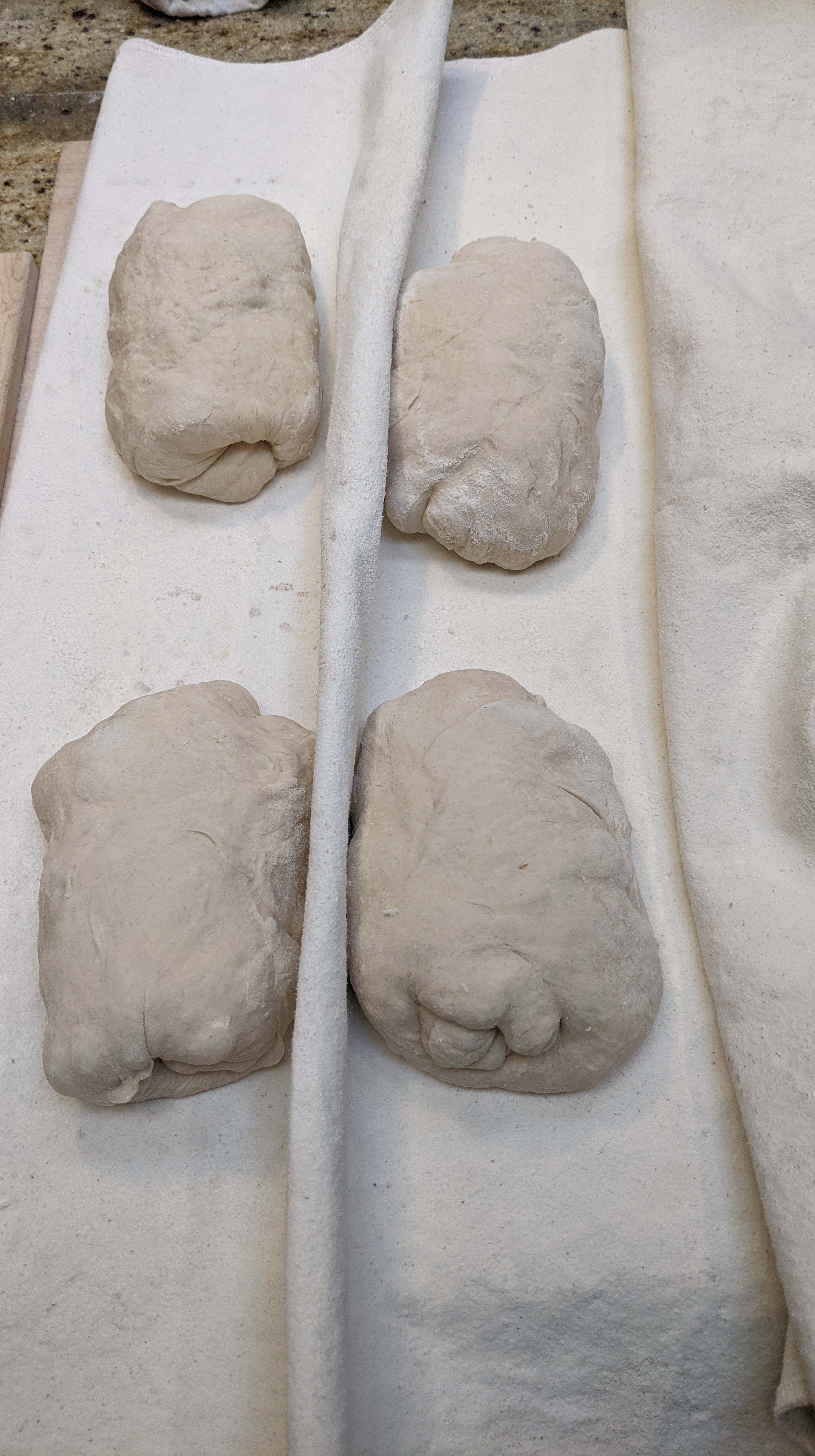
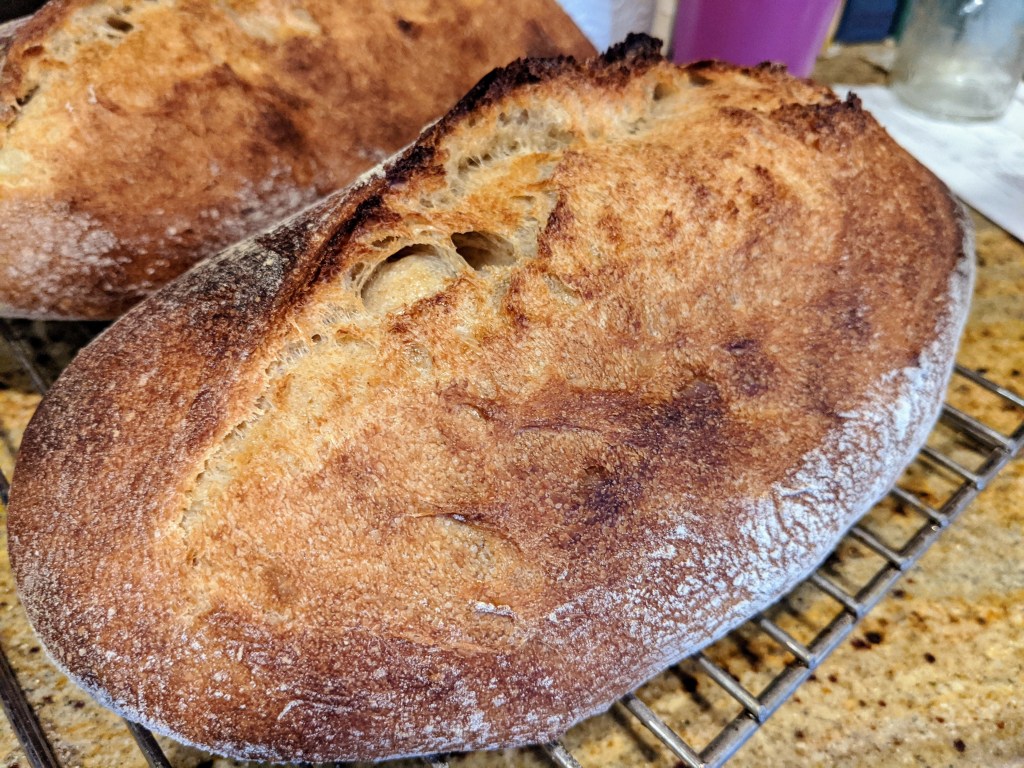
For instance, with the loaves shown above, I actually tore the skin of the one on the left because I wasn’t paying attention when I preshaped the dough. And though I re-preshaped it after letting it rest a few minutes, I didn’t know how it would turn out in the end. And I was okay with that – If can can, no can no can… In the end it turned out fine. It spread out a little in the oven, but not severely to it was all good. But even if it did really collapse, it wasn’t going to end the world.
Not that I don’t fully let things go… I admit that I did have a concern because I inadvertently allowed bulk fermentation to go WAY longer than I normally do. Whereas I normally bulk ferment to about 25%-30% expansion, I let this dough go to over double because of a meeting. When I was done with the meeting, I saw how far it had gone and immediately went to preshape. I could tell that the dough was close to the edge of full-fermentation, so that tear got me a little worried that my dough wouldn’t have enough fuel for the long, cold final ferment.
When I pulled the loaves out of my fridge the next day, I took a whiff, and whew! They were sour-smelling; not in an off-putting way, but I knew that I had to bake them, lest they fall into a heap in my oven from over-fermenting. And alas, they turned out fine… If can can, if no can no can…
Spend any time on most home-bakers online forums and you’ll be convinced that your bread has to have an open crumb – the more open and lacy the better. When I was really getting into making artisan bread, I strived for that as well, upping my hydration percentages beyond 90% and using high-gluten flour, and learning the dough development techniques to achieve an open crumb.
It was a great experience, but in the end, that’s not what I wanted out of my bread. Aesthetically it looked great and it tasted great on its own. But especially with boules and batards where I’d be cutting slices, the bread was totally impractical! Any spread like mayonnaise and mustard would ooze right through. They were great for dipping in fine olive oil and balsamic, but that’s about it.
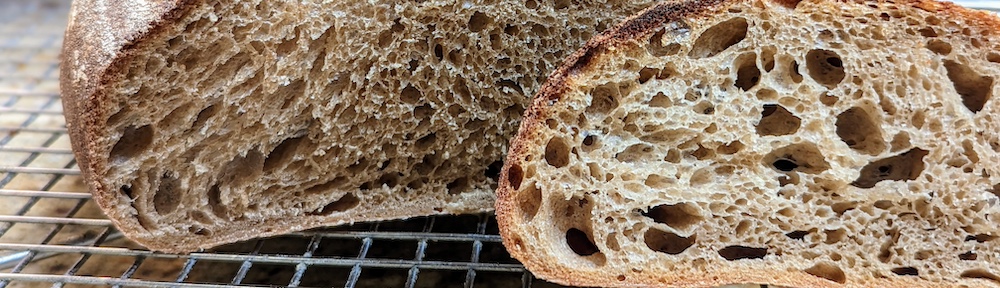
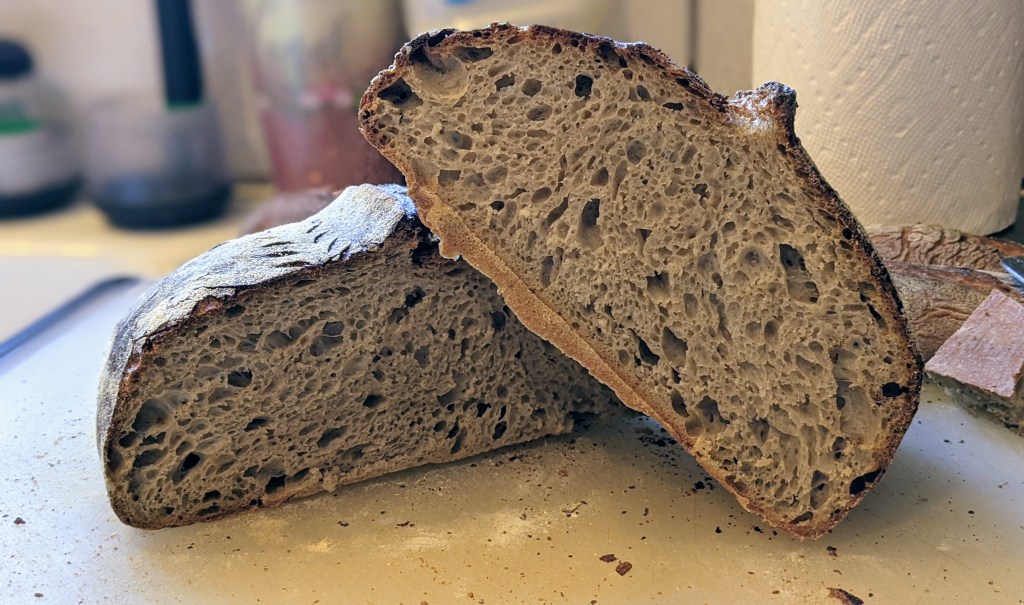
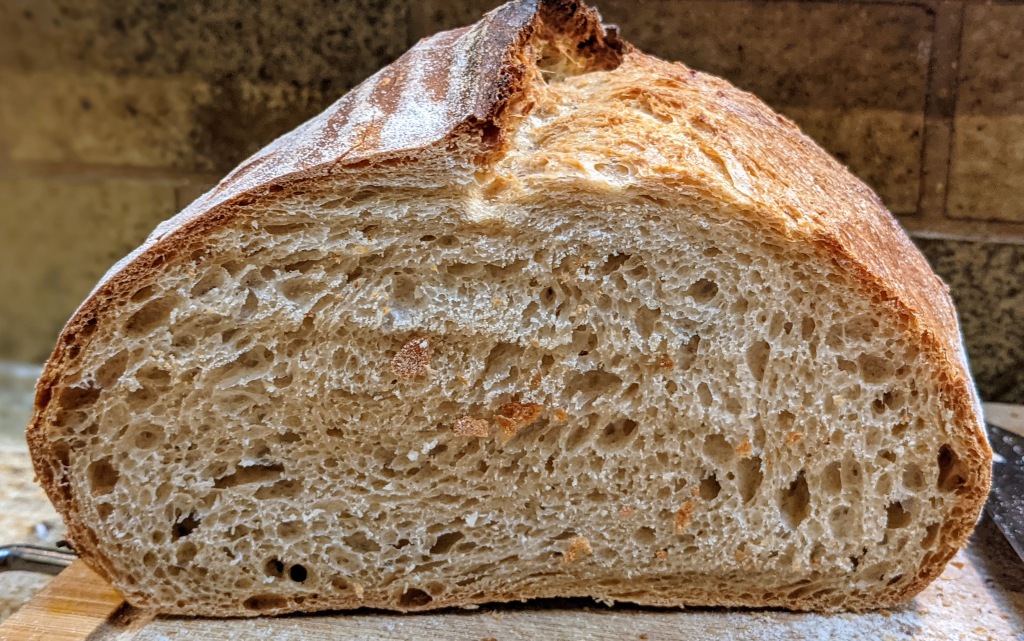
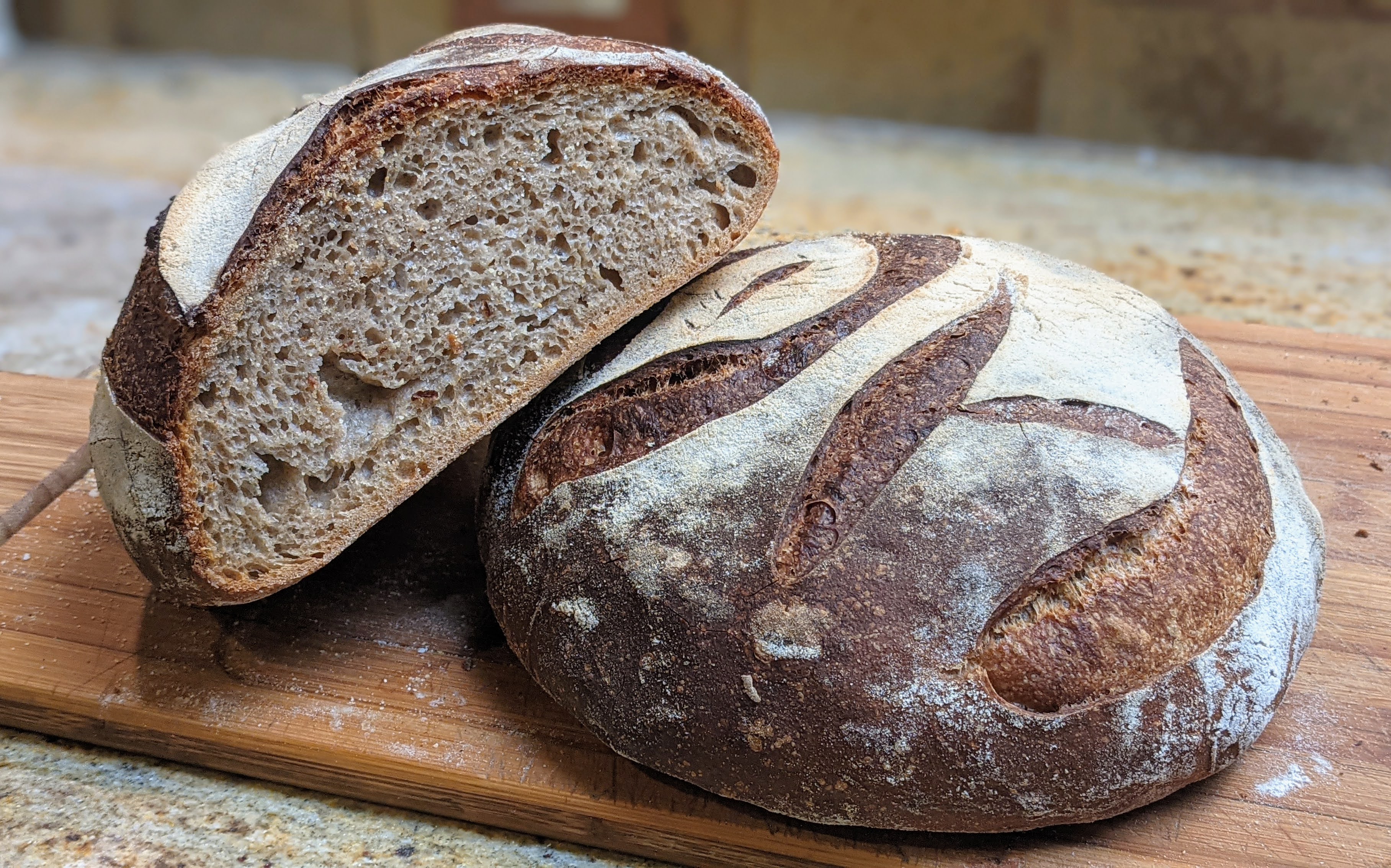
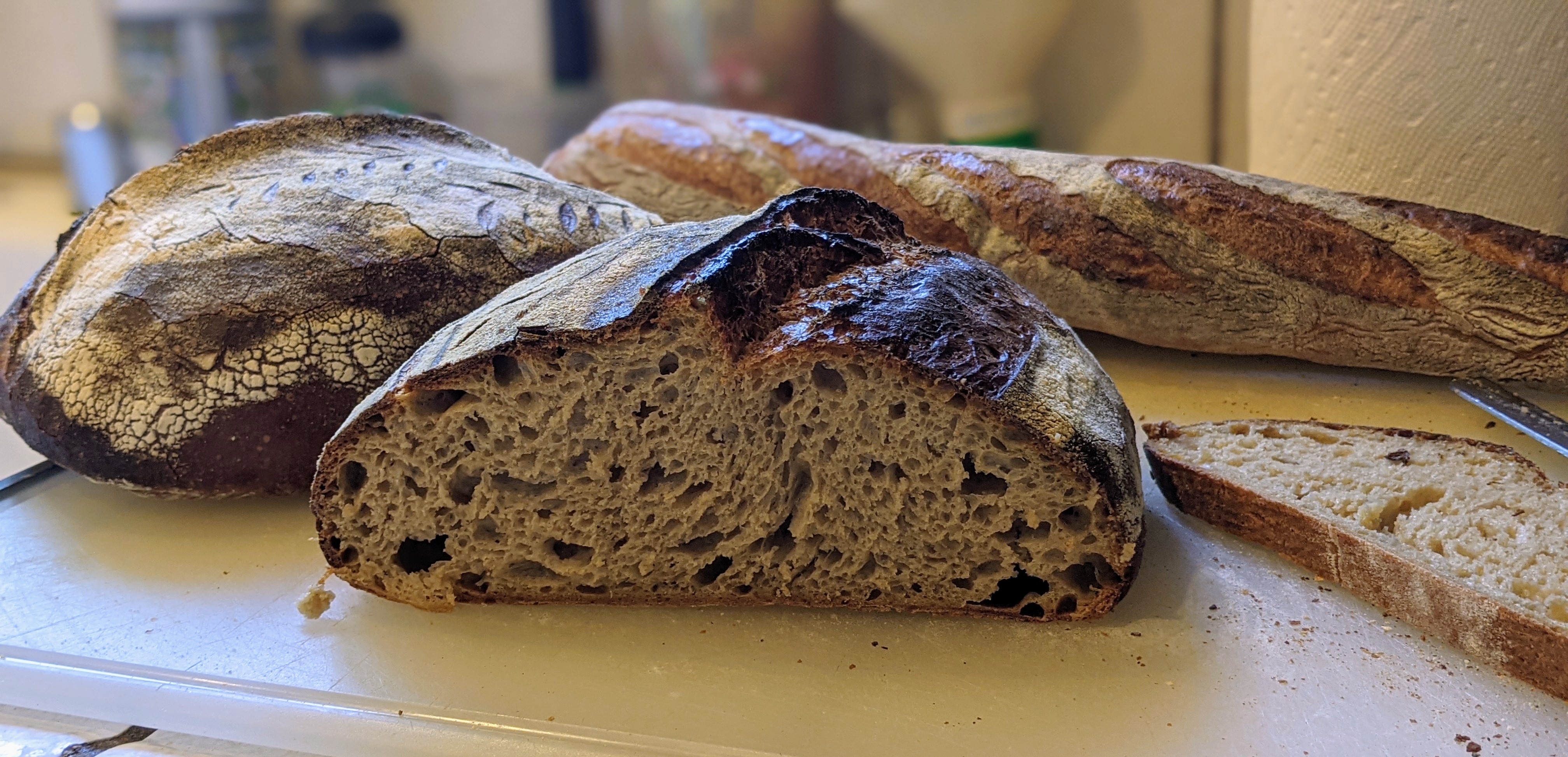
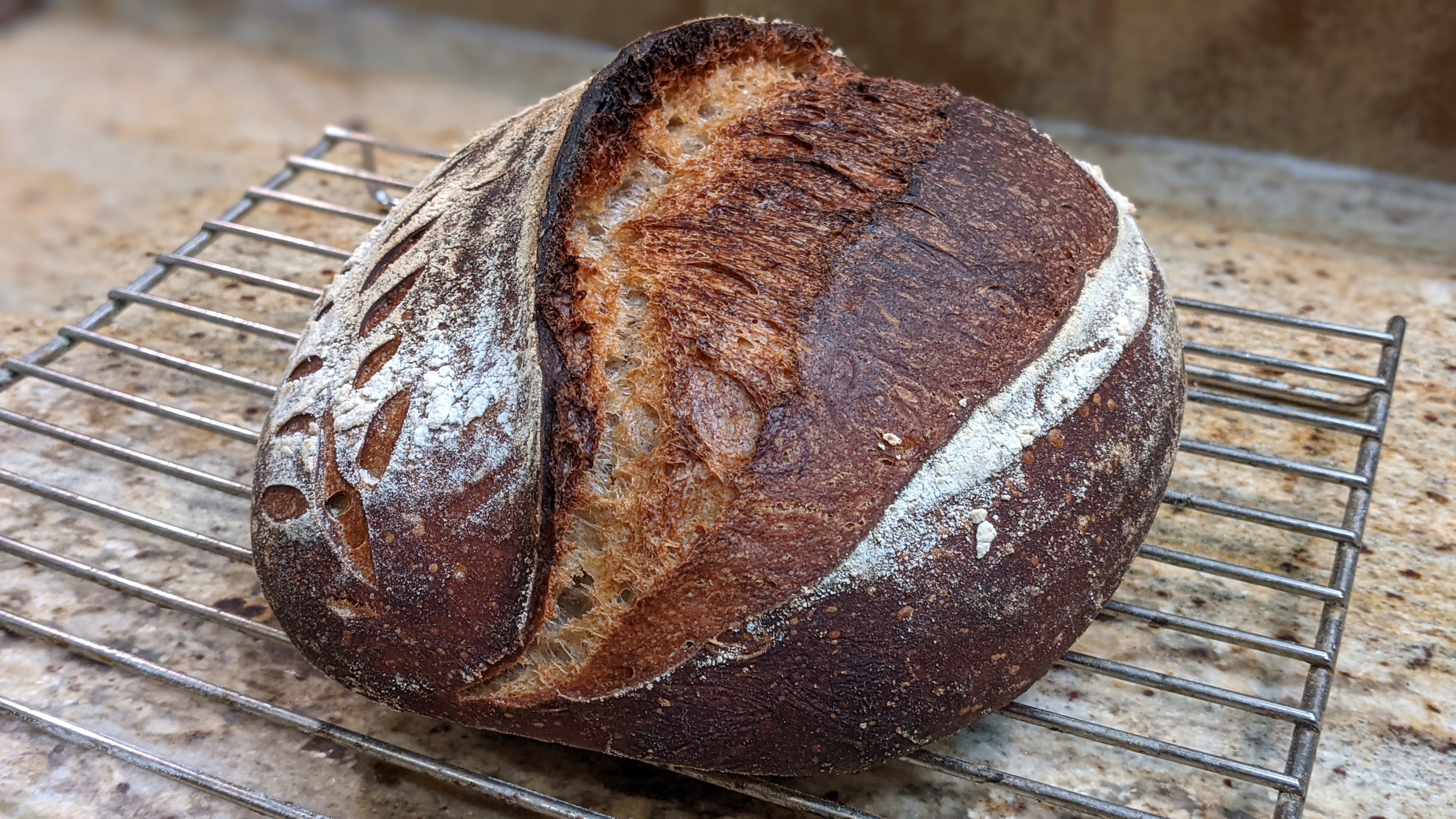
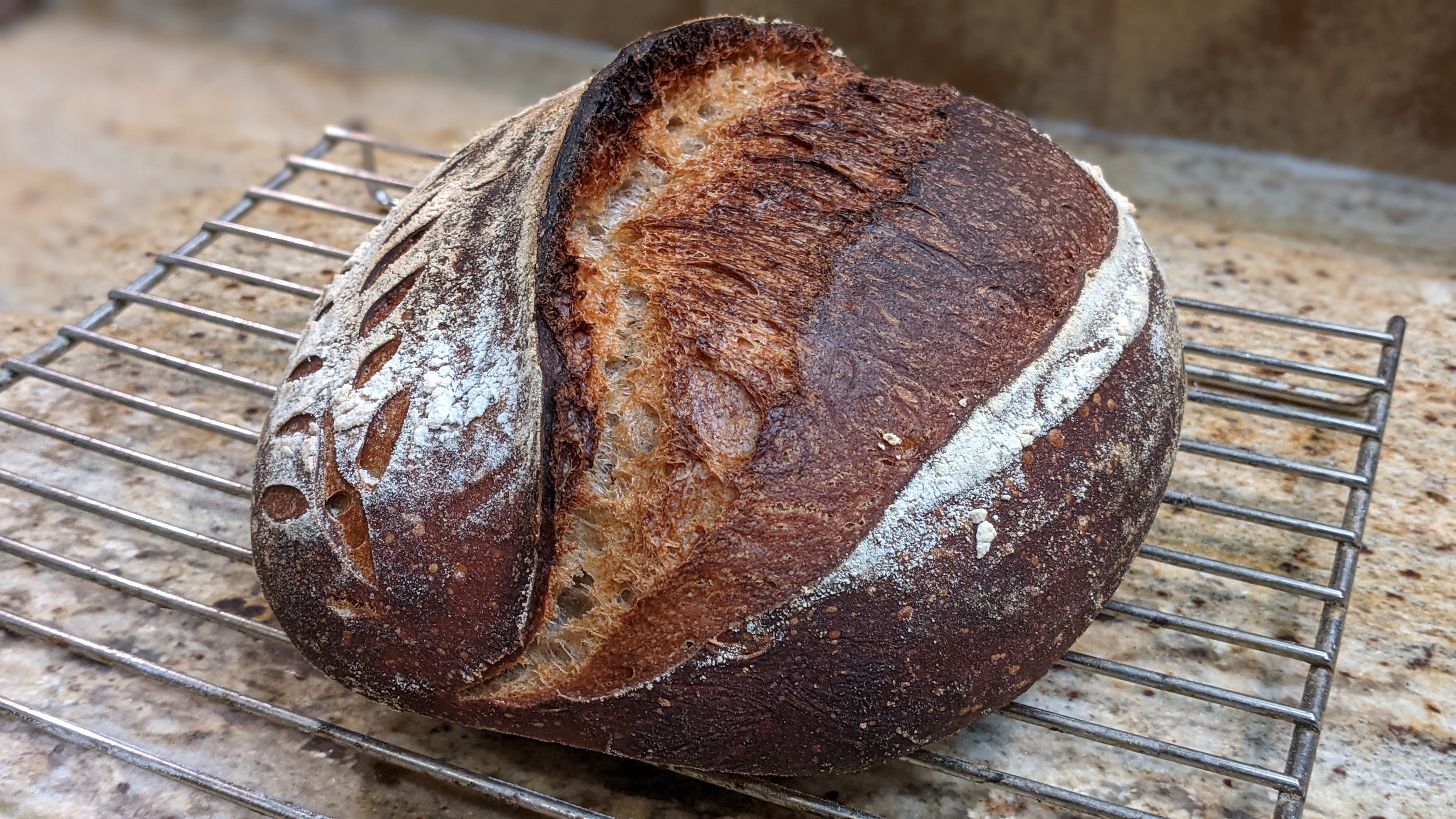
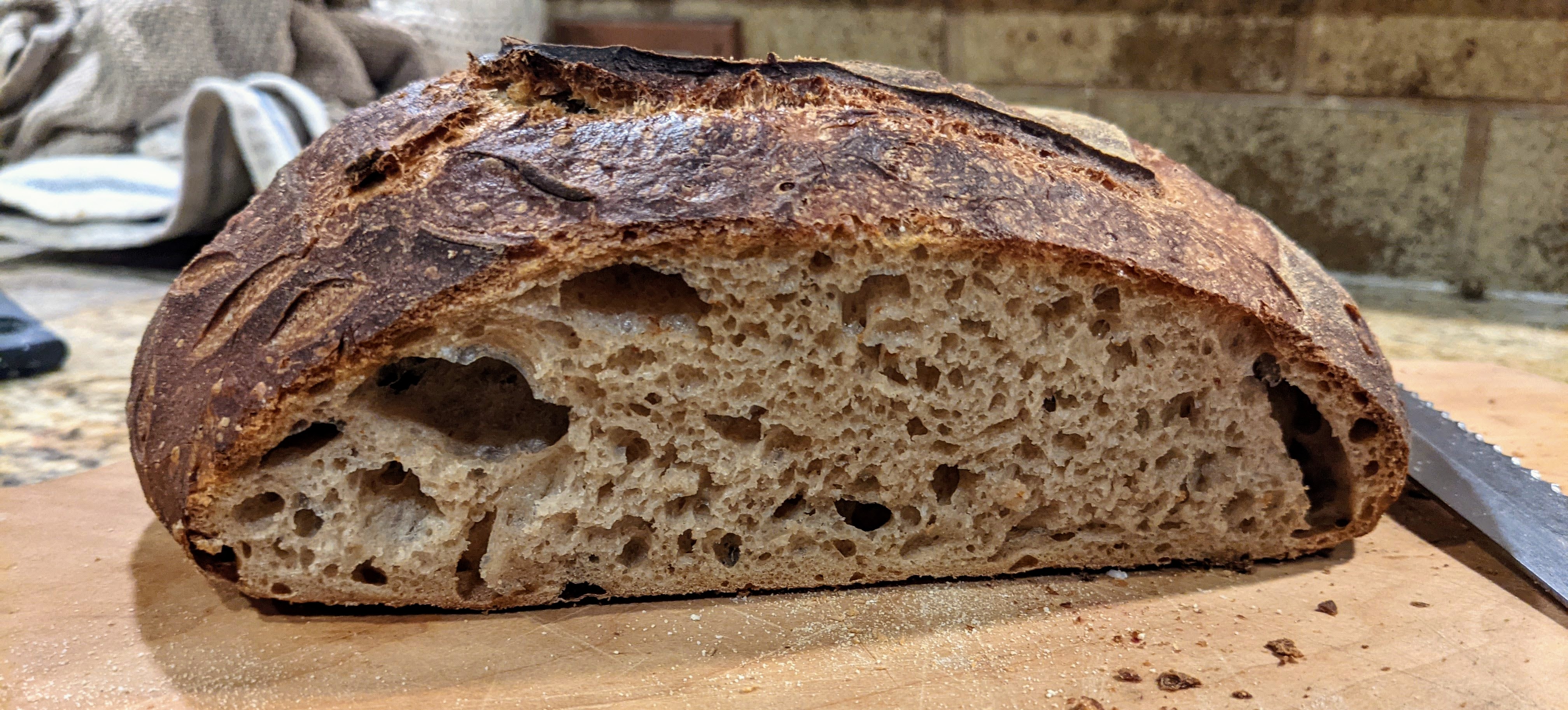
With the pictures above, I wanted to show the normal crumb of the boules and batards that I make. Though they employ different kinds of flour, I’ve figured out the hydration and processing that will get me that kind of crumb consistently. You’ll notice that while there are some larger holes, in general, the crumb of each loaf is only moderately open. What’s important to me is making sure the bread is fully fermented and that the yeast action is consistent and even during baking. Ultimately what I’m after is a soft, moist, yet airy crumb that has substance, but isn’t dense.
You’ll see on closer inspection that there are in fact numerous very small holes. I get lots of oven spring, but not due to large holes but by small holes acting together to raise the bread. If I’ve done the right job in making sure my dough is fully fermented, I’m good with that and it’s what I personally prefer. Given that, let me say this: A super-open crumb is not the be-all, end-all to baking bread! It really boils down to a baker’s preference. But this has somehow become a thing in home baking circles.
To be fair, I can understand why there’s so much enthusiasm surrounding an open crumb. It’s just not that easy to achieve when you don’t have the experience. And really, that’s what it takes: experience. In order to achieve that kind of open crumb, there are so many interdependent factors involved; and no, it’s not just upping the hydration as so many people are wont to recommend. And the only way one can fully understand the various interdependencies is through practice and repetition. So when someone finally achieves an open crumb with their bread, it’s understandable that they’d be excited.
And speaking of the recommendation to increase hydration, I have to admit that it’s irritating to me when I read this when someone asks how to get a more open crumb because most of the time that’s all the person answering says. So many people just blurt out, “Just increase your hydration,” as a catch-all, and don’t consider the flour the asker is using. First, your flour has to be able to absorb the extra water, and second, your flour has to have a high enough protein content to maintain the dough structure with higher hydration. Otherwise, you may very well get an open crumb, but your loaf will expand out and not up during baking.
And even with higher protein content, there’s the dough development and handling techniques to achieve that open crumb. Then you also have to consider the size of the loaf. A larger format loaf is going to have a lot of weight that could affect the openness of the crumb significantly. Like I said, there are lots of interdependencies…
Captured from Tartine Bread
Tongue-in-cheek, I kind of blame Chad Robertson for this craze because I’m fairly sure his book, Tartine Bread, had a lot to do with people’s notions of what constitutes an ideal crumb. Look at the picture to the right that I captured from Tartine Bread. That crumb is aesthetically amazing (unless, of course, you have trypophobia). And while it looks delicious – and I’ve had Tartine bread and it tastes amazing – spread some honey on a slice of that. Just make sure you don’t lay the slice directly on your hand without a napkin. And butter? Fuhgeddaboutit!
While that style of crumb isn’t what I’m personally after, it’s what Chad wanted to achieve as a baker and that’s entirely his prerogative. He spent years in search of that and developing the technique to achieve that crumb consistently in all his different kinds of bread – and at high-production levels, no less! So kudos to him!
And kudos to others who want to achieve this. It’s just not for me. Unfortunately, I’ve been on forums where people are downright snooty about other folks’ crumb shots that are like mine. And worse yet, they’ll say things like, “It looks like your dough is underfermented,” or “You need to up the hydration of your dough.” In my case, all my loaves contain a significant portion of whole-grain or high-extraction flour, at least 25% and usually more, and unless I add vital wheat gluten – which I try to avoid – I will not get big holes. The best I can hope for is a crumb similar to the leftmost loaf in the pictures above.
I know I kind of went off here… But don’t feel bad about not getting a super-open crumb. Even if that’s what you’re ultimately after. What you really should be concerned about is ensuring that your dough is fully fermented. Get that down first. Then study your flour to see if it can handle a higher hydration rate. You’ll also then have to ensure that you’re thoroughly developing your dough. Like I said above, there are lots of interdependent factors.
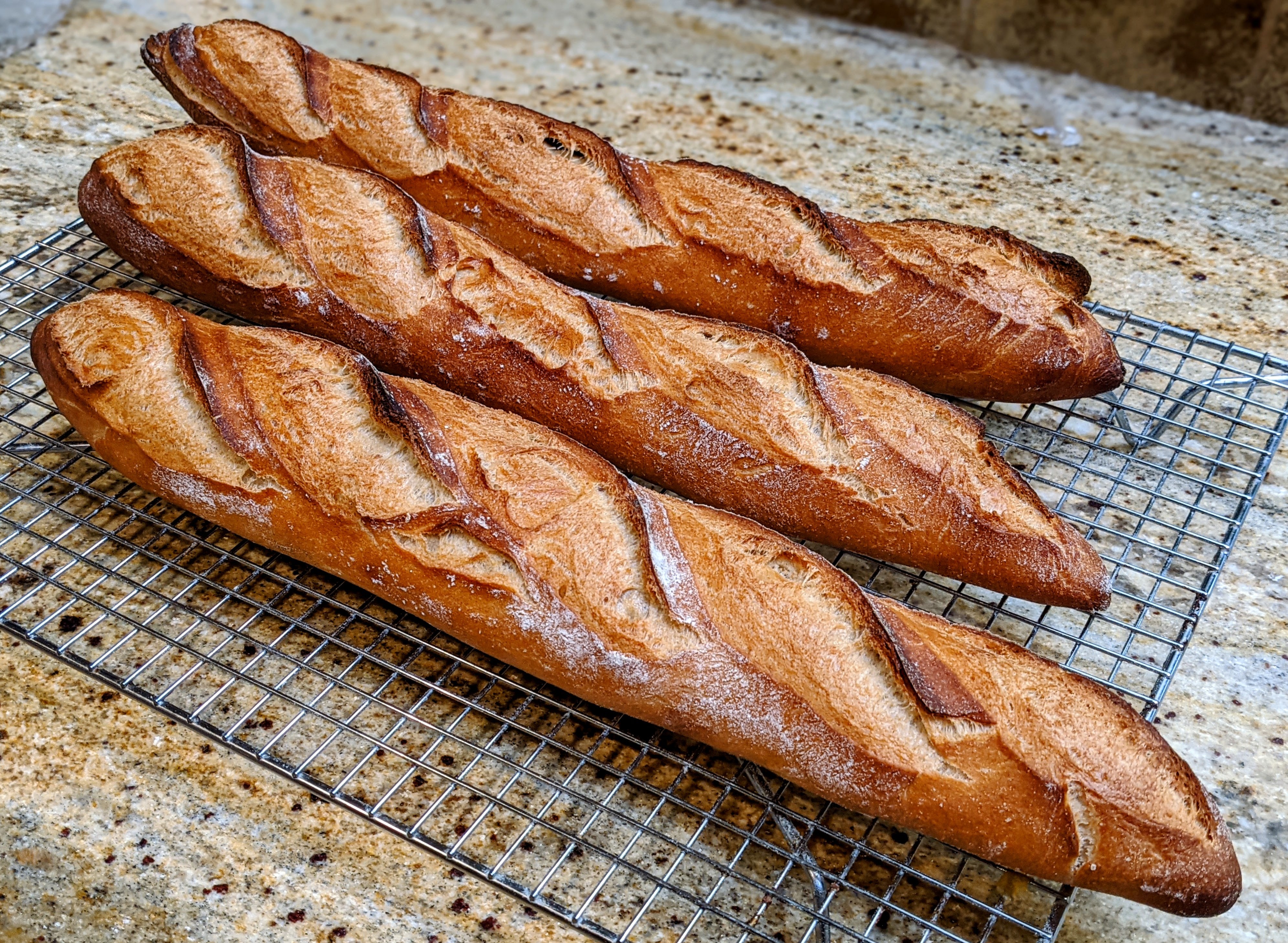
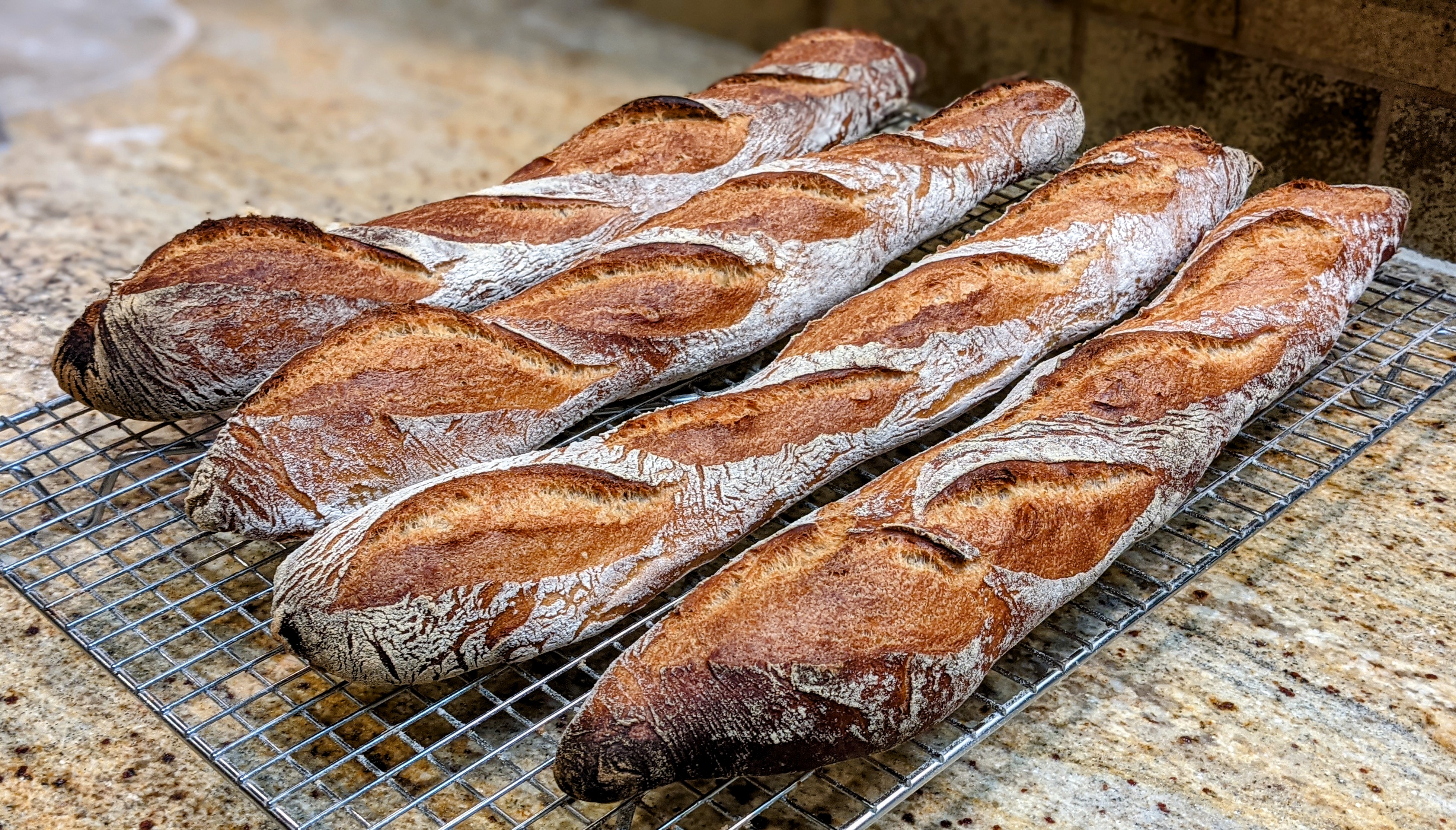
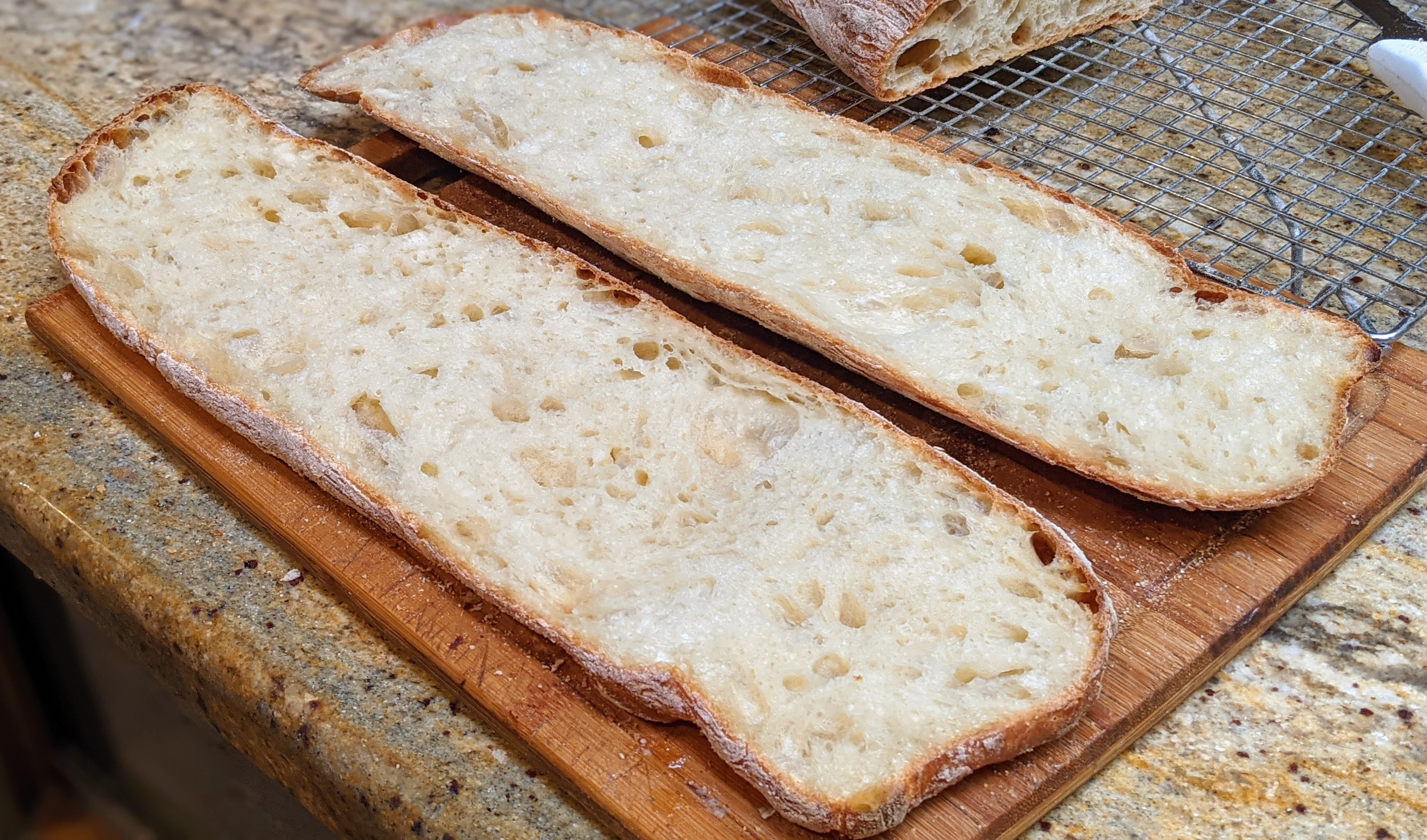
This morning, I was thinking about the several different types of techniques of baguettes that I make: Pointage en Bac, Baguettes de Tradition, Poolish, Levain, Poolish, and Sourdough, Sourdough and Yeast; not to mention varying the hydration and flour blends to achieve different textures. The baguettes pictured above are Poolish and Levain baguettes ala Tartine Bread. They’re a low hydration double preferment bread that produces a crunchy crust and a chewy crumb. My Baguettes de Tradition on the other hand create a light, crispy crust with a light, airy crumb.
In any case, I realized that I use two dough development techniques depending on the type of rising agent I use: One for yeasted and another for sourdough. So I thought I’d share them here so I could just link to them in my future baguette recipes as I’m tired of duplication.
Flour Type
People ask me what flour I use for making baguettes. Traditionally, baguettes are made with white flour. But unless I’m teaching a basic technique or introducing a new recipe, I invariably use a mix of different kinds of flour to affect different flavor profiles in my bread.
Sift Your Flour!
Whether or not you use a blend of different flour, you should always sift it before mixing. This will prevent large lumps from forming during the mixing process.
Yeasted Baguette Dough Processing
Mix. Mix all the ingredients together to form a shaggy mass. With my yeasted dough baguettes, I normally don’t do an autolyse.
Bulk Fermentation. 1 1/2 to 2 hours or 6-18 hours in the fridge. Bulk fermentation is finished when the dough has expanded about 50%.
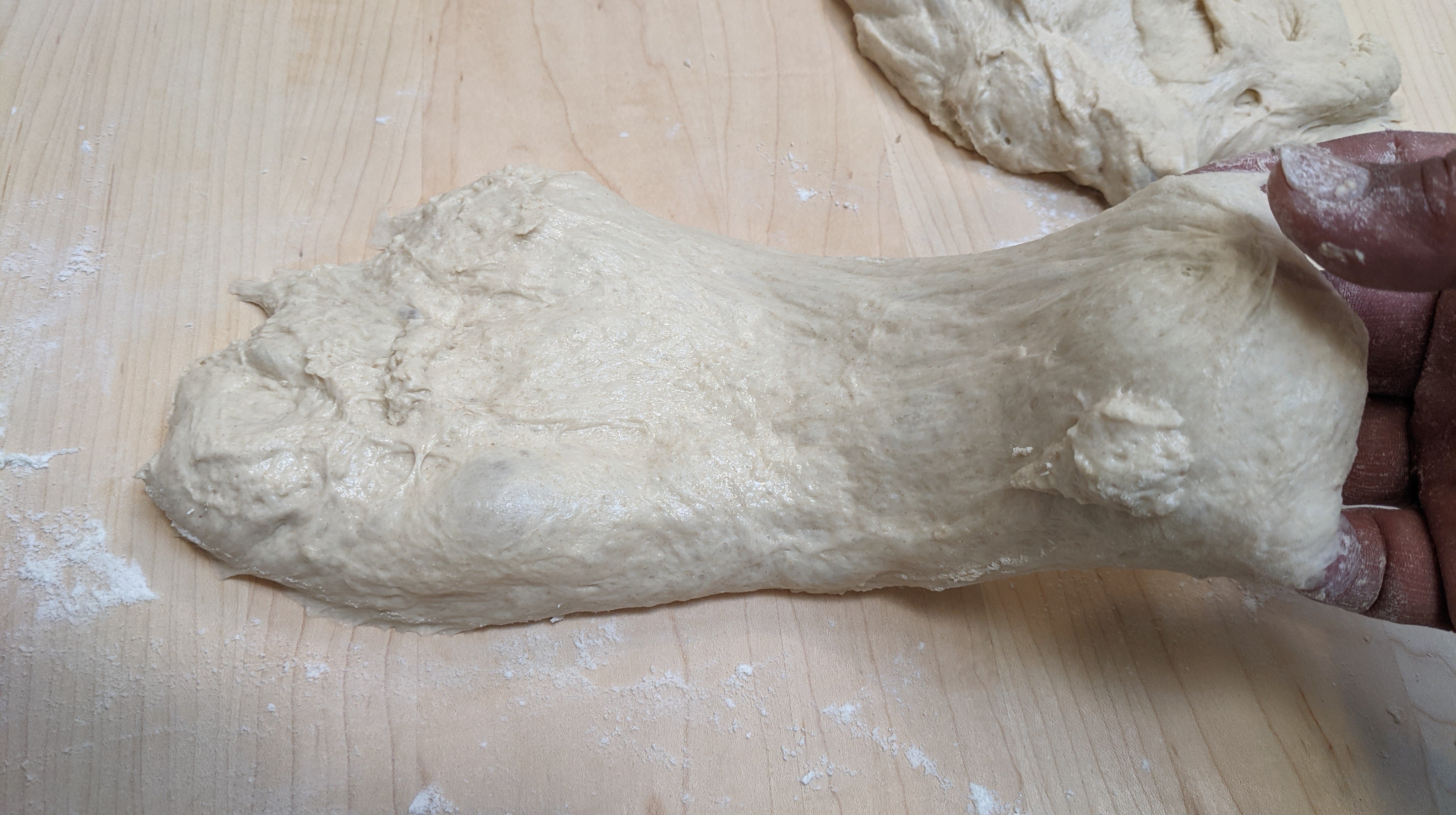
Folding. Whether doing a cold bulk fermentation or not, stretch and fold the dough every 20 minutes in the first hour. By the third fold, the dough should be smooth and luxurious and will be highly extensible.
Levain Baguettes
Whether I’m making a double-preferment (both poolish and levain) or just a straight levain dough, I use the same process for both, which leans heavily on Chad Robertson’s dough development technique.
Initial Mix. Reserve 50g of the water and set it aside. In a large bowl, dissolve the preferments(s) into the remaining water to create a slurry. Add the slurry to the flour and mix until no dry ingredients are left and you’ve formed a shaggy mass. Cover and allow to rest 30-60 minutes.
Final Mix/Bassinage. Sprinkle the salt over the dough, then add the reserved water to the bowl. Work the salt and water thoroughly into the dough until all the water is absorbed and you can no longer feel any grittiness from the salt.
Bulk Fermentation. 3-4 hours @ room temp. Bulk fermentation is complete when the dough has expanded about 25%-30% in volume.
Folding. Fold up to 6 times every 30 minutes for 3 hours. That said, really feel the dough and check its extensibility before each folding session. This folding schedule is based on the Tartine method which calls for 6 folds over 3 hours. However, I’ve rarely gone past 4 folding sessions with the flour blends I use – they get strong real fast, even if I’m handling them gently!
Once you’ve built up dough strength, you can either proceed to shaping or pop the dough into the fridge for further flavor development from 8-18 hours.
Both Yeasted and Levain Baguettes
Divide and Pre-Shape. All the baguette recipes I post here either make 4 X 335g baguettes or 6 X 220g baguettes. Whichever you choose, divide the dough into pieces of that weight. Once divided, letter fold each piece by stretching one side, then folding it to the center, then stretch the other side and fold it over the body of the piece. Then roll the piece up like a jelly roll perpendicular to the folds, seal the seam, then place the piece seam-side-up on a well-floured couche.
No matter the shaping technique you use, bear in mind that shaping a baguette is not just rolling the dough into a long, skinny log. The first part of getting it into a cylindrical shape builds skin tension prior to rolling it out. This is absolutely critical to achieve ears on your cuts when you score! I will submit that this particular step is the most important step of shaping.
Final Fermentation: Depending on the ambient temp of your kitchen, final fermentation can take anywhere from 30 minutes for yeasted baguettes to 2 hours for levain baguettes. In either case, to determine when the loaves are ready for the oven, poke a floured or wet finger about a half to three-quarters of an inch into a loaf, then pull your finger back quickly. Observe the rate at which the indentation comes back. If it doesn’t come back at all, pop the loaves into the oven immediately – you’re extremely close to over-fermenting the dough. If it comes back quickly, and almost fills the indentation back up, give it a bit more time. If it comes back quickly, but immediately slows down, then you’re ready to bake!
Scoring. Scoring should be done in the middle third of the loaf, using fairly straight lines that overlap each other by about a third. The lame or scoring blade should be at an extreme angle to create a flap which will in turn bake into an ear as seen in the picture below.
Don’t cut across the loaf! This will only create diagonal slashes!
Though Chef Markus mentions overlapping the scores, he doesn’t discuss why you need to do it. If you don’t overlap the scores, your baguettes will indeed open at the scoring sites, but they’ll come out as bulges and remain narrow where the cuts didn’t overlap, so the sides of your baguettes will be wavy, not straight.
Baking. Bake at 475ºF with steam for 12-15 minutes or until the loaves start taking on color. Vent the steam and remove your steaming container, then bake for 12-15 minutes at 425ºF or until the loaves turn a nice, deep, golden-brown.
Alternative Baking Method. Bake at 400ºF for 20 minutes with steam. Remove the steaming container, then finish baking at 425ºF for 25-30 minutes. I know it sounds backward, but it actually works great!
I’ve made no secret that much of what I bake is heavily inspired by traditional and ancient French and Italian bread. There’s a certain romance to it all and as a hopeless romantic, making these kinds of bread have a deep appeal.
But despite my love of ancient bread, my dough development techniques are all influenced and inspired by studying modern baking masters such as Markus Farbinger (Il de Pain, Knysna, South Africa), Jeffrey Hamelman (Director of Baking, King Arthur), Chad Robertson (Tartine Bakery, San Francisco), Carol Fields (Author of “The Italian Baker”), Nancy Silverton (Founder, La Brea Bakery, Chef & Restauranteur, L.A.), and Paul Barker (Cinnamon Square Bakery, UK)… which brings me to this particular recipe.
Asked to think about French bread and most people will immediately think of baguettes or the thicker long loaves labeled “French Bread” in the grocery. Long loaves made of white flour seem to have become synonymous with the country. But the baguette, while much loved (if you read this blog, you know how much I love to make baguettes), isn’t that old – at least relative to the traditional bread – having only been introduced in the early 20th century when bakers started using brewers yeast to leaven their bread. Before that, like hundreds of years before, naturally leavened bread ruled.
This particular bread really is a melding of the ancient and modern. While it’s a pure levain bread I use what Chad Robertson calls a young levain that provides a very light tartness as opposed to being strongly sour, which explains why I feed the levain twice in one a day prior to mixing (plus it’s highly active to give a good rise). The base of my starter uses employs a yeast-water culture I learned from Paul Barker’s Naturally Fermented Bread. And the recipe leans heavily on Hamelman’s Pain au Levain in Bread. Bread is so cool…
Overall Formula
Flour
100.00%
Water
65.00% (With 50ml optional bassinage 68%)
Salt
2.00%
Bassinage is optional. But I like to add a bit of water to the autolysed dough as it helps dissolve the salt.
Levain
Mature Starter
25g
Flour
150g
Preferment
150g
Required for Recipe
229g
Final Dough
Flour I use: 40% unbleached bread or high-extraction flour 30% whole grain flour (whole wheat, Kamut, red fife) 30% unbleached AP flour
949g
Water (warm)
617g
Salt
22g
Levain
229g
Yield
~1817g 2 X 900g loaves
Optimal Dough Temp
82ºF
Build the Levain
With this levain build, there’s no discard, save for what’s leftover from the build which you can pop into the fridge and use later. The thing about this levain is that it’s young and the way it’s prepared promotes yeast growth over bacterial growth. Traditional French sourdough has a tang but is not sour, so we focus on the yeast with this kind of levain.
Initial Levain Build. Add 25g mature starter (I just take it directly from the culture in my fridge) and add it to 50g flour and warm water, respectively. Allow doubling in volume with a slightly domed top and lots of bubbles. The build’s ready when it passes the float test – about 3-4 hours.
Second Levain Build. Add 75g of each flour and warm water to the levain. Mix thoroughly and let ferment. It should be ready in just a couple of hours – or even less. The levain is ready when it passes the float test.
If you’re working from home: Timing-wise, you could start the build early in the morning and mix before mid-afternoon.
If you have to go into the office: Do the first build immediately before leaving for work and leave it in a cool place. By the time you come home, the levain will have peaked and collapsed – that’s okay, but it’ll be pretty sour. You can discard a bit of if you don’t want the bread to be too sour. I myself just keep it all. But to help counteract the sourness, I use 100g of each flour and water. You’ll mix by early evening then shape right before bed. Then you can bake as soon as you get up!
Make the Dough
Initial Mix/Autolyse. If you’re using a flour blend, mix the flour until well-combined. In a separate bowl, measure out the levain you’ll need, and dump in all the water. Dissolve the levain until you have a thin slurry. Pour the slurry into the flour, then mix until no dry ingredients remain. Rest the mix for 30-45 minutes.
Final Mix/Bassinage. Sprinkle the salt over the dough, then add the 50ml of water. Work the salt and water into the dough until thoroughly combined.
Bulk Fermentation. About 2 1/2 – 3 hours, or until dough has risen to 50% of its original volume.
Folding. Fold twice at 50-minute intervals.
Shape. There’s no preshape with this bread! Gently turn the dough out onto a lightly floured surface, then divide into 900g pieces. Shape the pieces into tight rounds then place them into linen-lined baskets.
Final Fermentation. 1 1/2 – 2 hours @ room temp, or pop into the fridge for 6-12 hours.
Bake. Bake at 440ºF 45-50 minutes. Bake with steam for the first 20 minutes, then finish the bake with a dry oven.
Coming Clean…
Though I provided a recipe here, it’s really meant as a guide to enable you to freestyle later which sort of explains why I didn’t take much space with the more verbose explanations I usually provide. In fact, with the loaves at the top of the article, though I did measure out the ingredients so I could prove out the formula, I freestyled the process.
I had to because now that I’m going into the office three days a week, my baking time is limited. With the levain build, I actually did start the first build before I left for the office. And though I stored it in the coolest part of my house, by the time I got home, it had peaked and collapsed into a pleasingly sour mass. But I just fed it – and my instinct told me to use a higher ratio of flour and water and not just do a 1:1:1 so I probably used a 1:3:3 – and the microbe density was so high at that point that the second build was ready in just over two hours!
That’s the whole point of calling this a “Poilane-style” bread. At the famous Poilane Bakery in Paris, bakers make their famous miche relying purely on instinct. They go through a year and a half apprenticeship to learn the technique so well that they can pretty much eyeball the whole process. For me, baking by pure instinct is the ultimate expression of being a bread baker, but also the most pure form of historical expression, if you will.
Think about it. Back in ancient times, they didn’t have digital scales and temperature gauges. Bakers just relied on their senses. They took a little bit of this, a little bit of that and they just instinctively knew when to move on to the next step. So if and when you make this bread, pay attention to the look, feel and smell of the dough as you develop it. Then the succeeding times you bake, rely less and less on the recipe. You’ll actually be pleasantly surprised at how much you retain.
As is our habit after we dine in a particular town, my wife and I ended up perusing a book store where I, of course, sought out the bread books. I ran across this nice book called, “Boulangerie at Home,” and immediately thought to myself, There’s got to be a baguette recipe in there… I wasn’t wrong.
As for the book, it was beautifully laid out with lots of pictures, but though the title implied it was written for home bakers and perhaps even beginners, it’s a bit more advanced than that. I’ve been baking a long time, so I can look at a recipe and work out the baker’s math pretty much in my head. But these aren’t recipes that a newbie could do with ease.
But despite that, I found the baguette recipe and I snapped a picture of it. Then when I got home I started working through the baker’s percentages. The basic formula is below:
Overall Formula
AP Flour (King Arthur or Bob’s Red Mill) or T65* flour
100.00%
Water
71.43%
Salt
2.00%
Yeast – Instant**
0.25%
*T65 flour is flour with a protein content of 12%-13.5%. You could use King Arthur or Bob’s Red Mill bread flour for this, but I myself prefer King Arthur AP Flour at 11.7% protein content. The author calls for the use of high-gluten flour, but T65 is not THAT high. To me, high-gluten flour has protein over 15% (check out Janie’s Mill High-Protein flour – it’s expensive but wonderful). **The recipe from the book calls for fresh yeast, and if you have some, use 0.7%. For this recipe that would be about 6-7 grams of fresh yeast
Levain
The author called this “liquid starter,” but that just means it’s a 100%+ hydration starter. In this case, it’s a 100% hydration starter.
Preferment Flour % of Total Flour
4.80%
Hydration %
100%
Preferment Flour Weight
37g
Preferment Water
37g
Preferment Required for Recipe
75g
Final Dough
Flour
742g
Water (lukewarm)
519g
Salt
16g
Yeast
2g
Preferment
75g
Total Yield
4 X 335g loaves 6 X 222-225g loaves 1353g total
Optimal Dough Temp
78°-80°F
For dough development, I prefer my own method. The one in the book wasn’t bad, but I’ve been making baguettes for a long time, and the method I’ve developed works for me, so that’s what I’ll share here.
Note that this employs a hybrid rising method that uses both a levain and some yeast to rise the dough. The levain adds flavor and contributes a bit to the rising, whereas the yeast does the heavy lifting. You could use the levain exclusively, but then bulk fermentation will go on for much longer, and I suggest taking a Tartine approach and fold the dough every half-hour for 3 hours. Like any sourdough, depending on the ambient temp of your kitchen, bulk fermentation at room temp could take 6-8 hours.
Make the levain. If you have a mature starter already, take 20-30 grams of it then mix it with 100g of flour and 100g of water, essentially making a 1:5:5 (1-part starter, 5-parts flour, 5-parts water) ratio levain. The levain will be ready when it passes the float test. You’re not going to do several builds with this as you want to use a relatively young starter to limit the sourness of the bread.
Initial Mix/Autolyse. Reserve 50 grams of the water, then dissolve the starter in the remaining water. Add this mixture to all of the flour and mix until no dry ingredients are left. You’ll form a shaggy mass. Let this rest (autolyse) for 30-45 minutes. This will get the natural yeasts going.
Final Mix. Sprinkle the salt and the yeast over the dough, add the reserved water, then work them into the dough until thoroughly combined. The dough will still be a little shaggy, but considerably smoother than the initial mix.
Bulk Fermentation. 2-5 hours at room temp (depending on the ambient temp of your kitchen) or cold ferment (39°F to 42°F) for 6-12 hours following folding. If you decide to do a cold bulk fermentation, use half the yeast. Bulk fermentation is finished when the dough has risen about 50% (don’t let bulk fermentation go much further than this).
Folding. In the first hour of bulk fermentation, fold the dough 3 times at 20-minute intervals. After the third fold, let your dough rest and check its expansion. As I mentioned above, you only want the dough to expand about 50%.
Divide and Preshape. Pour out your dough onto a lightly floured surface. Gently work it into a rectangle, then divide it into 4 X 335g pieces. With each piece, letter fold the left and right sides of the piece (stretch out a side then fold it over the body of the piece, then jelly-roll the piece over the seams. Place each piece seam-side-up on a well-floured couche, the let them rest for 20-30 minutes (or just a little more) depending on how tight you rolled each piece. You want the dough to be nice and relaxed. You may see a little rise out of the pieces during this time.
Shape. Shape the rested logs into baguettes, then place the shaped loaves on the couche for final fermentation.
Final Fermenation. 1-1 1/2 hour or until the loaves have puffed up to about 75-85% – just under doubled.
Bake. Transfer the loaves to a loading board, score them, then bake at 475°F for 12 minutes with steam. Remove the steaming container, turn the oven down to 425°F, then bake for another 12-15 minutes or until the crust is deep, golden-brown. This bread really benefits from a full bake.
I read some reviews of the book online and there were lots of people who wrinkled their noses at the use of commercial yeast in the recipe. The plain fact of the matter is that there are numerous ways to leaven bread. For me, as long as you’re not using chemical additives to leaven dough, you’re golden. But to eschew a technique just because it’s not sourdough, to me at least, lends itself to elitism. There’s more to bread than sourdough, folks…
The same goes for those who won’t bake bread that has a hydration rate of less than 75%. Even Jeffrey Hamelman shakes his head at that in his book Bread, calling it a shame that people cut themselves off from learning different techniques and methods because of this. I get it, though. The thinking is that higher hydration makes it easier to form holes in the dough. And for the most part, that’s true. But a lot ALSO has to do with how you handle the dough.
For instance, look at the picture to the left of the baguettes I made from the Tartine Bread book by Chad Robertson. What a crumb! Really open with lots of holes. Guess what? The dough that came from was 64% hydration! It was my gentle handling of the dough and its thorough development that allowed that to happen, not the hydration.
I have to admit that I was a little incredulous myself when I worked out the formula. But after having made these several times now, I love the technique!
As I’ve shared in the past, I’m a software engineer by trade, though I will come clean that I haven’t really coded professionally for years as I’m in executive management. Since January of this year, I had been officially unemployed as my previous company got purchased (and no, I didn’t make F-U money), and was taking a long time to evaluate what I wanted to do next. Of course, one of the options was to start a bakery, which I kind of did by creating Dawg House Bakery to bake bread to donate to shelters. Another option was to just go back into engineering as a senior-level software architect. But the thought of returning to the workforce as an individual contributor grated at me. So I decided to go back into engineering management.
So now I’m the Executive VP of Engineering for a small firm in the SF Bay Area Peninsula. I spent a couple of months talking to the firm and I’m super-happy to have joined. But when I landed the job, I worried that I wouldn’t have time to bake.
But I had nothing to fear because the management team is only required to come in three days a week (though lots of others come in because we like being together). So guess what I’m doing while I’m working from home? The fruits of my labor are pictured above. I took that loaf to work and shared it with my company! So cool!
Honestly, I’m no longer able to bake every day and I’m a little saddened by that. But on the bright side, at least I can still bake a couple of days out of the week. So I can still satisfy my obsession with dough!
The loaf above just came out of the oven about 15 minutes ago as I write this recipe! This was a free-form batard where I didn’t use a banneton and proofed on a couche!
I love making bread from a poolish – or sponge – before I go to bed, then make a couple of loaves the next day. With this recipe, I’m using 25% fine-ground white whole wheat flour. You can use red whole wheat as well, but just make sure it’s fine-ground or extra-fine ground.
I will be upfront: It’s going to take a bit of patience, especially after mixing the final dough because there’s very little yeast used in total (I kind of wanted to simulate sourdough dough development). But your patience will be rewarded with a slightly sour bread with a wonderful, light, chewy texture. I did my folds in between meetings today! And the bulk ferment took about 5 hours. So yeah… it takes patience. Without further ado, let’s get to the recipe!
Overall Formula
Bread Flour
75%
Whole Wheat Flour
25%
Water
75%
Salt
1.5%
Yeast (Instant)
0.075%
Poolish
Fine- / Extra-Fine-Ground Whole Wheat Flour
250g
Water
250g
Yeast (Instant)
0.25g
Since the recipe calls for 500g of poolish, it’ll be a good idea to make more than what you need like 520g.
Final Dough
Bread Flour
750g
Water
500g
Salt
15g
Yeast (instant)
0.5g
Poolish
500g
Make the Poolish
Just-mixed poolish, ready for a long nap.
The evening before you bake, in a large bowl, mix up the ingredients for the poolish until everything’s incorporated. Make sure to scrape down the sides of the bowl with a spatula. Cover the bowl with plastic wrap, making sure it vents to release the gases. Let it sit and do its magic for 12-16 hours. If your kitchen is really warm like mine, 12 hours is the max! But please do not rely on time! What you’re looking for is the poolish being bubbly and slightly domed on top. It should pass the float test (see picture below).
Tip: Alternatively, you can pop the poolish into your fridge and let it develop for 18 to 24 hours. I’ve found that this actually mellows the sourness a bit, but introduces some interesting nutty and earthy notes. NOTE that if you decide to do this, let your poolish “wake up” for an hour at room temp before doing the final mix.
Poolish is ready and passes the float test.
The Next Day ~ Mix and Bulk Ferment
Measure the temperature of your flour. We’re after around 75-80-degrees of final dough temperature. Use the following table to determine the temp of your water:
Flour Temp
Water Temp
55
110
60
100
65
90
70
80
75
70
80
60
85
50
Add the rest of the water, salt, and yeast to the bowl with the poolish and mix thoroughly with a dough whisk or fork until the poolish is fully dissolved. Once combined, add the bread flour in batches.
Using a Danish dough whisk makes quick work of bringing ingredients together. That was probably one of the best investments I made for baking bread. By the way, that’s a 24″ wide mixing bowl. I prefer mixing in a huge bowl like that because it makes mixing by hand much easier as I don’t have to worry about ingredients popping out of the bowl!
Form the dough into a rough ball and let it rest in the bowl for 10 minutes. After 10 minutes, fold the dough, then turn it over to rest on the folds. From there, fold the dough every 30 minutes for the next 2 hours or until you feel the dough is strong and extensible (hint: do the windowpane test to see if it is developed enough). Other than the windowpane test, I know the dough has developed enough strength if I can take 1/4 of the dough ball and stretch it up about a foot without it tearing. But bear in mind that as you are using whole wheat flour, you need to be gentle when handling the dough!
I use a 6-liter Cambro container for bulk fermentation.
Finally, cover the bowl and let the dough rest for 2 hours or until it has expanded about 25% to 30% in volume with a nicely domed top. You may not see bubbles on top, but that’s okay. Give your container a gentle shake. The dough should be jiggly, which means there are air bubbles in the dough, which is what you want! If you don’t see much growth, and the dough’s not very billowy, just give it more time.*
Tip: Turn on your oven to 475 before dividing and shaping. If you’re cooking on a stone, make sure it’s placed on the middle rack and you also place a metal baking pan (I use a sheet pan) on the bottom rack. You’ll be pouring a cup of hot water into the pan to create steam.
If you’re using a Dutch oven, place it in the oven now so it’s hot when you’re ready to bake. A steam source isn’t necessary for the Dutch oven since the baking bread will provide enough steam in the enclosed chamber.
*Notice that I didn’t say wait untildoubled. The whole doubling in size that you often see is a little misleading. Most recipes, even some of my early recipes, give that as a telltale. But to be honest, if you let your dough fully double or even triple in size, chances are that you’ll end up on, or close to the very end of the fermentation cycle where the yeast and microbes have no fuel left for the final fermentation. This is why I mentioned inspecting the dough to see if it’s jiggly (which means there are air bubbles in it). I’ve learned to rarely let the dough go over 50% expansion in volume unless I will be shortening the final proof.
Typically, you’ll see a double in size telltale with quick bread, or bread that is baked within a few hours. Those typically have a fairly short final fermentation. But with this particular bread, we’re only using a very small amount of yeast, so dough development is much more akin to sourdough as the rising process is much slower.
Divide and Shape
This is a fairly high-hydration dough at 75%. It’s not impossible to work, but it can be a bit challenging, especially if you haven’t worked with dough at this hydration rate. Anyway, pour your dough out from the bowl and divide it into two equal pieces. With this recipe, they should weigh ~880 grams each. Preshape into rounds.
I learned how to pre-shape and shape high-hydration dough with the following video:
I use a different batard shaping method that can be viewed here.
Final Proof
Once you’re done shaping, place the dough in an appropriate proofing container (banneton, wicker basket, etc.). Proof the dough for an hour or two. But check it after a half-hour with the finger dent test. On especially warm days, my dough proofs quickly.
Tip: For smaller batards, I got some french fry baskets to use as bannetons that work great. I also did an 18-hour proof in my mini-fridge, set to about 40-degrees to do a slow proof. Frankly, if you have room in your fridge (or a second fridge to use as a dough retarder like I do), I’d recommend doing a slow, chilled, final ferment. Cold dough is much easier to slash and also, even more importantly, cold dough releases steam into the bread for a longer time, promoting better oven spring.
Alternatively, you can shape these into logs, and instead of placing the dough into bannetons, place them into loaf pans. This recipe makes excellent sandwich bread!
Bake
Once proofed, place the dough on a peel or appropriate device to slide onto your stone that has been liberally sprinkled with cornmeal or flour if you don’t have cornmeal. Don’t be shy about it! Your dough has got to slide off the peel easily. 🙂 But before you place the dough into the oven, score it with a super-sharp knife or a lame. Slide the dough onto your stone. Immediately pour the cup of hot water into the baking pan below. Careful of the steam that will rise!
If you’re using a Dutch oven, remove the Dutch oven from the oven and place it on a heat-safe surface. Remove the cover, then place your dough directly into the pot. Cover and place back into the oven.
Bake at 460 for 40 minutes or until the crust achieves the classic tri-color of a deep burnished brown, golden in the cut groove, and blackened at the tips of the ear. Remove the baking pan from the oven after 20 minutes. If you’re using a Dutch oven, remove the lid after 20 minutes and bake open for the last 10 minutes.
Yesterday I made dough for two loaves, a batard (left), and a boule. I intended to bake them both early this morning but decided to only bake the batard and take it to the office and let the other sit in my fridge, though I was thinking that both loaves were ready and probably should bake them both. But I ignored the instinct, popped the batard into my oven, and left the boule to sit until I came back home.
It bugged me all day that I didn’t bake it because I had a sinking feeling that the boule would be over-proofed when I got home. And as I suspected, the dough was slightly over-proofed; not to the point where it laid out like a pancake on my transfer board, but it didn’t hold its structure very well, which means that a lot of the gluten got broken down. Plus, being in a plastic bag all that time, a skin didn’t get a chance to form.
So I knew as soon as I baked it that I wouldn’t get much of a vertical rise. I expected a reasonably open crumb because I shaped it well, but I was pissed because I knew that with most of the yeast exhausted, my oven spring would suck and I’d get more horizontal spread rather than vertical rise.
Given that, I could’ve turned down the temp in my retarding fridge. I keep it at a constant 42°F, which is perfect for overnight fermentation. I should’ve dropped the temp to 38°F or 39°F. That might be just a slight drop in temp, but below 40°F, yeast activity drops significantly. Or… I could’ve just baked the damn thing! 🙂
No way am I going to take credit for developing this recipe, though I have made my own tweaks to the flour. The recipe comes from master chef Markus Farbinger. I had no idea who he was until I happened to stumble on his baguette shaping video on YouTube. His technique was so incredible that I ended up buying his baguette and ciabatta video series on Vimeo. This ciabatta recipe is from that series.
To be honest, even though I’m documenting the recipe, I’m really only scratching the surface. I highly recommend renting or purchasing the series. Chef Markus the former Dean of Curriculum and Instruction for Baking and Pastry Arts at the Culinary Institute of America, and is co-owner of the Ile de Pain bakery in South Africa where he uses a wood-fired oven to bake his artisan bread. In other words, this dude is totally legit!
Overview
Like traditional baguettes, this ciabatta uses a poolish that you make the night before you bake, then in the morning, you mix the final dough. With this particular recipe, the process is quick! I mean, real quick. Things happen much faster than with your typical artisan loaf. Once you mix the final dough, your loaves are in the oven within an hour-and-a-half!
On top of that, you only manipulate the dough three times before baking and two of those times are devoted to creating structure. So you really only have two opportunities to create structure and strength in your dough before you bake. That third time is just pushing the dough into a loaf shape and transferring it to a couche. There’s no formal shaping and scoring with a ciabatta. So you have to get the structure-building steps down!
Now don’t go thinking that this is a beginner’s bread simply because of the short prep time or the use of commercial yeast. It isn’t. What makes it difficult is the hydration rate is a whopping 85%! At that level, it’s almost like working with a batter, and even for seasoned bread makers, that kind of hydration rate can be a little daunting. So like making baguettes, making a great ciabatta is less about the ingredients and so much more about the technique.
The Recipe
If you read the recipe table, you won’t see any olive oil. The only time it is used is to coat the mixing bowl after the second fold, just prior to the final fermentation. I’m not sure why this is, but the results are pretty marvelous just the same.
Like baguettes, the process occurs over two days. You create a poolish the night before, then mix the final dough and bake in the morning.
Overall Formula
I’m providing the overall formula because it is possible to do this as a straight dough.
Flour
Water
Salt
Yeast
100% (10% Whole Wheat) (90% Bread Flour)
85%
2%
0.64%
Poolish – Day 1
I love that the flour of the poolish represents 50% of the total flour. The influence of flavor from this amount of poolish is immense!
Flour
Water
Yeast
100 g Whole Wheat Flour 400 g Bread Flour
500 ml
0.4 g
Mix all the dry ingredients together, then add water in batches until you form a smooth, thick batter. Set aside at room temperature for 12-16 hours. I shoot for 14 hours. As an early-riser, I make the poolish at about 4pm then mix the final dough at 6am the next day.
If you’re using yeast packets, simply take a healthy pinch from a packet to use for the poolish, then use the rest for the final dough.
Final Dough – Day 2
Flour
Water
Salt
Yeast
Poolish
500 g Bread Flour
350 ml
20 g
6 g
1000 g
– If you’re wondering if the amount of yeast listed seems to be a bit much, bear in mind that Chef Markus uses 15 grams fresh yeast. The instant/active yeast equivalents are 30-40% of fresh yeast.
Dough Temp: 475F/24C
Before you start, I recommend using a round-bottom mixing bowl for the fermentation steps. The dough is so wet that it will be difficult to do stretch & folds if you use a vertical-sided container. Also, a couche is very helpful to have, especially for the final proof.
Note that the times listed are approximate! I just baked a batch yesterday and because it was early in the morning and very cool, I had to extend the times to 30 minutes, and I let the final proof go for 20 minutes.
Mixing. Sift the flour into a mixing bowl, then add the salt and yeast. Use a whisk to combine and thoroughly incorporate all the dry ingredients together. In a separate bowl, combine the poolish and water and completely dissolve the poolish. Once it’s liquified, pour the liquid into the mixing bowl and mix until no dry ingredients are left. Mix into a shaggy mass, then let the mixture rest for 20 minutes.
You can use a stand mixer for this step, but with this small amount of dough, I just mix by hand and use a Danish dough whisk. It’s pretty fast with this kind of hydration.
Bulk Fermentation First Fold. After the dough has rested, do a series of stretches and folds in the bowl. The trick to folding a super-wet dough like this is to make your hand like a wooden spoon, with your fingers pressed together. Scoop from the side and slip your fingers under the mass, then lift. At first, most of the dough will kind of pour out of your hand, but as you stretch the dough more and more, you’ll feel the tension building and the dough won’t pour out nearly as much. Wet your hand regularly! Once you feel as if you can pick up about a third of the dough mass when you scoop, you’ve built up enough strength for that session. Cover the dough and rest for another 20 minutes.
At this point, it’s a good idea to start preheating your oven (to 475°F/250°C), especially if you use a baking stone like I do.
Bulk Fermentation: Lamination. Generously flour your work surface, and I mean generously, then pour out your dough onto your work surface. Check to see if you can lift up the edges of the dough, and use your bench scraper to push flour under areas that are sticking. Gently tug the dough into a square, then starting at the bottom edge, quickly work your fingers under the dough (your fingers should be pressed together, give that side a stretch toward you, then fold the edge about 2/3 over the dough. Do the same with the top edge. Once you’ve folded the top edge over, gently pat the dough down to even out its thickness, then fold the left and right sides. Gently pat down the folded dough, then repeat the process.
Chef Farbinger laminates his dough 3 times. But with the King Arthur AP flour I use, by the time I’m finished with the 2nd lamination, the dough is nice and strong. Not matter what, once you’ve finished lamination, Roll the dough onto its seams then form it into a round. Place the dough into a well-oiled bowl (I just rinse out my mixing bowl then spray oil in it). Let the dough rest for 20 minutes.
Divide and “Shape“: Flour your work surface again, but not nearly with as much flour as with lamination. Slide the dough ball into the surface. Then using your bench scraper, gently tug the dough into a rectangle with fairly even thickness. Cut the dough down the center along the long edge to form two “slippers.” Then work each piece into long rectangles. Picking the loaves up from the ends and scooping towards the middle, transfer the loaves to a well-floured couche or tea towel. Lightly flour then dimple the tops to even out the thickness.
Final Fermentation: 10 minutes
Bake. If you’re baking on a stone, transfer the loaves to a loading board generously sprinkled with cornmeal. If you don’t have a board, cover a baking sheet with parchment paper, then sprinkle cornmeal on the parchment paper. Bake the loaves at 475°-480°F (~250°C) with steam for 15 minutes. Remove steaming container(s), then turn down the oven to 400°F (200°C) for another 15-20 minutesor until the crust turns a deep golden brown. If you want to follow tradition, don’t bake your loaves past this as the standard crust thickness should be 3mm on average according to Italian law. But that said, bake the loaves to whatever doneness you want!
I put “tradition” in italics above because technically ciabatta didn’t exist until the early 1980s. However, the technique is steeped in thousands of years of tradition.
After the success I had with the baguettes based on the Tartine Bread recipe, I thought I’d apply a similar principle to making ciabatta. But this time around, roughly 30% of the flour would come solely from a young sourdough starter as opposed to the half levain/half poolish of the baguettes.
Notice that I mentioned employing a young sourdough starter. This is important in that I wanted lots of yeast activity and also to mitigate the sourness from the bacteria. This is along the lines of Chad Robertson’s approach in Tartine Bread.
Like all ciabatta, this is an extremely wet dough. When you fold this dough the first time, it’ll feel a little icky. But don’t worry. The results are fabulous! Let’s get into the formula.
Overall Formula
Flour
100.00%
Water (warm – 85°F)
80.00%
Salt
2.00%
Olive Oil
5.00%
Total Percentages
187%
Levain
Preferment Flour %*
30%
Hydration %
100%
AP Flour
194.44
Water
194.44
Mature Starter
~30
Preferment Required
389
Note that the weights listed here are what is needed for the recipe. I’ll get into building the levain below.
Final Dough
Flour
454
Water
324
Salt
13
Olive Oil
32
Levain
389
Total Yield
1212 2 X ~600g loaves
Optimal Dough Temp
80°F-82°F
Weights are in grams
Please TRUST YOUR EYES AND YOUR HANDS with this. I list out times like 30-60 minutes, but things can happen faster or slower. As with any baking process, times are only guidelines!
Make the Levain. I do a double feeding to really crank up the yeast activity before I mix the dough. So I first take a good spoonful of mature starter and add that to 100g of AP flour and 100ml of water and mix it up well. I place my container in a fairly warm place (80°F+) and let it more than double. When it’s ready, the top is bubbly – very bubbly – and you can see the activity of the yeast. Once it gets to that point which, at least for my starter, takes about 2-3 hours, I feed it with 100g flour and water, then let that double. The activity is pretty strong at this point, so the levain is ready in under 2 hours (yesterday, my levain was ready in an hour!). The levain will be fairly bubbly and as with the initial feeding, you should see activity at the top of the mass.
Initial Mix. In a large bowl, mix the levain and all of the water and completely liquify the levain. Place the flour in another large bowl, then gradually add the water and mix until there are no dry ingredients. Rest for 30 minutes.
Final Mix. Sprinkle the salt over the dough mass, then once lightly incorporated into the dough, add the olive oil. It’s best to just squeeze it into the dough to work it in. Once all the olive oil is incorporated, do a series of light stretches and folds to fully incorporate the salt and oil. Note that this isn’t meant to build strength in the dough. Rest for 30 minutes.
Bulk Fermentation. Up to 2 hours depending on ambient temp. Ideally, your dough should ferment in an environment that’s no lower than 78°F.
Folding. After 30 minutes, stretch and fold the dough. It will be wet and will feel like a batter. Continue stretching and folding until you start feeling some tension build in the dough. You may have to do 10-12 stretches and folds. Four will not do the job. This is a critical step in building up some dough strength and gas retention properties in the dough. I love this part because I can literally feel it transform from a very liquid mass into a dough. After folding, rest for 30 minutes.
You may not see much apparent fermentation activity at this point,but that’s okay. The yeasts are working!
Lamination. This is the last step in building structure in the dough, so it’s pretty important. Liberally flour your work area. Don’t be stingy with the flour here because you do not want it to stick and tear the dough. Using your bowl scraper pour your dough out onto your work surface. Then to ensure that there’s flour underneath your dough, use your bench scraper to push flour underneath any areas that could potentially stick. To make sure your dough’s not sticking, move the whole mass around. It should move easily. Then once you know it’s not going to stick, with quick, definitive motions, slide your fingers under the sides of the dough and lightly stretch it into a square till the dough is about 3/4″ thick.
Take the top of the dough and stretch it away from you a bit and bring it to the center. Take the bottom half, pull it toward you, then completely overlap the top fold. Gently pat the rectangle down to even out the thickness, then do the same stretch on the left and right sides. Pat the dough down, then repeat the process two more times if you can. If the dough fights you, that’s a good thing. It means you’ve built some strength into the dough. Once you can no longer laminate the dough, gently roll it onto the seams and with cupped hands, work it into a round. Transfer the round seam-side-down into a lightly oiled bowl. Let the dough rest in the bowl for another 30 minutes or until you see about a 25% increase in volume. Note that this could take a little longer.
At this point, preheat your oven to 500°Fand make sure you have steaming container handy – a cast iron pan or a loaf pan with water-soaked towels.
Divide and Shape. Slide the dough out of the bowl onto a well-floured surface. As with the lamination step, gently pull the dough into a square with roughly even thickness, then cut it into two equal halves. Gently tug each half into long rectangles (forming the slippers). Then holding a rectangle at each end, bring your hands together to scoop the rectangle and place it onto a well-floured couche or towel. Once it’s on the couche, gently tug it back into shape. Once both loaves are on the couche or towel, gently dimple the tops of each piece to promote even rising.
Final Fermentation. This can take anywhere from 30 minutes to 2 hours. What you want to watch for is that the loaves are nice and puffy with obvious bubble formation on the skin. Exercise some patience here because with natural yeast, things happen A LOT slower than with commercial yeast, and if you bake the dough too early, you will not get very good bubble formation!
Bake. Get some hot water into your steaming container to get the steam going in your oven about 10-15 minutes before baking.
You’ll really need a flip board for this so as not to degas the loaves. If you don’t have one, you’ll have to basically do the same motion as putting the loaves onto the couche to transfer the loaves to either a baking sheet covered lightly with cornmeal (if you don’t have a baking stone) or flipped onto a transfer board sprinkled with cornmeal or semolina.
Quickly place the loaves into your oven and immediately turn the heat down to 475°F. About five minutes into the bake, check to make sure there’s still water in your steaming container. If not, replenish it (see notes). Bake with steam for 12 minutes then remove your steaming container(s) (I use multiple to ensure steam is produced faster than it can be vented) and reduce your oven temp to 425°F. At this point, the loaves will have started to take on color. Bake for another 12-15 minutes or until the crust is a deep golden brown. You can let these cool if you want, but there’s nothing like slathering a hot slice of ciabatta with butter and honey!
Notes
Some bakers I’ve encountered talk about not being able to keep steam in their ovens. I can’t either. Like almost all domestic ovens, my oven is designed to vent moisture. But if you produce more steam than the rate that the oven can vent it (I use multiple containers), you’ll be able to maintain a steamy environment. Furthermore, when you bake with steam, you need to check to see if your water has burned off during the time you need to be steaming! I always check my steaming containers 5 minutes into each bake to make sure they’ve got plenty of water to do the job.
Once you add the olive oil, the dough will really feel liquidy. Don’t worry and please don’t add flour. Olive oil is like a gluten lube. It increases a dough’s extensibility immensely and in addition to adding great flavor, contributes to the production of large bubbles.
Speaking of olive oil, do yourself a favor and use nothing but real extra virgin olive oil, not the cheap grocery store stuff.















 The Dawg House!