In addition to writing this blog, I also write a fairly popular blog called GuitarGear. To write that blog, I interact a lot on various forums, and meet other guitarists. Especially in the forums, there’s lots of debate about which pedal or amp or guitar – what have you – works in a particular situation. Some of the threads go on for several pages. Invariably though, someone will pipe in and say something to the effect of, “Just shut up and play.”
Sometimes I feel like saying this when I’m in meetings with fellow geeks and a side debate starts on some topic; especially on the merits of one technical direction vs. another. In the best of cases, these discussions/debates yield a good direction; actually, in the end, they almost always yield a direction. But invariably, that direction could’ve been arrived at in a much shorter span of time. I think that part of the problem, especially with well-established teams is that everyone’s comfortable with each other. That’s both a good thing and a bad thing. It’s good that you can rely on your work mates, but that comfort can dangerously lead to losing “the edge” of urgency to deliver as you belabor points. The plain fact of the matter is that we have product to build; we shouldn’t be wasting time on trivialities. So shut up and develop!
A friend at work often chides me in saying that despite the fact that I’m a Republican, how I speak about politics makes me a Democrat. I’m just as Republican now as when I first registered to vote when I was 18, and I still hold to the traditional Republican values of small government, individual freedom, and conservative – as in judicious, not political – financial responsibility. My friend teases me because I have a much more moderate position with respect to my politics, which focuses on the issues and not the ideology, so I suppose it must seem to him that since I don’t speak politics like 95% of the Republicans out there, I must be Democrat. He’d probably say the same thing about Maine Senator Olympia Snowe, who is one of the few moderate Republicans in Congress today, and who unfortunately is not running for re-election.
I read an article about her frustration with American politics today this morning, and despite the article’s title of “Frustrated Senator Olympia Snowe Give Obama an ‘F,'” the actual meat of the article focused on her general frustration with Congress. Here’s a quick excerpt:
“I think a lot of the frustration frankly in our party, in the Tea Party challenges or even Occupy Wall Street is really a reflection of our failure to solve the major problems in our country,” said Snowe. “It’s become all about the politics, and not the policy. It’s not about governing, it’s about the next election.”
So has this Congress failed the country on those critical questions?
“Absolutely,” Snowe asserted. “You have to sit down and talk to people with whom you disagree,” said Snowe. ” And that is not what is transpiring at a time when we desperately need that type of leadership.”
What she said above mirrors EXACTLY what I’ve been talking about with others when discussing politics. Especially with my ultra-conservative friends, I’m often apt to say before going into a political discussion, “I’ll only engage in this discussion if we talk about the issue, not about the ideology. If you want to bitch about Obama did this or Obama didn’t do that, then let’s talk about how the Sharks are doing instead. Whether you like the guy or not, we have real problems in this country, and discussing political ideology is NOT going to solve them.” We usually end up talking about the Sharks…
I read an article today that was published in yesterday’s San Jose Mercury News Business Section written by columnist Chris O’Brien entitled, “Key Job Sector Losing Ground,” describing how growth in science and engineering jobs over the past decade has remained flat relative to previous decades, and kind of being a doomsayer in that that flatness may have an effect on innovation. He does quote a researcher that said that perhaps that flat growth means a lack of demand for science and engineering jobs. Being in software engineering, I would tend to agree with that assessment. But I disagree that that flatness may lead to the possible constriction of innovation.
I think that the flatness is actually a correction of the excesses of the dot-bomb era. Even in 2007, there was a minor uptick in the technology sector, and several companies, including my former company, SuccessFactors, added LOTS of engineers in a very short period of time. Unfortunately, during a boom period, especially in technology, the focus tends to be on putting “butts in seats” quickly as opposed to getting the right butts in the right seats. I saw that at SuccessFactors, where we added lots of really mediocre engineers to our software development team. Most of these “engineers” were the typical, “code-first-think-later” code-monkey types. As a result, in 2008 when the economy soured, the company had to shed that excess and frankly, unneeded baggage.
I’m probably sounding a bit crass and elitist, but honestly, I truly believe that what’s happening with the technology job growth, especially here in Silicon Valley has more to do with companies being careful about choosing the right people to fill their employment needs, and choosing only those whom they feel will take them to the next level.
People talk about jobs being shifted off-shore. To me, it’s natural that they’d go there. Think about the jobs being shifted off-shore. I don’t think I’d be too far off the mark in saying that those are jobs that tend to be more maintenance and production-level types of jobs. The real innovation stays here. Even with my previous company SuccessFactors, despite senior management constantly saying that our engineering group was “global,” and always tried to blur the lines between domestic and offshore development, in reality, all the innovative work took place here in the States; and even new product development offshore followed the models and innovation established domestically. Plus their designs were always subject to approval from the US-based team. So in consideration of that, to me, this “flatness” is not really flatness. I believe it’s shedding the production and maintenance workers, and distilling down to a workforce of innovators here in Silicon Valley.
Call me insensitive, but as opposed to Mr. O’Brien, I’m in the industry, and have experienced the growth and decline of job number from behind the lines. Yes, I realize that I’m opining, but it’s not uneducated and not without experience in the sector.
A colleague at work today posted a couple of JavaScript/Front-End Development conferences that are coming up in the near future. One of them, the O’Reilly conference has a speaker talking about writing maintainable JavaScript. I did a bit of searching on him speaking about this topic, and the material that he presents is generally pretty good – at least from a coding standpoint. But I think that focusing only on coding won’t solve the problem. From personal experience, nothing can mess up maintainable code more than bad or non-existent design practices.
I know I don’t get too much traffic to this blog, but for those who have read my technology articles, they’ll know that I have a real design focus. Why? Simply because high-quality, easily maintainable software starts with good design, and I have LOTS of personal experience in this. I was able to get roughly 200 front-end engineers at a previous company to code the same way – in a maintainable fashion – by first teaching them good design practices. It all started out with using UML as the way to communicate our designs, then writing good technical design documents to describe and discuss the diagrams, then writing code that followed the designs. Of course, included in the process were both design and code reviews ensuring that the final product that was produced with lots of input and feedback.
Most would think that adding all this onto the development process would tack on more time to development. Admittedly, at first it does. That’s the “learning tax.” But once people are used to doing designs, and going through a few review processes to defend their designs and code, they become faster at development; much faster than they were before they started practicing “design first, code later.” While this also requires an overall organizational acceptance, it’s an easy sell because the overall code quality will shoot through the roof.
Plus, doing design then coding is the fundamental difference between software engineers and code monkeys. I’ve been around long enough in this industry to say that most software developers, though they like to think of themselves as engineers are code monkeys; albeit, with varying levels of experience. The more experienced developers will most likely be able to tackle a problem and get it right a lot of the time, but to me, when there’s not a design to accompany the development, there’s always a risk that problems that could’ve been mitigated and avoided with a design will trickle through. That’s not to say that a design will mitigate all bugs. That’s ridiculous. But you can avoid lots of problems simply by doing a design and following it; that is, implementing code according to what’s described in the design.
To crystallize the point further, let me say this: Code is PRODUCT; design is engineering. And when people are designing in the same way, they will tend to adopt coding practices and standards that are similar and maintainable throughout the organization.
So which do you want to be, engineer or code monkey? If you’re not already doing design, you know who you are…
A Real Pet-Peeve
Now that I’ve pontificated on the virtues of design, I’ll discuss code. The speaker on writing maintainable JavaScript, Nicholas Zakas, is quite an engineer, currently a principal at Yahoo. But in reading through his blog and reading through the conference highlights, plus reading this article that he wrote on the subject, he missed a VERY important point that is one of the very things that pisses me of more than anything else and that is lack of comments. I’m very good about commenting my code simply because once I’ve got it checked in, I want to be able to get a gist of the flow when I return to it weeks, months, or years from when I wrote it. I also do it so that others who may maintain my code after I’ve left know what I’m doing in my code.
I’ll just say it plainly: Commenting code is Programming I; not 101. You should be commenting your code from the get-go. Period. It’s such a key component to team coding and writing maintainable code, but it is often missed in talks and lectures because it’s assumed people do it. Nick, believe me, they don’t. 🙂
LUCILE PACKARD OF STANFORD MEDICAL CENTER
Sr. UI/Front end Deveoper
Perm, Up to 115K
Top of the Line Benefits
Our client, Lucile Packard Foundation is looking for a permanent UI Developer to join their team immediately on a full-time basis. Please find the responsibilities below and let me know if you might have interest.
Skillset & Requirements:
•7+ years experience developing complex dynamic web applications
•Development and Collaboration w/ both small and large development teams
•Expert knowledge of HTML/XHTML
•Ability to write code without WYSIWYG editor
•Advanced Object Oriented JavaScript
•Experience with JavaScript libraries such as jQuery and DWR
•Practical knowledge of AJAX using JSON
•Proficient in the implementation of Cascading Style Sheets
•Skilled in the use of CSS Selectors
•Competent in Web Design and graphic creation
•Experience w/ WebSphere or WebLogic is a plus
Notice I bolded the “Advanced Object Oriented JavaScript” line. This is the problem that I have with this job requirements list: The very next line mentions jQuery. Every time I see requirements lists like this it almost invariably means that they’re really not doing OOP JavaScript. Oh, they use objects and such, but their actual implementation of OOP tends to be fairly limited. Another problem related to that line is that there is not associated line that requires object oriented analysis and design. Essentially, that shop is doing DOM-level stuff. The effects are cool, but I can tell that the position is pure coding, very little engineering.
Having gone through many interviews in the latter half of last year, when I’ve interviewed with companies who have these kinds of descriptions, invariably, when they post requirements like this, they’re only paying lip-service to actual object-oriented programming. And if they do indeed do OOP, they design by code, which raises a HUGE red flag for me. Only a couple of companies that I interviewed with (one of which I joined) did some level of design, or at least wanted to begin a process that included design. Now by design, I don’t mean visual design, but engineering design, which includes UML diagrams (or industry-standard diagramming), and technical design documents. The best company that I interviewed with up in San Francisco actually spent the better part of the interview grilling me on an object diagram they had me create based upon a set of animals within a fictitious animal kingdom. I had to create the object hierarchy, and also draw out simple sequence diagrams to illustrate the interactions between the animals and their “world.” Very cool stuff, and just about the best interview I had ever gone through.
Unfortunately, a lot of companies just don’t take the time to do real engineering design. Most internet-based companies engage in “agile” development. Gawd I hate that term, mainly because practicing it has been so bastardized. What many organizations just don’t realize is that Agile development requires so much more developer discipline than most engineers are willing to commit. This is exacerbated by pressure from sales and product management to constantly deliver features and the time allotted for delivery just doesn’t allow for taking the time to do design.
As for the last line in the previous paragraph, that’s actually horseshit. In my experience, with good developer discipline, you can actually deliver more in the same amount of time because you don’t waste time flailing around with code. If you discipline yourself to design what you’re going to build, then coding is simply connecting the dots. It may seem counter-intuitive, but I will posit that if you’re not spending at least 60-75% of your development time designing, you’re really not being very productive. Food for thought.
I am so glad Glenn Beck is off the air. That man was an absolute cancer to American politics. The irresponsibility of his claim there was no evidence of global warming has set back the movement to help heal our planet for years (I won’t even touch on his negative influence on controlling Wall Street). I started getting clued in on his negative influence when a very close friend and I had a heated debate about global warming. As a faithful watcher and listener of Glenn Beck, he just spouted back what Beck said: There was no evidence of global warming. I was amazed by that claim, after having read scientific evidence to the contrary! My friend challenged me to provide evidence right then and there – and as we were on the phone, he knew it wasn’t possible. In any case, he was so firm in his position, that nothing I said would make him even consider the possibility.
It completely amazed me that my friend, whom I believed to be reasonable could be utterly and complete brainwashed by a known “shock jock” who was hired by Fox News Channel simply to incite the angst and anger of people. Way to go Fox, mission accomplished! You managed to drive a wedge into US politics where we’ll be cleaning up the mess for years to come, as this article from the Huffington Post relates.
I read that article last year and wanted to throw it into the face of my friend; tell him that his devotion to this wacko was dangerous, and that following the advice of someone who didn’t even believe this stuff he was saying would simply create a greater divide between conservatives and liberals. Okay, deep breath… Circling back to the issue of global warming, what really set me on the edge was what that article said about Glenn Beck’s personal position on global warming vs. what he actually said on his show,
Let’s take the example of climate change. There was a time when mainstream Republicans like John McCain, Lindsey Graham and Tim Pawlenty thought that man-made climate change was a real problem and that government had a role in fixing it. Then Beck and friends on Fox News Channel and talk radio in went to work. Beck’s role in all this is remarkably cynical, as he told USA Today Weekend that he personally believed in climate change — “you’d have to be an idiot not to notice the temperature change,” he said — but said the complete opposite on the air. “Americans know this global warming thing is a scam,” he proclaimed on the radio.
When I read that, I just about screamed out in rage! Here was a man who single-handedly defeated any kind of measure to control a serious problem by getting his listeners and viewers to follow what he said on his shows and put pressure on their representatives such that Republicans who were once in favor of global warming legislation completely turned their backs on it!
Months ago a study was released that Fox News viewers were less informed than those who don’t watch the news. I don’t think it suggests anything about their level of intelligence, but to me, it suggests that Fox News isn’t really focused on news, but on commentary and opinion on a a narrow set of issues that they know will incite the anger of their viewers. Rather amazing, but I believe the net effect coming from this type of “journalism” is that it has completely changed the face of American politics from open debate on issues to arguing on whose ideology is better. Throughout history, we’ve seen what governance through ideology gets us: pre-WWII Germany and Russia.
The thing that is very frightening to me is the Republican fixation on ideology. It is turning people who I have known to be great debaters and political conversationalists – such as my close friend whom I mentioned above – into ideologues. No longer do they try to get their news from a variety of sources; no, they get their news from sources that simply fit their ideology. Worse yet, they’re unabashed about regurgitating everything they read.
Another person whom I know well is particularly prolific at ideological regurgitation. I used to have a lot of respect for him, as he is a very successful attorney, and one with whom I used to have intelligent conversations on various issues. But now, he has been reduced to yet another Obama-hater, using Facebook to post link after link on why “Obama is this…” or why “Obama is that…” What a waste of a brain.
You’ve got to hand it to Fox and their ilk: They’re powerful enough to sway people – super-smart people – away from intelligent and respectful debate. But that’s where the danger lies. If we allow emotion – especially anger – affect our thinking, we’ll never come together as a country. But this seems to be Fox’s goal. Appeal to the angst and you can get millions to move. Fox gets ratings that drives in revenue. But the losers are the people. It’s saddening to see what’s unfolding before our very eyes.
I’ve been developing an MVC application using Backbone.js as my MVC engine. This is a very powerful framework and its capabilities extend beyond a proprietary MVC engine that I helped develop in a previous company. One thing that I absolutely love about Backbone.js is how you can use a third party DOM library such as jQuery. With the proprietary MVC engine I helped develop, we actually stringified our HTML and wrote it all out with innerHTML, and DOM operations were performed with DOM scripting. You might think this is screwy, but it ensured that we followed a fundamental rule: No component could know about another component’s DOM. The net result is that all view objects were completely encapsulated and their DOM’s protected from other objects.
With jQuery and other DOM-scripting libraries, all you need is a selector, and that sort of opens up your views’ DOM’s to be open to manipulation. I even found myself starting to do this in a module that I built where a two-column informational table was actually constructed from four different data sources and four different views. Luckily, I fell back on my old experience and made the conscious decision that my individual views would only know about the specific section of HTML for which they were responsible. But I could’ve easily broken the rule that a component only knows about its DOM and its DOM only.
You might ask, “So what? What’s the harm in that?” There’s actually not much harm of that, but if you have two components competing for the same patch of HTML, you could have some deleterious results. So my advice here is relegate your views to specific sections of HTML on they and only they act upon. This will ensure that you won’t stepping all over yourself and having to deal with resource contention.
This is a bit of rant, but something that I’ve seen time and again in development groups that I’ve worked with over the years: Engineers adopting a design pattern then falling out of the pattern when it’s convenient. The most egregious is breaking out of the MVC pattern when the interaction gets difficult. Don’t get me wrong, there will always be exceptions; but especially in UI engineering, I see a lot of “falling back” on the tried and true DOM-based operations before adequately exploring whether or not it can be done within the context of the particular MVC engine that is being used.
There are several reasons for breaking from the pattern:
JavaScript is wide open, and there are lots of ways to skin a cat, so if you hit a bit of a roadblock, there are lots of tools available to solve the problem. But in rebuttal to that, just because you can do something, should you?
Because JavaScript is not strongly typed, enforcing patterns is difficult at best. Everyone has to buy into it.
What I see a lot of is falling back on DOM-based libraries such as jQuery. For instance, if you want to show a popup window to display some information from the server when a user clicks a link, the MVC way would be that the view that holds the link intercepts the click, triggers an “action” event of some sort which is intercepted by a controller that would then tell a DAO that would retrieve the information from the server. When the data is available, the DAO would fire a “data available” event that a model is listening to; the model in turn would update itself, trigger a “change” event to which a view is listening. The view updates itself, then displays the results.
This seems a little convoluted and complex but what it ensures is that you have proper separation of concerns; each different component is responsible for only what it was intended to do. The anti-pattern to this is just call a function and use jQuery or another DOM-based library to handle it all, which is totally easy. You make the call, use jQuery’s AJAX method, then display the message with a jQuery modal dialog. Simple.
But here’s the problem with that: Once you go that route, you’re using an external entity outside of your MVC system that acts completely independently of your system. That entity combines MVC and DAO operations. You could argue that that makes it a self-contained MVC. But that would be wrong because there is no separation of concerns, which is what MVC is all about. If you’re going to follow the pattern, there are no multi-roled objects.
Furthermore, the approach that is commonly taken is to make that function globally available because “Hey! It’s a cool function that we could use everywhere!,” which usually means polluting the global namespace. That has some serious security implications when you do that because you’re exposing the function to the world, and because that function is making an open server call, it is possible to expose it to CSRF attacks. Not good.
You see this behavior mostly from developers who are new to MVC. So how do you teach them? Simple. You have to get team buy-in to specific rules:
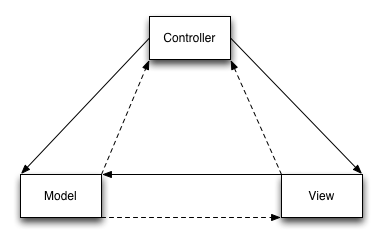
1. Obey the knowledge barrier. Look at the diagram below:
The solid lines represent direct knowledge from one entity to another. From that we can see that the controller knows about both the view and the model, and the view also has direct knowledge of the model. The dashed lines represent an implicit knowledge in that the only way for those entities to communicate with the destination object is via messages/events.
2. I mentioned this above: No multi-role objects.
3. DOM-based libraries should only be used to interact with the DOM; that is, they’re mostly used as helpers for the views. However, since they also have AJAX capabilities, they can also be consumed for use with DAO operations, but a DAO object should always be relegated to that whether the DAO is explicitly or implicitly declared. For instance, Backbone.js utilizes jQuery’s AJAX for CRUD operations. In that case, the DAO is implicit, and actually obfuscated from the developer as the models and collections interact with the Backbone.sync object which is itself a DAO.
4. Finally, to mitigate shortcuts, developers have to learn and practice good architecture and design; that is, they need to start using some sort of class and object interaction description methodology such as UML.
Those are four simple rules. Having taught this over several years, I know how difficult it can be to enforce and have developers obey them because the temptation is to always go the easy route. But great programs can only be created with a thoughtful approach to building them. Just as in construction, you wouldn’t build a house without a blueprint, and when you’re building you wouldn’t use construction methods that don’t follow the standards. Why would you do this in software?
Hmmm…. Not sure that I really buy into all the craze in Parasitic Inheritance the last couple of years. Perhaps I’d buy into it if I heard a really great technical explanation, but thus far, all I’ve heard and read about the virtues of Parasitic Inheritance center around not having to use “this” and “new.” My reaction to that line of reasoning is “So what?” “this” and “new” are artifacts of the JavaScript language. Deal with it. Another line of reasoning used to justify the use of Parasitic Inheritance is the concept of the durable object, which is defined as “A durable object contains no visible data members, and its methods use neither this nor that. Again we return to the non-use of “this.” And again, “So what?” You can achieve something similar this using while defining a custom object in the traditional way:
function myObj() {}

myObj.prototype = (function() {
    function myPrivFunction(myArg) {
       return ...do something with myArg...
    }
    return {
        myMethod : function(param) {
            return myPrivFunction(param);
        }
    };
})();
You can have a whole set of private functions defined above the return that will not be changeable to the outside world. Furthermore, one of my biggest problems with Parasitic Inheritance is that you lose instanceof. Yes, there are ways to deal with it, but most of the examples I’ve seen deal with overriding Object and Function prototypes, or creating some intermediary “helper” function to enable instanceof with Parasitic Inheritance. My thought about this is if you have to make changes to the core of the language, then the “solution” you’re providing is simply an interesting engineering exercise.
On MVC: Put the DOM in Its Place, Dammit!
One of the things I see quite a bit of when working with JavaScript developers who are relatively new to using MVC frameworks such as Backbone.js is that their thinking is very DOM-focused. And while MVC in JavaScript does mean interaction with the DOM through the View, most developers focus their thinking around the View. As a result, their programming is all about direct references. But MVC is about separation of concerns, and each part of the MVC has an important role to play. As such, one of things that I do my best to help “teach” is having developers divorce themselves from DOM-based thinking, and start thinking at a much higher level; specifically, the system or application; breaking the application or system into constituent MVC parts.
Admittedly, it’s difficult for many to make the conceptual leap into MVC thinking because what we as UI Engineers produce ultimately shows up on the DOM. But the DOM is a by-product of MVC interaction. Once you get that concept down, then thinking with a perspective of MVC becomes quite easy.
It doesn’t help matters much when you have examples that are very DOM-focused, as many developers that move over to MVC are expert in jQuery or YUI or prototype.js, what have you. As a result, these developers provide examples that lean heavily on that previous experience. It’s a bit of vicious cycle.
…and How Several Years of Successful Coaching Shows Me Why Republicans Will Lose in the Election
I’ve been a Republican since I registered to vote 32 years ago, and though I’ve had my ups and downs with political involvement over the years, I always have been an apt observer. This coming presidential election has especially piqued my interest because it has been amazing – and horrifying and even a bit amusing – to observe the Republican strategy in the race up to the election. This amazement comes from having been a coach of various sports over the years. I have a winning record in all the sports I’ve coached, and have four championships under my belt for my high school roller hockey team.
Not to say that I’m a great coach – everyone has room to improve – but I did learn quite a bit from studying successful and arguably great coaches such as Bill Walsh and Herb Brooks. From what I observed, a huge part of their success was simply teaching what it takes to develop a team with a winning attitude. We could talk about collaboration and cooperation and such, but there’s one thing that I learned as a coach that you never do: Ever mention or plan my game around the word “lose.”
And from that, I don’t mean don’t play the game to not lose, but also don’t play the game to make the other team lose. What? Not play the game to make the other team lose? What’s THAT about, you might say. Basically it’s this: If you plan your game around the mindset of making the other team lose, what you’re doing is projecting onto the other team your own idea of what it means to lose. Ultimately, your mindset will be your undoing. We can’t possibly know what the other team thinks with respect to losing, so if we project our sense of losing onto the other team, we essentially end up focusing on what will make us lose, and ultimately play a game of “not-losing vs. losing” as opposed to winning vs. losing. The best we can hope for in that scenario is a draw.
A good example of this comes from a Star Trek: The Next Generation episode “Peak Performance” where Data plays a rather arrogant opponent in a game of Stratagema.
When I saw this years ago, the one thing that struck me in Data’s explanation of beating Kolrami was that he was playing to a draw. But I looked at it the other way. Kolrami had projected what his “values” of he believed would make his opponent lose onto Data. Data didn’t just didn’t play the game that way, and though he technically did not win the game, he played it in such a way to force Kolrami to withdraw.
And this is EXACTLY what I’m observing in the GOP right now. They’re playing the election game very much like Kolrami, and frankly, with all the absolutely STUPID stuff the leadership is spouting, such as John Boehner’s repeated claims of the “unconstituionality of Obama-care” though the US Supreme Court ruling completely blows that out of the water, they’re doing a great job of it. We have also had to hear every single Republican representative say in the press, “Our goal is to make Obama a one-term president.” Every time I hear that I have to laugh because that is exactly the kind of rhetoric Obama wants to hear. The GOP has essentially stated their entire strategy, and it’s working in Obama’s favor. His job approval ratings (Gallup) are starting to trend upward. The GOP will state that his job approval ratings are historically low as compared to other presidencies. But the only thing that matters is where they’re at in this current election year, and should they press above the 50% mark, the GOP can kiss the election goodbye.
The net result for the GOP? Since they’re all partaking in the same strategy, the GOP presidential nomination is frankly, still up in the air. Though Romney won Florida, his lead of 31% vs. Gingrich’s 26% isn’t significant enough for him to claim victory. Plus, 31% is not really a number about which to be ecstatic. If the numbers were in the 40’s that would be a different story, but as the numbers don’t lie, it is easy to interpolate that the Republican Party is generally fractured on who to follow. Not good.
And based upon those numbers, I’m apt to yet again vote outside the party. I have zero confidence in Romney, whom I see as simply buying the election with his riches and well-funded super-PACs. I was hopeful that Gingrich would fare better, but he has his own skeletons in the closet to deal with, and makes me seriously doubt his ability to lead the country. As such, there’s really no one in the GOP race that appears to me to be an outright leader. I realize that the number will go up as more candidates leave the race. But I also see that as those supporters settling for the remaining candidate(s). I would much rather see someone who’s garnering support organically rather than through inheritance.
Obama, on the other hand, has been quietly going about his business, and no matter what the hyperbole of the GOP may state, his policies have had success. Do I like the fact that he didn’t act much stronger on the Wall Street executives? Not at all. Do I like Obama-care? I’m a bit on the fence with that, but it has not killed jobs as the GOP keeps touting, and it has cost FAR LESS than what idiots like Michell Bachmann, Glenn Beck and Sarah Palin have made so many believe.
I never did dig the bailout, but understand why it had to happen, though I’m hopeful that legislation will pass that will prevent institutions from growing too big to fail. And mind you, those institutions were allowed to grow that big due to the rescinding of regulations under the Clinton and Bush administrations. Obama inherited a shit sandwich, and though I’m a Republican, I have to say that he’s done okay given the circumstances under which he took the presidency.
In any case, I believe that the only way for a true GOP leader to surface among the mediocrity that’s present in the race right now is for one of the candidates – and perhaps the party as a whole – to stop playing the game of “not losing.” They need to start volunteering their leadership on issues that are important to americans – all americans – and not just the financial elite and lobbies. Until they stop playing the game the way they’re playing, Obama has nothing to worry about.

 The Dawg House!