Unknown's avatar

About Unco B

Known as "Goofydawg" for decades, a few years ago, I reinvented myself from the geeky image I used to portray to that of a patrician whose life has been refined from experience. And I realized that I'm at the time of my life where I want to share that experience and hopefully pass on some of the knowledge and wisdom I've gained over the years.

A Boring but Important Subject: YIELD

I’ve written about calculating ingredient amounts from the baker’s formula. But while I was lurking in a bread baking forum, I read a thread where the home baker wanted to know how much preferment they should use for the bread. A responder correctly showed them how to calculate the amount. And reading that, I had my own question: How much bread do you want to make?

Before I started my micro-bakery, like most home bakers, I’d just make a couple of boules or batards or a few baguettes and I had figured they’d get eaten anyway, so no big deal. But once I started baking at scale, I needed to know precisely how much I needed to make so I wouldn’t be short bread nor make too much and have a lot of waste. To be honest, I’d give my surplus away to friends and family, but as I got more into it, I had to keep an eye on my expenses, so I had to start employing some economics.

To that end, I created a very precise dough calculator which would tell me how much of each ingredient I would need to achieve a certain yield. That helped me immensely. But I also had to figure out what my yield needed to be. I couldn’t just arbitrarily say I’d need six loaves at 650gr each. I needed to know just how many loaves. And that was a little trickier.

When I bake for a shelter, as I’m doing this coming Tuesday, bread is merely a component of the meal. It would be one thing if I were just making garlic bread. I’d be less careful in my planning. But in this case, I’m making BBQ pulled pork sandwiches. So, not only do I have to calculate the bread, but I must also calculate how much meat I need! It can get complicated pretty fast!

But here’s what I know: I will be feeding forty residents and five workers. Given that, each sandwich will have two ounces of meat, and two ounces of coleslaw. I already barbecued the pork and made over six and a three-quarter pounds of pulled pork (just to be safe). Serving sizes will be about two ounces of meat and two ounces of coleslaw. Those will go on 4″ ciabatta. My ciabattas are 20″ long, so I will get five pieces from each loaf. To feed forty-five, I’ll need ten loaves of ciabatta, which will give me fifty pieces (a few always want seconds).

So given that I need ten loaves I now know how much I’ll need to bake. So, here’s my yield calculation:

# Loaves10
Desired Loaf Weight650g
Process Loss %1%
Target Dough Weight6565g

My formula for a straight-dough ciabatta is as follows:

Flour100.00%
Water80.00%
Salt2.00%
Yeast1.10%
Olive Oil5.00%
Total %188.10%

And based on that formula I will need the following ingredient amounts (in grams):

AP Flour3490g
Water2792g
Salt70g
Yeast38.39g
Olive Oil175g
Total Yield6565g

For most folks, stuff like this really isn’t that important or even relevant most of the time. But it’s still helpful to know how much you should make at times. For instance, if you’re planning a big party and want to serve bread as part of the food offerings, it’s a good idea to plan ahead. It helps keep the stress of preparation much more controllable!

BBQ Pulled Pork on Sourdough Ciabatta!

I have a recipe for Sourdough Ciabatta that I wrote a couple of years ago, so I won’t go into the details of that. But it’s a great recipe and as you can see from the picture above, it’s the perfect platform for BBQ pulled pork sandwiches. So, what I will focus on here is making the BBQ!

NOTE: I’m assuming that you have a smoker of some sort. I have a Traeger Century 22, which is probably the smallest Traeger. It’s a Costco exclusive that my wife bought me for Father’s Day several years ago. Anyway, let’s get to it.

Amazingly enough, I’ve found that barbecuing pork is one of the easier – and more forgiving – meats to smoke. Or maybe it’s because I’ve loved grilling or barbecuing pork for so long that I just know it well. Here I’ll just share my technique.

Pork Butt or Pork Picnic (shoulder)?

You can use either cut for pulled pork. The cooking technique is the same. But personally, I prefer cooking the picnic for a variety of reasons:

  1. There’s less fat in the picnic. That doesn’t mean there’s no fat. But there is less fat than in the pork butt. There’s still plenty of fat for flavor. Personally, I prefer the higher protein content of the picnic.
  2. Because there’s less fat, the final texture of the meat when pulled will create those nice ropes of meat which I prefer.
  3. And even after a long rest in a cooler post cooking, the meat will not get squishy. It will maintain its texture much better.

The picnic usually comes two ways. With the skin on, in which case I will normally cook it like a lechon over an open fire or charcoal; or, it will come without the skin. But I have found that when it comes skinless, the butchers typically cut it up into three-to-four-pound pieces. That’s okay, as the cooking technique is the same. But each piece must be tied with twine, so they cook evenly. The 18-lb picnic I just cooked yesterday was cut up into five pieces and I had to truss them up. It wasn’t a big deal. It took all of ten minutes to do it. The only inconvenience with the picnic being in five pieces was I had to take the temperature of each piece individually. But that didn’t bother me.

Rub

I make my own rub that consists of a bunch of different spices. But you can use whatever rub you’d like. Just make sure that you’re generous with it and that the entire surface of the meat gets some rub. Some folks rub mustard on the meat first so that the rub will stick. i do this most of the time, but it’s really not necessary. I didn’t have any yesterday and just applied the rub directly on the meat.

Cooking

  1. I set my Traeger to 250℉ and let it warm up for about 20 minutes before I cook.
  2. Once it’s up to temp, I place the meat in the center of the rack or, if I have several pieces like I did yesterday, I make sure they’re evenly distributed on the rack.
  3. I insert the Traeger’s probe into the meat.
    NOTE: A lot of people complain that the Traeger’s probe isn’t accurate. That has not been my experience. But what I have found is that you have to get the probe in the right place. To determine that, I use an instant read meat thermometer to get the initial temperature, then I place the probe in the same hole, at the same depth. The most variance I’ve seen from the instant read is three degrees. Why not use the instant-read thermometer all the time? Simply because I don’t want to open the lid unless it’s necessary, like spritzing.
  4. I spritz the meat every 30-45 minutes for the first few hours with a mixture of 25% apple cider vinegar and pepper 75% water. After that, I spritz it every hour. This helps the meat absorb the smoke and helps with creating a nice bark.
  5. Once the meat reaches an internal temperature of 165℉, I wrap the meat in butcher paper. I do this with both the picnic and the butt. I know there’s a lot of debate around this subject but I’ve been doing this for years with great results.
  6. I place the meat back on the smoker, then use my instant read thermometer to find the sweet spot, then replace it with the probe.
  7. I cook the meat until it reaches an internal temperature of 203-205℉.
  8. Once the meat has come to temp, I immediately transfer it, wrapper an all, to a jumbo Ziploc or Hefty food storage bag. Then I put the bag in a cooler for a long overnight rest. I’ve gotten the best results with a minimum of a four-hour rest. But when I BBQ a picnic, it’s best to go a lot longer to ensure a full cook as it will continue cooking in the cooler for several hours.

So, for yesterday’s barbecuing, I cooked eighteen pounds. I put the meat on the rack at noon. I wrapped it at 7pm, and it came to final temperature at just after 10pm, then I transferred the meat to my cooler. I pulled it apart at 7:30 this morning. My final yield was about 11 lbs (yeah, you lose a lot during cooking). I put 6 lbs in the freezer for pulled pork sandwiches that I’ll make next Tuesday for a homeless shelter. I traded 2 lbs for a couple of jars of honey from a beekeeper friend, then kept 3 lbs for the family. It was a successful cook!

Today, I made a sourdough ciabatta (pictured above) and made a wonderful pulled pork sandwich with stinky Camembert cheese (if you can find Le Chatelin, it’s the best and the most stinky, yet flavorful Camembert). I sauced the meat with a light Kinder Gold BBQ sauce. It was spectacular. Sorry, I don’t have a picture of the sandwich because I forgot to take one. 🙂

Simple Pan Loaves for Sandwiches/Toast

Sorry, no picture for this one recipe, but I thought I’d share it anyway because it is super-easy to make! With sandwich loaves, I’ve found that the trick to them is adding fat. Many will use milk, but I prefer to use olive oil because the resultant crumb has a chewier texture than one made with milk, and you can cut thinner slices.

As I’ve shared in the recent past, I haven’t been baking bread much as of late, except to fill orders when my wife needs bread for a local shelter. But a couple of weeks ago, she brought home white sandwich bread from the grocery store with the intent that we would make sandwiches with it. Unfortunately, no one ate the loaf, and it went bad. When my daughter saw that the loaf had molded, she asked if I could make sandwich loaves. But she wanted to white sandwhich loaves, and not whole grain.

Ugh! I thought to myself… White bread is SO boring. But white or whole grain, a handmade loaf is one hundred times better than the processed crap that passes for bread at a grocery. So, digging into baking formulas, I pulled out a super-simple recipe that you can do in a day that I’ll share here.

For this recipe, I use half AP flour and half bread flour. If I used all bread flour, the crumb would be too chewy. The AP flour helps cut it. I’ve also made it with 100% AP flour, but at this hydration, it makes the dough a little difficult to use. Also, this is a straight dough, so all processing and baking can take place in a day.

Overall Formula

Flour100.00%
Water75.00%
Salt2.00%
Yeast1.10%
Olive Oil5.00%

Final Dough

Bread Flour331g
AP Flour331g
Water496g
Salt13g
Yeast7.28g
Olive Oil33g

Mix. Measure out and add all the dry ingredients to a large bowl and mix thoroughly. In a separate bowl, add warm water (~95℉-102℉) and the oil. They won’t mix, but that’s okay. Then add the liquid to the dry ingredients and combine well.

Knead. Once all the ingredients are incorporated together, knead the dough on your work surface until you attain a smooth consistency. If you do this by hand, it’ll take about 13-15 minutes. If you use a stand mixer, mix at medium-low speed with a hook for about 5-7 minutes or until the dough climbs the hook. Just make sure to regularly scrape the sides and bottom of the mixing bowl when using a stand mixer.

Bulk Fermentation. 2-3 hours. Transfer the dough to a lightly oiled bowl, cover with a tea cloth, then place in a warm place. I use my oven with the light on, cracking the door so it doesn’t get too hot. Ambient temperature should be between 78℉-82℉. After an hour, fold the dough either on your work surface, or just do stretches and folds in the bowl, then place the dough seam side down. Bulk fermentation will be complete when the dough has roughly doubled in volume.

Divide and Pre-Shape. Remove the dough from the bowl and place it on your work surface. Tug it into a rectangle, then use a bench scraper to bisect it. You should be close to about 600g per piece. Form the dough pieces into tight boules, then rest them on your surface seam side down for 15-20 minutes or until they have relaxed.

Shape and Final Fermentation. I like to use a batard or baguette shaping technique to shape the loaves so that they fit in a 9″ X 5″ loaf pan. You need to ensure that as you shape, you create good tension on the surface of the dough! Once shaped, seal the bottom seam then place each loaf, seam side down, into a lightly greased 9 X 5 loaf pan, cover the pans then place in a warm environment to complete fermentation. Final fermentation will be complete when you poke the dough, and the indentation is slow to recover and doesn’t entirely fill in. If it recovers quickly and the indentation fills in, it is not ready!

Bake. Slash the loaves down the middle, then bake in a 425℉ oven for 30-35 minutes (10 minutes with steam to promote oven rise).

Cool. Allow the loaves to cool and cure on a wire rack for a few hours after baking. These loaves need time to evaporate any excess water and to set the crumb.

A Little Change of Pace – Homemade Beef Jerky

While many know me as a baker, people who’ve known me for a long time know me as someone who loves to cook all sorts of things besides bread. And close friends know that I love to grill and smoke meat. I regularly make carne and pollo asada; love to prepare chicken in a variety of ways; grill and BBQ fine steaks; and every year at Christmas, I BBQ a whole Prime Rib. Last year, it was an 18-pound A5 Wagyu!

But despite all my experience in cooking meat, one thing I hadn’t done in all my years of cooking was beef jerky. Holy shit! After I made a batch yesterday, I was kicking myself for not making it much earlier. Instead, I was filling pockets of Jack Links and Pacific! 🙂 But now that I know how to make it, I’m going to make it often.

For the batch I made above, I used a basic soy sauce and brown sugar marinade with a bunch of spices: Seasoning Salt, Cumin, Black Pepper, Red Pepper Flakes, Garlic Powder, Hot Spanish Paprika, Old Bay, Allspice, and a touch of Montreal Steak Seasoning. And no, I didn’t measure. I tasted the marinade as I added spices than added more if it needed it. In the end, I added a bit more soy and brown sugar because there wasn’t enough liquid.

As for the meat, I used thinly sliced top round that I got from the grocery store. It was already sliced, so that was convenient. I then trimmed all the fat off the edges, then made thin strips (about an inch to an inch-and-a-half). According to my research, you should use very lean meat as fat will spoil over time. Next time, I’m going to try it with flank and flap steak.

After prepping the meat, I dumped it all into the marinade and massaged it to make sure all the slices got coated. Then I transferred the entire mix into a Ziploc bag to marinate in my fridge overnight.

The next morning, I set up a cooling rack over a large baking sheet and placed the slices on the rack. Then I popped it into my Traeger set to “Smoke” for 4 1/2 hours. I let the meat cool to room temperature, then transferred it to a couple of Ziploc bags and into the fridge. The bulk of it is going to my son as a part of a college care package this weekend when I see him. I showed him the picture I took and he replied with a “fire” emoji.

Tell you what, it may be an investment in time, but it beats the shit out of paying $15 for a bag of jerky!

10% Rye Baguettes for Sandwiches

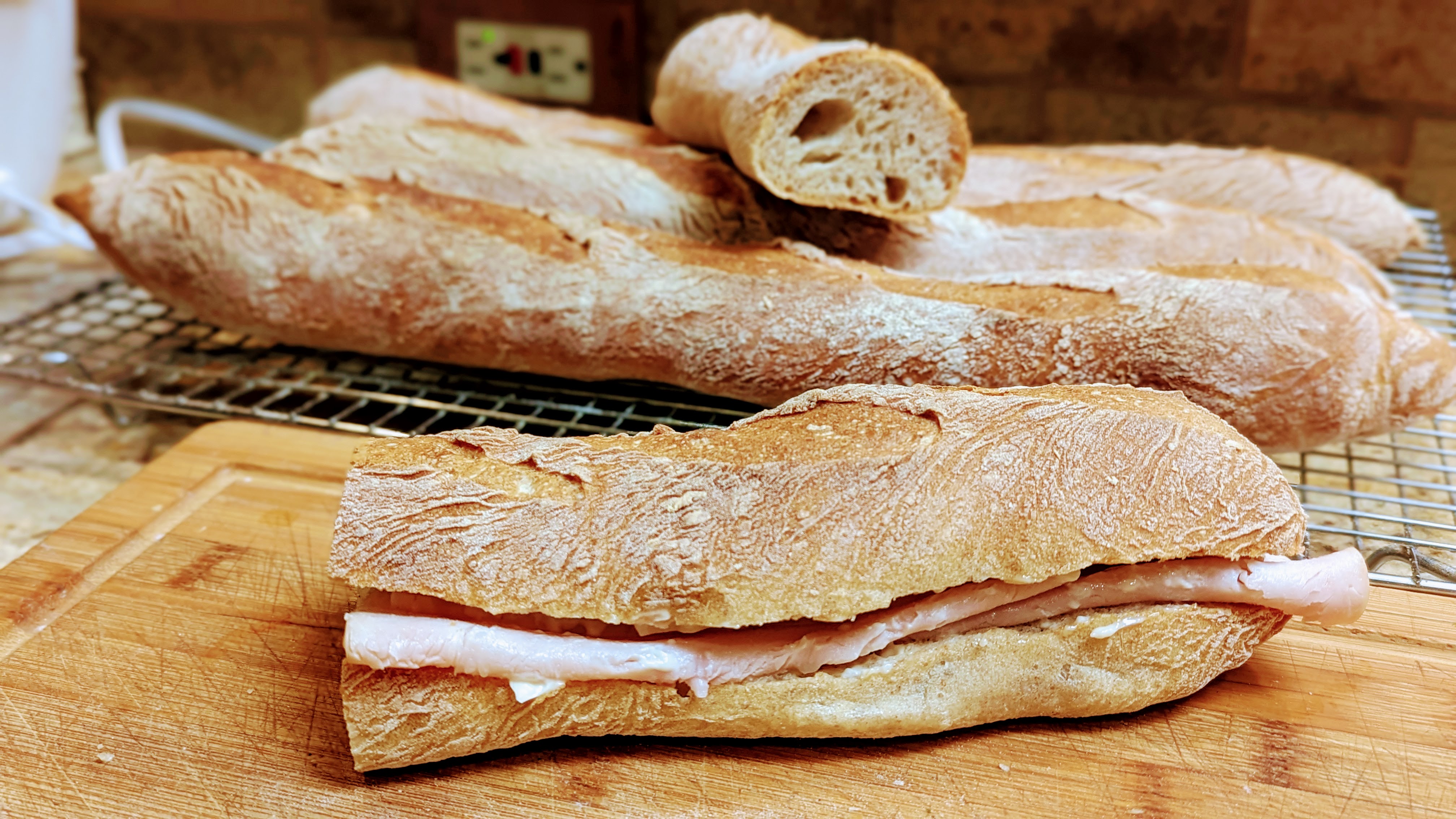
If there’s one thing I love in this world, it’s a great sandwich. And being a baker, to me, the key component of a sandwich is the bread. You get this wrong, fuggetaboutit! This past Sunday, while I was watching the 49ers rout the Cowboys, it struck me that a sandwich would be good. But… I didn’t have any bread. So, I thought to myself that I could make a sandwich for Monday Night Football.

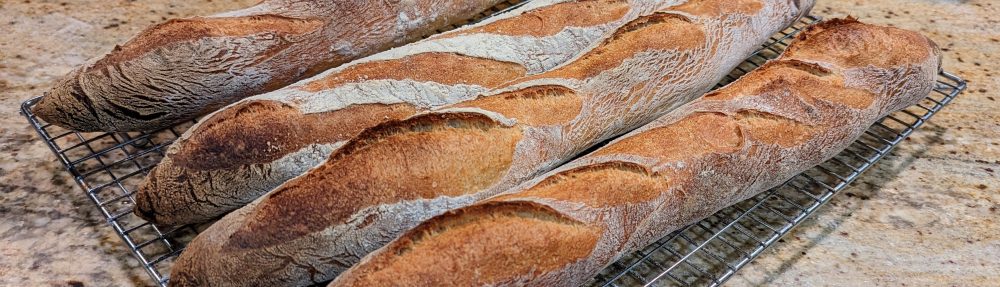
But I didn’t want to make just any bread. I wanted a sub, and for me, that meant making baguettes! But I didn’t want to make just a straight-up dough. I wanted a bit different of a flavor. So, I decided to use just a bit of rye flour. I also decided to challenge myself a little and up the hydration to 80%, plus use a poolish to add some extra complexity. Here’s the formula:

Overall Formula

Flour100.00%
Water80.00%
Salt1.80%
Yeast0.50%

Poolish

Flour122g
Water122g
Yeast %0.25%
Yeast0.31g

Final Dough

AP Flour557g
Rye74g
Water483g
Salt13g
Yeast3.41g
Preferment223g
Total Yield1353g
4 X 335g loaves

Make the Poolish. The night before you bake, make the poolish. Dissolve the yeast in the water then add the flour. Mix well. Cover with plastic wrap, and leave on the counter until morning. The poolish should be ready withing 8 hours. But don’t fret if you go over. That’ll just add more organic acids (read: flavor).

Mix. Combine the flours and mix well until you get a homogenous mix. A stand mixer with the paddle attachment works excellent for this. Add the yeast and the salt and continue mixing to ensure an even distribution of both. In a separate bowl, dissolve the poolish in warm water until it completely liquifies. Add that to the dry ingredients then mix until you create a shaggy mass and there are no dry ingredients. I used a Danish dough whisk for this instead of a mixer.

Bulk Fermentation. 1 1/2 to 2 1/2 hours depending on your ambient temp. This requires only two folds. Do the first after 20 minutes, then do the second an hour after that. I did the first fold in the bowl, then I did the second fold on my work surface, doing an N-S-E-W fold, then flipped the mass onto the seams and rounded it with my hands. I then sprayed some oil into my bowl, then set the dough seam-side-down in it to finish fermenting. I eyeballed the dough to just under double in volume, if not a little earlier because I wanted to give plenty of time for final fermenation.

Divide and Pre-Shape and Shape. Divide the dough into four 335g pieces. If there’s any leftover, just distribute it between the four pieces. From here, please refer to my Baguette Dough Development Process (will open a new tab).

Bake. Bake at 475°F for 12 minutes with steam. Remove your steaming container, then bake for another 20 minutes at 425°F. When you remove the baguettes from the oven, they should feel lighter than they look. If they feel a little heavy, that means there’s still water in the dough that needs to be evaporated. Pop them into the oven for another 10 minutes if this happens. I had to do this with the batch above.

Notes

  1. Even with this small amount of rye, bear in mind that rye contains absolutely no gluten, so folding is going to be a challenge. This is why I did the second fold on the bench, much like I’d handle a ciabatta.
  2. Also, because this dough is so wet, don’t be afraid to use a bit more flour on your bench than you normally would.
  3. Shaping at this high of a hydration is challenging. I suggest using Martin Philip’s shaping technique. The important thing with his technique is that the fingertips and heel of the hands maintain contact with your work surface. With this dough, you will use more flour on the board.

Why Would You Hamper Yourself?

I was perusing a bread forum last night when I ran across a post of someone showing off the baguettes they had made. They were okay looking but a little mishapen. When I read the proceeding threads, in one post the baker mentioned – actually kind of boasted – that they didn’t have all the tools such as a couche or a lame or a transfer board. Once I read that post, I immediately asked out loud, “Why the hell would you purposely hamper yourself.”

Then I looked back on when I first started baking artisan bread and how proud I was that I was able to make something edible. I didn’t have a digital scale. I used an old analog food scale. I didn’t have a proper couche and instead used dish towels. I fashioned a lame out of hanger wire (I still use it). I did make a transfer board that I use to this day that’s made of 3/8″ sanded, untreated plywood that I sealed with beeswax. I also didn’t have a baking stone and instead used a loaf tray, which was fine, but the bottoms turned out round – not really what I’d call ideal.

Then I realized that I was working WAY TOO HARD to make baguettes and that’s when I decided to make a small investment in some crucial equipment. I got a digital food scale with 1-gram accuracy for $15. To measure out my yeast and salt precisely, I got a great precision scale (.01 gram accuracy) for $12. I bought a linen couche for $15. I already had the transfer board, but that piece of wood only cost me $6.

That small investment of less than $50 completely changed the game for me. It made the entire process so much easier; especially having the couche and the transfer board. Now I could manipulate my dough with ease and not worry about screwing them up with my hands. The transfer board could be used to straighten my loaves before I popped them into the oven.

The scale allowed me to create loaves that were all the same size. But also, with the loaves being the same size and weight, I could ensure a consistent quality for all my loaves.

It’s these kinds of things that I didn’t get when I first started. But it wasn’t until I got them that I truly understood just how important they were to making beautiful loaves of bread.

Time for Some Kamut Sourdough!

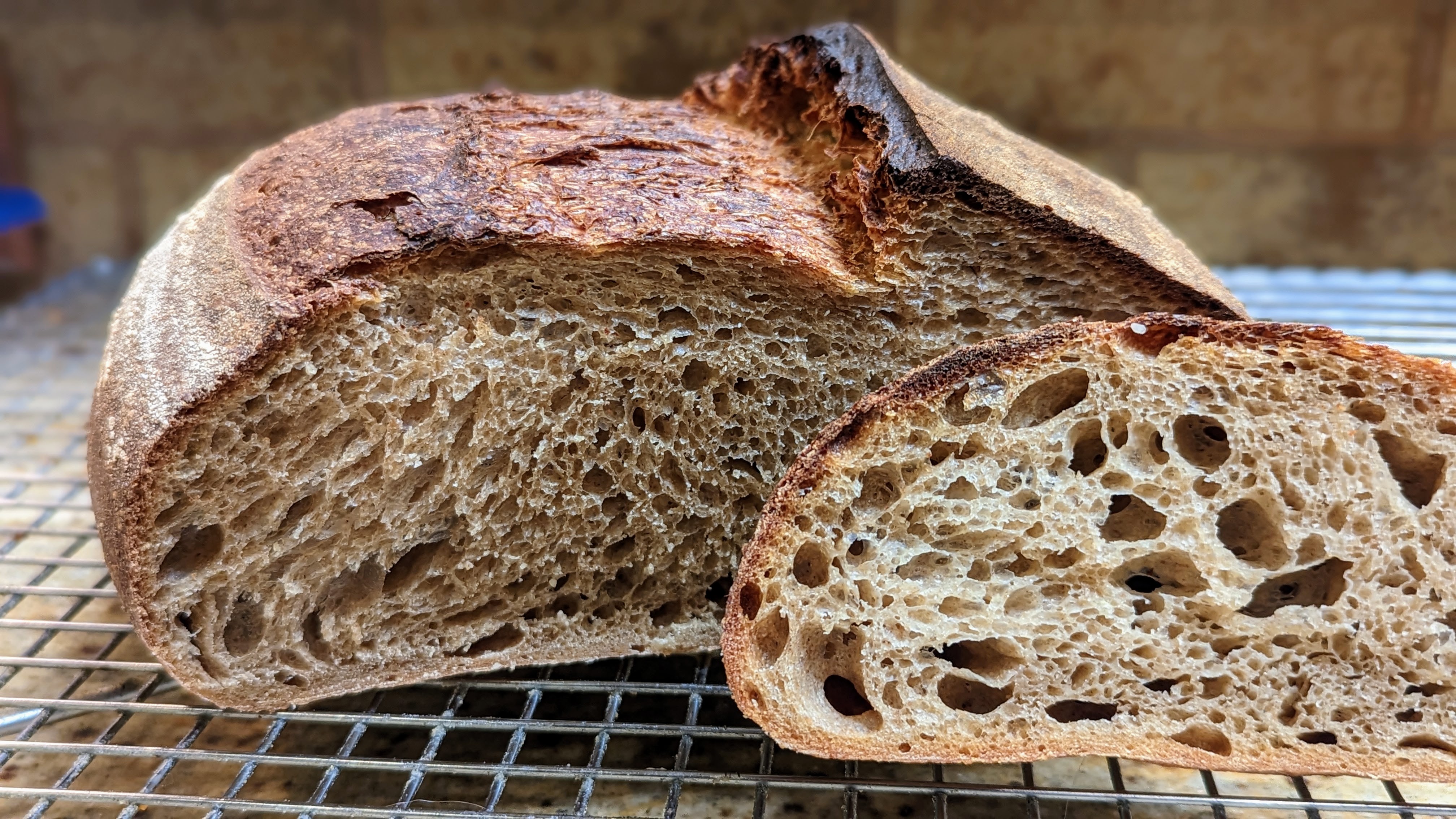
I just finished the second feeding of my mother starter to make some sourdough dough this morning. Afterward, I asked myself, what kind of flour blend do I want to use? Then it occurred to me that I hadn’t used a Kamut blend in a while. I love bread that has Kamut in it. It’s my favorite flour as it brings a nuttiness and a hint of sweetness to the flavor profile. Plus, if you’ve read this blog previously, you’d know that Kamut has some incredible nutritional benefits as well. But that aside, any bread I’ve made with Kamut has an incredible flavor! For this bake, I’m using the following formula/recipe:

Formula

Flour100.00%
Water75.00%
Salt1.80%
Total176.80%

Final Dough

Flour 1628g
Flour 2343g
Water686g
Salt21g
Levain343g
Levain weight is 30% of total flour

This is a straight-forward dough and frankly, the formula is a master formula I use as a master formula for most of my bread. If I use predominantly whole-grain flour, I will up the percentage to 85% or more depending on the flour.

As for processing, it’s straight-forward as well:

  1. Mix the flour, starter, and water, reserving 100g of the water.
  2. “Fermento-lyse” for up an hour.
  3. Dissolve salt into the reserved water, then do the final mix to incorporate the salt.
  4. 2-4 stretch and folds on the bench at 45 minute intervals. I always play it by ear with the folds because Kamut’s gluten is very delicate, and it is easy to tear, so I try not to do any more than I need to. Also, the windowpane test is reliable with this flour, especially if I’m using a large amount of kamut. What I’m looking for is the folded dough to maintain its shape for several seconds after folding.
  5. Shape into batards or boules and usually do an 18-24 hour final fermentation.
  6. For my oven, I bake at 460° for 35-40 minutes with the first 15 minutes with steam.

Has It Really Been That Long?

The other day, my fridge went on the fritz, and I had to remove all the perishable stuff and put it in a cooler. What didn’t make it was my starter. But that didn’t bother me because I literally hadn’t used it for months, and I was planning to throw it out and start anew…

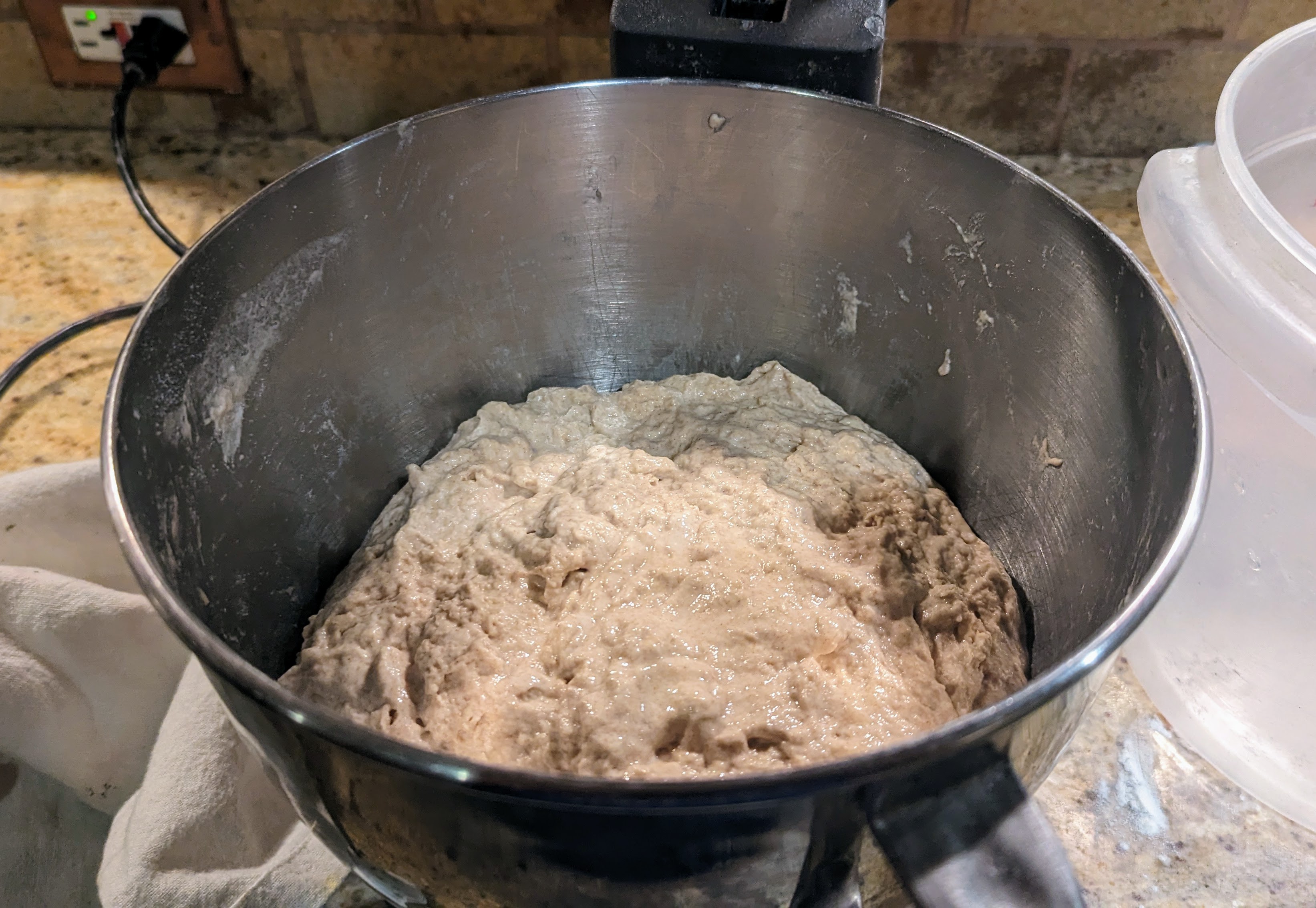
But looking at my starter, I got a little sentimental and decided to feed it. And in that moment, I remember a recent conversation that I had with a friend who mentioned that she missed my sourdough. Yikes! So, I dumped out the hooch, then mixed in some flour and water, then let it sit overnight. By morning, it was clear that it had peaked and declined, so I dumped out half and re-fed it. Damn! It doubled in just three hours!

Normally, with that kind of doubling rate, I’d set out to make dough. But I wanted to be sure it was ready, so I re-fed it after 4 hours’ time as I had to cook dinner. I couldn’t believe that it tripled in an hour-and-a-half! It was ready.

Since I feel a little rusty, I went to a tried-and-true formula that I’ve used for years. Here it is:

Formula

Flour100.00%
Water75.00%
Salt1.80%
Total %176.80%

Final Dough

High-Extraction Bread Flour571g
100% Certified Organic AP Flour400g
Water686g
Salt21g
Starter (levain)343g
Total Yield2020g
2 X 1000g loaves + 1% for processing

Quick Process

This is a riff on the Tartine Country Loaf. It’s about as straight-forward as can be. I do a 30-minute fermentolyse to hydrate the flour, then I only do two folding sessions separated by 45 minutes as opposed to the six folds at 30-minute intervals that Chad Robertson does. This is because the flour I use develops gluten FAST. It’s also a reason I use about 35% AP Flour. It helps lighten the dough and produces a lighter and loftier crumb. As for total bulk fermentation, I’m expecting it to last about 3-4 hours at most, especially with how active my starter is.

For folding, I used to do stretches and folds directly in my 6L Cambro container. But before I had to curtail my baking, I started folding my dough on my workspace. I feel that I could more effectively stretch it that way and not de-gas the dough as much.

Once bulk fermentation has completed, I’ll shape batards and place them in my 14″ batard baskets. I love these baskets as the finished product always creates a nice oval shape. Plus, because the dough isn’t as constrained in

As I sit here writing, I’m incredibly excited to be baking sourdough again. I forgot how much I love the process.

Recipe: All-Purpose Dough for Rolls, Sandwich Bread, and Pizza Crust!

For years, I’ve occasionally experimented with creating a dough that I could use for both pizza crust and bread, and I finally produced a formula that works wonderfully for both! As you’ll see in the formula below, there’s not much to it. But the kicker for me was using a much lower hydration than I’ve been experimenting with in the past.

My earlier experiments employed hydration 75% and above. I was also using a combination of high-gluten bread flour and AP flour, and sometimes mixed with some Kamut™️ flour. But yesterday afternoon, I thought about an episode of Diners, Drive-ins, and Dives where Guy Fieri visited this pizza place and the chef used AP flour only. That got me thinking that if I used just AP flour and lowered the hydration, I could still achieve decent gluten formation, and the small amount of olive oil would help to create a soft crumb if I used it for bread.

As far as bread is concerned, this dough produces a closed but airy crumb that is perfect for rolls, but placed in loaf pans, is perfect for sandwich loaves! For pizza, the lower hydration creates a nice, strong dough that can easily be spread out into a pizza crust. And here’s the kicker: The long, cold fermentation takes place during bulk fermentation. This means you can create the dough the day before, and let it sit in the fridge for 12-24 hours. If you’re making pizza, you can divide the dough immediately after kneading, then let it rise in the fridge. More details below. For now, here’s formula and the final dough to make 6 buns.

Formula

AP Flour100.00%
Water65.00%
Salt2.00%
Yeast0.60%
Olive Oil1.30%

Final Dough

AP Flour825g
Water (lukewarm)536g
Salt17g
Yeast5g*
Olive Oil11g
Total Yield1394g
6 X 230g buns
12 X 115g rolls
*Use half the yeast for a 24-hour bulk ferment

I must come clean. I experimented with making longer buns as you can see in the pictures above. They turned out great, but they’re a little too heavy to be used for sandwich rolls. Based on those results, I’d lengthen them to make bread sticks for dipping. And if I’m going to use it for sandwiches, I’d definitely make loaves for loaf pans.

Process

Mix. Combine all the dry ingredients together. Then add the oil and water and mix thoroughly. Knead the dough until smooth (you can use a mixer or do it by hand).

Bulk Fermentation. If you’re making bread or rolls, place the dough into a container (I use a 6-liter Cambro container). If you’re making pizza dough, divide the dough into two or three equal pieces, depending on the crust size you want, form into balls, then place on a sheet and cover with plastic wrap. In either case, place the dough in your fridge with a temperature in the range of 39℉-42℉. Ferment for 12-16 hours. The dough may triple or quadruple in volume during this time. But it’ll be okay if it’s domed in the middle.

If you want to go for a long bulk fermentation, use half the yeast. With that amount, the dough should expand to its fullest in about 24 hours.

Divide and Shape. If you made pizza crusts, there’s no need to divide. Simply gently press out the balls to about 1cm-thick discs, then cover and set aside. For rolls, divide into twelve pieces, then form balls and place on a baking sheet covered with parchment paper. For sandwich bread, divide into two equal portions, then form each into logs and place them into loaf pans. For breadsticks, form into long logs then set on a well-floured couche.

Final Fermentation. Let the dough proof for an hour at room temperature or until it doubles in volume.

Bake. For bread, lightly brush the tops of the loaves or rolls with a little water, then score if you want. Bake at 425℉ for 30 minutes. Use steam for the first 10-15 minutes of the bake to help rise. For pizza, shape, top, and bake as you normally would.

Mexican Telera Bread: The Soul of the Torta

Having been to Mexico several times over the years and being born and bred in California, I have a deep appreciation for Mexican food. But I have a special place in my heart for the Torta, the Mexican version of a sandwich. In the US, when we think of a “sandwich,” what typically comes to mind is a flat piece of meat with some condiments like mayo or mustard, and maybe some lettuce, onion, and tomato.

But the Torta… Ah, the torta. Like a sandwich, it’s meat between some bread, but that’s where the commonalities end, especially with the meat. The meat can be carne or pollo asada (grilled steak or chicken), or puerco (pork), camaron (shrimp), polpo (octopus), and my favorite: arrachera (marinated, grilled skirt steak). Heck! You can use any type of meat – yes, cold cuts as well. But instead of mayo, there will invariably be avocado. As for vegetables, you might get some grilled onion or diced tomato. In the states, shredded lettuce or lighly pickled cabbage are often added as well.

What I love so much about the Torta – and I suppose sandwiches in general – is that there are no rules. It’s a wide-open playing field! But that said, there is a type of bread that is commonly used for Tortas, and that is the Telera roll.

The Telera is an oval or rounded rectangle roll that is neither too wide nor long. The crumb is soft and fluffy with a firm but slightly chewy crust, making it perfect to soak up the juices of the various meats that are used. Visually, it is marked by two indentation lines across the top (we’ll get into that later). As for taste, technically, the Telera is a savory roll, but there is a slight sweetness as the dough contains a small amount of sugar.

As you can see in the picture to the left, it’s much like a hamburger bun that is ever-so-slightly longer on one side. This makes it a perfect platform for the grilled meats or seafood that are usually put on it.

Being a baker, after having a few Tortas on my last trip to Mexico just recently, I wanted to learn how to make them. And after a bit of research, and a bit of trial and error, I finally got a formula and recipe that’s both easy and delicious!

Overall Formula

Flour100.00%
Water60.00%
Butter (Softened)5.00%
Yeast1.40%
Salt2.00%
Sugar4.00%
Total Percentage172.40%

Final Dough

Flour516g
Water309g
Butter (Softened)26g
Yeast7g
Salt10g
Sugar21g
Total Weight889g*
8 X 110g rolls
78ºF/26ºC
*The extra 9g is factored in to allow for process loss.

Mix. Combine all the dry ingredients together in a large mixing bowl and mix to evenly distribute. If you use a mixer, use the paddle at lowest speed. Cut butter into the dry ingredients much like you’d do with biscuits (butter should be soft). Add the water in 3-4 batches, making sure it’s well-incorporated. If using a mixer, switch to the dough hook and slowly add the water until everything has been incorporated together.

Knead. Even though I use a mixer to mix, I enjoy kneading simply because I don’t do it that often as most of my bread is “no-knead” bread. Turn out the dough onto a clean work surface and knead it for 5 minutes or until the dough is smooth. Richard Bertinet’s slap and fold works great too! Work the dough into a ball, then place it in a greased bowl (I use olive oil), seam side up. Flip the dough over onto the seams so the whole ball is covered. Cover the bowl with a cloth.

Bulk Fermentation. Place the bowl in a warm place and let the dough rise and expand to almost double in volume. 45 minutes – 1.5 hours. Remember, watch the dough and not the clock!

Divide and Shape. Punch down the dough to release the gas (no, you don’t want an open crumb), then divide the dough into 110g pieces. Roll each piece into a tight ball, then set aside to relax for about 15 minutes.

On a lightly floured surface, press each ball out into an oval of about 1 -1.5 cm thick. Sprinkle a little flour on top of the oval, then about a 1/3 of the way from the long side of the oval, press a straw or chopstick down to the board, being careful not to tear the dough, but really work it down into the dough. Repeat on the other side, then place on a baking sheet covered with parchment paper. BTW, you’ll want to move the sections together when you place them on your baking sheet. This is a method of scoring without a blade. And if you find that your dough sticks to your work surface, just use a bench scraper to lift it up.

Final Fermentation. Once all the rolls have been shaped, cover the baking sheet with a damp cloth (you don’t want to form a skin), and allow the rolls to double in volume. This could take 30 minutes to an hour depending on your ambient temperature. Preheat oven to 400ºF/200ºC.

Bake. Before baking, lightly brush the tops of the rolls with water, then bake for 15 minutes at 400ºF/200ºC or until golden-brown on top. Don’t let these overcook as the sugar – even though there’s just a little – will caramelize easily so be watchful!

Making a Torta

There are no hard and fast rules when making a torta. Even in Mexico, tortas vary from region to region. And while it’s generally accepted that the Telera roll is the common roll to use, even in Mexico, depending on the region, different bread may be used. For instance, in Guadalajara, there is the Torta Ahogada or “drowned” torta that uses a sourdough bread called “Bilote Saldado.” But for our purposes, we’ll just stick with the basic torta.

If you want something really basic, just put some grilled meat between the halved bread, top it with avocado, then close the bun. This is the way it is normally served in Cozumel. But if you want to get fancier (and I like to get fancier), coat the halves with smashed avocado, spread some shredded lettuce or cabbage (I prefer cabbage), add some sliced tomato, then top that with the grilled meat. Add lime juice for a little zest.

As for meats, you can use pretty much any meat or even seafood. Cold cuts are fine as well. My favorites are:

  • Carne or Pollo Asada
  • Arrachera (skirt steak)
  • Grilled Octopus
  • Shrimp (Grilled, Sauteed)
  • Grilled Fish

My two big favorites are Arrachera and Octopus. But truth be told, I’ve only had octopus in Mexico. Not sure how it’s prepared, but it ROCKS!

Here’s my Carne Asada recipe, if you want to give it a try!