Working with Flour That Has a Lot of Bran And Germ

I’m going to just be up front: The one thing you have to expect when you introduce 100% whole wheat flour into your dough, or like me, where you use a combination of high-extraction flour and whole wheat is that you will not get a big vertical oven spring; at least compared to a pure white flour loaf. The more bran and germ there are in the flour, the less vertical rise you’ll get and that’s a fact of life and there’s nothing you can do about it.

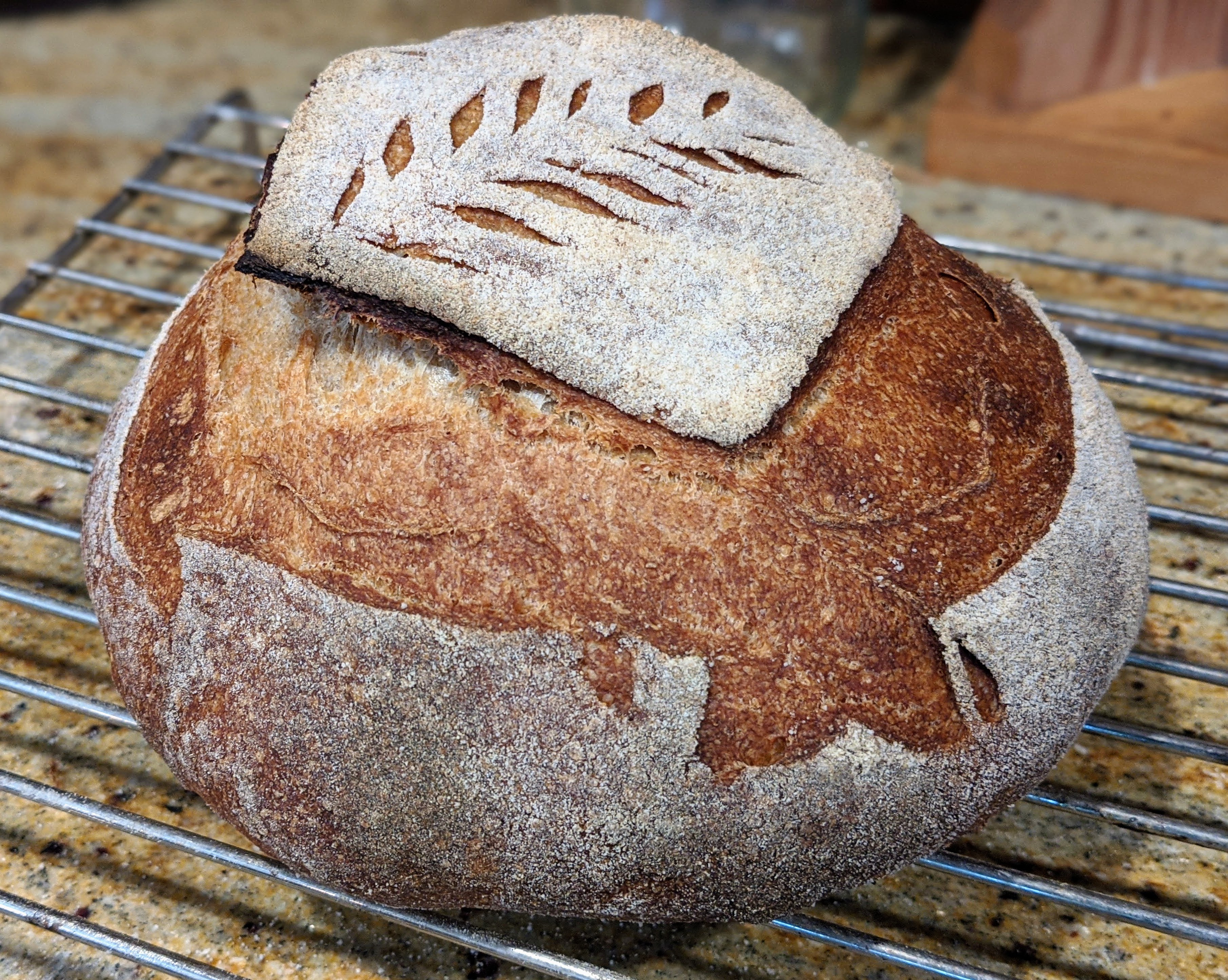
This is something I’ve had to expect once I made the move to more nutritious flour. Especially when I moved to high-extraction flour in lieu of white bread flour, I noticed a distinct lessening of the vertical rise. The fact that my bread was making nice ears meant that I was getting great oven spring (as evidenced above) and open crumb. It just hasn’t been as vertical and you know what? I’m now okay with that! But admittedly, it has taken several adjustments to achieve the crumb that I achieved with those loaves above.

Before I go on to explain what I did, I just can’t believe the flavor and texture of the final bread that this combination of flours produces. It’s chewy but with a velvety-smooth texture. I just can’t say enough about how great these Azure Standard Unifine flours are!

Adjustment Time

Lots of changes to my process… I used to pride myself on being able to make bread in a day, but with the switch to these flours, that’s no longer possible if I want to get results like I got above.

  • The first thing I had to do was up my hydration to 82%. I started out with 75%, 78% and 80% hydration, and while the loaves turned out pretty good, they were still a little dense. Just that extra 2% between 80 and 82 made a HUGE difference. Now you might think that at 82% the dough would be difficult to work with. I won’t lie. It’s a challenge, but it’s not nearly as bad as one might think. You just have to get used to working with a wet dough.
  • The next adjustment that I made was using a poolish. But instead of doing an overnight poolish, I started it at 7 AM in the morning, let it bubble up for 12 hours. then made my final dough at 7pm.
  • After mixing the final dough, I kneaded it until smooth, let it rest for 10 minutes, then did a stretch and fold. I then did five more stretch and folds every 10 minutes over the next hour or so.
  • After I did the last stretch and fold, I moved my container to the fridge where I let it bulk ferment for 14 hours. After the bulk ferment, I divided and shaped the loaves, then proofed them for 45 minutes at room temperature, then popped my bannetons in the fridge for an hour.
  • I then baked the loaves at 500 degrees for 30 minutes on my baking stone.

Here’s the recipe:

FlourWaterSaltYeast
Poolish2502500.40
Final Dough750570193.00
Totals1000820193.40
Bakers %100.00%82.00%1.90%0.34%
  1. In a separate container, make the poolish and mix everything together until smooth. This wet, you don’t want any lumps. You can make this in the early morning then let it sit out all day (at least 12 hours) at room temperature, then make the final dough in the early evening – you’re going to refrigerate it for awhile. At the end of the 12 hours, it should be pretty bubbly.
  2. Just before the poolish is finished fermenting, in large bowl, add the remaining flour.
  3. Add the water to the remaining flour, but reserve a little bit (like 50-100 grams) to rinse out the poolish container after you’ve added the poolish.
  4. Mix the flour and water until you get a shaggy dough, then let it rest and autolyse for 30 minutes. We just want to get it started because bulk fermentation will take place in the fridge.
  5. After the final dough has rested, evenly sprinkle the salt and yeast over the dough, then add the poolish to it.
  6. Rinse out the poolish container with the water you reserved and make sure you get everything in the poolish container. Add that to the final dough.
  7. Mix well until all the ingredients are fully incorporated.
  8. At this point, you either dump it out on your board and knead it until it’s smooth, or if you’re using a stand mixer, mix at Speed 2 until the dough is smooth.
  9. Let the dough rest for 10 minutes, then do a stretch and fold.
  10. Over the next hour or so, do a stretch and fold every ten minutes until you’ve done 5 or 6 folds. You’ll know you’ve done enough when you pick up a corner of the dough and the whole ball comes will try to come with it without tearing.
  11. Cover the container with a lid or plastic wrap and let it ferment in your fridge for at least 14 hours or until the dough about doubles in size. It really depends on the temperature of your fridge. I have my mini fridge set to 49-degrees and 14 hours is the sweet spot. You should see some nice bubbles in the dough. If not, let it ferment some more. It could take up to 30 hours.
  12. Once the dough has doubled, remove it from the fridge and divide and shape it as you normally would, but be EXTREMELY gentle with the dough. You do not want to degas it!
  13. Once shaped, proof for 45-minutes to an hour at room temperature, then move the loaves into your fridge once again to chill for an hour.
  14. Once chilled, remove the loaves from their proofing containers, score the loaves, then bake for 30 minutes at 500 degrees.

Yes, this is at least a 2-day process. But believe me, the results are totally worth it!
Poolish In the Morning, Fresh Bread in the Afternoon

I know, I know… There’s all this craze about good artisan bread taking at least two days. I do it because the results are amazing. No doubt that using a 12-24 hour pre-ferment or a levain provides extra flavor complexity. But sometimes, I just want to make bread and have it ready the same day. But that doesn’t mean I have to completely sacrifice all flavor complexity.

From what I’ve been able to gather recently, one of the trends that seems to be occurring in artisan bread baking is that bakers seem to be leaning less on the leavening agent to provide flavor complexity and more on other factors such as flour. Myself, I now almost always have at least 25% whole wheat flour in my dough. I also started using high-extraction bread flour, where more of the wheat kernel is extracted than regular bread flour (think Type 85 flour). Just that change in flour has provided incredible flavor complexity to the 1-day loaves I bake.

This recipe is a riff on a poolish-based bread. It actually uses a poolish, but instead of fermenting from 12-24 hours with half a gram of yeast, I ferment it for 4 hours with 2 grams of yeast. We don’t get all the benefits of the microbes kicking and creating sourness (though there is some), but we do get the benefits of using a poolish which provides much better dough extensibility.

Also, it’s optional, but I add 1.5% diastatic malt powder to help the yeast along and promote great oven spring and crust color, especially if I use a 50-50 whole wheat to bread flour ratio. It really helps guarantee that the Maillard reaction occurs and we get the flavor benefits from a darkened crust.

With this recipe, if you start at around 8 AM in the morning, you should have bread by 4 PM. Here’s the basic recipe:

Create the Poolish

250 grams fine-ground whole wheat flour
250 grams bread flour
7.5 grams diastatic malt powder (optional)
500 grams 100-degree water
2 grams instant yeast (about 1/2 teaspoon)

Mix dry ingredients with a whisk until well-incorporated, then add the water, making sure no there are no dry spots. Mix until there are no large lumps. The dough will be a little shaggy and super wet – it’s 100% hydration so that’s okay. Make sure to scrape down the sides of the bowl you get everything. Finish mixing until smooth.

Cover the bowl with plastic wrap and set aside in a warm place for 4 hours. I place my container in the oven with an open oven door to provide a warm environment for the yeast to do its thing.

Final Dough

500 grams bread flour
7.5 grams diastatic malt powder (optional)
16 grams salt
4 grams instant yeast (1 level teaspoon)
21 grams honey (optional) – that’s about a tablespoon

250 grams 100-degree water

Tip: If your kitchen is anywhere near 80-degrees like mine gets in the summer – I have horrible HVAC ducting in my home – drop the hydration down to 73% or even less (FYI, at 73%, you’ll add 238 grams of water). In really warm environments, it will be difficult for a dough to hold its shape. And even 73% is pushing it. The boule I made above was done at 73%, but it it was originally shaped as a batard, but no matter what I did, I couldn’t get the batard to stop laying flat, so I re-shaped the loaf into a boule where I could control the surface tension better. Another option might have been to roll out a couple of baguettes.

Mix the Poolish and Final Dough

Measure out the 250 grams of water, then if you want to use the honey, add it to the water to dissolve it. Add the water to the poolish, then mix to create a slurry.

Add all the rest of the dry ingredients to a large bowl. Mix thoroughly and set aside. If you used small container for the poolish, you should transfer it to a larger bowl. This will be your mixing bowl.

Add dry ingredients to the poolish in batches until well-incorporated and you form a shaggy dough. At this point, if you’re using a stand mixer, mix on low to medium speed until the dough pulls away from the sides of the bowl, then transfer to the container you’ll use for the bulk ferment (I don’t like to use the stand mixer bowl because of the raised bump at the bottom. If you’re mixing by hand, once everything’s incorporated, since it’s a fairly wet dough, give it several stretch folds in the bowl until you feel the gluten strands developing.

Bulk Ferment

Note that the bulk ferment comes in two phases. The first phase, which is the first hour and half to two hours involves doing gentle stretch and folds. The second phase is letting the dough rest for a couple of hours.

Let the dough rest for 10 minutes then do a stretch and fold. Stretch and fold every 30 minutes two more times. After the third stretch and fold, give the dough the windowpane test to make sure you can stretch it thin without the dough tearing. If it tears, let the dough rest for another 30 minutes, then do a stretch and fold one last time. By this time, the dough should pass the test. If not (which is probably due to temperature), lather rinse and repeat the stretch and fold.

TIP: Be extremely gentle with your stretch and folds, especially an hour into the ferment. You want to avoid tearing the dough and you also want to retain as much of the gases as possible.

Let the dough rest and finish bulk fermenting in a warm place for a couple of hours, but check it after an hour. It probably won’t be done fermenting after an hour, but it’s a good thing to check its progress. By the end of two hours, you should see at least a 50% rise. At that point, you can let it go a little longer if you want or you can start shaping.

Divide and Pre-shape

The great thing about this particular dough is that you can pretty much do what you want from here. It produces about 2 kilos of dough. And since it’s a fairly high-hydration dough, you can make boules or batards or even simple baguettes if you want.

For boules and batards, you can split the dough into two or four equal pieces. For baguettes, there’s enough for eight sandwich size baguettes or 5 or 6 larger baguettes that’ll fit in a standard oven. No matter how you divide the dough, pre-shape your loaves into tight balls, lightly flour the tops, then bench rest them for 15-20 minutes.

Shape and Proof

Tip: Since this recipe produces two ~2-lb loaves, I make one that day, then pop the other shaped loaf into my fridge to proof for 24-hours. That way the family can have a loaf of fresh bread each day. Or… you can even freeze the dough after shaping. When you’re ready to bake, let it come to close to room temp and let it finish proofing. You won’t be killing the yeast by freezing it; you’ll only force it into hibernation.

Shape the loaves then proof for 45 minutes to an hour or until your dough passes the finger dent test. In warmer weather, I usually check proofing at 30 minutes. It’s usually not done by then, but there have been times where it has finished proofing in that small amount of time.

While the loaves are proofing, set your oven to 475-degrees. If you’re using a Dutch oven, pop it in the oven to pre-heat.

Bake at 475-degrees.

For boules and batards: 35 minutes

For baguettes and small, round loaves: 25 minutes