Making Bread Like in the Old Days?

And I mean in the old days like a few thousands of years ago. Archaeological evidence has been found that people have been making some form of bread for almost 30,000 years! But I want to fast forward to Egyptian times (about 3000 years ago) as they seem to be credited with the first “mass” production of yeasted bread and generally establishing what we now know as Artisan Bread. If you look at the ancient pictograph above, what we do today to bake our bread really hasn’t changed much since those days… or has it?

The basic technique of mixing flour water and salt and adding a leavening agent really hasn’t changed much since those ancient times. But let’s make no bones about it: What we do today is MUCH easier than how they did it back then.

Think about it: The way we make Artisan Bread – whether at home or commercially – today is graced with a plethora of conveniences that our predecessors just didn’t have. Bread making has come a long way since then. Let’s look at a few things that we take for granted.

Our forefathers had to grind their flour. Though the Mesopotamians invented the grinding wheel and what we know today as milling, this was low production, highly manual intensive work to get flour. Even today, there are countries where community millers still exist. And if you think about it, the type of wheat or grain people baked with was highly regional. They basically baked with what grain crop was grown in the vicinity.

We, on the other hand, go online, and get our organic, hard red or white wheat, either stone ground or steel rolled or processed with a Unifine mill. We can get AP flour, bread flour, high-extraction flour, whole grain. We can get wheat, spelt, rye, millet, ancient grains like einkorn or durum. The variety that we have accesses to – literally at our fingertips – is mind-blowing!

Also, look at our baking apparati! At home we have our electric or gas ovens. For the more rustic-thinking, there’s the Ooni and other hearth-like ovens. Commercial bakers have deck ovens or huge stone or brick hearth ovens. For those using the traditional wood-burning ovens, sure, there’s a lot of labor that goes into maintaining a fire. But consider this: Our environments are controlled and somewhat predictable. Ancient bread makers didn’t have HVAC.

Furthermore, not everyone had a baking hearth. Most villages had a community oven. In his wonderful book, The Apprentice, chef Jacques Pepin described being a boy in a village in France where on a certain day, the whole village would bake at the community oven. Us? We preheat our oven at home and pop our bread in any damn time we choose!

Also, think about how information was passed on from baker to baker back then. It was all word of mouth. And it was truly a craft where master bakers took on apprentices, and the apprentices went on to being masters and pass that on. But today, we open up our browser and look at bread making blogs and join home baker forums. We learn in a matter weeks or months what would have taken years for an apprentice to learn.

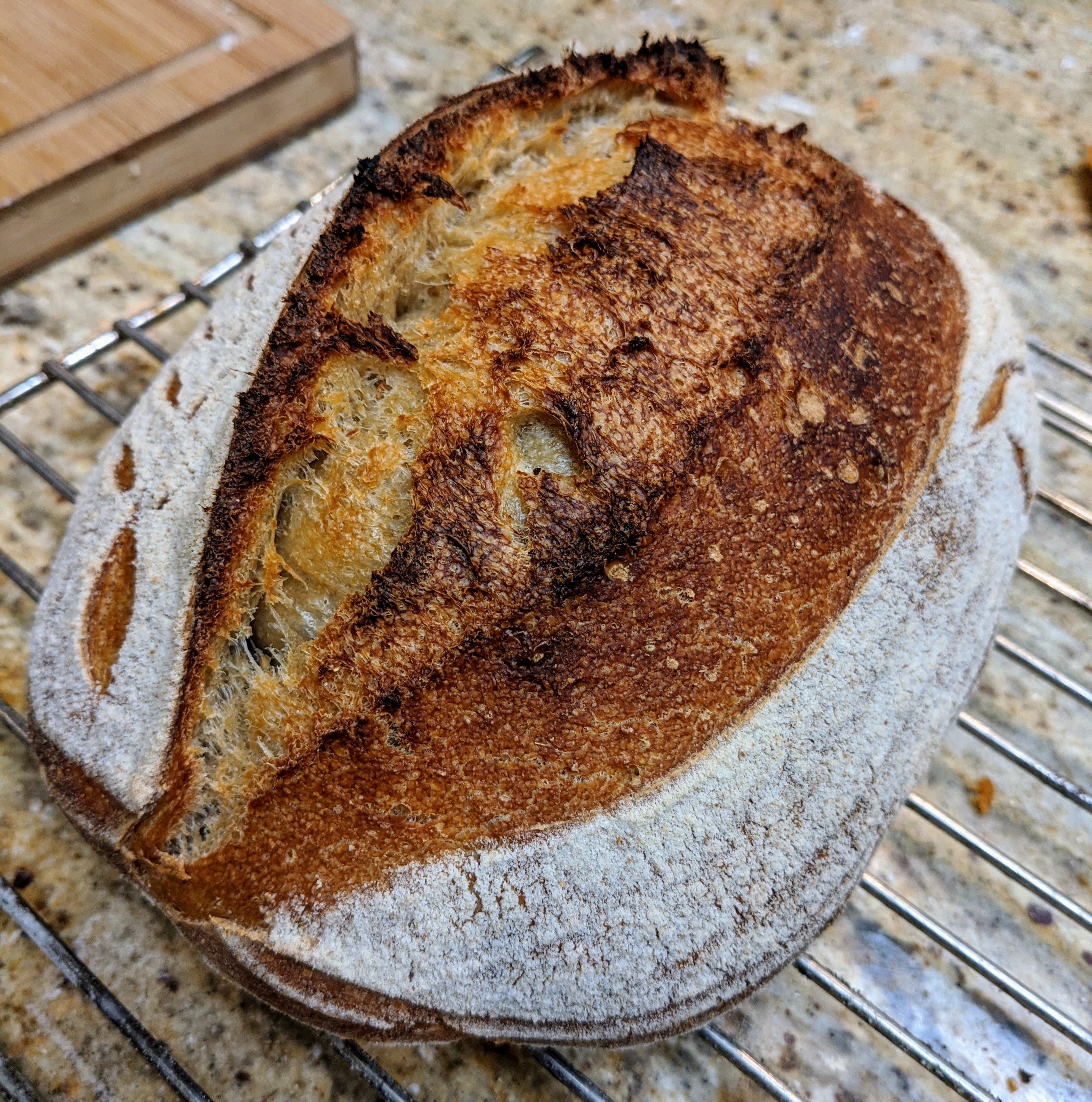
For instance, I went from this:

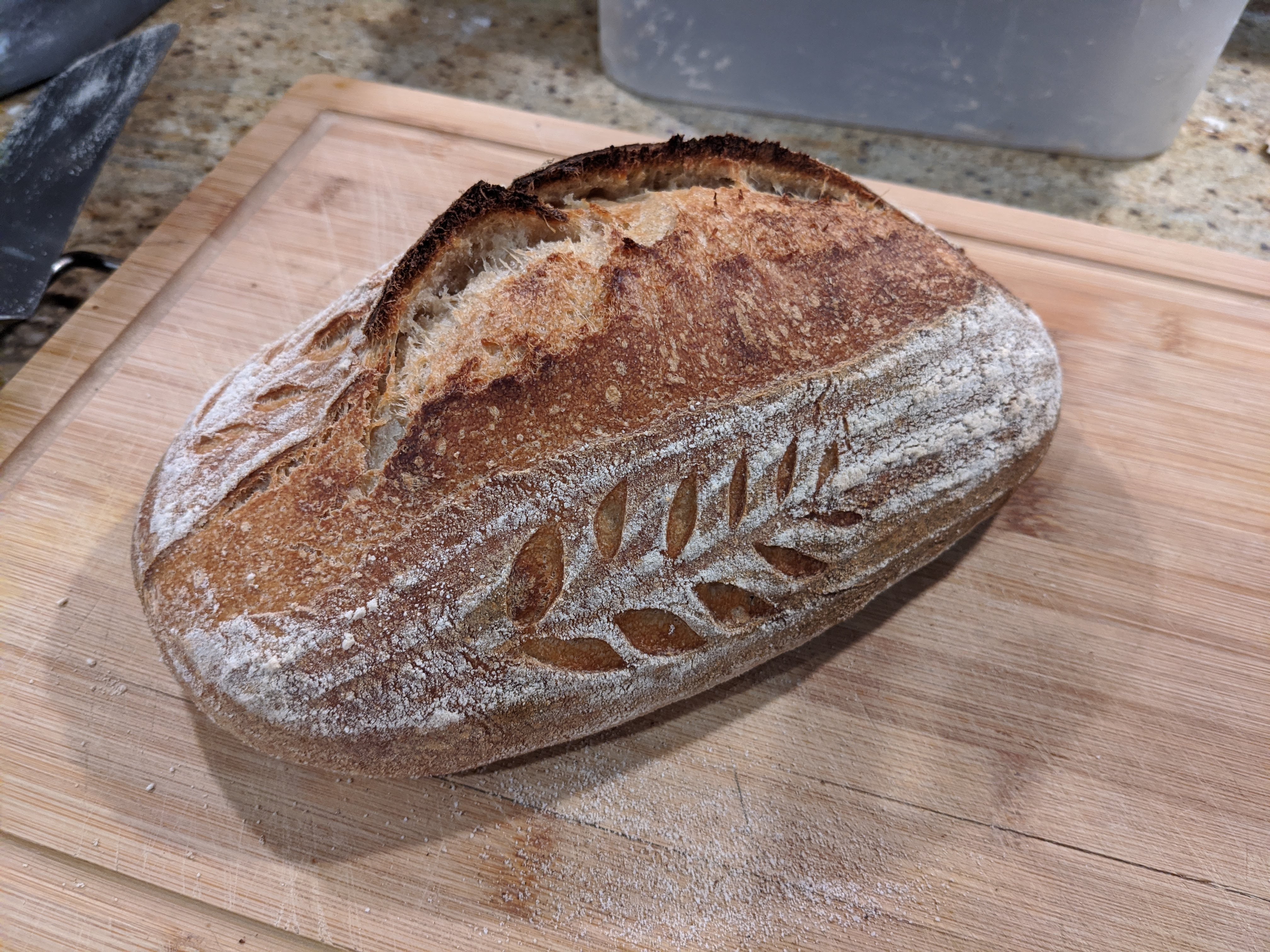
To this:
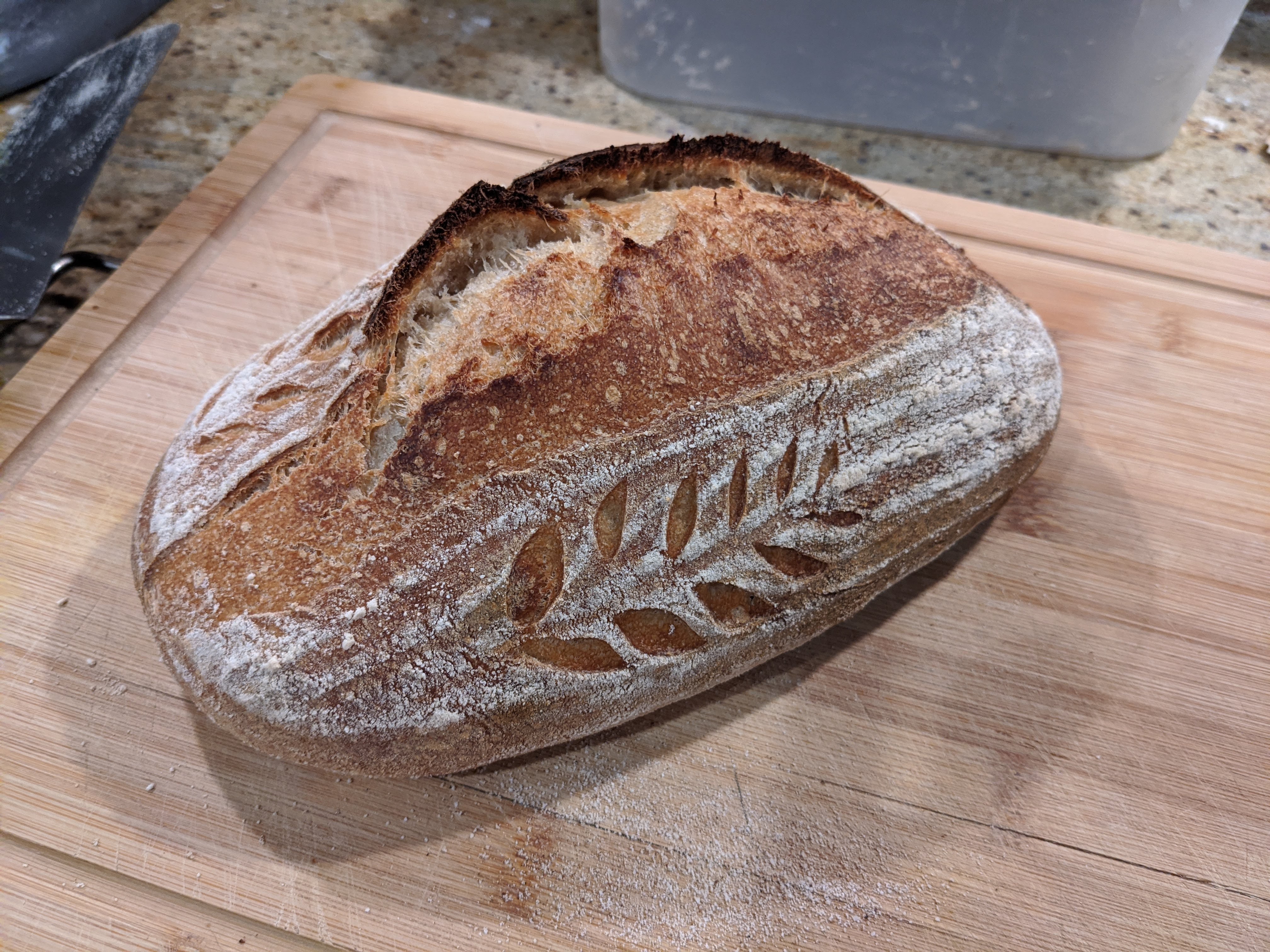
…in just a matter of months. Sure, it was a lot of learn by doing, but I also had the luxury of the Internet to help diagnose issues. And mind you, that loaf above is one of my so-so loaves. I’ve been able to reach a level of consistent quality not just by doing it a lot (I do bake practically every day), but having information readily at my fingertips. And I’m not alone in this. What I’ve seen other home bakers create is absolutely amazing! And I’ll submit that it’s the quick, free-flow of information that has enabled people to get to relative mastery much sooner than in the old days.

And while there are people who have totally geeked out on creating and maintaining a sourdough culture, I’m not one of them. I generally use a poolish or a biga to get the slightly sour taste in my bread. But I can do this because of the easy availability of commercial yeast. That said, I actually do maintain three active cultures but I bake several different types of bread. My cultures are tools, not pets. 🙂

Back in the old days, people had to create and maintain their starters. But let’s take a deeper dive into that. They didn’t have refrigeration. They didn’t have convenient little tupperware or glass jars. They didn’t have high-precision gram scales to get the right proportions. They certainly didn’t have silicone spatulas to clean out their bowls! Get the picture? While there is still a definite amount of craft that goes into our baking today, our lives are SO much easier than the artisans of old!

But from the standpoint of tradition, very little has changed. If there was any good about this whole 2020 lockdown, the fact that so many turned to baking – myself included – has been a real bright spot. And based on my participation in bread making forums, there’s a widespread, renewed enthusiasm for making bread. It’s heart-warming to see so many keeping the tradition alive!
Working with High-Extraction Flour

As I was watching a YouTube episode from Proof Bread in Mesa, AZ, Jonathan mentioned that Proof uses Type 85 flour, which is a high-extraction flour where 85% of the wheat kernel is retained in the milling process. At the time, I was trying to make a transition to including more whole wheat into my bread for nutritional reasons and Jonathan mentioning his flour really intrigued me. So that put me on a quest to find Type 85 flour.

I did finally find a Type 85 flour through Azure Standard, but they were sold out. Then I ran across their Ultra-Unifine Unbleached Bread Flour and got really intrigued. This is what sold me:

“We’ve taken a strong, full-bodied hard red wheat flour and refined it slightly by removing about 10% of the bran,” said  Azure Mill Manager. “In the milling industry it’s known as a particle reduction processing technique. We’re taking an already fine Unifine flour, sifting out some of the bran and giving you a finished product that has softer flavor notes, rises better and adds a little lightness to your artisan breads.”

I love this flour! But I have to admit that though it kneads and folds and feels like regular bread flour when you work with it, it acts a lot like whole wheat flour when it bakes; that is, it doesn’t have the oven spring that I’m used to with white bread flour. But that is to be expected because even though 10% of the sharp bran particles have been removed from the flour, there’s still a lot of the germ and bran left over. So given that, I’ve had to make adjustments.

First of all, just like with baking with 100% whole wheat flour, I’ve upped the hydration ratio when I’m working with this flour. I experimented with 73%, then went up to 75%, and today I prepared a 78% straight dough.

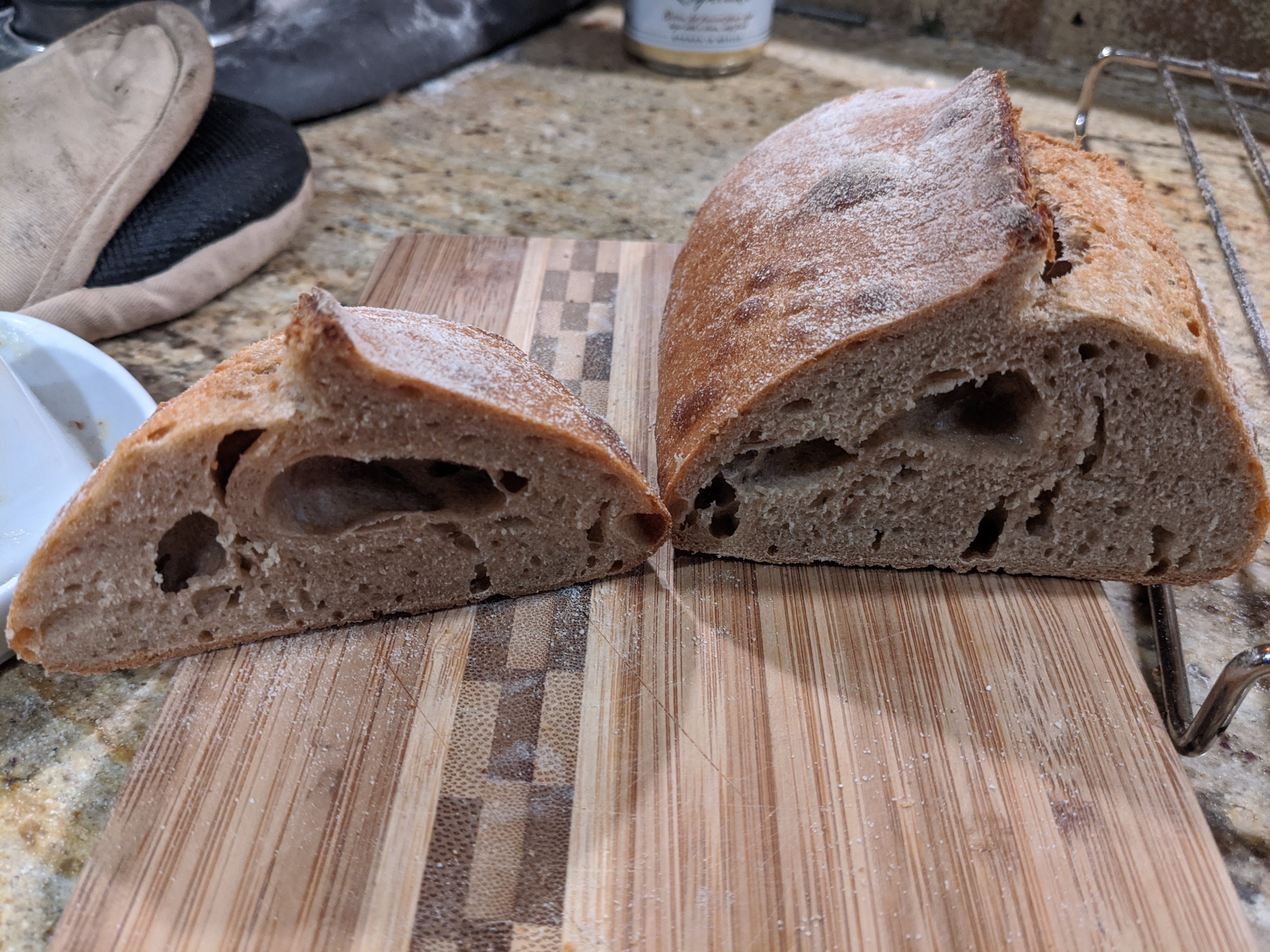
The 73% hydration dough produces an okay oven spring, but has a fairly dense crumb as one would expect from a whole wheat flour. It’s not bad, and by no means does it taste bad, but it is a little dense.

The 75% hydration dough has much better oven spring with a much more open crumb than the 73%. And it amazed me how just a 2% increase in water content could have such an effect on the oven spring.

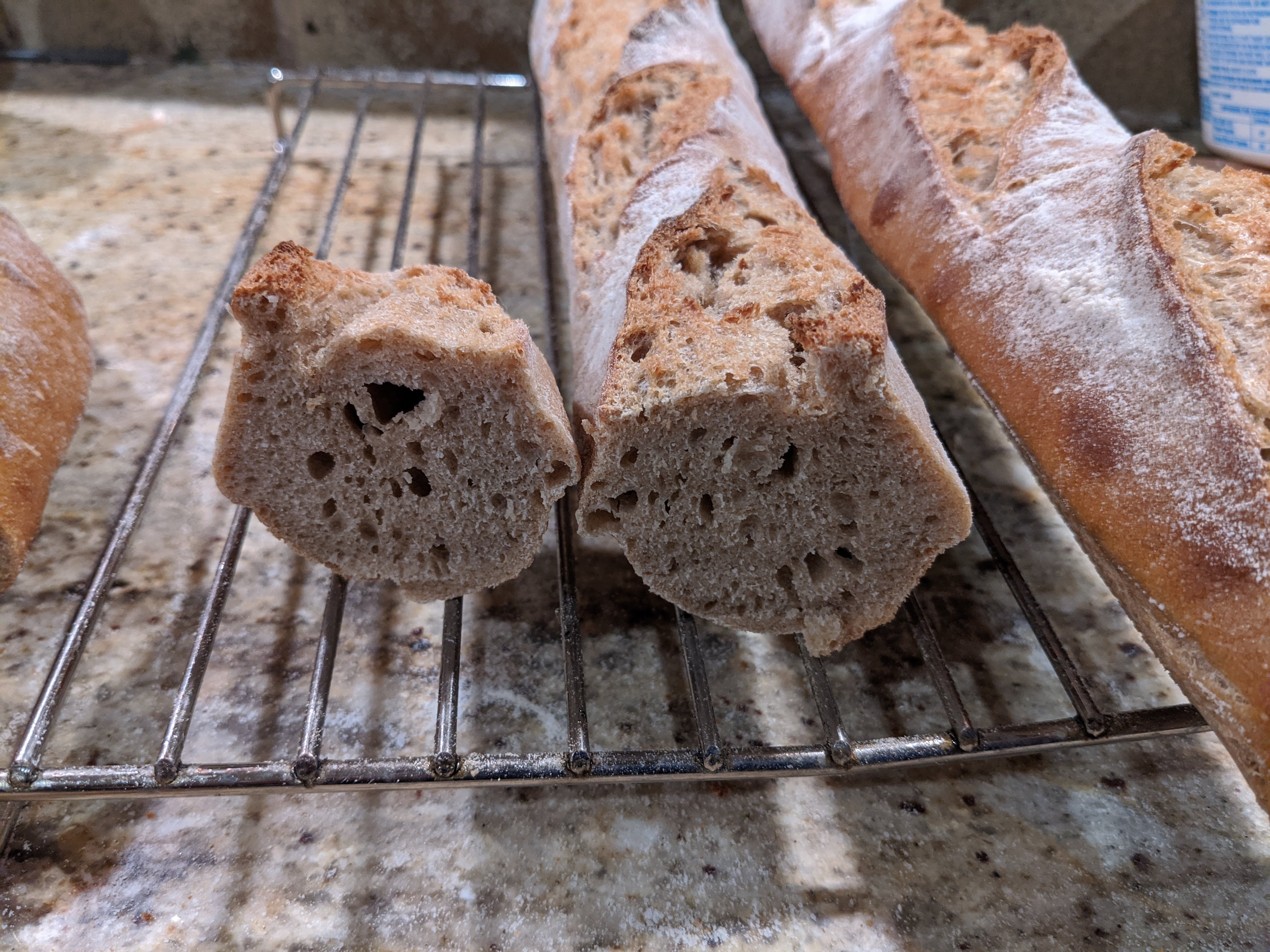
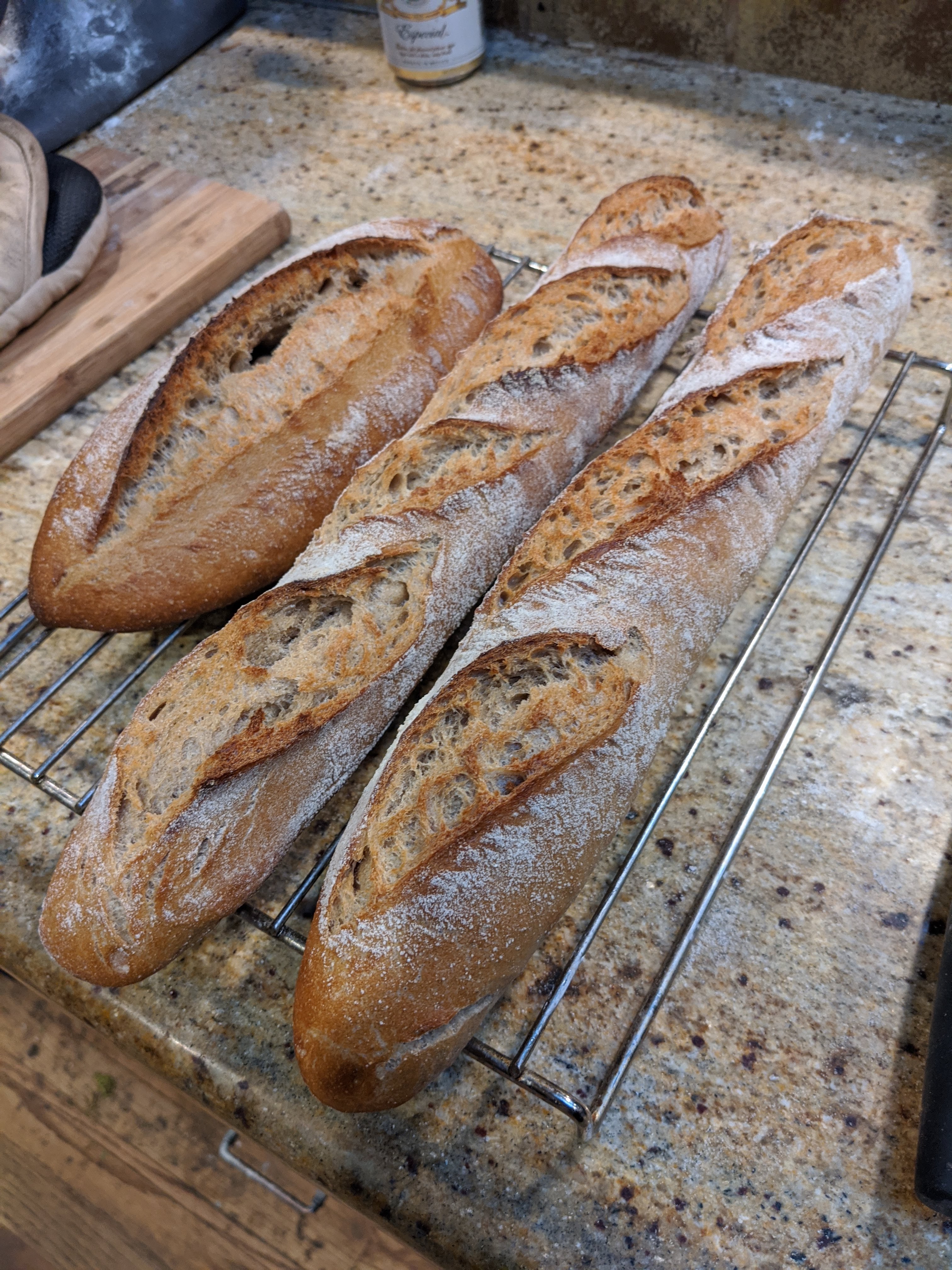
Finally, the 78% hydration dough… Well, I think I found the sweet spot. As I mentioned, I just did a straight dough today. I made two baguettes and a small batard, and they all turned out fantastic!

You’l notice that the crumb on the batard is a little wonky – not sure what that was about, and though the baguette crumb seems to be dense, it’s actually not. As opposed to big holes, there a lot of small holes. The bread is amazingly light in texture.

I didn’t change a thing with respect to how I prepared the dough. I just added a bit more water. It really made a big difference. And while I think this might be the sweet spot for hydration, I think I’m going to try a dough at 82% hydration to see how that works.

So now that I’ve got the basic sweet spot, I’ll start working with a poolish and then I’ll cold proof overnight. I’ve found with high-hydration flour, a cold-proof works best and the dough will hold its shape better when I score and put it in the oven, promoting a more vertical rise as opposed to spreading out. I’m also going to see what adding a bit of diastatic malt powder will do to open it up even more.

Stuff like this just gets me SO jazzed about baking bread! There’s a definite precision that you must observe, but at the same time, variations in the environment force you to make adjustments on the fly. It’s a lot like golf where even though you develop the basic swing, conditions like wind direction and humidity force you to make adjustments. And it’s that constant challenge of making adjustments that keep you coming back for more!

Experimenting With Proofing Temperature

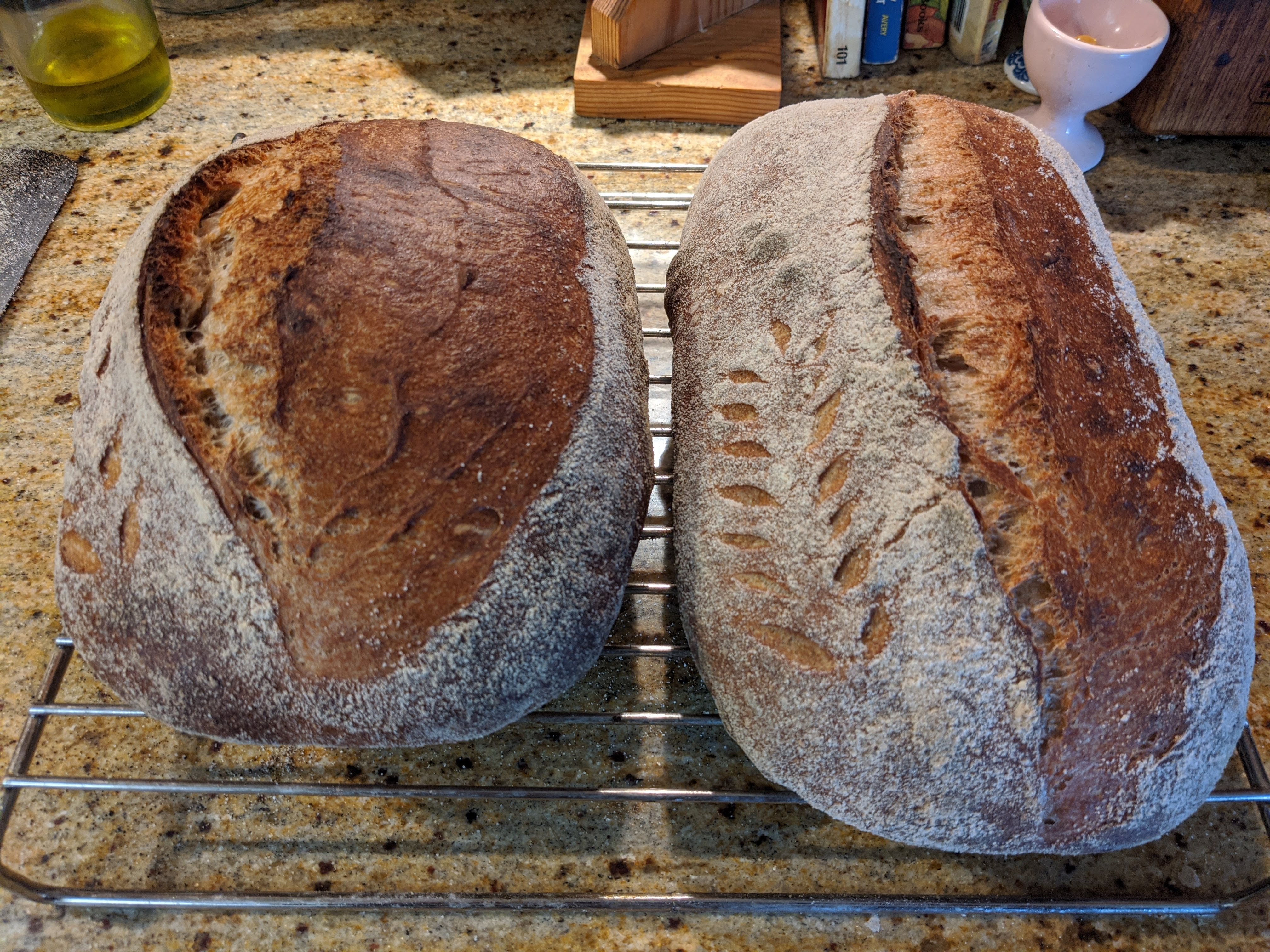
The picture above shows two loaves I created from the same base dough (77% hydration). I proofed the loaf on the right at room temp (~80-degrees), and the one on the left I proofed for 30 minutes at room temperature then popped it in my dough retarder for an hour to not just slow down the proof but to chill the dough.

Based on the final results, chilling a slack, high-hydration dough maintains the shape much better whereas not chilling that same dough will spread out. Both loaves are roughly the same height, though the left-hand loaf is just a tad taller. But the big difference is that the chilled loaf has much more consistent vertical spring throughout the entire loaf, and did not expand length-wise. It did expand a bit width-wise, but that’s okay. I expected that to happen with my scoring. As you can see, the bread really opened up where I slashed it.

To be open and honest, I didn’t come up with this idea. I happened to be reading a blog post last night where the author suggested chilling a nearly-proofed loaf for about an hour in the fridge. The thinking was that it would chill the outside skin of the loaf and be much easier to score. I had to try it today and the results speak for themselves.

While there’s plenty of oven spring – and I’m actually expecting a nice, open crumb with both loaves – there’s not as much spring as I would get with regular white bread flour. The base dough was made with that high-extraction bread flour that contains more of the wheat kernel than regular bread flour. And even though it has a high protein content at 14.7%, the fact that there is more bran and germ in the flour affects the overall structure. Given that, I’m probably going to have to fortify the flour with some vital wheat gluten. But that said, I will be chilling all my high-hydration doughs from here on out or even doing overnight proofing.

Working out things like this is what has made my bread making journey so rewarding. I have fewer and fewer outright fails now than when I did in the beginning. But now, even my less than ideal loaves are much smaller “fails.”

As Mel Gibson said in the movie The Patriot, “Aim small, miss small.” For me, improving my technique has been about making little changes. With this particular experiment it was about tweaking one little thing – temperature. And that one small thing produced tremendous results!

“Fake” Sourdough…

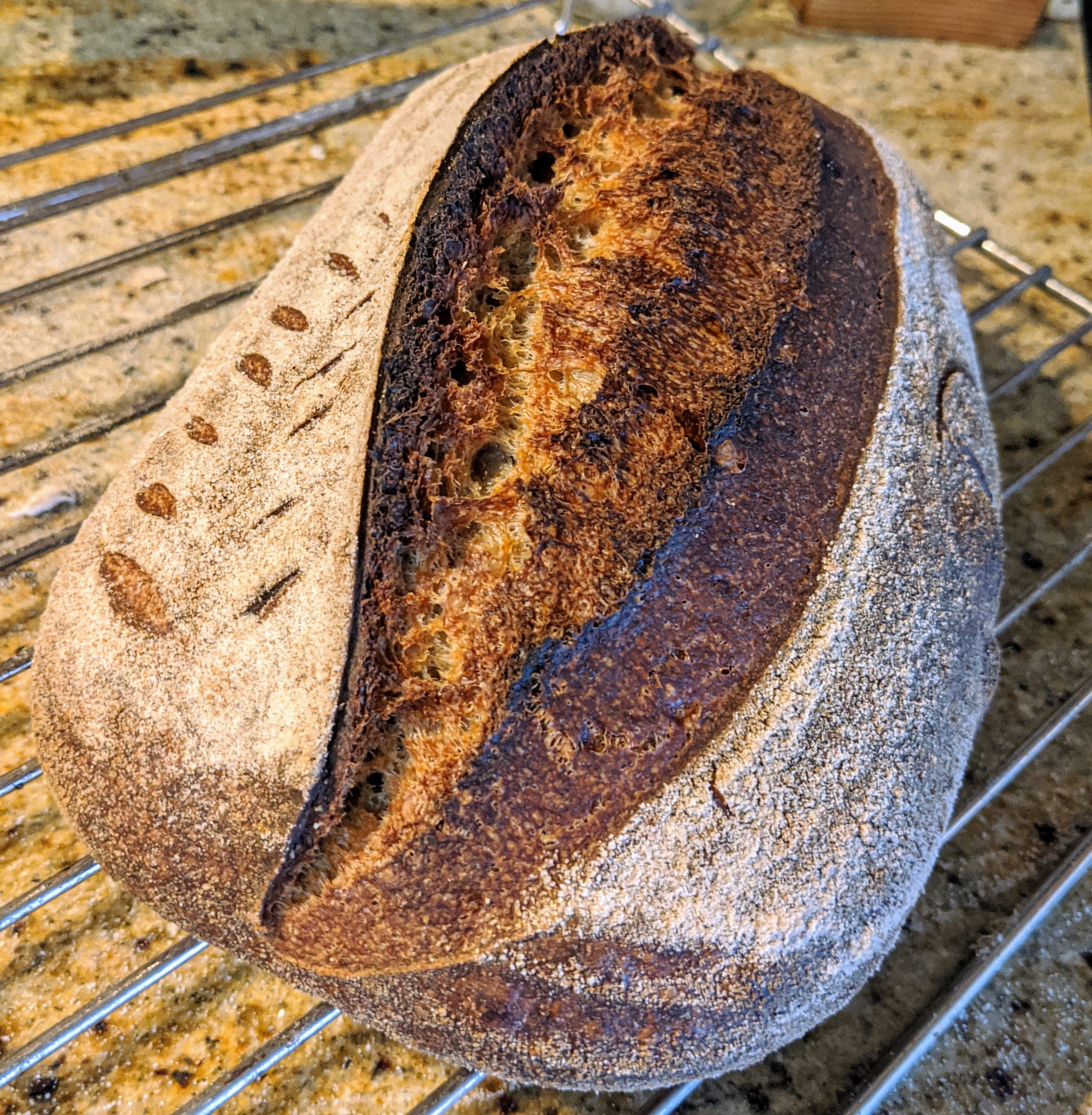
See that loaf above? Beautiful right? It has a nice, sour taste to it that’s perfectly balanced with the rest of the flavor profile. To most people who’d eat it, they’d think that it’s a loaf of sourdough bread. But it’s not. It was started with a poolish I made the previous day. So technically, based on the accepted convention, my bread really isn’t sourdough… or is it?

Traditional sourdough is made from a culture where wild yeasts and bacteria work together to leaven a dough. The result is that the bacteria produce both lactic and acetic acid which provide the sour taste. Bakers yeast, on the other hand, isn’t nearly as tolerant to acidic environments. But it can leaven a dough all by its lonesome.

So given that my poolish bread was started with bakers yeast, how does that account for the sour taste of my bread? The only thing I can think of is that since I do a long ferment of my poolish – like 18 to 24 hours – the wild yeasts and lactic acid bacteria have time to develop and make a contribution to the fermentation process. And given that I literally start my poolish with less than 1/2 gram of yeast (literally 0.4 gram), there’s plenty of room for the wild yeasts to do their thing, which in turn help to feed the bacteria.

And this is where it gets a little interesting. The bakers yeast kicks off the process, but the environment may become too acidic for it. I’m kind of wondering if it actually gets killed off when the dough becomes acidic. The reason I say this is because a notable trait of a traditional sourdough is that fermentation takes a long time. My poolish bread takes several hours to go through bulk fermentation. The dough for the loaf above took almost six hours to get through bulk fermentation! That’s right in line with using a sourdough starter.

So this gets back to the question: Is sourdough a taste, or is it a technique? Or maybe I’m just full of crap. After all, I did recently write that I just want to make great bread. I love the fact that my poolish bread imparts a distinct sour flavor to add to the overall flavor profile of the finished loaf. And I’ve done it enough now where I can reproduce it every time. But in the end, what makes it a great loaf is the process. So yeah… technique…

Look, I Just Want to Make Great Bread

The Covid lockdown has had an interesting effect across the world: Lots of people started baking bread. I’m one of them and I’ll be the first to admit that I jumped on the bandwagon! And all throughout this time, there seems to be this one term that gets thrown around by beginners and experts alike when it comes to baking artisan bread: sourdough.

It seems, to me at least, that the term sourdough has also seemed to become synonymous with making artisan bread. There’s so much buzz about sourdough that when you go on online forums, all anyone talks about with respect to baking bread is baking sourdough bread, as if it’s the ONLY valid way to make bread. Of course, that’s not true. There are different ways to ferment flour and water.

I’ve felt so inundated by the term sourdough, that I’ve developed a bit of a mental aversion to the term. And to be honest, I feel just a little guilty about having this aversion to it which is why I’ve been writing articles in an attempt to articulate why I feel this aversion. But after a lot of careful thought, I think I can finally explain why I feel this way.

It boils down to this: Once you add a leavening agent to flour and water, the process is pretty much the same. Of course, you have to react to variants in hydration and environment, but irrespective of your leavening agent, you react to those variants in the same way. Hot room? Shorter bulk and proof times. Higher hydration? Stretch and fold; and you pre-shape with a scraper, forming a ball with the rotate and pull method. Whether you started with instant yeast or a poolish or a biga or a sourdough starter, after that, you handle the inoculated dough the same damn way!

Sure, there is an art to creating and maintaining a sourdough starter. For instance, I’m totally blown away by Nancy Silverton’s (of La Brea Bakery fame) Grape Method (look it up, it’s cool). But to me, the real art is in the actual manipulation of the fermented dough to produce loaves of bread. It may start with the starter, but it becomes bread through working the dough. And also, though I’m still pretty much a beginner at this, I’ve developed this sense that the actual craft of artisan bread is not just creating a single loaf of bread, it’s in creating different types of bread in a consistent fashion.

For instance, here are a few pics from recent 2-pound batards I made:

I just pulled the loaf on the far left out of the oven a few minutes ago. The thing about these loaves is that they all look, feel, and taste pretty much the same. Of course, that’s due in large part to my proofing baskets. But still, they’re all pretty similar. To tell you the truth, I’ve only just reached this point in the last couple of weeks. I’ve been working hard on consistency in my process; working on the craft.

And herein lies my slight aversion to the word sourdough. The starter is only a single piece of the puzzle. You have to construct the dough and build and shape its gluten structure for it to become a great loaf of bread. And for me, as I entitled this post, I just want to make great bread, no matter what leavening agent I use!