Breaking With Convention

This originally appeared at the end of my afternoon batard recipe, but after reading through it again, I decided that it deserved its own entry.

Conventional wisdom states that bread made with a pre-ferment like a poolish, biga, or levain is much more complex in flavor. It is. I’ve made bread with all the pre-ferments and I can attest to that. But complexity doesn’t necessarily mean bread made from pre-ferments is better, which tends to be the equivocation of complexity. I’ve tasted and made plenty of loaves with “complex” flavors that simply weren’t all that good in terms of texture or appearance. They may have tasted fine, but they were only okay when taken as a whole.

In my bread making journey, I’ve learned that making great bread is less a function of the leavening agent, and almost entirely a function of technique and understanding the ingredients with which I’m working and just as important, how the ingredients respond to my kitchen environment at the time I’m making bread.

For instance, because I like a slower to moderate fermentation rate, I adjust the amount of yeast depending on the temperature of my kitchen. In summer months, I tend to use a slightly smaller amount of yeast and cooler water. In colder months, I use a little more yeast and warmer water (by the way, it’s still a small amount and varies by a gram or so).

And to be clear, I almost always use roughly half the yeast than a recipe normally calls for (unless they suggest already using a small amount – like 2-3 grams) because I want the yeast to be helper, rather than relying on it entirely for fermentation. In my recipe, as opposed to a 1 or 2 hour rise, I promote 3 to 4 hours – or even an overnight rise in the fridge.

This allows the natural airborne bacteria to also come into play. It may be a relatively short time compared to doing a days-long fermentation, but even taking just this shorter amount of time has a huge effect on flavor development.

And then there’s the type of flour I use. Not all brands and types of flour are the same. Protein content differs, which affects the gluten network. Fineness differs which has an effect on texture. Absorption differs which will affect with the hydration ratio.

For instance, my flour of choice is King Arthur Special Patent flour. Though they say it’s best use for buns and enriched bread (brioche, etc.), I love it for making loaves. But it has a lower water absorption rate than the standard KA bread flour. So I usually take the hydration ratio down one or two percent from recipes that I see. If a recipe calls for 78% hydration, I’ll use a 75% or 76% ratio.

Furthermore, with the flour I use, I found that I have to work it a bit more to achieve the proper structure where it won’t collapse during proofing. And speaking of working the dough, that’s another technique that is absolutely critical to success. And the thing about working the dough is that while the mechanics can easily be taught, it really requires feeling the dough. So even though I do the initial mix in my stand mixer, I knead and/or fold my dough entirely by hand.

I guess the point is this: I always question whatever is the convention. It’s not to be purposefully contrary. It’s just that I want to push beyond the limits of the convention if it’s possible. I may discover that the convention is the way to go in my discovery process, but at least I’ll have discovered for myself what the limits are.

This is probably why I’ve resisted regularly using a levain. Everyone’s doing it, especially in this lockdown. They love their sourdough bread. I like sourdough, but I don’t want it to be the only kind of bread that I make. I’m looking for a complexity of flavors in my bread and perfecting my technique. That may very well lead to me using a levain, but I’m making great bread right now without it.

As I shared with my cousin today when she asked me if I was making sourdough, “Not really, though I’m using poolish and biga pre-ferments and doing extended bulk fermentation. But not sourdough. Everyone is doing sourdough these days. And you know me, if everyone’s doing something, I’m gonna do something else.”

That something else has led me down a rabbit hole of different techniques that I otherwise wouldn’t have discovered if I just made one kind of bread and stuck to a single recipe. It has made research different factors that affect the process like water temperature and fermentation rates; when and when not to autolyse. It pushed me to learn how to shape different kinds of loaves and how to create tension on the surface of my bread.

Had I just stuck with the recipes and techniques – however incredibly valuable they are – from Ken Forkish’s insanely great book, “Flour Water Salt Yeast,” I’d still be baking my bread in a Dutch oven! I still use a Dutch oven from time to time, especially for baking high-hydration doughs that benefit from a confined space. But I wanted to make batards and baguettes and full loaves and sandwich breads. It meant breaking with the convention.

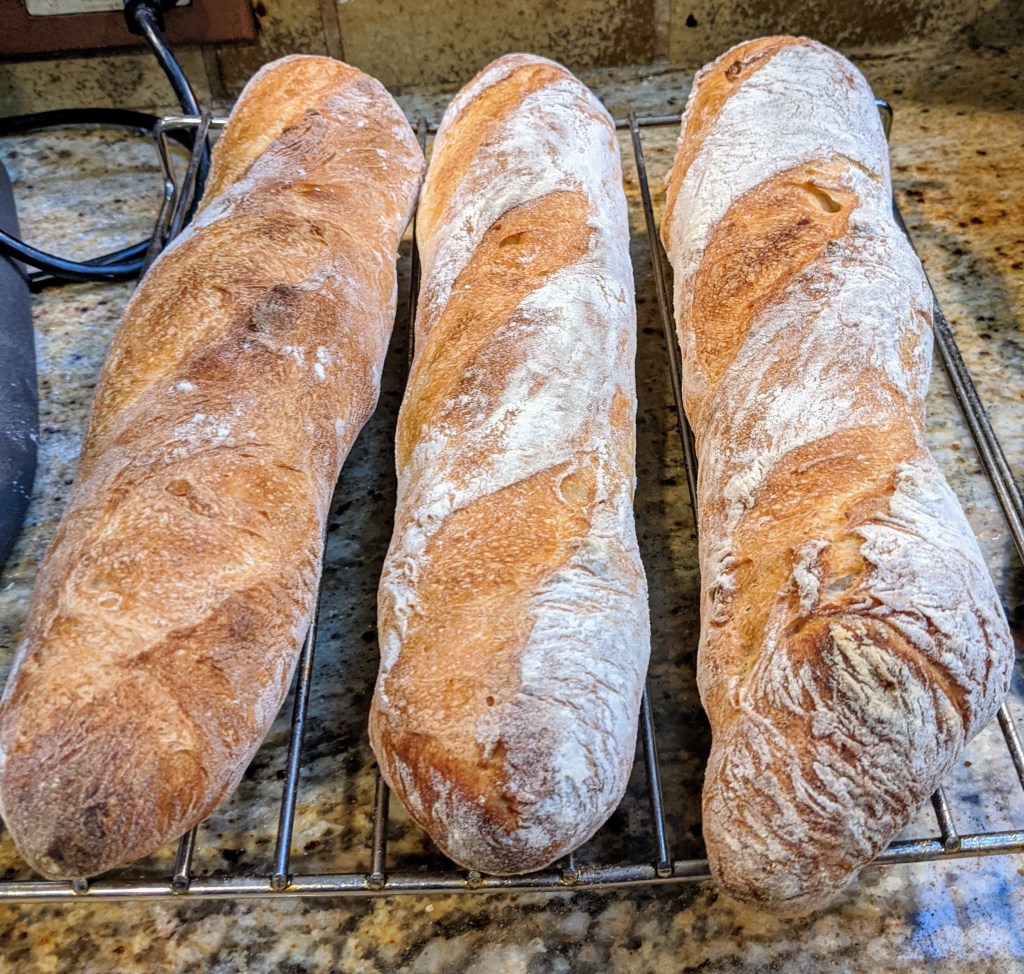
Flour. It’s Important.

I know, that’s a no-shit-Sherlock statement. Obviously, you can’t make bread without it. But there’s more to that statement than just the ingredient itself.

For dietary concerns, I’ve recently started incorporating more whole grain into my dough and I’m really looking to eventually move entirely to whole grain bread. I’ve made some loaves with nominal success with varying blends of bread and whole wheat flour. I’m blending mainly because of the crumb. 100% whole wheat dough, unless it’s worked for a long time or up above 90% hydration, just doesn’t rise that much – even with helpers like vital wheat gluten or psyllium fiber. Those provide a little help with oven spring and rising, but you just won’t get that wide crumb.

Enter white whole wheat flour.

From what I’ve been able to gather in my research, white whole wheat flour will get me that wide crumb. Granted, I still have to ferment it a long time and work it more than regular bread flour, but it apparently works great. Furthermore, by law, whole grain flour cannot have any GMOs in it and that’s a big concern for me and actually, a big reason why I’m moving to whole grain flour (or making sure I’m using flour produced by a company that ensures their flour is non-GMO certified, like King Arthur).

Given that, I’ve spent the last few days researching different brands.

And this is where I’ve gotten into a bit of a conundrum. Brands like King Arthur or Bob’s Mill tend to be a bit pricey – even with free shipping with Amazon Prime. Others, like Stafford County Flour Mills Hudson Cream Whole Wheat flour, are exceptionally reasonably priced, but shipping is expensive. For instance, a 50-pound bag of their Hudson Cream Whole Wheat is only $12.60 direct. But shipping is $48! See what I mean? Now that’s comparably priced to King Arthur with “free” shipping from Amazon, so I don’t feel too bad about the total price.

On the other hand, I found a great flour called Kansas Diamond White Whole Wheat flour. It has gotten great reviews. But it is produced by Archer Daniels Midland, which is a HUGE agriculture conglomerate on the scale of ConAgra – get the picture? No, I’m not looking at them as the evil empire, but for me at least, I think it’s important to support independent producers; especially independent farms and farmers of which there are fewer and fewer as time passes.

And speaking of Amazon… as of late, I’ve really been doing my best to NOT buy from Amazon. We’ve all heard the tales of their business practices and how they treat their employees, and let’s face it: Jeff Bezos is a wealth-hoarder. I have some serious issues giving my financial support to someone who has so much, but shares so little.

Circling back to the title of this post, I am of the conviction that it’s important to know where your ingredients come from – or at least as much can be known. And I think it’s essential to provide direct support for the small, independent businesses that are quickly being gobbled up by the big corporate machine. Small businesses and the people who work and run them are the salt of the earth. For this writer at least, I want to make sure my life is seasoned with them!

Sourdough? We Don’t Need No Stinkin’ Sourdough!

I’m not sure why this is, but it seems that people equate making artisan bread with sourdough. I’ve shown several people pictures of the some of the loaves I’ve made and to a person they ask if they were sourdough loaves. What? Is making sourdough some kind of rite of passage?

To tell you the truth, while I like sourdough bread, my personal preference in taste is for yeasty, non-sourdough bread. Both traditional French and Italian loaves are not sourdoughs. They’re yeasty with an expansive crumb and have crisp crusts. But still, many people who have been following my posts still ask if I’m going to make sourdough. I answer that eventually, I’ll get around to it, but I’m not in a big rush.

But to be completely honest, even though my tastes run to the non-sourdough variety of bread, I have been completely immersed in developing my technique. Like any good cook, I’ve totally focused on my mise-en-place and working out my moves.

I don’t want to just bake different types of loaves or work with different dough hydration rates. I want to make a consistent product. That takes doing things repeatedly and developing my sense of all the ingredients and implements I need to get me to a high level of consistency – mise-en-place.

I don’t have any aspirations of being a professional bread baker, but when it comes to cooking, what I do aspire to be is a great craftsman. This is why I’ve geeked out on bread making. For me, it’s not enough to be able to say I know how to bake bread. I have to KNOW how to bake bread; that is, I have to have developed the craft so that on any given day and in any given environment, I can produce loaves of the same quality. For me, when I learn to cook something, I need to get to the point where the process becomes intuitive.

Take grilling meat, for example. I’m known in my local community as the guy who cooks whole pigs over coals. I’ve been doing it for over 40 years, having learned how to do it from my father when I was teenager. I’ve done it so much that I instinctively know what to do given the size of the pig, the temperature of my pit, the ambient temperature of the day, etc.. In other words, I can roast a pig with my freakin’ eyes closed, and I’m not bragging when I say that. It’s just a matter of fact.

I’m not there yet with baking bread. I’m getting there, that’s for sure. But there are so many things that I still need to learn before I can confidently say that I’ve attained a level of expertise. And because of that, I’m in no rush to make sourdough bread.

Home Baking Essentials

Since I’ve started to finally get this whole artisan baking thing down, I thought I’d share some thoughts on what I feel are the essential tools you need to successfully bake quality bread at home. These aren’t in any particular order of importance; to me, they’re all equally important.

Digital Scale

My first month of baking, I used recipes based completely on volume (cups, tablespoons, and teaspoons). But real recipes always listed things by weight; specifically, in grams. The reason is because to a baker, everything is measured by percentages in weight, based on the flour. This makes it easy to scale a recipe up and down if you know the percentages. For instance, if a recipe calls for a 72% hydration, you know that the weight of the water divided by the amount of flour will be 0.72. So if the recipe calls for 1000 grams of flour and is 72% hydration, you know you’ll need 720 grams of water.

I normally take 1000 gram recipes down to 800 grams because that works better with my KitchenAid stand mixer. But I could easily go up from there as well. Get the picture?

You don’t have to spend a lot of money on a digital scale. My 22-lb. capacity scale costed me $15, and it works great. It’s not as precise as a professional kitchen scale, but for my purposes it works.

Plastic Scraper

I have a few of these, but I normally just use one scraper that I originally used for taping drywall. It has a flat edge on one side and a curved edge on the other. I love it because I can bend it to fit the curvature of any bowl that I use.

Even before I got a digital scale, this was a tool I knew that I could not be without. I can scrape dough off the sides of my bowls, I can scrape my bench, I can collect bench flour. I even use it for folding my high hydration dough so I don’t get too much dough on my working hand.

I actually got mine for free as a promo item from a sewer blockage company – go figure – but it works incredibly well!

Bakers Lame (pr. “lahm”)

To score loaves, a lame is indispensable. Basically, it’s a razor blade in a handle and can be curved or straight. Personally, I made my own curved lame from a wire hanger and a BiC pen. 🙂 And for my straight lame, I actually use a straight-razor because it works great for scoring.

You could use a super sharp knife, but it has to be razor sharp. You also could use a razor blade all by itself, but you risk cutting yourself.

Bakers Couche

This is not absolutely essential, but since I got mine, it has become something I can’t live without. I originally got it for proofing baguettes, but I use it for proofing all my long loaves, and I also use it to cover my bowl during bulk ferment. Very versatile.

Not Sure If I’m Being Snobby

I’ve always been an innovator. Though I can create things independently, I’m much better at tweaking and improving an existing process. And I’m not boasting when I say that I’ve had a successful career in software development being an innovator. Call it a quirk of my personality; it’s just who I am.

When I picked up bread making a few months ago, within a week of playing around with recipes from Ken Forkish’s excellent book “Flour Water Salt Yeast,” (FWSY) I started experimenting with different variables in the bread making process. One of those things was what I kind of felt was breaking free of the Dutch oven.

While I loved all the content in FWSY, just a few times into making some of Ken’s bread recipes, I started feeling confined. I didn’t want to just make boules. I wanted to make buns and baguettes. I wanted to make pan bread and batards. But with a Dutch oven, I had one shape and one shape only: The shape of my Dutch oven. It felt incredibly limiting even though I was still learning.

So I started using a baking stone to bake all my bread; actually, two of them as I have a double-deck oven. That opened up a whole new world to me and literally forced me to learn about working dough and forming the gluten network structure. It forced me to learn how to properly shape all kinds of dough to create surface tension. It forced me to learn how to use steam to get a great oven spring.

Once I stopped using a Dutch oven, I had a few epic fails, mostly with collapsing loaves that would come out fairly dense. I’m smiling as I write this because they were ugly loaves! I’m a lot better with shaping now, though I realize I still have a ways to go. But in spite of that, I have a sense of freedom now that I’m not using a single baking medium.

Which leads me to the title of this post…

I was recently on an online forum where people share their bread making techniques and their finished products. Ninety percent of the folks shared their boules, which made me immediately think that they used a Dutch oven. I’ll be honest: When I read how they were making their bread, I immediately thought they kind of cheated.

I know. It makes no sense. These loaves were legit! Great crust, great crumb, and I imagine, great-tasting as well. But having graduated beyond the Dutch oven, I couldn’t help but feel that they were limiting themselves to just that style of bread. I immediately felt ashamed for thinking that, which is why I’m writing this post – kind of as an apology for being a bit condescending.

The plain fact of the matter is that I have completely geeked out on home-based bread making. I spend hours every day researching different techniques and adapting them to my home kitchen. I want to learn how to make all types of different bread. I want to experiment with different hydration rates and different flours. And the funny thing is that I can’t even eat 95% of the bread I make because I have high blood pressure! 🙂

So I realize that my journey is completely different from others. And to avoid ever descending into sanctimonious behavior, I’m going to share my journey in this blog.

Happy baking!