In addition to baking, I barbecue a lot. And one thing I’ve learned in making great bread and great barbecue is to have the patience – and trust – to leave your dough or meat alone. Especially with baking, sometimes it’s SO tempting to check how your baking is going, but temperature fluctuations can have a deleterious effect on your bread. So, as in the words of Nancy Reagan, “Just say no!”
In the first 10-15 minutes of baking, when you’re applying steam to certain bread, opening your oven will release the steam and your bread will not get oven spring because it’s the steam that keeps the crust moist and allows the bread to expand. Talk about killing a bake!
Several people have asked me why their bread doesn’t spring much, and many times I find out it’s because they open their oven door to see how their bread’s doing. I know, it can be tortuous to have to wait, but if you have a little trust in the process, you’ll be rewarded. Remember the saying, curiosity killed the cat.
I had to learn lots and lots of patience when I started barbecuing in earnest. For instance, a pork butt requires at least 12 hours. A brisket can take up to 16 hours! Of course, there will be times when basting or spritzing the meat is necessary, but in between those times, I’ve had to learn to just let the meat cook, lest it come out tough and chewy, and no one want that.
So, have some patience, trust in the process, and let your dough do its thing!
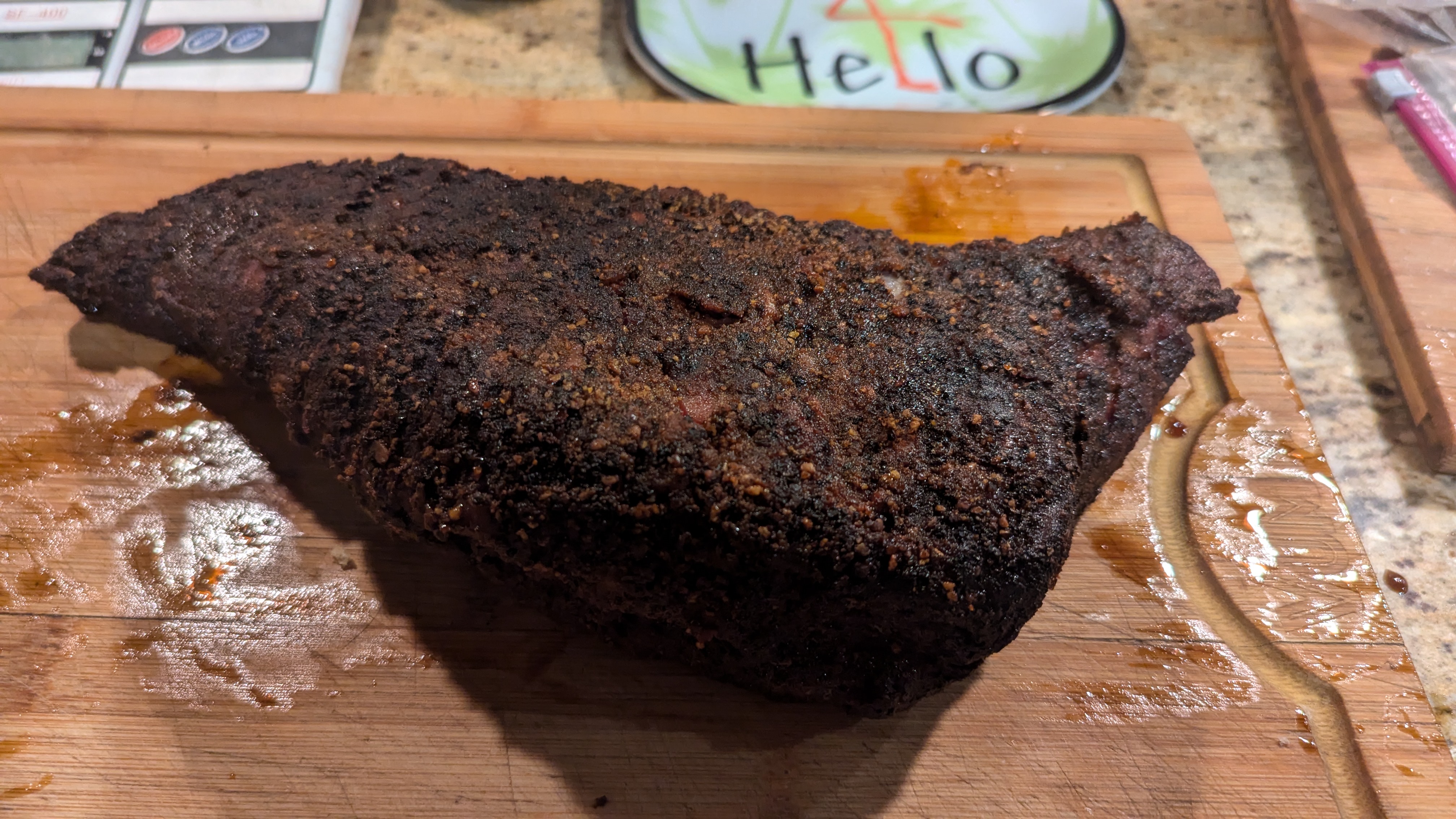
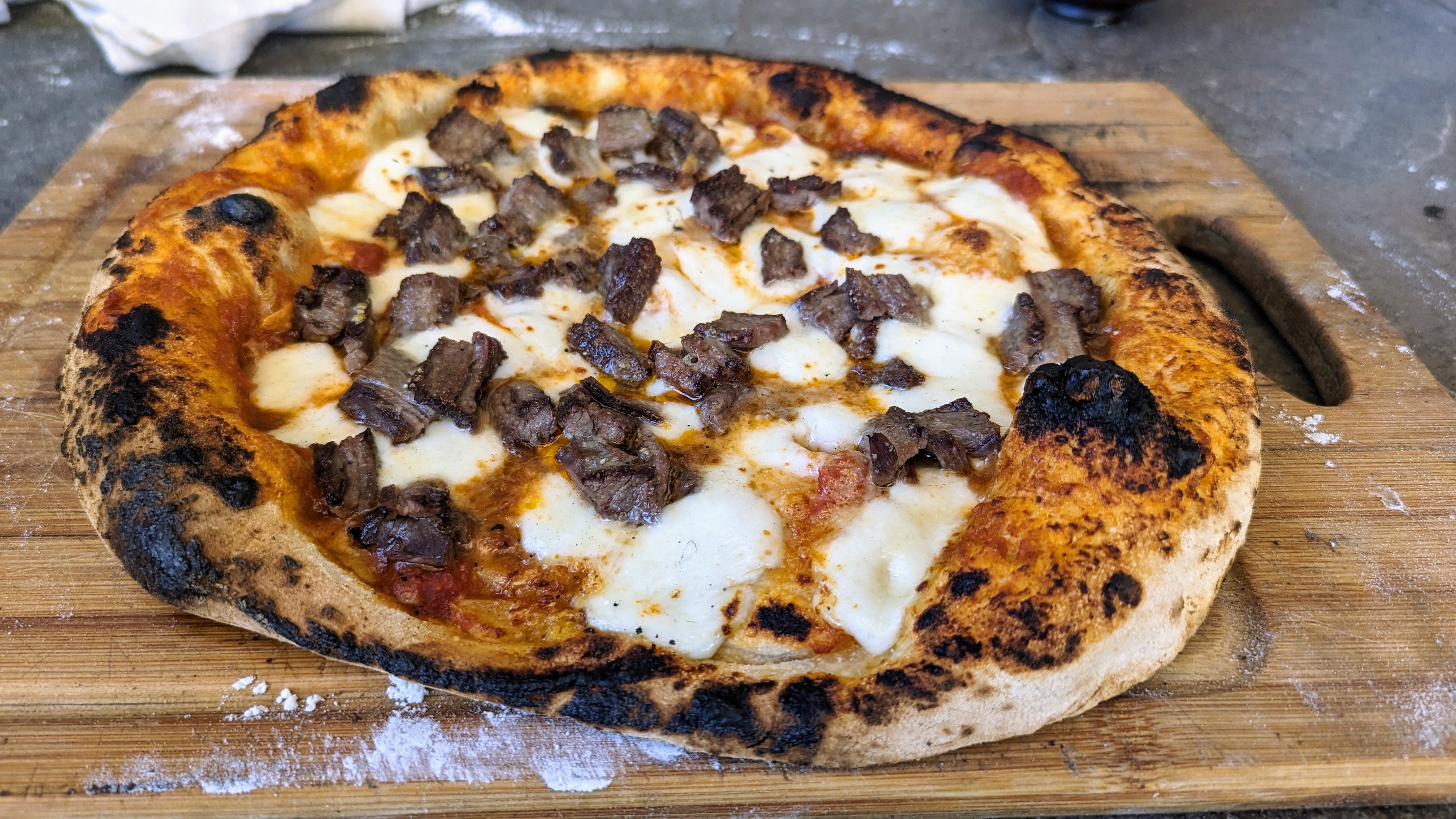
Now and then I like to share things I’ve cooked other than bread. But they’re also great to go with bread! This time it’s brisket-style barbecue Tri Tip steak. Tri Tip is predominantly a US West Coast cut, and more specifically, it tends to be a California cut. But if you can find it outside of California, it’s a great cut that can be cooked in a variety of ways.
The traditional way of cooking Tri Tip is over a hardwood pit using indirect heat for the first part of the cook then searing the outside in a sort reverse sear method. This is a method I’ve used for years. But since I got such a great deal on the last two Tri Tips I purchased, I decided to smoke one like I would a brisket to see how it would turn out. As you can see from the picture above, it turned out fantastic!
Here are the steps:
Preparation
Tri Tip is a rather lean cut of meat, but invariably, it will be encasd on one side with a thick layer of fat. So before you do anything, trim the cut, removing the hard fat and silver skin. If you do leave some fat, make sure you don’t leave more than 1/8″.
Next, you should brine the steak for 12-24 hours. With the steak above, I dry brined it with my homemade rub. In the future, I think I will wet brine in a marinade. The reason is that Tri Tip has a loose muscular structure, and even though good cuts have marbling, because of that loose structure, the fat leeches out during a long cook. Wet brining should help bolster the moisture in the meat.
Barbecue!
Like any barbecued red meat, it takes time to cook. For this cut, I used my Traeger pellet smoker:
2 hours on the “Smoke” setting (it’s about 160)
Turned up the smoker to 180℉ and cooked until the internal temperature of the meat read 160℉. By this time, the meat formed a beautiful bark! (~3 hours)
I removed the meat from the grill and wrapped it tightly in butcher paper and turned the temperature up to 225℉.
Returned the meat to the grill then barbecued it until the meat had an internal temperature of 200℉. (~6 hours)
I immediately transferred the meat (still wrapped) to a jumbo ziploc bag, then let it rest for 30 minutes in a cooler. Normally I’d rest it for a couple to a few hours, but it was dinner time and I was hungry! 🙂
As you can see, it was a pretty straightforward process. That’s the beauty of barbecue! In the future, I will definitely dry brine the meat overnight and even inject it to bolster the moisture. The only issue I had with this cook was that even though the meat came out super-tender and moist, I would’ve liked it to be a lot more juicy. Tri Tip has less fat than brisket, so I believe you have to make up for the lack of fat with some other liquid.
That first night after cooking, I just ate it straight with some BBQ sauce and some veggie on the side. But since I still had a bunch of meat left over, it made some great sandwiches the next day!
I’ve gone to my house in Hawaii and so far, I’ve already baked a couple of times and will bake bread yet again for a Labor Day party in couple of days. I got a special request for Labor Day by the host of the party, and my wife’s friend invited us to dinner tonight and asked if I could bake some bread to bring to the dinner. Then my daughter asked me to bake some bread for her because she hadn’t had any of my bread for a year.
It is never a problem for me to bake. I love it and enjoy baking when I have the time; yes, even on vacation. But one thing I haven’t done is bring my starter with me. I suppose could bring a little starter and grow a levain if someone specifically wanted sourdough, but my thinking is that I can make so many diverse types of bread that it seems almost pointless to bring a starter.
Plus, I refuse to let my starter rule my life. Holy crap! I’ve seen people proudly post pictures of themselves in their hotel rooms proudly holding up their jars of sourdough starter that they took on vacation with them so they can feed it. To each their own, but if I’m on vacation, I don’t want my activities limited by my freakin’ starter feeding schedule! I feed my starters (yes, I have anywhere from two to four) before I leave then put them in the fridge. They’ll keep for weeks.
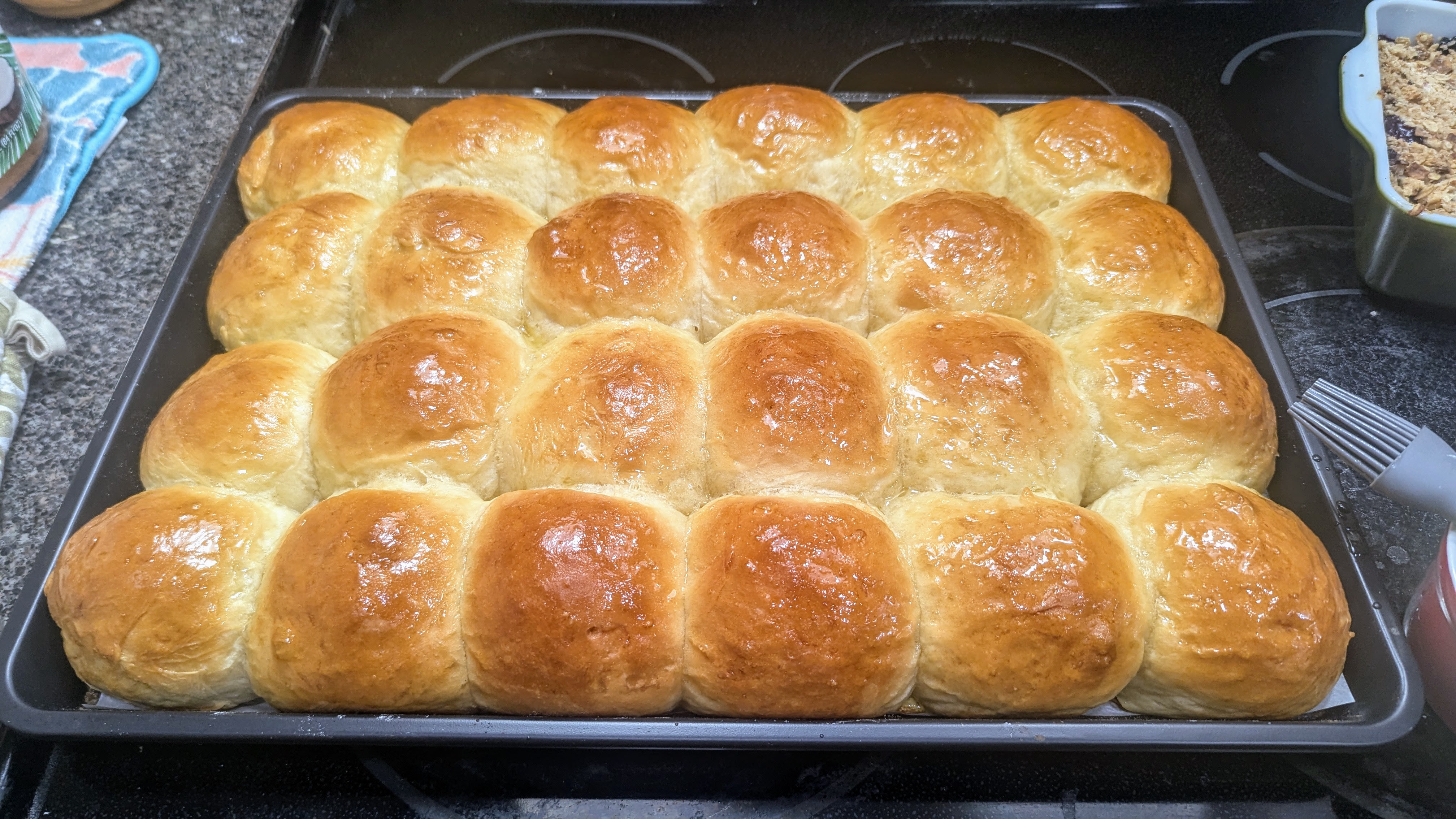
So what did I bake? I made two batches of ciabatta, one for us and one for the dinner party with our friends. For the Labor Day party, I baked two dozen Hawaiian rolls that went perfect with the BBQ short ribs we had. Both of those types of bread just required regular old yeast. For the ciabatta, I made an overnight biga preferment. Wow! Were they delicious.
And the Hawaiian rolls were the hit of the party! They didn’t last at all! They were rich with butter and soft and pillowy. I’m going to have to make more!
Anyway, the point to this is that if you want to bake on vacation and have the means to, go for it. But just remember this: It doesn’t have to be sourdough.
I’ve spent lots of time perfecting this recipe. Though I’ve been making these for several years, I’ve also been tweaking it to get the right results. My main goal with this bread has been to make it much like brioche with the butter and eggs, while retaining the island vibe; hence, the 50% pineapple juice.
Like brioche, this is a very wet dough even though the total liquid represents only 65%. But the eggs and butter up the hydration, and make it feel like an 85%+ hydration dough. It’s a little tricky to work with, but with good gluten development and handling technique, it’s not too difficult. We’ll discuss this more below.
Overall Formula
Flour
100.00%
Pineapple Juice – (canned, not from concentrate)
50.00%
Milk
15.00%
Egg
10.00%
Butter
20.00%
Yeast
1.00%
Salt
1.50%
Sugar
7.50%
Total Percentage
205.00%
Final Dough
Flour
709g
Pineapple Juice
355g
Milk
106g
Egg (1 large egg + 1 yolk, reserving the egg white)
71g
Softened Butter
142g
Yeast (Instant or Active Dry – 1 pack)
7g
Salt
11g
Sugar
53g
Total Yield
1454g 24 X 60g rolls
Preparation. There’s a bit of preparation that has to be done before you get into mixing.
First, measure out the pineapple juice into a microwave-safe container and nuke it for about 1 minute or heat on the stove to at least 180°F. This will eliminate the enzymes that would break down your gluten. Let it cool to 105°F. It’s ultra-important to use canned pineapple juice and not from concentrate that often has added sugar!
Warm the milk to around 95°-100°F, then mix the yeast into it to bloom the yeast. I do this with instant yeast as well to get it going as exposure to the high amount of sugar from the juice and granulated sugar will send it into osmotic shock. This won’t kill the yeast, but it will slow it down. So, I want the yeast to wake up first rather than slowing it from the get-go.
Finally, separate a yolk and from 1 egg, retaining the white to brush the rolls before baking. Beat the egg and extra yolk. You may exceed the required weight, so be mindful of using only the amount called for in the recipe.
Though you can certainly mix this by hand, I recommend using a stand mixer because of how sticky the dough will be.
Mix. Combine the flour, salt, and sugar in the mixing bowl. Mix these on low speed for at least 30 seconds. Add all the wet ingredients to the bowl, then mix with the paddle at low speed until all the ingredients are thoroughly combined. Scrape down the bowl, then continue to mix for at least another minute. Remove the paddle, scrape it down, and scrape down the bowl. Switch to the dough hook and start kneading at medium-low speed for 2 minutes. Increase the speed to medium and knead for 4-5 more minutes or until the dough begins looking smooth. Your dough temperature should be around 78°-85°F from the warm pineapple juice and milk (this is important).
Bulk fermentation – Part 1. Allow the dough to rise for 45 minutes (don’t worry, there won’t be much expansion), then turn it out onto a lightly floured surface. Using your bench knife, fold the dough twice in a North-South-East-West pattern, patting the dough down in between stretches. Finally, turn the dough over then shape into a round ball and return it to the bowl seam side down, covered. Wait another 45 minutes then fold the dough again.
Bulk fermentation – Part 2. Place the dough in your fridge until it has doubled in volume. This can be an hour or even more. But because the dough temperature is high, the yeast activity will keep on going, even though the dough is getting chilled.
Divide and shape. Turn the dough out onto your work surface, then measure out 60g pieces. With well-floured hands, roll the dough pieces into balls. Place the balls onto a full-size baking sheet lined with parchment paper, arranging them into six rows of four balls.
Final Fermentation. Cover the balls with damp paper towels (they won’t stick because of the butter) and let them proof and puff up for about 45 minutes or until they nearly double in size. It’s fine if they touch each other since they will all come together during baking anyway.
Bake. Before you pop the sheet into the oven, make a mixture with water and the reserved egg white, and brush the tops of the rolls. Bake at 350°F for 20-25 minutes or until the internal temperature of the bread is at least 195°F. Mine took 22 minutes.
Once they’re done, remove the sheet from the oven, brush the tops with melted butter, then cool them in the sheet for an hour before transferring them to wire rack. This will allow the butter to soak in and crumb to set up.
There are times when I want some bread and don’t have the patience nor time to make a loaf of sourdough. Today was one of those days. I had meetings solid in the morning, had a major architectural problem to solve, and though I knew that I wanted some bread for dinner this evening, I didn’t have the time to get a levain started; truth be told, I just didn’t want to fuss over a starter. It was a bit of a dilemma
So, to solve my dilemma, I turned to a yeasted same-day recipe that I’ve developed over the years. I got the inspiration for this loaf when I attended a retreat, and the chef had a huge mixing bowl filled with proofing dough. I asked her about her process and decided to develop my own same-day bread.
The challenge with making a loaf like this is that it can turn out to be insipid and with a crumb that dries out easily. But this bread has plenty of flavor due to the addition of a bit of honey and the use of T90 bread flour for a bit of whole grain and diastatic malt powder. The diastatic malt powder is optional. It provides a bit of flavor but more importantly, it will produce a soft crust and a moist but not gummy crumb. This is a perfect loaf for making sandwiches!
Formula
Flour
100.00%
Water
72.00%
Salt
2.00%
Yeast
1.00%
Diastatic Malt Powder
0.50%
Honey
3.00%
Final Dough
High-Gluten Bread Flour (I recommend using 12%+ protein content flour)
577g
T85/90 or Whole Wheat Flour
102g
Water (~95-100℉)
489g
Salt
14g
Yeast
7g
Diastatic Malt Powder
3g
Honey
20g
Total Yield
1 loaf X 1212g
Mix. Thoroughly combine all the dry ingredients together in one large bowl. Dissolve the honey in the water then add the water in batches to the dry ingredients until there are no dry ingredients in the bowl. Mix to a shaggy mass.
Bulk Fermentation. (about 1 1/2 to 2 hours) Do two sets of stretches and folds every half-hour in the first hour, then resting the ball on the seams. Make sure you stretch the dough to its extents during folding. You really want to develop the gluten network! After the final stretch and fold, allow the dough to expand in volume to almost double. With this amount of yeast, plus the addition of honey and malt, on a warm day like today (it’s 75º in my kitchen), a half-hour after the last fold was all I needed to complete bulk fermentation.
Pre-Shape/Bench Rest. Pour the dough out onto your work surface, then shape it into a boule, making sure the skin is nice and taut. Pop any large bubbles that form – there may be a lot! Cover it with a tea cloth then let it bench rest for twenty minutes.
Now would be a good time to preheat your oven and Dutch oven to 475℉
Shaping/Final Fermentation. ~45 min to an hour. Turn the dough over, then gently punch it down. Don’t be too rough! Shape it into a boule or a batard, then place it seam-side-up in a well-floured banneton, then place the banneton in the fridge for final fermentation. Do the poke test to make sure it’s ready. As with any bread, you want to make sure that final fermentation completes, less you get a fool’s crumb.
Bake. Bake at 475℉ for 20 minutes covered I also thrown in a couple of small chips of ice to add to the steam. Remove the lid and finish baking at 425℉ for 20 minutes.
Cool for at least an hour before slicing! Happy Baking!
Update 9/18/2024: I just made patty melts for my kids’ dinner this evening and they both said the bread was FIRE! My son made a huge sandwich with it earlier in the day. Looks like I will be making yet another loaf. 🙂
Notes
There’s an obsession in the home baking world with creating an ear. Having baked this loaf many times, this will not create an ear or make a small ear at best, even if you make a deep cut. There are a few reasons for this: 1) The crust is thin on this type of loaf; 2) The diastatic malt moistens the dough, making a soft crust; 3) Finally, the yeast action is so dramatic during baking that the loaf expands too fast for an ear to form.
You may be concerned about the loaf not having much flavor since both bulk and final fermentation add up to just over two hours. That’s the reason for using a bit of whole grain flour, honey, and diastatic malt. The addition of these ingredients provides subtle but important flavor enhancement.
As I mentioned above, this makes a perfect sandwich loaf! Looking at the picture, you’ll notice there aren’t any large holes. But there are many, many small holes. Squeezing the loaf after it cools feels like you’re squeezing a sponge; the crumb is exceptionally light and airy! And using high-gluten flour helps the loaf keep its structure during baking.
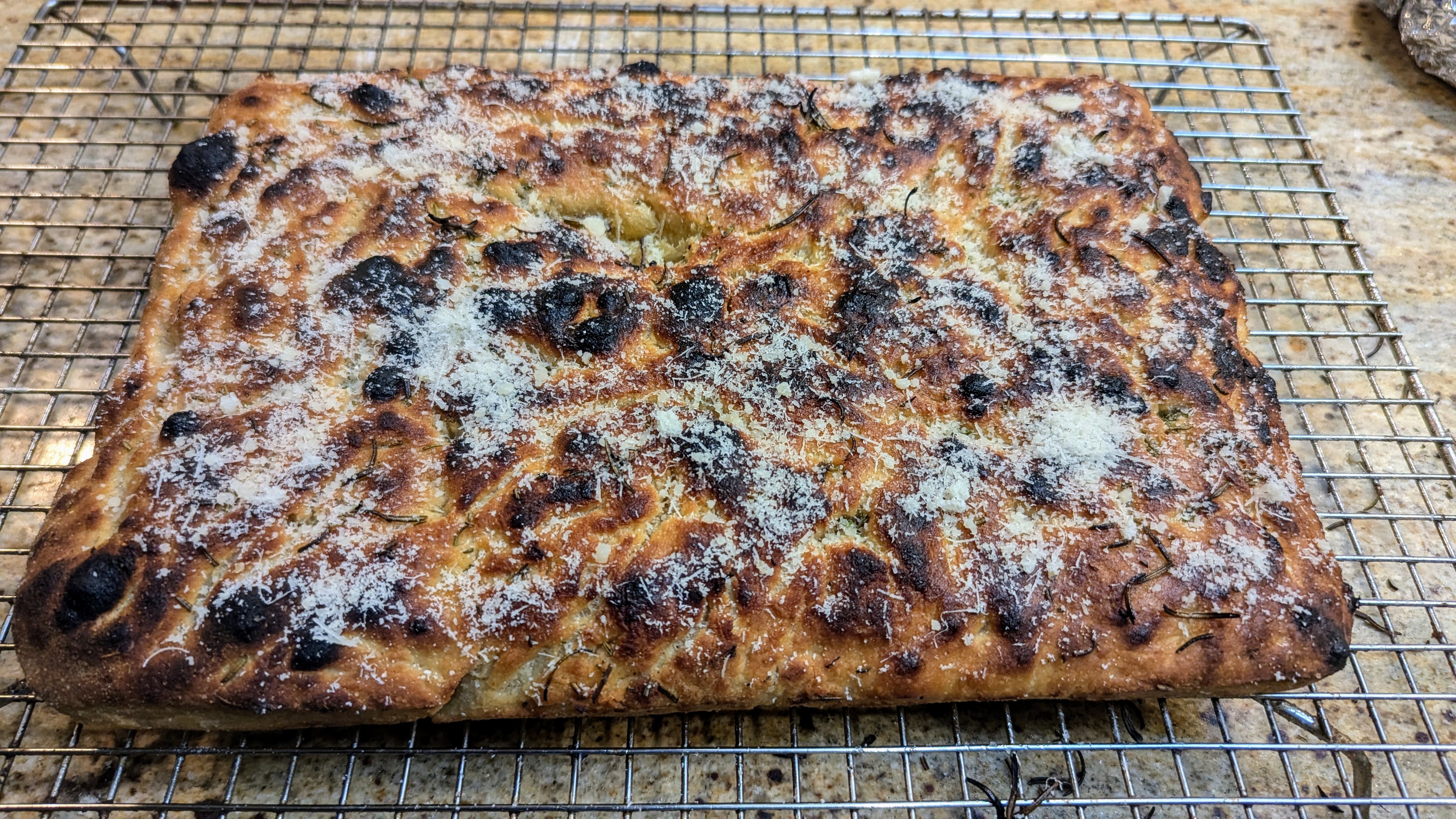
The very last piece of focaccia. It didn’t last an hour after I baked it!
Now that I’ve gotten into making wood-fired pizza, I’m back to making dough on a regular basis. And more importantly for me, I’ve revived my mother culture to create levain which I use for all my dough now. Yeah, I know… Yeast is typically used for Italian breads, but there is nothing like the texture and flavor of a dough risen with a sourdough culture.
In doing my research on focaccia, like other Italian breads, there are various kinds depending on the region. This recipe is a sourdough riff on Ligurian focaccia which tends to be a thicker, puffier kind as compared to a Genovese focaccia which is thin like flatbread. Also, even though I list honey as part of the formula, I didn’t include it in my final dough because I baked it in my wood-fired pizza oven. And even though it is baked in a pan, I didn’t want to risk the sugar burning. However, if you’re baking in a regular oven, by all means, include the honey! Either way, it’s still delicious.
And finally, I wanted to add a little complexity to the flavor profile by using whole grain, fine ground semolina flour. The results were spectacular!
Formula
AP Flour
70.00%
Finely Ground Semolina Flour
30.00%
Water
75.00%
Salt
1.50%
Yeast
1.10%
Olive Oil
6.25%
Honey
1.80%
Total %
185.65%
Final Dough
The final dough will fit in a standard 9″ X 13″ baking pan.
AP
248g
Semolina
129g
Water ~100℉-105℉
269g
Salt
6.46g
Olive Oil
27g
Honey
8g
Levain
108g
Total Yield
800g
Make the Levain. Make a 1:5:5 levain; that is, one part starter to five parts flour and water each. If you make the levain the night before, you can let it ferment overnight on the counter, then mix the dough in the morning. If you want to do a same-day bake, once you’ve mixed the levain, place it in the oven with the light on and maintain a temperature of 78℉-82℉. This will favor yeast activity over bacterial activity.
Mix. In a small bowl, measure out the levain you’ll need, then add all the water to it and dissolve the levain. Add the honey and whisk to dissolve. Add the olive oil to this mixture (don’t worry, it won’t mix). In a separate, large bowl, combine all the dry ingredients and mix thoroughly to ensure even distribution. Add the liquid mixture to the dry ingredients and mix to a shaggy mass, making sure there are no lumps or dry ingredients. Scrape down the sides, cover, then rest for 10 minutes.
Bulk Fermentation, Folding. 2 1/2 to 3 hours. Fold the dough every 30 minutes in the first hour and half of bulk fermentation. By the third fold, you should have achieved a nice windowpane. If you haven’t, then do one more fold. Allow the dough to rest until it has almost doubled in volume.
Final Fermentation. Punch down the dough, shape it into a rough rectangle in the shape of a 9″ X 13″ pan. Place into the pan, then use your fingers to spread out the dough and distribute it evenly in the pan. Let the dough rest for 20-30 minutes. After resting, sprinkle flaky salt on top and fresh rosemary all over the top. Sprinkle good extra virgin olive oil over the entire surface, then dimple the dough to let the oil pool in the dimples.
Bake. In a conventional oven, bake at 450℉ for 25 minutes or until the top becomes a nice chestnut brown. If baking in a wood-fired pizza oven, the focaccia will only take about 10 minutes. Don’t let it get too close to the flame to avoid burning and turn the pan every 30 seconds to achieve and even bake. Like a Neapolitan pizza crust, you should get charred spots.
Remove from the oven. Spray or sprinkle more olive oil on top, then lightly powder with freshly grated Parmesano Reggiano. Let it cool for at least 15 minutes. It’s best when it’s warm!
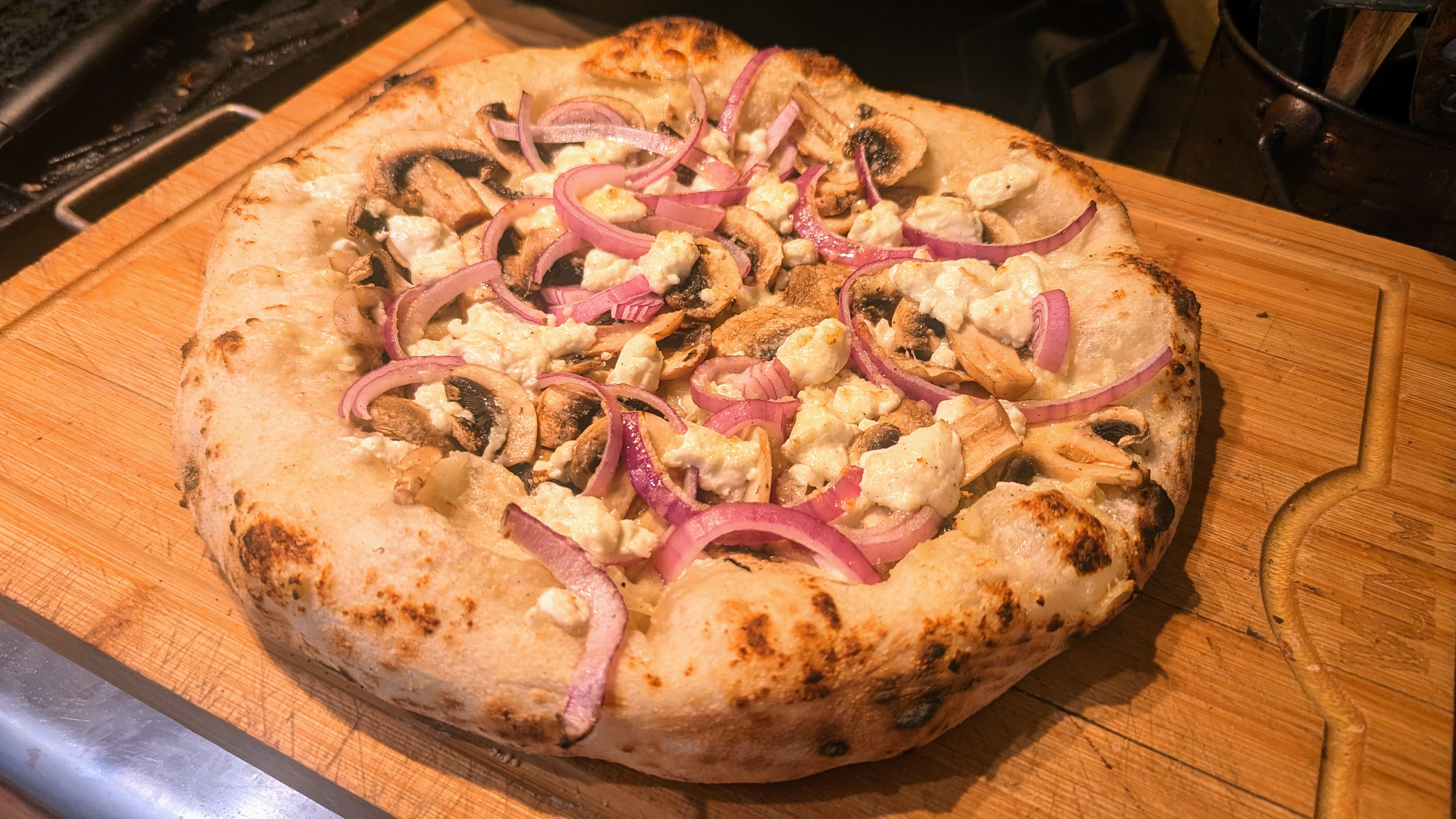
My son who lives in San Francisco was telling me the other day that a trend with pizza in the city – at least with the places he and his fiancé frequent – is crust made from sourdough. I took it as a tacit challenge. Plus, I hadn’t used my starter in months, so it gave me an excuse to wake it up. And now that I’ve done it, I’m going to go Mandalorian and say, “This is the way!”
I got an absolutely incredible oven spring from this dough. And the trick to that was building up a super-active levain, one that doubled in less than two hours. With the pie above, though I laid my toppings almost to the edge, it popped up so much that it pushed everything in! The result for both pies was crispy skin and chewy crumbs.
Baker’s Formula
Bread Flour
100.00%
Water
67.00%
Salt
2.00%
Total %
169.00%
Final Dough
Bread Flour
457g
Water (~100°F – 105°F)
280g
Salt
11g
Levain
161g
Total Yield
909g 2 X 450g 16″ dough balls
Make the levain. As I mentioned above, I built up lots of activity in my starter to where it peaked in less than two hours. This was a basic 1:1:1 levain using AP flour. Since I had to wake up my starter, it took me three days and a few feedings to get to this point. Technically, you don’t have to do this, but your levain should pass the float test, and not just pass it. It should float on the water like it’s Styrofoam.
Mix. When the levain is ready, dissolve it in the warm water until fully broken down. Add the flour and mix to a shaggy mass, making sure no dry bits or large lumps are left.
Fermento-lyse. Allow the mixture to rest for at least 30 minutes to hydrate the flour. Once that’s done, add the salt, and work it into the dough until you don’t feel any salt crystals.
Knead. You can knead by hand, but I just knead in my KitchenAid at speed 2 for 5-7 minutes to really develop the gluten.
Scale and Cold Ferment. Once you’re done kneading, scale out two 450g dough balls, then form them into tight balls. I shape them like I’m shaping mini boules. Place the balls in a well-oiled container. Then pop them in the fridge for at least 48 hours.
Final Fermentation. On baking day, remove the balls. They will probably have collapsed in the container. That’s fine. Reshape them into tight balls, then place them covered in a warm place to come to room temperature. This may take 2-3 hours depending on your ambient temperature.
Make pizza. There are so many different techniques out there, so I’ll leave it to you to find out how to shape and top your pies.
NOTE: If those dough balls are too large, you can easily half the recipe ingredients and make 225g balls that will make 10-12″ pizzas.
I finally got a pizza oven for my backyard kitchen, so of course I had to make some dough. I have been using a super-simple formula that works as a quick dough and for cold fermenting. It’s more along the veins of a Neopolitan-style dough, but I use King Arthur or Bob’s Red Mill bread flour as opposed to 00 flour since it’s more accessible.
Overall Formula
Flour
100.00%
Water
67.00%
Salt
2.00%
Yeast
1.50%
Total %
170.5%
Final Dough
For the final dough, I make two 450g balls.
Bread Flour (King Arthur or Bob’s Red Mill)
533g
Water
357g
Salt
11g
Yeast
8g
Total Yield
909g
Note that in my calculations, I add 1% extra for process loss
The process for this is simple.
Mix. In a large bowl, combine the flour, salt, and yeast until well-incorporated. Add the water, and mix thoroughly until no dry ingredients are apparent.
Knead. Knead the dough for 10 minutes by hand, or if you’re using a mixer like I do, run the mixer at medium-low (position 2 on a KitchenAid) for 5 minutes.
Alternatively, once you mix the dough, you can just put some plastic wrap over it and let it sit for 8-12 hours. But note that if you take the no-knead approach, if the weather is warm, I’d use half the yeast to keep the dough from over-proofing.
Bulk Fermentation (Quick Dough). Once the dough is kneaded, form it into a nice, tight ball and place it in a well-oiled bowl, seam side down. Cover with plastic wrap and allow the dough to double in volume. On a warm day, this can take less than an hour. Once it has doubled, divide it into two equal balls, and shape each like you would a boule.
Final Fermenation (Quick Dough).Transfer the balls to a parchement-lined sheet pan, cover with a tea cloth and let them rise for at least an hour. They should expand about 75%.
Bulk Fermentation (Cold Ferment). This is my preferred way. Once the dough is kneaded, immediately divide the dough into two equal pieces. Shape each into a tight boule and transfer them to a container that will give them room to expand. I use a couple of plastic ramen bowls. Cover the container(s) with plastic (I put my ramen bowls in a jumbo ziploc), then place them in the fridge for up to 72 hours.
The advantage of a long, cold ferment is that yeast activity is retarded, but bacterial activity isn’t. Organic acids are allowed to develop in the dough that will help with its extensibility but more importantly, add all sorts of flavor. The texture of the final cooked pizza crust also becomes airy and creamy.
The dough for this pizza sat in my fridge for 3 1/2 days! The flavor and texture were amazing!
Final Fermentation (Cold Ferment). Remove the balls from the fridge and place on a parchment-lined sheet. Cover with a damp tea cloth and allow them to come to room temperature. This can take a couple of hours. Technically, you can work with the dough right out of the fridge, but cold dough is incredibly difficult to work with and can easily tear.
Shape. Shape into pizza crust. The 450g balls will make 12″-14″ crusts. Here’s a great video on how to shape pizza dough:
While the word “focaccia” dates to the 14th century, the Romans baked panis focacius which was a flat bread baked in a hearth. In other words, this type of bread has been around quite a long time. It’s one of the simplest, most straightforward breads to make, and this version of it is super simple, only requiring mixing. No kneading, no folding.
Yesterday, I realized that I hadn’t baked any kind of bread for weeks because of my increasingly busy schedule of work. So, I resolved to remedy that and decided that I’d make some focaccia. I also realized that even though I’ve made it many times, I never posted a recipe here.
Don’t let the title of this bread make you think it’s something special or complicated to make. Focaccia al Rosmarino is simply focaccia topped with rosemary. Here’s the recipe:
Overall Formula
Flour
100.00%
Warm Water
88.00%
Salt
2.00%
Yeast
1.00%
Total %
191.00%
Final Dough
1/2 Bread / 1/2 AP Flour
529g
Water
465g
Salt
11g
Yeast
5.29g
Total Yield
1010g
Other Ingredients
Rosemary (fresh or dried, whole or chopped)
1 tbs
Butter
1 tbs
Olive Oil
~1/4 cup
Mix Dough. Mix all the dry ingredients together until fully combined. Gradually add water and mix dough until smooth. This is wet dough. If mixing by hand, I highly recommend using a Danish dough whisk if you have one. Otherwise, a stand mixer works great!
Bulk Fermentation. If you used a mixer to mix the dough, transfer the dough to a large glass bowl. At this point, you have two options: 1) Let the dough rise at room temperature until the dough ball doubles in volume or 2) Cover the bowl with plastic wrap and pop it into the fridge for 8-12 hours. Option 2) is better as that allows some organic acids to form to give the bread a slight twang.
Final Fermentation. Liberally grease a 9″ X 13″ glass baking pan with butter, then spray or spread olive oil on the bottom of the pan. Transfer the dough to the pan, placed roughly in the center. Transferring will degas the dough, but don’t worry, it will re-gas. Spray olive oil on the top of the dough. Cover with plastic or a tea towel and allow the dough to expand out to the edges of the pan, again doubling in volume. Once doubled, using your fingertips, dimple the dough to spread it out to the extents of the pan and to create little pockets on the top of the dough. Sprinkle rosemary all over the top, then liberally spray olive oil on the top as well. Allow the dough to relax for another hour.
Bake. Bake at 425℉ for 25 minutes (the top should be golden brown). Once baked, transfer the loaf to a cooling rack. Brush butter or olive oil on top then lightly sprinkle salt on the dough.
Knowing what to expect out of your dough is half the battle when it comes to artisan bread baking. And the only way you can get to the point where you can expect to achieve certain results takes time, practice, and incredible amounts of patience.
The artisan bread baking world is filled with lots of publications, both print and electronic. Of course, included with those are pictures of perfect loaves of bread with amazing crumbs and blistered crusts. There really is a lot of great bread out there made by incredibly talented and skilled bakers!
Sadly, though the pictures in the publications are beautiful and set a general aesthetic for prospective bakers to achieve, they don’t really tell the whole story and oftentimes end up building unrealistic expectations in the readers. Look at all the craze behind achieving an open crumb! You can blame Tartine Bread books for this! 🙂
The picture of the bread above was taken from the book, “Tartine No. 3” by Chad Robertson and is a picture of his White-Wheat Blend loaf. The flour blend for that loaf is: 50% high-extraction, 25% whole wheat, 25% white whole wheat flour. That crumb is gorgeous! And it’s a fitting example of presenting something in such a way that it sets expectations on how a slice from an ideal loaf of bread should look.
Unfortunately, most people wouldn’t even question the picture and would take it at face value that the whole loaf was like this partial slice. But if my experience with baking with flour blends that include a high ratio of whole grain flour has taught me anything, there are certain things I’ve come to know and expect. And though I won’t go as far as saying the picture’s misleading, I will say that it doesn’t really tell the whole story.
First, notice how the photographer only took a picture of the end of the slice and from the butt-end of the loaf. Especially with flour blends that have a high amount of whole grain and high-extraction flour, you don’t get as open a crumb as you move towards the middle of the loaf. The loaf is the heaviest there, so void formation is much lower in that area, even if you build good dough strength. But the sides will present a much more open structure; hence, the picture of the end of the slice.
Also, notice the shape of the slice above. Based on its widest point, that loaf didn’t get much vertical rise, which is consistent with whole-grain flour blends with super high hydration. That White-Wheat recipe has a hydration of 85%+! People might think that with the open crumb that’s shown in the picture that the loaf must be getting some incredible vertical rise. But it’s not. I immediately asked: Where’s the cross-section of an entire loaf?
Even Chad Robertson said in Jon Favreau’s Chef Show that the crumb pictures in his books are of the aspirational crumbs when Jon made mention of the open crumb. So, Chad knows exactly what’s going on! 🙂 Mind you, I’m not trying to rip on Tartine at all. Rather, I’m elucidating the inconsistencies between what gets shown to the world and – for lack of a better world – reality.
Whether published in hard copy or digitally, most pictures are expressions of the publisher putting their best foot forward. We look at these pictures and say, “Damn! I want to do that!” Then we follow the author’s instructions, create some dough, process then bake it, then once it has cooled, we cut it open, see the crumb, and exclaim, “Where the f$%k is the open crumb? I followed the instructions to a ‘T!'”
For example, with the crumb shot of the loaves directly above, I wanted to demonstrate the difference in crumb openness from the butt-end of the loaf and what it looks like in the center of the loaf. As you can see, the butt-end slice is super-open while the middle is moderately open. Though I know that some will marvel at the super-open crumb of the slice, it was not something I desired as I prefer a much more consistent, moderately open crumb like the middle of the loaf. But I wasn’t mindful of my dough temp during bulk fermentation, and it was WAY too high at 85℉. I had to cut bulk fermentation short because the yeast was going crazy! So I expected the result.
If you are after a certain aesthetic in your bread, like an open crumb, you must bake enough with your ingredients and under your conditions to understand how it all works together. It’s repetition that gives you that sense of what to expect. Put simply, the only thing you can expect is to set your own expectations based on YOUR set of ingredients and baking environment. And you can only achieve a level of expectation with reps – plain and simple.
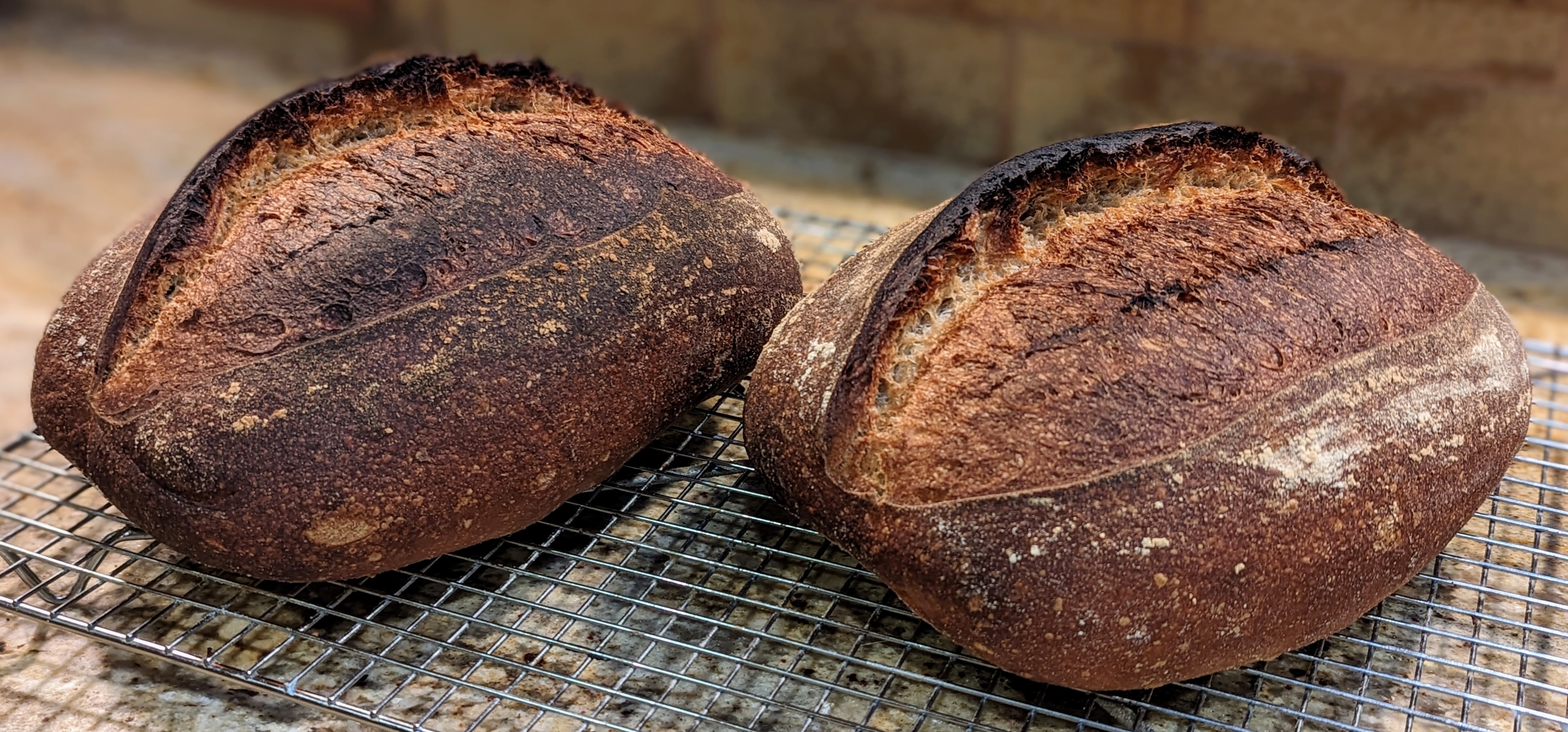
As another example, I made the loaves below a couple of days ago:
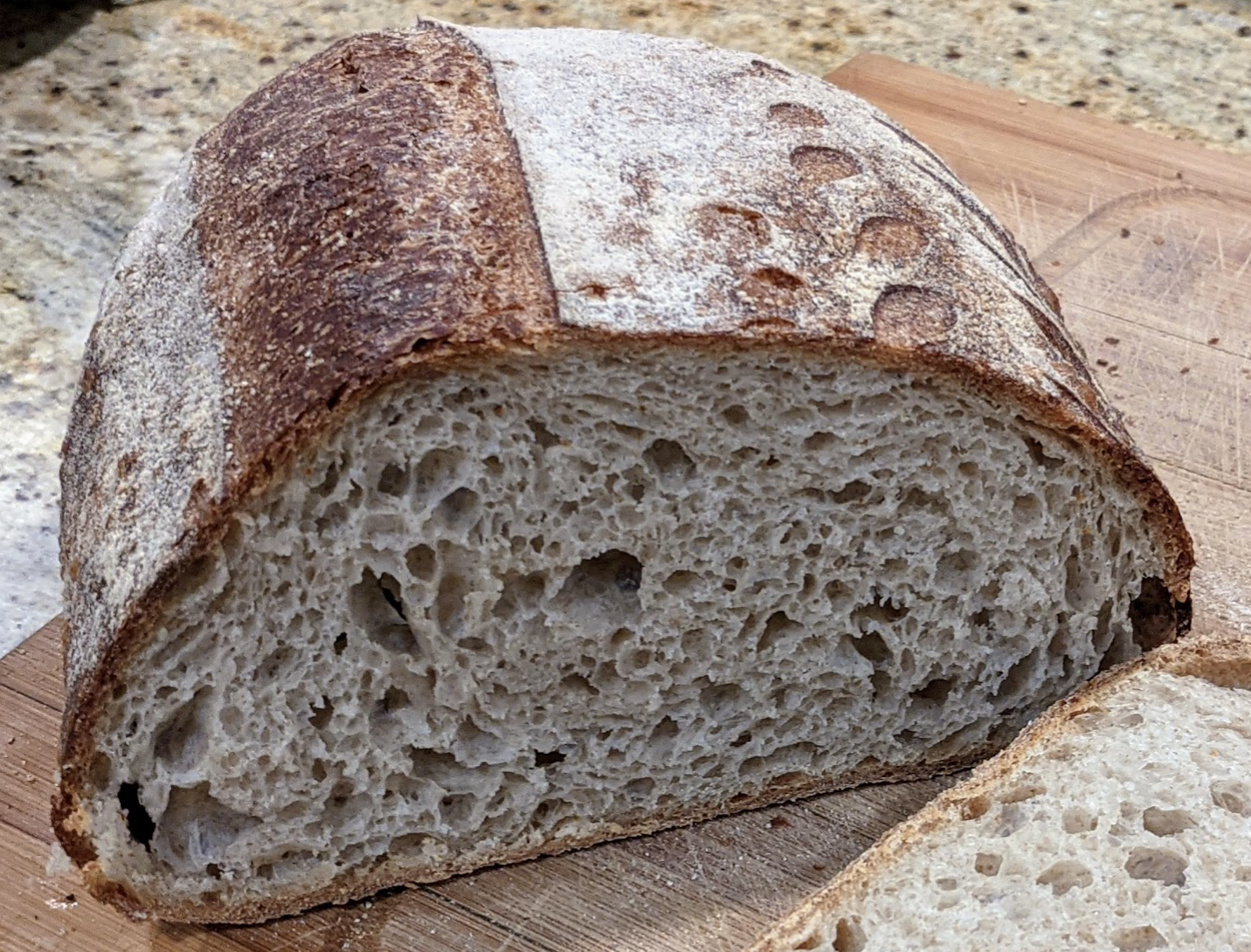
I used a flour blend like the Tartine No. 3 White-Wheat Blend recipe, though I used 50% high-extraction, 25% whole wheat, and 25% whole-grain dark rye. My overall hydration for the loaves was about 87%. As you can see from the pictures, I got a great oven spring, but not much vertical rise. Consistent with what I discussed above, the centers of the loaves weren’t as open, while the sides presented a nice, open structure. I expect to get results like this every time, and I do unless I mess something up along the way, which is rare. But mind you, I’ve only been able to achieve this by doing it – a lot!
The loaves had a nice, long nap in my retarding fridge of about 20 hours, but it took several hours for dough to come down to a temperature that would slow down yeast activity; thus, that super-open crumb because the yeast was still active. Based on experience, I implicitly knew this was going to happen.
And hey! As an aside, I can do the same thing as Tartine! The picture to the right is of a similar loaf I baked a while ago. It was 88% hydration and used a combination of high-extraction and Kamut flour. Look at that open crumb! But truth be told, the middle wasn’t as open as the sides and the rise wasn’t as vertical as a loaf baked with regular flour. In fact, the crumb was more consistent with the loaves above.
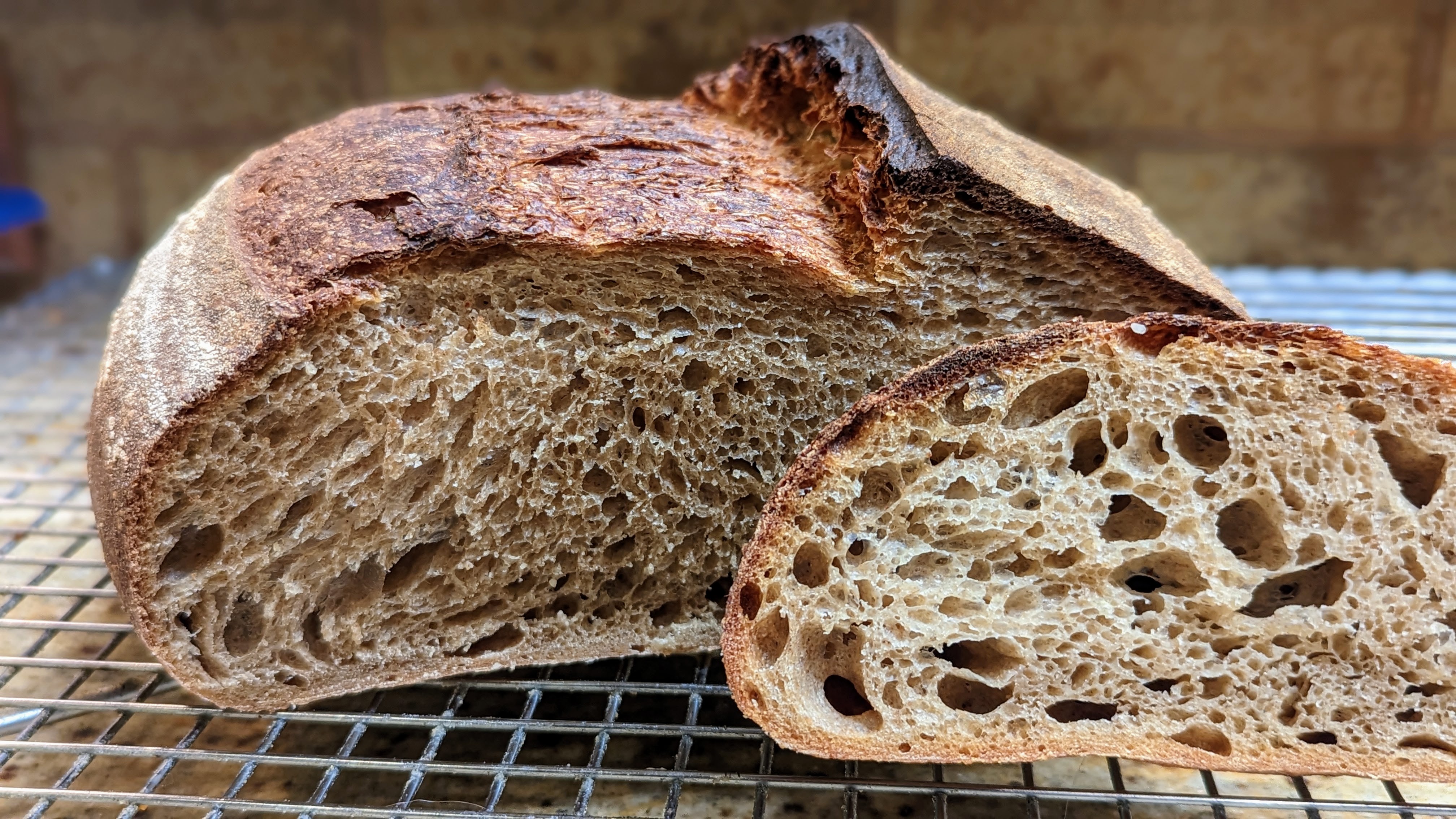
Speaking of using regular flour, look at the loaf below. That was made with 25% high-extraction and 75% unbleached white flour. Hydration was about 80% for that loaf. But notice how much more even the crumb structure is in the picture. It’s a real contrast to the crumb of a loaf that contains much more whole-grain flour. Moreover, look at the vertical rise. Because there’s not as much bran in the flour to cut the gluten strands, that loaf popped right up!
I realize that it might look as if I’m just showing off the bread that I bake. I’m proud of them for sure, but those results aren’t novel for me. I’ve baked these loaves many, many times, and over time I’ve developed both technique and familiarity with my ingredients that baking these has become SOP.








 The Dawg House!