Unknown's avatar

About GoofyDawg

Brendan "GoofyDawg" Delumpa is just a regular guy who has five passions in life: Guitar, Bread, Golf, Wine, and Whiskey. These are passions outside my work life as a technology executive.

Don’t Throw Out Your Old Cheese! Make Fromage Fort!

In addition to having a love for bread, I absolutely LOVE cheese. I usually have four or five varieties of cheese in my fridge. Unfortunately, I seem to be the only one in my family that eats as much cheese as I do, and I can’t eat it all, and thus, it gets old. It used to be that I would just throw out my old cheese, but in the early days of the pandemic lockdown, I learned to make an incredible cheese spread from the venerable chef, Jacques Pepin, called fromage fort or “strong cheese.”

Basically, fromage fort is a mixture of different cheeses that is combined with a little white wine and a little garlic, and optionally, you can add spices if you like. I spike mine with coarse black pepper and hot chili pepper powder to give the spread a little heat kick. It is SO easy to make! Here’s a quick recipe (scale it up as necessary):

Fromage Fort

1/2 lb leftover cheese
1-2 cloves garlic (peeled and crushed)
1/4 cup white wine
1 tsp coarse black pepper
Salt to taste*

*Cheese is salted, so you shouldn’t need it, but add some if you don’t think it’s salty enough.

Cube up the cheese, then add all ingredients to a food processor with the blade attachment installed. Mix for 30 seconds or so until the mixture is smooth. Add white wine in small amounts to get the texture to a really thick batter. Once it’s done, pack the mixture into small jars or containers (I like to use 4-6 oz jars).

All that said, it’s all about taste. I tend to like a lot more garlic in mine. And with the batch I made this morning, part of which is in the picture above, I used a combination of marsala and chardonnay. And because I wanted a bit of heat, I added some hot-hot South Indian chili pepper powder. At least in my mind, there aren’t any rules with fromage fort. Besides, every time I make it, it’s different because I use different cheeses

How Do You Use Fromage Fort?

Lots of different ways! The more common thing is to spread it on slices of bread and crackers. But you can spread it on bread and broil it, and even make grilled cheese sandwiches with it (though I also add a slice of cheese to make it really gooey). I also add it to cream-based sauces to give my sauces a little cheesy edge.

Another thing I love to do with it is to make Croque Monsieur, which is basically the French version of a grilled ham and cheese sandwich. I spread the fromage fort on a large slice of bread, place a slice of ham on top of that, then put a slice of Swiss cheese on top of the ham, and top it with a slice of tomato. I bake this in a 400-degree oven for 10 minutes. Wow!

Trust Your Dough: Part III of Working with High-hydration Dough

As I’ve been sharing in the past few posts, I’ve been experimenting with super-high hydration dough to test the limits of my flour blend. It has been a real learning experience. One big thing is that really wet dough doesn’t respond like lower hydration dough. Whereas a lower hydration dough will come together and it’s easy to create a nice gluten network pretty much immediately, it’s not so with dough above the 85% hydration level. In fact, right after mixing, the dough is somewhat of a gloppy mess. It looks like pancake batter and even feels like it.

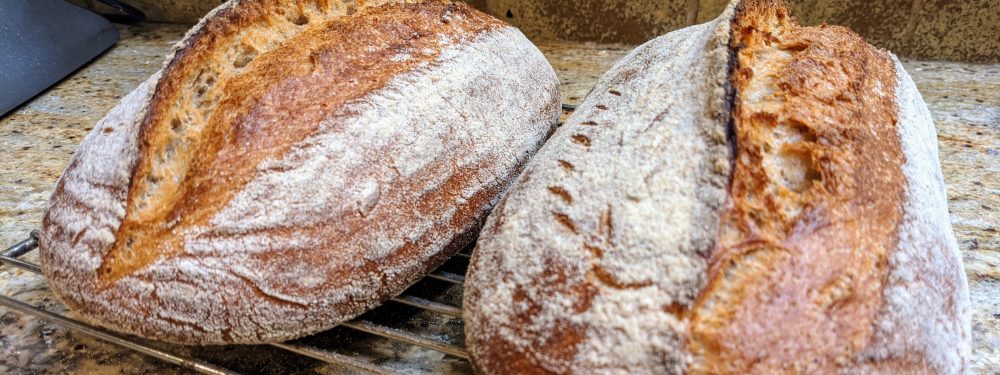
For instance, the loaf shown in the picture above was about 90% hydration. I was admittedly a little skeptical about the dough when I first mixed it. And after it had fully fermented, I didn’t even know if it would even shape! But I knew that the gluten strands were forming as I folded the dough. I could feel it. And damn if it didn’t spring up in the oven! VERY COOL!

Yesterday, I decided to push it even further and made a 95% dough out of the same flour blend. Because it was so wet, I decided to do the initial mix in my mixer. I’m so glad I did because after I got all the ingredients incorporated, the dough looked even more like pancake batter! Over the course of six folds over a 3-hour period, I definitely could feel the gluten forming as I folded.

But I have to be honest. Even though I could feel the gluten developing, the dough was still like a super-thick batter. When it came time to preshape and shape the dough, it was incredibly difficult to shape, and the resulting loaves were, let’s say, a little on the flat side. I got oven spring alright, but it was way more out than up. So I think exceeded the hydration limit with that particular flour blend.

But in spite of the difficulty in working with such a wet dough, I resisted the urge to tweak, though I could tell I probably wouldn’t get the most ideal results. And even though I’m fairly experienced as a baker, I had to see it through. I won’t lie. There were a couple of times while I was folding – if you could call it that – where I was tempted to add a bit more flour to the mix. But this was an experiment to test the hydration limits of that flour blend, so I let it go.

But despite the relative flatness of the loaves, I wouldn’t call the experiment a total disaster. The loaves rose up, which meant I could expect a reasonably open crumb, which I got. And quite frankly, the taste of the bread was magnificent. I used whole wheat levain this time around and this particular flour was packed with lactobacillus bacteria, giving the bread a gorgeous tang.

That “tang” means acid, and acid breaks down gluten, which may have been a contributor to the lack of gluten strength. So it’s one thing to consider for future bakes. I will either have to add vital wheat gluten to make sure there’s extra protein and perhaps still drop the hydration level just a smidgen.

As I think about this experiment, I look at all the time I’ve spent learning these past couple of years and it makes me smile. For me at least, the beauty of baking isn’t in the end product. The beauty is in the process and understanding all the variables that go into producing a loaf of bread. Though I’ve experienced failures or setbacks, they’ve all served to teach or reveal to me some subtle nuance. It’s like peeling back the layers of an onion.

Happy baking!

Easy-Peasy Zatar-Flavored Yeast Loaf

I was at a retreat this past weekend and on Saturday afternoon, I happened to pass by the cafeteria kitchen to see a big 20-quart mixing bowl almost spilling over with proofing dough! It smelled absolutely wonderful! I was drawn to the bowl and chatted it up with one of the cooks, sharing with her that baking bread is one of my life’s passions. I never got the chance to speak with the head cook, but I’m going to be contacting them to see if I could volunteer in the kitchen to bake bread for retreat attendees in the future. So cool!

In any case, the loaves they produced were straight-forward yeasted loaves, probably about 1.5 kilo each. And though they didn’t have an open crumb, the crumb was still nice and airy. Much like a quickly risen, yeasted loaf. And that got me thinking: Sometimes it’s just nice to make an uncomplicated yeasted loaf. It’s so easy to get caught up in sourdough this and sourdough that that I miss the real point of making bread and that is to feed people! So, inspired by those simple loaves, I resolved to bake a loaf like that for my family when I got home.

But instead of making a simple loaf, I thought I’d give it a little pizzazz and add a bit of that wonderful Middle Eastern herb mixture, zatar. I only added just enough to add a real subtle flavor, but just that little bit has a HUGE impact on the taste. Let’s get to the recipe!

Overall Formula

First I started out with my basic baguette formula, but instead of my normal 0.38% yeast, I went to 1% yeast…

Flour100.00%
Water75.00%
Salt2.00%
Yeast1.00%
Total %178.00%

Final Dough

Flour851g
Water638g
Salt17g
Yeast9g
Zatar*1-2g
It doesn’t take much…
Yield1 X 1500g loaf
*I didn’t factor the Zatar into the overal formula because I just measured out a couple of grams (honestly 2 teaspoons) of the mixture and added it to the flour. As for the yield, if you add everything up, it’ll come to 1516g, but I always add a fudge factor to account for loss during processing.

To be completely transparent, I actually used three flours for my dough in this recipe: 50% High-extraction bread flour, 30% Kamut flour, and 20% AP Flour. They were measured as follows:

High-extraction bread flour426g
Kamut flour255g
AP flour170g

Mix. Combine all the dry ingredients and mix well. Add the water and mix thoroughly until there are no dry ingredients left. Work the dough until it starts forming a smooth consistency. If you’re using a mixer (that’s what I did), mix until the dough become smooth and starts climbing up the hook (about 3 minutes at medium-low speed). If you’re mixing by hand, knead the dough in the bowl until smooth and it starts coming off the sides of the bowl (about 5-7 minutes).

Bulk Fermentation. About 1 1/2 hr.

Fold. The dough only needs to be folded once after 1/2 hour. After that, let it rise in the container until nearly doubled in size.

Preshape. After the dough has finished bulk fermentation, transfer it to an unfloured work surface and work it into a round. Allow it to bench rest for 15-20 minutes or until it has relaxed.

Shape. This is a really versatile dough, so you shape it into a round or an oval or even a long loaf. For my loaf, I did a standard batard shape, but rolled it out a little to form a longish loaf that I let rise in a 14″ banneton.

Final Fermentation. 30-45 minutes. By this time, the yeast will be really active and if it’s warm, final fermentation will happen quickly. So watch it! Use the standard poke test to determine the springiness of the dough. Your indentation should pop back a bit after poking the dough, but never fully come back.

Bake. Bake for 45 minutes at 450°F (no fan, please). During the first 15 minutes use steam to help the loaf rise. It will really spring up with this much yeast!

It’s Lent. Time for Bread Bowls on Fridays!

I’m a cradle Catholic and though I don’t consider myself to be particularly devout, I still do my best to observe the traditions on which I grew up. One of those traditions is not eating meat or poultry on Fridays during the season of Lent. For my family, that has meant eating soup. Normally, we go to our church as they have Friday soup days, but this Lent, we’ve been staying in and either preparing our own soup (which actually means me doing the cooking), or we buy freshly prepared soup from our local Safeway (the tomato bisque is the BOMB!).

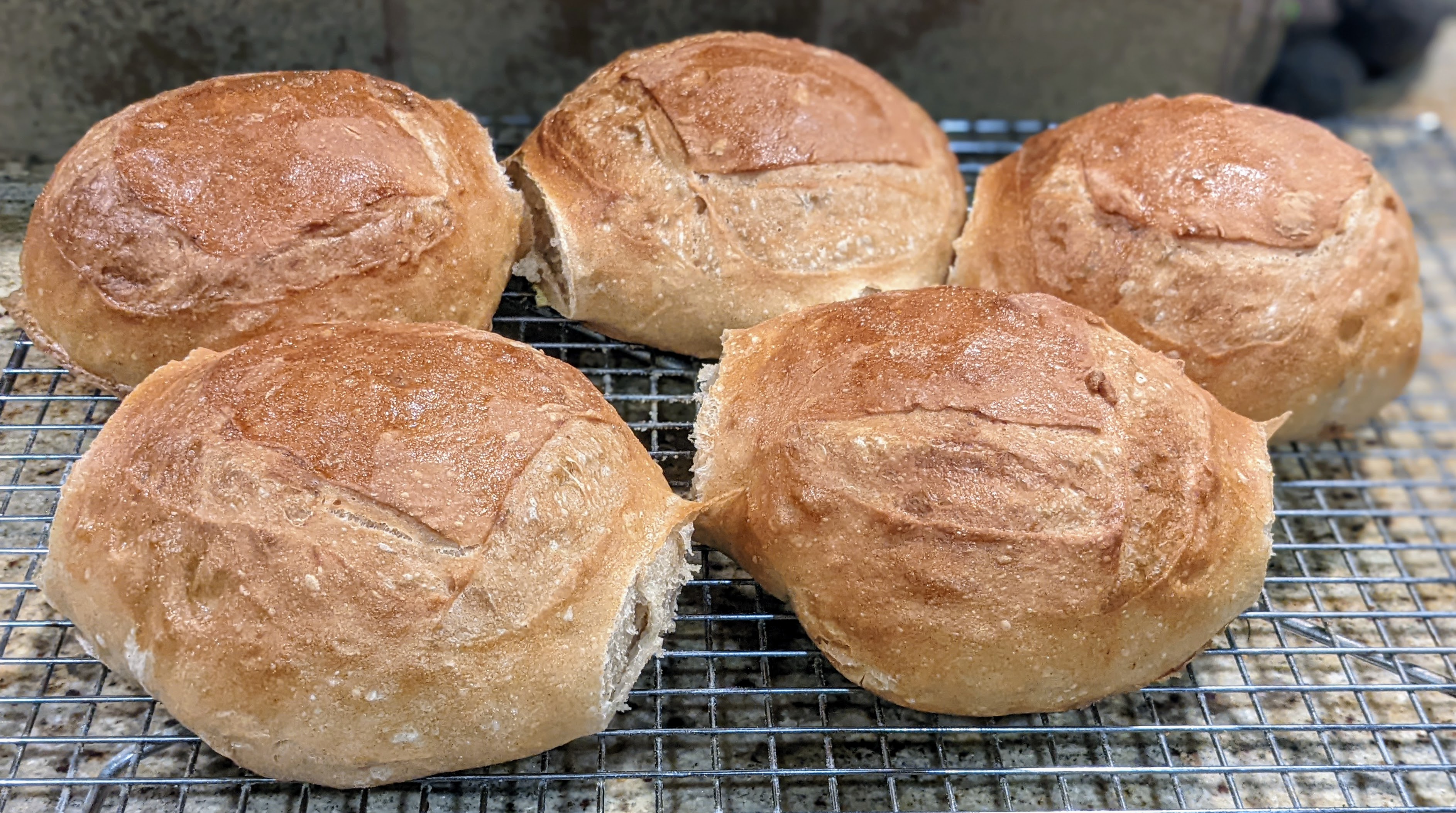
Last week, I made a batch of clam chowder. When my son came home from lacrosse practice he asked me what was for dinner, and I said, “Clam chowder.” He immediately asked, “In a bread bowl?” When I gave him a negatory, I could see his heart sink. I think he figured since Dad was a baker, I’d naturally make bread bowls. So… lesson learned, and this week, though I bought the soup, I decided to make bread bowls to make up for not having them last week.

These are not sourdough bread bowls. I could easily do those, but it being a fairly full-scheduled week, I didn’t have the time to get a levain going. So I decided to keep it simple and make a straight dough and make little boules from that. Now, not wanting to fuss with a recipe, the best I could come up with was a riff on my standard baguette recipe, but use a good amount of yeast. I also wanted to make the bread in less than three hours, so using plenty of yeast would get me there. Yeah, it’s a quick bread, but I wasn’t too concerned about making a particularly flavorful bread because it would get all its flavor from the soup.

Ahhhhh! The smell of yeasty bread! As much as I love sourdough, there’s nothing quite like a nice yeasty bread. It’s pretty amazing. Here’s the recipe!

Overall Formula

Flour100.00%
Water75.00%
Salt2.00%
Yeast1.50%
Total %178.50%

Flour Blend

AP Flour (King Arthur)60.00%
High-extraction Bread Flour (Azure Standard)40.00%

For flour, a specific brand isn’t that important. But for bread flour, I’d recommend using a fairly strong flour that has more than 12% protein content as this dough is pretty high in hydration at 75%.

Final Dough

AP Flour458g
High-extraction Bread Flour306g
Water ~90°-95°F573g
Salt15g
Yeast11g
Total Yield1364g
6 X 225g loaves

Mix. Sift the flour into a large bowl. Add all the salt and yeast, then mix all the dry ingredients until everything is evenly distributed. Make a crater in the middle of the dry ingredients, then pour all the water into the bowl. Using a Danish dough whisk or your hand, using a circular motion in the water, work the flour and water together, grabbing a little flour off the sides as you make circles. This is a lot like mixing pasta dough by hand. Once you’ve pulled all the flour off the sides of the bowl, use a rounded bowl scraper to scrape under the dough and turn the dry ingredients at the bottom into the dough mass. Once there are no dry ingredients left, cover your bowl with a cloth and place it in a warm place to rise.

Bulk Fermentation. 1.5 – 2 hours.

Fold. This dough only requires a single stretch and fold session after 45 minutes. There’s so much yeast, that after the first 45 minutes, the dough will be close to doubled. Using gentle motions, stretch and fold the dough until the entire mass lifts off the bottom of the bowl. Your dough will have developed all the strength it needs. After that, cover the bowl again with a towel, then let it sit in a warm place for another 45 minutes or until the mass is close to double in size.

Before dividing, preheat your oven to 475°F.

Divide and Preshape. Pour out the dough onto an unfloured work surface. Scale-out 225g pieces, then using your scraper, shape the pieces into rounds. No need to create a super-taut skin. Once preshaped, let the loaves bench rest uncovered for 15 minutes. The dough will spread out, but will still be nicely domed on top.

Shape. Lightly sprinkle the tops of the pieces with dusting flour (I use a 50/50 rice/AP flour mixture). Turn each piece onto the floured side then shape it into a boule. With dough at this hydration, I prefer to use a stitching technique similar to the Tartine shaping method to create a good internal structure, then use my bench scraper to form it into a round, making sure to tuck all the seams from stitching under the round.

Final Fermentation. Line a large baking sheet with parchment paper, then evenly space the rounds on the baking sheet. Once placed, you can optionally dust the tops with dusting flour, then cover the rounds with a towel and let rise for 30-45 minutes. But poke test after 30 minutes! Because it was warm in my kitchen today, I was bake-ready in just less than 30 minutes!

Bake. Bake with steam for 12 minutes at 475°F. After 12 minutes, remove the steaming container, then turn down your oven to 425°F. Bake for another 15-20 minutes until the loaves are nice, golden-brown.

Serve. Let the loaves cool for 15-20 minutes (they’ll still be nice and warm), then take a loaf and cut a large circle on the top. Using either a spoon or your fingers, gently hollow out the loaf. Fill it with your soup!

An “Easy” Dough Calculator

Here’s the link to the spreadsheet. You can’t edit it, but you can copy it to your own Google Sheets.

Several people have requested edit access to the spreadsheet. I will not give that level of access and requests will be ignored (sorry). As I stated immediately above, please copy the entire spreadsheet, then paste it into your own Google sheet. Thanks!

Being a software engineer by trade, I have a penchant for using technology to aid in automating manual tasks and baking is no exception. One thing I did early on was to create spreadsheets for calculating ingredient amounts based on my desired yield and a baker’s formula. I actually created a bunch over time, but there’s one dough calculator I created in particular that I seem to use the most. It’s displayed a the top. If you’re interested, click on the link above and copy it!

The calculator is split into 5 major sections:

  1. Loaf Calculation
  2. Formula
  3. Preferment
  4. Flour Blend
  5. Final Dough

One of the reasons I started building my dough calculators was that I wanted to bake bread to a certain, specific yield like 4 loaves at 335g apiece, then calculate the ingredients I’d need based on the target yield and the baker’s formula. This is in contrast to recipes you’d normally find in books and online where the ingredients are listed out and you have no idea about the yield other than, “Divide the dough into two equal pieces.”

That has always rubbed the more exacting side of my personality the wrong way. And especially when I started baking at higher volumes, I needed to know how much I was going to bake first. Then I’d figure out ingredient amounts based on that. Thus, I started creating dough calculators.

I use this calculator when I’m experimenting with different flour blends or different kinds of preferments. It takes all the guesswork out of figuring out what I need. Note that it is specifically meant for basic loaves that have no inclusions. This accounts for about 95% of what I bake such as sourdough boules and batards and baguettes.

Let’s step through the various sections:

The first two sections of the spreadsheet deal with the yield I’m after and the base baker’s formula. Just these two elements can drive all the ingredient amount calculations as the total flour can be obtained by simply dividing the target dough weight by the Total %. The Process Loss % field is a fudge factor for the total yield. There will always be some dough weight loss in processing, so adding a 1% or 2% fudge factor ensures that you can create all the loaves based on the dough weight.

Note that Yeast is included as an entry. If you’re making naturally leavened bread, this should be set to “0.”

The next section deals specifically with the preferment. You will provide the percentage of the total flour you’d like your starter to be, then set the hydration of your starter. A typical liquid starter is 100% hydration. A biga, on the other hand, will be around 75% to 80% hydration. Once you enter those things, the flour and water you’ll need to produce the starter, along with mature starter OR yeast will be calculated. Note that these calculations will produce more starter than you actually need for the recipe, but this is something that should be done anyway to account for process loss or starter sticking to the container.

The starter amount is meant to create a 1:5 ratio starter, the starter weight being 20% of the combined weight of the flour and water. But note that this is merely a guideline. If you’d rather do a 1:3:3 or whatever, that’s entirely up to you. You’ll just have to provide the amount of starter required in the ingredients list.

If you’re creating a poolish, the yeast you’d use is listed. I personally base the amount of instant yeast I’ll use for a poolish to 0.3%. You can change this in the cell formula if you use a different amount.

The last two sections of the calculator deal with the flour blend and the ingredients which really go hand-in-hand. This provides an easy way to figure out how much of a particular flour you want contributing the flour blend as a function of percentage. The grey line labeled “Preferment” is the percentage of the total flour that is already spoken for by the preferment. All the numbers should add up to 100%. The cell will be colored red if there is any variance.

Finally, we have the Final Dough ingredient list and the amounts required. The flour blend amounts are provided. The Total Yield is provided as an accounting measure to ensure everything adds up to what we expect. Though not shown, Total Flour and Total Water are displayed below the ingredient list and yet another check.

I invite you to copy the calculator. It has proven an invaluable tool for me!

How the Calculations Work

The First Rule of 90%+ Hydration Dough: Don’t Mess With It! Part II of Working with Extreme Hydration

In “Tartine-Style 50% Whole Grain Sourdough: Experimenting with Extreme Hydration, First Stop 85%,” my goal was to push the limit of the flour I use to see just how far I could take it. I postulated that 85% hydration was the outer limit for my flour, but to be completely honest, I was wrong. The loaf shown in the pictures above was hydrated to just over 90% hydration. The flour blend I used was 10% Whole Wheat (from the starter), 54% Bread Flour (Bob’s Red Mill), 36% Whole-grain Kamut Flour.

I was amazed at how the loaf maintained its structure enough to get a really great oven spring! I was a little unsure when I poured the dough out onto my loading board. It really spread out. But the important thing I noted was that despite the dough spreading out, it was still domed which meant that there was a structure to the dough. And rise up it did!

I’m going to keep pushing to find the outer limit of the hydration my flour can take, but one thing that has occurred to me in my high-hydration experiments is that the success I’ve been experiencing with the loaves I’m producing probably has a lot more to do with my technique than the flour itself. And that brings me to the crux of this post.

An important thing I’ve learned working with super-high hydration dough is to only manipulate it to accomplish what I need for a particular step and after that, leave it alone! When I’m stretching and folding the dough, I only do it enough to where I can feel the tension in the dough. And I also have learned to stretch the dough a lot slower than I normally stretch a less hydrated dough lest I degas it too much. Oh I stretch it as far it will stretch, but I don’t tug on it hard – just a slow and smooth motion.

With this batch of bread (I actually baked a few loaves with this batch of dough), I didn’t stretch and fold the Tartine method of six folds over three hours. I felt enough strength had built up after three folds. So I let the dough sit for 3 hours until it was almost doubled (my starter was a little sluggish that day).

When preshaping, I only preshape until the skin has been pulled a little taut and smooth. I don’t try to develop tight skin on the ball. And then I let it rest until it has relaxed. Depending on the weather, this could be 30 minutes or it could take an hour for the dough to relax.

With shaping, I use a stitching technique I learned from watching several videos of Chad Robertson shaping his bread at Tartine. Though it isn’t Chad Robertson, this video demonstrates the technique really well. It’s a gentle technique that creates structure but doesn’t degas the dough much and uses gravity and the natural tackiness of the dough to seal the bottom seam. Another way to get a great look at the technique is to watch John Favreau’s “The Chef Show” when he visits Chad Robertson’s Manufactory in Los Angeles.

Then finally, a long, 12-24 hour rest in the fridge for final fermentation will allow the flavors to develop and dough to perform its expanse.

Again, I want to stress that I only touched the dough when I absolutely needed to. The dough is so wet and delicate that I didn’t want to pop too many bubbles. Messing with the dough too much would undo all the hard work the yeast had done to create those wonderful gas-filled pockets!

Calculating Dough Yield – You Have to Work BACKWARDS!

I’ve touched upon this before that I’ve always had issues with recipes because they always list out the ingredients like 1000g of flour, then say, “Divide the dough into two equal pieces.” I suppose that’s fine if you’re just baking for your family and you don’t really care about things being truly equal. But when I started baking a lot and especially when I started Dawg House Bakery, dough yields and loaf weights became VERY important to me.

With regular recipes, even though they might include the baker’s formula, oftentimes they simply say, “Use this much of this and this much of that, etc.” It makes it incredibly difficult to calculate yields based on that approach, especially if you’re baking a dozen or more loaves. So I’ve taken to working backward. And by that I mean I figure out what I want to bake first, like 8 loaves @ 800 grams apiece, then work backward from there. And THAT is where the baker’s formula comes into play.

Now, most people look at a formula and only look at it from the perspective of calculating the non-flour ingredients, for instance, salt is 2% of the total flour. But the real secret of a formula lies in the sum of all the percentages. Let’s look at a basic sourdough baguette formula that I use:

Flour100.00%
Water80.00%
Salt2.00%
Total %182.00%

When I first started using formulas, I didn’t understand that Total % figure. Like most, I just looked at the non-flour ingredients. But once I learned that if you divide the total dough weight by that Total %, you get the flour amount that you need, it was a total game-changer!

For instance, let’s say I want to make 4 baguettes at 335g apiece before baking. The total dough weight would be 1340g. Now, if divide that by the 182% total percentage, the total flour in my recipe would be:

1340 / 182% = 736g

From there, it’s easy to calculate the rest of the ingredients!

If we were doing a straight dough, the numbers would look like this:

Flour736g
Water589g
Salt15g

For this amount, I just know from experience to use about 6-7 grams of yeast, so I don’t really factor that into my calculations, but typically it’s around 1% or less depending on the weather (the warmer it is, the less yeast I use).

But What About Using a Preferment or Sourdough Starter?

This is where it gets a little tricky because the preferment is technically part of the total flour and water, not a separate component. You will hear some bakers say that a preferment is the early stage of the dough. You still calculate the total amount of the preferment based on the total flour, but you have to subtract the flour and water of the preferment from the total flour and water when figuring out what you’ll need in the final dough. Otherwise, you’ll throw off your total dough weight.

For my sourdough baguettes, I want my starter to be 25% of the total flour. As my starter is 100% hydration, here are the calculations:

Preferment % of Total Flour25%
Preferment Total Weight184g
Preferment Hydration100%
Preferment Flour92g
Preferment Water92g

Based on that, here’s what the final dough ingredients will look like:

Flour736g – 92g = 644g
Water589g – 92g = 497g
Salt736g * 2% = 15g
Preferment736g * 25% = 184g
Total Yield1340g

For your convenience, I’ve created a Google Spreadsheet that you can use to calculate your ingredients. You won’t be able to edit the document, but you can copy it to your own spreadsheet, then edit it as you see fit. BTW, the calculations in the spreadsheet that you will first see are for creating 2 X 1000g Tartine-style 40% Kamut loaves. If you’re new to baking, I don’t recommend this recipe! At 90% hydration, the dough is VERY tricky!

To be honest, I have about 30 different sheets for the different kinds of bread that I bake. When I’m developing a new recipe, I always use a spreadsheet like this. It takes the guesswork out

Tartine-Style 50% Whole Grain Sourdough: Experimenting with Extreme Hydration, First Stop 85%

After re-reading Tartine No. 3 recently, I got inspired to start experimenting again with super-high hydration sourdough production. My typical hydration for sourdough is 75%, but Tartine goes even past 90% hydration! My earlier forays into 90%+ hydration were a little discouraging. I produced pretty flat loaves that, though possessed of a really open crumb, didn’t have much vertical rise. Then I saw some pictures of full loaves of Tartine and realized they had similar results!

But for me, I wanted to find a balance between extreme hydration and maintaining some oven rise. So I decided to do some tests, of which this is the first. The loaves in the pictures above were made with 85% hydration dough. I have a feeling that that is probably the limit of the type of flour I’m using, but the next bake, I’m going to push it to 90%.

These turned out a lot better than my previous forays. And part of that – I think – is due to the baskets I used. I watched some videos of both Tartine and several other bakers that were making high-hydration oval loaves and they all used what appeared to be 14″ baskets. So I got a couple. I think it makes a difference as it allows the dough to expand. But I won’t be absolutely sure until I make loaves using a standard oval basket and a long basket at the same time.

Baker’s Formula

Flour100.00%
Water85.00%
Salt2.00%
Diastatic Malt Powder (optional)**2.00%
Total Percentage189%
*Levain percentage factors the flour from the levain into the total flour
**Depending on the flour bread flour I use, I’ll add malt if there’s none added by the miller.

Final Dough

Flour
50% Bread Flour (13.8% protein), 30% Whole Wheat, 20% Kamut
935g
Water775g
Salt21g
Levain*267g
Diastatic Malt Powder21g
Total Dough Yield2020g
2 X 1000g loaves + 20g wiggle room
*Levain is calculated as 25% of the total flour which can be arrived at by taking the target dough weight and dividing it by the total percentage, so 2020 / 189%.

The Process

Make the Levain. Like Tartine, I prefer to use a young levain because I like the nutty flavor characteristics of a young levain and prefer to develop sourness during final fermenation. Even if I end up fermenting the dough enough to make it sour, it won’t be overpowering. For this particular recipe, I take about 50g of mature starter (I maintain a separate mother) and combine it with 150g flour and 150g water (warm enough to get my dough to about 80°F). Levain is ready when it passes the float test (anywhere from 2 – 5 hours depending on weather).

Initial Mix/Autolyse. Reserve about 50g of water, then mix the rest with all of the flour (if you’re using diastatic malt powder, add it now so the enzymes have a chance to break down the starches in the flour). When I use whole grain flour, I will typically autolyse for 2-4 hours, in parallel with my levain maturing.

Final Mix. Add all the levain, salt, and reserved water to the dough. Mix thoroughly until all ingredients are fully incorporated.

Bulk Fermentation. 4-6 hours depending on ambient temp or rate of fermentation or until the dough has expanded about 30-35% of its original size. There are a lot of variances in the timing. With the loaves shown above, they took a long time to bulk ferment, even at 80°F.

Divide and Pre-Shape. Divide the loaves into 1-kilo pieces, then work into rounds, developing a little surface tension. Bench rest uncovered for 20-30 minutes until the balls have relaxed.

Shape. Shape into rounds or ovals, then place into baskets.

Final Fermentation. 12-24 hours at 39°-42°F. The longer you go, the sourer the bread. I’ve taken loaves out to 36 hours but by that time, the acids started breaking down the gluten and I didn’t get much oven spring.

Bake. Bake at 475°F for 20 minutes with steam (if using a Dutch oven, then 20 minutes with the lid on). Remove the steaming container, then bake for 25-35 minutes dry at 425°F or until the crust has baked to a deep, golden brown.

Baking Is Like Playing Music

I was watching an excellent video on making poolish baguettes by King Arthur Baking Ambassador, Martin Philip. Though I feel I’ve really gotten the hang of baguettes, there’s always something to learn, plus I wanted to get affirmation on the techniques I’ve learned and employed to this point. While not much was new to me, it was great to get some insights into when the dough was ready for final shaping and also learn a new way to shape!

But about three and a half minutes into the video, he said something so compelling that I had to write about it. Basically, he drew an analogy between music and baking. It was one of the aptest insights about bread making I’ve ever heard. Here’s the video (I’ve queued it to where he makes it):

I love the analogy he drew between a recipe and a sheet of music, especially when he said that “a recipe is like musical notation in that it’s notes on the page and the notes on the page will get you close to the song, but they’re not the song. It takes time. It takes practice before you can interpret things before you can become a good musician… or a good baker.”

Dammit! I’m going to be using this for all sorts of lessons, not just baking bread!

I just love the analogy! The recipe’s ingredients are the notes and the directions are the notation of the notes on the page. With a piece of music, you have to learn it and play it several times before it sounds like a song. At first, because you’re unfamiliar with it, you’ll flail and stop and start, or play sections over. But as you get used to the flow of the music, it starts sounding like a song.

Such is the case with a recipe; especially if it’s brand-new. I remember the first time I tried making baguettes. I was proficient with dough development and knew what to look for and I wasn’t at all intimidated by the 75% hydration. And I’ve since learned that dough development is the easy part! But when it came to shaping the dough into loaves – eek!

I had prepared by reading and watching videos about the technique. But having no experience with shaping baguettes, let’s just say it was a helluva lot harder than all the books, articles, and videos may have indicated. Oh, I was able to elongate the loaves all right, but they were a little… misshapen to say the least. It took me about 10 bakes to start getting comfortable with shaping and probably another 40 to 50 bakes and breaking my oven before I gained a level of proficiency and consistency.

And taken holistically, it took me all that time to understand the dough development and processing as well. Though I mentioned above that dough development is the easy part, dough behaves differently in different environmental conditions. For instance, in warmer weather, I tend to stick to the base hydration of 75%. But in colder weather where the dough can be a little stiffer, I’ll add a couple to a few percentage points of water so that the dough feels like I think it should.

Repetition breeds familiarity.

Baking Bread: It’s a Perpetual Balancing Act

Last night, I watched a video of Paul Hollywood touring bakeries in San Francisco on a quest for San Francisco sourdough. He got bread from different bakeries all over the city apparently to see if he could find the epitome of sourdough and once he identified it, he’d go visit that bakery. Of course, it was going to be Tartine. That he saved the Tartine loaf for last in his evaluation was a total giveaway, which made that particular segment seem a little contrived.

The inevitability of Paul going to Tartine aside, one thing caught my eye when Paul showed the entire loaf. I was able to capture a screenshot from the video. Look at how flat that loaf is! Though the crumb is a classic, open Tartine crumb, the vertical rise in the bread is actually minimal. And if you look at the lower end of the loaf in the picture, it’s clear that the dough spread out – a lot – in the oven.

Then looking at a top-down view of the loaf (right), there wasn’t much opening from the scoring mark, which is another indicator that the loaf sprung more outward than up.

The reason for this is likely because Tartine dough is incredibly high-hydration. In some cases, and especially with their whole-grain loaves, the hydration levels exceed 90% (their flatbreads are over 100% hydration). At that level of hydration, no matter how well the gluten structure is developed to trap gas, the water in the dough will not allow the gluten strands to coalesce nearly as much as a lower-hydration dough. So as the dough bakes, it tends to spread out rather than rising up.

Mind you, I don’t consider this to be bad in any way, shape, or form. In fact, based on what I’ve gathered from studying the Tartine method, I’d expect a loaf like this to have little vertical rise and tend to spread out. But it’s a great illustration of the balancing act of baking. In this case, in Tartine’s quest to produce a highly-open crumb, they increase hydration and sacrifice vertical rise. Other bakers may not want this.

For me, I prefer a tighter, softer crumb and more vertical rise similar to the picture below:

It’s by no means a dense structure as evidenced by the sheer number of small holes in the crumb. And I prefer this because this kind of crumb structure will hold spreads like mayonnaise and mustard and have far less leakage when used with a sandwich as compared to a crumb that has lots of big holes. In my case, I sacrificed that open crumb structure that so many people seem to obsess over in favor of vertical rise and the ability of the crumb to hold spreads more effectively.

The point of all this is that I’ve found that it’s necessary to weigh the different factors that go into producing a loaf of bread. If I’m after a particular outcome, I have to constantly balance that with what I might have to sacrifice in another area.

For instance, like many, when I first saw pictures of Tartine bread, I wondered what it would take to produce bread similar to that. And after lots of study and experimentation, I finally got the method down to produce loaves with a super-open crumb such as the ones shown below:

I must have baked at least 50 loaves before I could achieve this consistently. A friend of mine whom I had given a loaf messaged me and remarked how it was like Tartine bread. What a compliment!

But despite my success in achieving that, personally, I didn’t like the bread. It tasted great and the long, final proof really brought out its sour characteristics. But from a practical standpoint, it frustrated me. Though it looked and tasted great, I felt that bread like this wasn’t very versatile. So I had to do quite a bit of rethinking and balance the desire for an open crumb with its practical use. So after weighing all the different factors, I decided to drop the hydration rates of my boules and batards to around 78%-82% depending on the flour blend I use.

I realize that for beginning bakers I’m probably sounding like the teacher in Charlie Brown: “Mwa-ma-wah-wah-mwa…” But if once you start baking with regularity and gaining knowledge and skill, you’ll see what I mean about the balancing act of baking bread.