Recipe: 25% Rye Sourdough

As much as I love baking with KamutTM, my normal supplier has been out of it for some months now. But what they have had in stock is dark rye flour. So for the past few months I’ve been experimenting with it and trying to find a good ratio. Like KamutTM, rye flour doesn’t form gluten. They’re both high in protein, but their proteins are more gelatinous in the presence of water as opposed to forming chains. Needless to say, they don’t add to the structure of the dough.

While you certainly could do a 100% rye or KamutTM loaf, you’d have to keep the hydration pretty low or bake your bread in a pan. As for myself, while I’ve made bread using 100% rye or KamutTM, I have to admit I’m not a fan. But I love what they contribute to the bread when used in a flour blend.

For this recipe, the final blend is a 75% bread flour / 25% rye flour blend. 15% of the flour comes from the rye-based starter. The other 10% blended with the bread flour for the final dough.

Here’s the recipe:

Overall Formula

Flour100.00%
Water76.00%
Salt1.50%
Total %177.50%

Flour Blend

Rye Flour from Preferment15.00%
Bread Flour75.00%
Rye Flour10.00%
Total %100.00%

Final Dough

Bread Flour854g
Rye Flour114g
Warm Water694g
Salt17g
Levain341g
Total Yield2020g
2 X 1000g loaves
Total Flour1138g
Total Water865g
Optimal Dough Temp78°-82°F / 25° -27°C

Prepare the Levain. Make a levain that will yield about 350g or a bit more from a mature starter and equal parts of rye flour and water. The mother culture I use for this is 100% rye flour, but if yours isn’t, don’t sweat it. Once the levain passes the float test, it’s ready.

Initial Mix. In a separate bowl, mix the levain with all the water and make sure to break up the levain. The water should be very warm to increase the yeast activity. Blend the bread and rye flour together well, then add the liquid to it. You can mix by hand, but I use a mixer on the lowest setting. Mix until you achieve a shaggy mass and there are no dry ingredients. You don’t want much gluten development at this point. Cover and let the dough rest in a warm place for 30 minutes to ensure the flour is well-hydrated.

Final Mix. Sprinkle the salt over the top of the dough, then fold it into the dough. I do this with a wet hand, scrunching the dough together, then folding it. I do this until I can’t feel salt granules. This also serves as a bit of a stretch and fold session.

Bulk Fermentation. I’m not going to give a time for this as it varies wildly. But the telltale you’ll look for is 75-100% volume expansion – almost double. With the amount and type of starter I use (it’s from an ancient Italian culture that I got from Sourdoughs International), my bulk fermentation is about 2 1/4 hours! It’s fast. Make sure your dough temp is within the optimal range I listed above!

Folding. Fold once after the first hour of bulk fermentation. I realize this seems counterintuitive, especially if you’ve followed the dogma of 6 folds over a 3-hour period. But we’re baking with rye flour and even though it represents only 25% of the total flour, it’s still delicate. So don’t want to keep punching it down. When you fold, make sure you’re getting a really good stretch from the dough and fold it until the mass no longer wants to be folded and the whole mass comes up when you stretch. When you’re done, turn the mass onto the folds and LET IT SIT!

Divide and Shape. Gently transfer the dough to an unfloured work surface. Divide it into two equal piece weighing a kilo each. Shape into rounds and bench rest for 15-20 minutes, or until the dough has relaxed. Finally, shape them into rounds or ovals, then place them in bannetons.

Final Fermentation. Pop your bannetons into your fridge and let the dough ferment for 12 – 18 hours. I went up to 24 hours with my previous batch as an experiment, and though flavorful, there wasn’t much energy left in the yeast for oven spring.

Bake. Bake at 460°F/240°C for 15 minutes with steam. After this, remove your steaming container, then turn your oven down to 425°F/220°C and bake for 25 minutes. You can go longer if you want a darker crust.

So… You Want an Ear… There’s More To It Than Just Shaping and Fermentation

Of course, if you don’t get those right then you’ll never be able to achieve an ear. But I don’t want to get ahead of myself…

The pictures of the loaves above and the one below were made using the exact same formula (85%/15% Bread/Rye flour, 75% hydration, 2% salt), processed and fermented in the same way, and shaped using the exact same technique. They are all 1-kilo loaves. The crumb of the loaves in all three pictures looks similar to the picture below. They are all moderately open with a complete rise throughout the interior. They were also scored using the same lame and same scoring technique.

But as you can see in the top-right picture above, my loaves didn’t form ears. Most people would immediately say that I needed to create more skin tension. Sorry, that’s not it. Others would say I didn’t let the loaves ferment long enough. Sorry, that’s not it either. Still, others would say that I didn’t have enough steam, and the crust hardened before it could form an ear. Nope. So what’s the answer?

The loaves in the top picture were made from the same batch of dough, but the loaf on the left was part of a batch that was baked after the two on the right. What happened was that my stone had not come to temp, thus the ambient temperature was higher than that of my stone. As a result, the bottoms of the loaves did not expand as fast as the rest, and the exposed surfaces literally ballooned during baking, destroying any chance of forming an ear.

What also led me to this conclusion was that since the bottoms of the loaves were not as hot as the rest of the loaves, the yeast activity took longer to come to a close on the bottoms of the loaves. As a result, the exposed crusts set before the bottoms were done and one of the loaves literally sprung a leak as dough burst through a crack in the crust! Now THAT was funny!

When I removed the loaves from the oven, I laughed out loud because the loaves were HUGE and as I mentioned above, one of the loaves had leaked and a rather large protrusion was sticking out the back! On the other hand, the loaf at the top-left and the other in its batch came out as expected because my stone had come up to temp by then. Ugh! So I’ve learned my lesson and have an infrared thermometer on its way to me so I can ensure that my stone has come to temp.

The point of this is that as with other things I’ve written about in the past, there are several variables that will affect the outcome of a bake. Even in a commercial bakery, though conditions tend to be much more consistent than in a home kitchen, there’s variability in the environment. So you have to take the time to know your environment so you can achieve consistent results from bake to bake.

This is why I get a little irritated at some YouTubers who entitle their videos, “The Last _________ Recipe You’ll Ever Need,” or some nonsense like that. Though there are helpful tips in those videos, the vloggers invariably fail to mention their kitchen conditions and talk about how to deal with variances. For instance, baking bread on a hot day versus a cold day in a home kitchen, or failing to mention what their optimal dough temperature is!

Look, I realize that processing and shaping dough is challenging, and mastering just those things are probably the first things you need to accomplish to become proficient in bread baking. But as you get deeper and deeper into it, you realize things like temperature, or in my case, the stone equalizing with the oven affects the dough and the outcome of the bake.

As for developing an ear, I hate to break it to you, but that is NOT a sign of mastery. It is a sign that your loaf expanded, but don’t think that just because your loaf didn’t form an ear, you somehow failed. There are lots of gatekeepers in the home-baking world, especially in sourdough circles who believe that these things are important. They’re not.

But here are some rules of thumb that you can follow:

  • You don’t have to make a super-deep cut into your loaf when scoring. It’s more important that you maintain a shallow angle with your lame. For the loaves above, my cuts were about 1/2″ deep.
  • Also, understand that the purpose of scoring is NOT to make an ear. The purpose of scoring is to control where the loaf expands. Otherwise, your loaf will expand unevenly.
  • Make sure your dough is fully fermented. And no, it’s not just bulk fermentation. Yes, you want a thorough bulk fermentation, but you have to make sure there’s food left for the yeast for final fermentation. This is why Chad Robertson only takes his loaves out to about 30%-50% volume expansion in bulk fermentation. With his long, cold, final fermentation, he needs to make sure there’s food left for the little beasties.
  • Of course, shaping is absolutely critical. But you don’t have to get super-tight skin to get an ear. And though others may stress the importance of tight skin, the purpose of shaping is to orient the gluten strands.
  • Speaking of orienting the gluten strands, in order to orient them in the first place, you need to build strength in the dough but make no mistake, depending on the flour, the amount you stretch and fold will vary wildly. I use bread flour that is very high in gluten content (>13.5). Though I usually cut it with some other kind of flour, if I bake with it as the only flour, my dough only takes two stretches and folds before it has built up strength. On the other hand, if I use pastry flour that is made from soft red wheat, I have to do 4-6 stretch and fold sessions before it has built up strength. The point of this is that you should never overdo your folding. Fold until the dough can hold its shape for a while before it relaxes. Then leave it alone!
  • Finally, especially if you’re using a baking stone or steel, make sure your surface is equalized with the ambient temp of your oven. This is much less of an issue if you’re using a Dutch oven, but even when using a Dutch oven, you need to preheat it. That said, I saw a video where Chad Robertson was giving a master class and was using several Dutch ovens. He was popping them in the oven cold! But he was using a commercial convection oven to bake, so it’s likely the Dutch ovens came up to temp pretty fast.

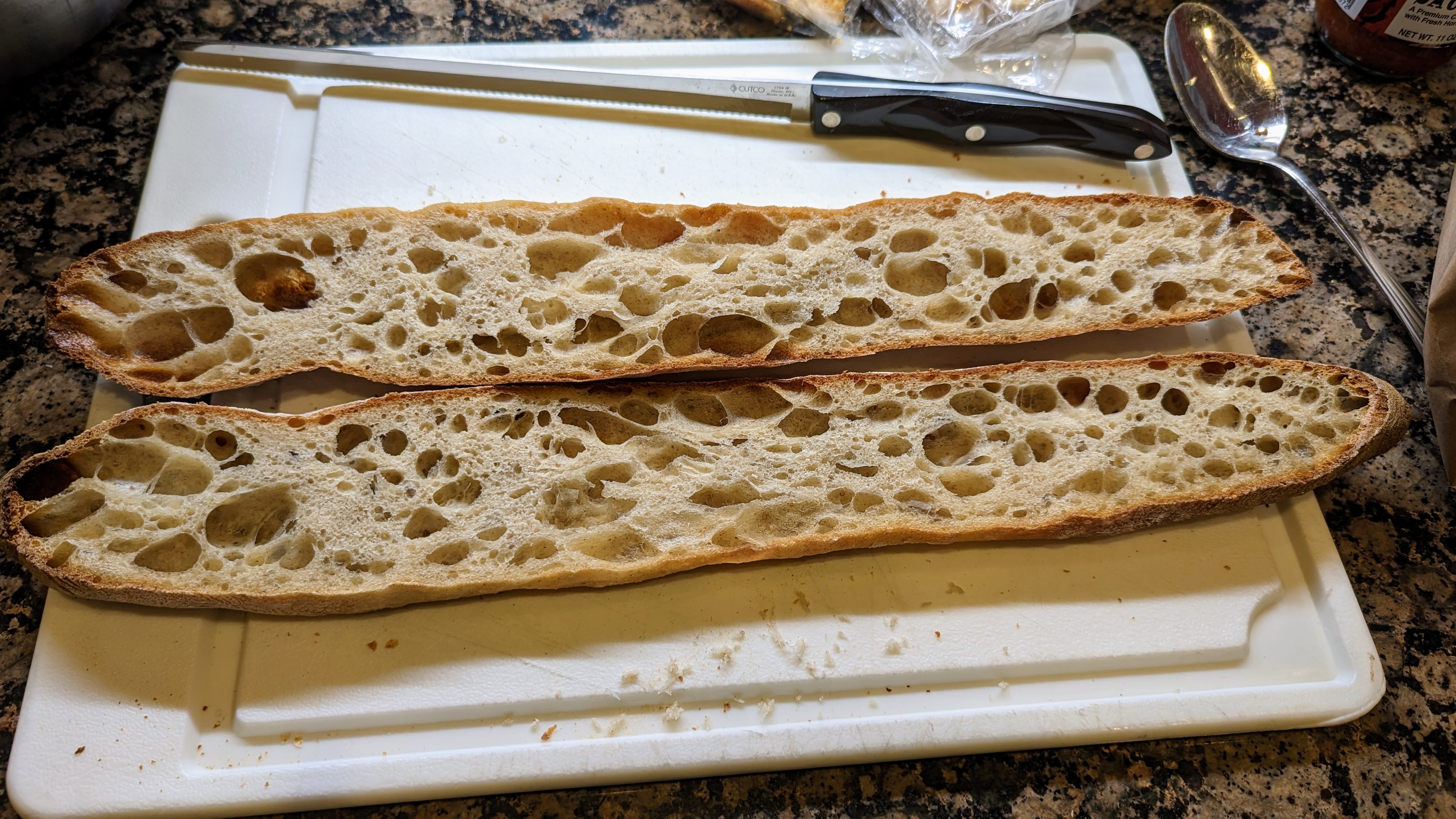
100% Sourdough Baguettes Using a Rye Starter

As I’ve mentioned many times in previous posts, the bread I love to bake the most is the baguette. The reason is that what makes a great baguette boils down to technique. Whether you use yeast or a starter to raise the dough, the dough itself is simple and straightforward. But the dough development and shaping techniques – for lack of a better word – are unforgiving. And on top of that, I’ve found that making baguettes requires using quite a bit of intuition and feel, much more than other types of bread I bake.

With more standard loaves like rounds and ovals, I tend to focus on building dough strength during fermentation. As long as I do that, shaping is pretty easy. Baguettes, on the other hand, are a different animal altogether. Dough strength is important, but timing and observing certain telltales with the dough are critical to getting a good result. And when using a sourdough starter, the process is a little slower than with commercial yeast, so the telltales are important. I’ll discuss those below.

As for these particular baguettes, the rye flour adds incredible flavors that really enhance the taste of the bread. You get the rye grain flavor as about 12-15% of the total flour comes from the rye. But I’ve also found that a rye starter creates a nice sour tang. It’s not really strong, but it’s noticeable.

And at least in the case of my mother starter, the yeast absolutely loves rye flour. In fact, if I add my mother starter cold from fridge into the rye flour and water mix, it will peak in less than 3 hours! I don’t know what that may be due to, but there must be something in the rye that makes my yeast go wild!

Overall Formula

Flour100.00%
Water76.00%
Salt2.00%
Levain30%

Levain

Rye Flour125g
Water @ about 100℉125g
Mature Starter50g

Final Dough

Bread Flour418g
AP Flour228g
Water @ about 95-100℉ to get a 78-82℉ dough temp464g
Salt15g
Levain (30% of total flour)228g
Total Yield4 X 40cm-335g loaves

Initial Mix. Reserve 50g of the water. We’re going to do a Tartine-style autolyse by combining the flour, levain and water. Mix well and make sure all dry ingredients are incorporated with no large lumps. Personally, I do the initial mix with a mixer with the dough hook. Let rest in a warm place for 20 to 30 minutes. We don’t want fermentation to really get going.

Incorporate the salt. Dissolve the salt into the reserved water, then mix it into the dough. You can use a mixer for this, but salt will tighten up the dough and it will quickly climb up the hook. So I just mix the salt in by hand. If you do it this way, wet your hand often. Transfer dough to another container to do your bulk fermentation (I use a 6L Cambro).

Bulk Fermentation. No time on this. You’re looking for a 30%-50% rise from the original dough mass. Using my active starter, this usually takes about 2 – 2 1/2 hours total with a dough temp of 80℉.

Folding. This only needs two folds within the first hour and a half. In each session, stretch and fold until you can pick up the entire mass. After the second fold, just let the dough ferment until you achieve 30-50% rise from the dough.

Telltale: Before you start folding, check the dough. You want to get good extensibility out of the dough. It should stretch very well but not tear. By the time bulk fermentation is complete. your dough should feel velvety smooth and luxurious.

Divide and Pre-Shape. Divide the dough into 335g pieces. You can refer to my baguette dough development process. Let rest for 20 minutes or until the dough as relaxed.

Shape. Roll pieces into logs, then transfer each to a well-floured couche.

Final Fermentation. Especially with sourdough baguettes, it is critical to leave them alone once you start final fermentation. You want the shaped dough to expand to almost double in volume or until the indentation of the poke test comes back very slowly. You’re taking the dough out to almost full fermentation.

Bake. Bake a 475℉ for 12 minutes with steam, then 425℉ for 12-15 minute or until the crust is the desired color. I prefer a slightly darker crust without getting too crunchy.