Recipe: All-Purpose Dough for Rolls, Sandwich Bread, and Pizza Crust!

For years, I’ve occasionally experimented with creating a dough that I could use for both pizza crust and bread, and I finally produced a formula that works wonderfully for both! As you’ll see in the formula below, there’s not much to it. But the kicker for me was using a much lower hydration than I’ve been experimenting with in the past.

My earlier experiments employed hydration 75% and above. I was also using a combination of high-gluten bread flour and AP flour, and sometimes mixed with some Kamut™️ flour. But yesterday afternoon, I thought about an episode of Diners, Drive-ins, and Dives where Guy Fieri visited this pizza place and the chef used AP flour only. That got me thinking that if I used just AP flour and lowered the hydration, I could still achieve decent gluten formation, and the small amount of olive oil would help to create a soft crumb if I used it for bread.

As far as bread is concerned, this dough produces a closed but airy crumb that is perfect for rolls, but placed in loaf pans, is perfect for sandwich loaves! For pizza, the lower hydration creates a nice, strong dough that can easily be spread out into a pizza crust. And here’s the kicker: The long, cold fermentation takes place during bulk fermentation. This means you can create the dough the day before, and let it sit in the fridge for 12-24 hours. If you’re making pizza, you can divide the dough immediately after kneading, then let it rise in the fridge. More details below. For now, here’s formula and the final dough to make 6 buns.

Formula

AP Flour100.00%
Water65.00%
Salt2.00%
Yeast0.60%
Olive Oil1.30%

Final Dough

AP Flour825g
Water (lukewarm)536g
Salt17g
Yeast5g*
Olive Oil11g
Total Yield1394g
6 X 230g buns
12 X 115g rolls
*Use half the yeast for a 24-hour bulk ferment

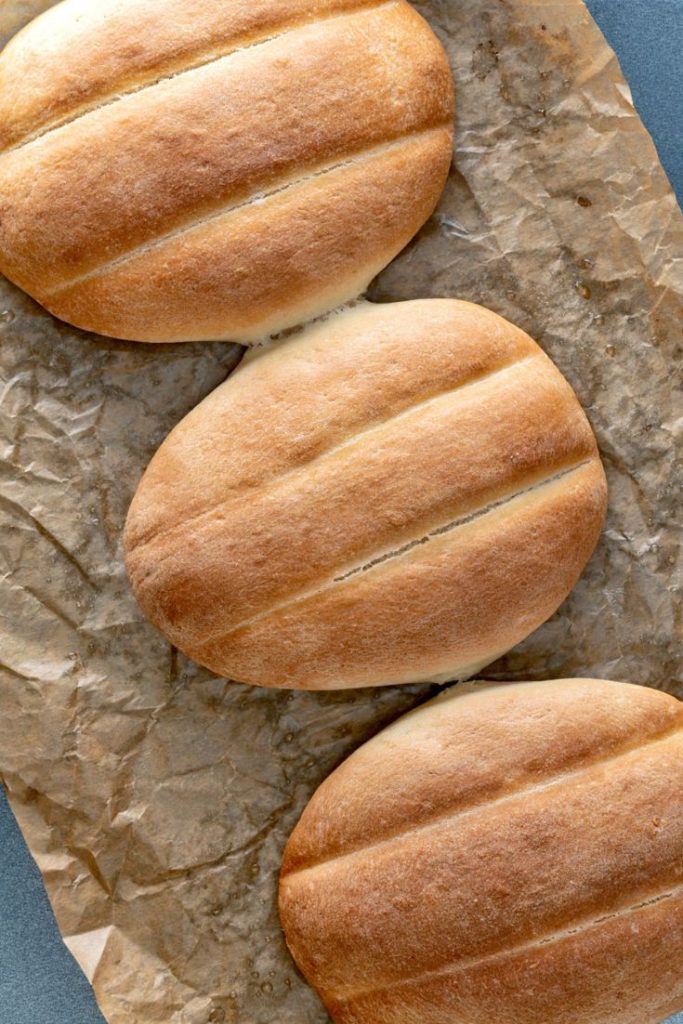
I must come clean. I experimented with making longer buns as you can see in the pictures above. They turned out great, but they’re a little too heavy to be used for sandwich rolls. Based on those results, I’d lengthen them to make bread sticks for dipping. And if I’m going to use it for sandwiches, I’d definitely make loaves for loaf pans.

Process

Mix. Combine all the dry ingredients together. Then add the oil and water and mix thoroughly. Knead the dough until smooth (you can use a mixer or do it by hand).

Bulk Fermentation. If you’re making bread or rolls, place the dough into a container (I use a 6-liter Cambro container). If you’re making pizza dough, divide the dough into two or three equal pieces, depending on the crust size you want, form into balls, then place on a sheet and cover with plastic wrap. In either case, place the dough in your fridge with a temperature in the range of 39℉-42℉. Ferment for 12-16 hours. The dough may triple or quadruple in volume during this time. But it’ll be okay if it’s domed in the middle.

If you want to go for a long bulk fermentation, use half the yeast. With that amount, the dough should expand to its fullest in about 24 hours.

Divide and Shape. If you made pizza crusts, there’s no need to divide. Simply gently press out the balls to about 1cm-thick discs, then cover and set aside. For rolls, divide into twelve pieces, then form balls and place on a baking sheet covered with parchment paper. For sandwich bread, divide into two equal portions, then form each into logs and place them into loaf pans. For breadsticks, form into long logs then set on a well-floured couche.

Final Fermentation. Let the dough proof for an hour at room temperature or until it doubles in volume.

Bake. For bread, lightly brush the tops of the loaves or rolls with a little water, then score if you want. Bake at 425℉ for 30 minutes. Use steam for the first 10-15 minutes of the bake to help rise. For pizza, shape, top, and bake as you normally would.

Mexican Telera Bread: The Soul of the Torta

Having been to Mexico several times over the years and being born and bred in California, I have a deep appreciation for Mexican food. But I have a special place in my heart for the Torta, the Mexican version of a sandwich. In the US, when we think of a “sandwich,” what typically comes to mind is a flat piece of meat with some condiments like mayo or mustard, and maybe some lettuce, onion, and tomato.

But the Torta… Ah, the torta. Like a sandwich, it’s meat between some bread, but that’s where the commonalities end, especially with the meat. The meat can be carne or pollo asada (grilled steak or chicken), or puerco (pork), camaron (shrimp), polpo (octopus), and my favorite: arrachera (marinated, grilled skirt steak). Heck! You can use any type of meat – yes, cold cuts as well. But instead of mayo, there will invariably be avocado. As for vegetables, you might get some grilled onion or diced tomato. In the states, shredded lettuce or lighly pickled cabbage are often added as well.

What I love so much about the Torta – and I suppose sandwiches in general – is that there are no rules. It’s a wide-open playing field! But that said, there is a type of bread that is commonly used for Tortas, and that is the Telera roll.

The Telera is an oval or rounded rectangle roll that is neither too wide nor long. The crumb is soft and fluffy with a firm but slightly chewy crust, making it perfect to soak up the juices of the various meats that are used. Visually, it is marked by two indentation lines across the top (we’ll get into that later). As for taste, technically, the Telera is a savory roll, but there is a slight sweetness as the dough contains a small amount of sugar.

As you can see in the picture to the left, it’s much like a hamburger bun that is ever-so-slightly longer on one side. This makes it a perfect platform for the grilled meats or seafood that are usually put on it.

Being a baker, after having a few Tortas on my last trip to Mexico just recently, I wanted to learn how to make them. And after a bit of research, and a bit of trial and error, I finally got a formula and recipe that’s both easy and delicious!

Overall Formula

Flour100.00%
Water60.00%
Butter (Softened)5.00%
Yeast1.40%
Salt2.00%
Sugar4.00%
Total Percentage172.40%

Final Dough

Flour516g
Water309g
Butter (Softened)26g
Yeast7g
Salt10g
Sugar21g
Total Weight889g*
8 X 110g rolls
78ºF/26ºC
*The extra 9g is factored in to allow for process loss.

Mix. Combine all the dry ingredients together in a large mixing bowl and mix to evenly distribute. If you use a mixer, use the paddle at lowest speed. Cut butter into the dry ingredients much like you’d do with biscuits (butter should be soft). Add the water in 3-4 batches, making sure it’s well-incorporated. If using a mixer, switch to the dough hook and slowly add the water until everything has been incorporated together.

Knead. Even though I use a mixer to mix, I enjoy kneading simply because I don’t do it that often as most of my bread is “no-knead” bread. Turn out the dough onto a clean work surface and knead it for 5 minutes or until the dough is smooth. Richard Bertinet’s slap and fold works great too! Work the dough into a ball, then place it in a greased bowl (I use olive oil), seam side up. Flip the dough over onto the seams so the whole ball is covered. Cover the bowl with a cloth.

Bulk Fermentation. Place the bowl in a warm place and let the dough rise and expand to almost double in volume. 45 minutes – 1.5 hours. Remember, watch the dough and not the clock!

Divide and Shape. Punch down the dough to release the gas (no, you don’t want an open crumb), then divide the dough into 110g pieces. Roll each piece into a tight ball, then set aside to relax for about 15 minutes.

On a lightly floured surface, press each ball out into an oval of about 1 -1.5 cm thick. Sprinkle a little flour on top of the oval, then about a 1/3 of the way from the long side of the oval, press a straw or chopstick down to the board, being careful not to tear the dough, but really work it down into the dough. Repeat on the other side, then place on a baking sheet covered with parchment paper. BTW, you’ll want to move the sections together when you place them on your baking sheet. This is a method of scoring without a blade. And if you find that your dough sticks to your work surface, just use a bench scraper to lift it up.

Final Fermentation. Once all the rolls have been shaped, cover the baking sheet with a damp cloth (you don’t want to form a skin), and allow the rolls to double in volume. This could take 30 minutes to an hour depending on your ambient temperature. Preheat oven to 400ºF/200ºC.

Bake. Before baking, lightly brush the tops of the rolls with water, then bake for 15 minutes at 400ºF/200ºC or until golden-brown on top. Don’t let these overcook as the sugar – even though there’s just a little – will caramelize easily so be watchful!

Making a Torta

There are no hard and fast rules when making a torta. Even in Mexico, tortas vary from region to region. And while it’s generally accepted that the Telera roll is the common roll to use, even in Mexico, depending on the region, different bread may be used. For instance, in Guadalajara, there is the Torta Ahogada or “drowned” torta that uses a sourdough bread called “Bilote Saldado.” But for our purposes, we’ll just stick with the basic torta.

If you want something really basic, just put some grilled meat between the halved bread, top it with avocado, then close the bun. This is the way it is normally served in Cozumel. But if you want to get fancier (and I like to get fancier), coat the halves with smashed avocado, spread some shredded lettuce or cabbage (I prefer cabbage), add some sliced tomato, then top that with the grilled meat. Add lime juice for a little zest.

As for meats, you can use pretty much any meat or even seafood. Cold cuts are fine as well. My favorites are:

  • Carne or Pollo Asada
  • Arrachera (skirt steak)
  • Grilled Octopus
  • Shrimp (Grilled, Sauteed)
  • Grilled Fish

My two big favorites are Arrachera and Octopus. But truth be told, I’ve only had octopus in Mexico. Not sure how it’s prepared, but it ROCKS!

Here’s my Carne Asada recipe, if you want to give it a try!