
Stiff vs. Liquid Starter? Which One Creates a Sourer Taste – It Depends

If you follow baking blogs or participate in online baking forums, you’ve probably heard this: The stiffer – lower hydration – the starter the sourer the taste. The thinking is that a stiffer starter promotes aerobic metabolism, thus creating more acetic acid, while a more liquid starter promotes anerobic metabolism which favors the creation of lactic acid. The difference is that acetic acid tastes more sour than lactic acid.

That’s all well and good. But as with so many things in making sourdough, there are several variables that can affect the sourness of your bread. For instance, with the loaf at the top, I used a 100% hydration starter to ferment the bread. It was 20% inoculation relative to the flour (BTW, I hate using that word with respect to bread because it has a specific scientific meaning). But at that hydration level, the yeast density was low, and it took 24 hours for final fermentation in my fridge. That loaf was nice and tart!
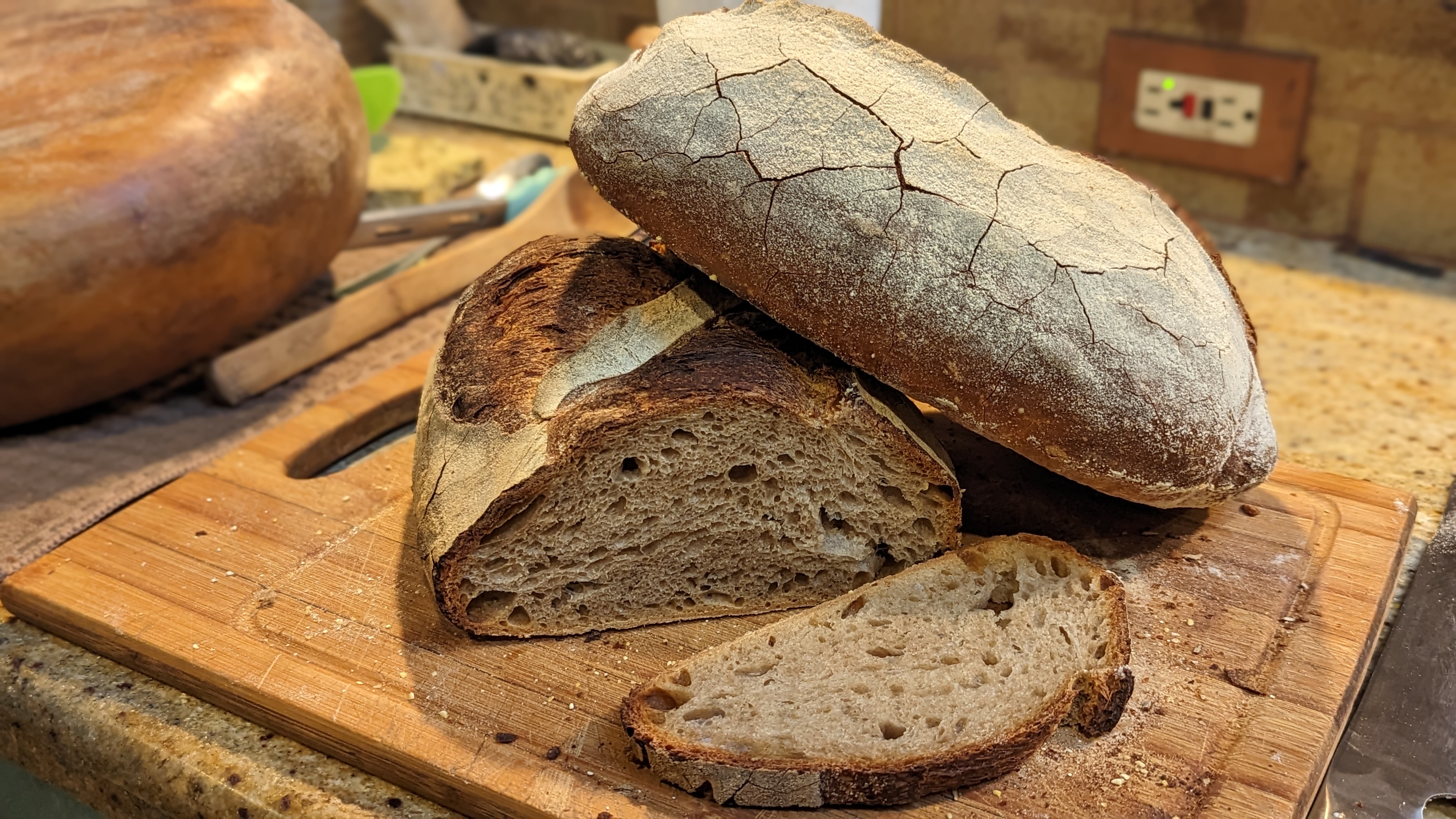
On the other hand, with the loaves immediately above, I used a 60% hydration starter, with the same inoculation level of 20%. But the yeast density was so much greater than the liquid starter, that final fermentation was barely 10 hours and I was pushing it, which accounts for the less open crumb. It hardly has any sour taste.

Myself, I’ve never bought into that rule of thumb that a stiffer starter will make a more a sour tasting loaf of bread. I’m quite familiar with the food science behind that and agree that aerobic metabolism promotes the production of acetic acid which will be perceived as more sour. But baking as long and as much I have, the best way I know that making a sour loaf involves a lot more than just the starter. The stiff starter gives you a head start as it favors the production of acetic acid. But other factors such as the environment, fermentation time, type of flour, and amount of starter also affect sourness.

As far as a long, cold fermentation is concerned, while yeast metabolizes, it creates inhibitors that block bacterial activity, effectively mitigating or eliminating competition. So, using a lower inoculation level will ensure a lower relative yeast density and will help mitigate fungal activity, and in turn, allow the bacteria to flourish during bulk fermentation. Then when bulk fermentation is complete, doing a cold fermentation of around 38℉ (and no higher than 40℉) will slow down yeast activity even further and let the bacteria continue do their thing. These principles apply to using all sorts of starters, from pure liquid fruit-based starters to high hydration starters, to super-stiff starters. So, at least for me, the type of starter isn’t as relevant as the dough fermentation techniques I employ.

That said, I could be completely full of it, and there are folks who will disagree with me vehemently. I get that. But for me, it’s time and technique that will dictate how sour my bread is, not my starter.

Loving My Flour!

The other day, I got a shipment of my favorite flour, Azure Market Organics Unbleached Bread Flour. I’ve written about it several times, so I won’t go into detail about it. But if you’ve read this blog, you know I love this flour! It’s so flavorful and wonderful to work with, but until recently, it was out of stock at Azure. They finally got it back in stock and I immediately ordered it. I feel like a kid in a candy store!

I’m excited because this flour has been integral to my flour blends, and with it unavailable, I’ve had to use alternatives. That hasn’t been too much of an issue, but any time you change things up, you need to adjust to the change, and sometimes it takes a few times to get comparable results to what you’re used to, as you tweak hydration, preferment amount, fermentation times, etc. But baking with this flour? It’s like putting on a pair of broken-in shoes. It’s just comfortable, which in turn makes my dough development process comfortable and familiar.

And I’ve realized that a very large part of my progression as a baker has been getting familiar with my ingredients. When you’re used to working with different ingredients, you just know how they’ll react and you can execute your process without having to apply too much conscious thought. Things just become automatic.

I once got in a great conversation with a professional chef. He said that the fundamental difference between him and a home chef is that he knows his ingredients so well that he doesn’t have to think about what he’s cooking. He can just focus entirely on creating his dishes. But more importantly, he said he gets the reps in that build that familiarity. It’s the same way with baking. When you’ve put in the reps, you just know, and as they say, when you know, you know.

As soon as I got my flour, I made the dough for the loaf above. With that loaf, I used a 500% hydration starter (yes you read that right) to ferment a 75-25 Bread/AP flour blend. Final hydration was around 75%. That’s just a basic loaf. But this was a bit of a challenge because I couldn’t do as long a bulk fermentation as I normally do because of time constraints. But knowing this blend and recipe so well, I knew that I could make up for it by doing an extra-long final fermentation. So, this loaf spent about 18 hours in my fridge.

When I checked it baking through my oven’s window, I just smiled and gave a sigh of pure satisfaction. I just nodded and said, “Mm-mm-mm, how sweet it is!” Then when I removed it from the oven, I was giddy. I saw how much the loaf had expanded, and I knew it was going to turn out great. Yes, it has a nice, open crumb, but more importantly, the dough was fully fermented and in no place was dense. So satisfying…

Like many other bloggers, I often talk about experimenting with different ingredients. I think that’s part of the process of developing skill. And while experimentation is great, getting reps in and learning what ingredients work best for you is just as important.