Don’t Throw Out Your Old Cheese! Make Fromage Fort!

In addition to having a love for bread, I absolutely LOVE cheese. I usually have four or five varieties of cheese in my fridge. Unfortunately, I seem to be the only one in my family that eats as much cheese as I do, and I can’t eat it all, and thus, it gets old. It used to be that I would just throw out my old cheese, but in the early days of the pandemic lockdown, I learned to make an incredible cheese spread from the venerable chef, Jacques Pepin, called fromage fort or “strong cheese.”

Basically, fromage fort is a mixture of different cheeses that is combined with a little white wine and a little garlic, and optionally, you can add spices if you like. I spike mine with coarse black pepper and hot chili pepper powder to give the spread a little heat kick. It is SO easy to make! Here’s a quick recipe (scale it up as necessary):

Fromage Fort

1/2 lb leftover cheese
1-2 cloves garlic (peeled and crushed)
1/4 cup white wine
1 tsp coarse black pepper
Salt to taste*

*Cheese is salted, so you shouldn’t need it, but add some if you don’t think it’s salty enough.

Cube up the cheese, then add all ingredients to a food processor with the blade attachment installed. Mix for 30 seconds or so until the mixture is smooth. Add white wine in small amounts to get the texture to a really thick batter. Once it’s done, pack the mixture into small jars or containers (I like to use 4-6 oz jars).

All that said, it’s all about taste. I tend to like a lot more garlic in mine. And with the batch I made this morning, part of which is in the picture above, I used a combination of marsala and chardonnay. And because I wanted a bit of heat, I added some hot-hot South Indian chili pepper powder. At least in my mind, there aren’t any rules with fromage fort. Besides, every time I make it, it’s different because I use different cheeses

How Do You Use Fromage Fort?

Lots of different ways! The more common thing is to spread it on slices of bread and crackers. But you can spread it on bread and broil it, and even make grilled cheese sandwiches with it (though I also add a slice of cheese to make it really gooey). I also add it to cream-based sauces to give my sauces a little cheesy edge.

Another thing I love to do with it is to make Croque Monsieur, which is basically the French version of a grilled ham and cheese sandwich. I spread the fromage fort on a large slice of bread, place a slice of ham on top of that, then put a slice of Swiss cheese on top of the ham, and top it with a slice of tomato. I bake this in a 400-degree oven for 10 minutes. Wow!

Trust Your Dough: Part III of Working with High-hydration Dough

As I’ve been sharing in the past few posts, I’ve been experimenting with super-high hydration dough to test the limits of my flour blend. It has been a real learning experience. One big thing is that really wet dough doesn’t respond like lower hydration dough. Whereas a lower hydration dough will come together and it’s easy to create a nice gluten network pretty much immediately, it’s not so with dough above the 85% hydration level. In fact, right after mixing, the dough is somewhat of a gloppy mess. It looks like pancake batter and even feels like it.

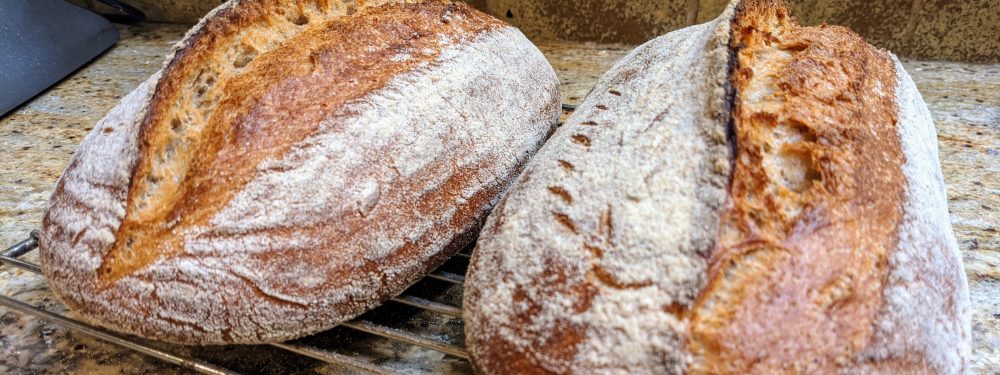
For instance, the loaf shown in the picture above was about 90% hydration. I was admittedly a little skeptical about the dough when I first mixed it. And after it had fully fermented, I didn’t even know if it would even shape! But I knew that the gluten strands were forming as I folded the dough. I could feel it. And damn if it didn’t spring up in the oven! VERY COOL!

Yesterday, I decided to push it even further and made a 95% dough out of the same flour blend. Because it was so wet, I decided to do the initial mix in my mixer. I’m so glad I did because after I got all the ingredients incorporated, the dough looked even more like pancake batter! Over the course of six folds over a 3-hour period, I definitely could feel the gluten forming as I folded.

But I have to be honest. Even though I could feel the gluten developing, the dough was still like a super-thick batter. When it came time to preshape and shape the dough, it was incredibly difficult to shape, and the resulting loaves were, let’s say, a little on the flat side. I got oven spring alright, but it was way more out than up. So I think exceeded the hydration limit with that particular flour blend.

But in spite of the difficulty in working with such a wet dough, I resisted the urge to tweak, though I could tell I probably wouldn’t get the most ideal results. And even though I’m fairly experienced as a baker, I had to see it through. I won’t lie. There were a couple of times while I was folding – if you could call it that – where I was tempted to add a bit more flour to the mix. But this was an experiment to test the hydration limits of that flour blend, so I let it go.

But despite the relative flatness of the loaves, I wouldn’t call the experiment a total disaster. The loaves rose up, which meant I could expect a reasonably open crumb, which I got. And quite frankly, the taste of the bread was magnificent. I used whole wheat levain this time around and this particular flour was packed with lactobacillus bacteria, giving the bread a gorgeous tang.

That “tang” means acid, and acid breaks down gluten, which may have been a contributor to the lack of gluten strength. So it’s one thing to consider for future bakes. I will either have to add vital wheat gluten to make sure there’s extra protein and perhaps still drop the hydration level just a smidgen.

As I think about this experiment, I look at all the time I’ve spent learning these past couple of years and it makes me smile. For me at least, the beauty of baking isn’t in the end product. The beauty is in the process and understanding all the variables that go into producing a loaf of bread. Though I’ve experienced failures or setbacks, they’ve all served to teach or reveal to me some subtle nuance. It’s like peeling back the layers of an onion.

Happy baking!

Easy-Peasy Zatar-Flavored Yeast Loaf

I was at a retreat this past weekend and on Saturday afternoon, I happened to pass by the cafeteria kitchen to see a big 20-quart mixing bowl almost spilling over with proofing dough! It smelled absolutely wonderful! I was drawn to the bowl and chatted it up with one of the cooks, sharing with her that baking bread is one of my life’s passions. I never got the chance to speak with the head cook, but I’m going to be contacting them to see if I could volunteer in the kitchen to bake bread for retreat attendees in the future. So cool!

In any case, the loaves they produced were straight-forward yeasted loaves, probably about 1.5 kilo each. And though they didn’t have an open crumb, the crumb was still nice and airy. Much like a quickly risen, yeasted loaf. And that got me thinking: Sometimes it’s just nice to make an uncomplicated yeasted loaf. It’s so easy to get caught up in sourdough this and sourdough that that I miss the real point of making bread and that is to feed people! So, inspired by those simple loaves, I resolved to bake a loaf like that for my family when I got home.

But instead of making a simple loaf, I thought I’d give it a little pizzazz and add a bit of that wonderful Middle Eastern herb mixture, zatar. I only added just enough to add a real subtle flavor, but just that little bit has a HUGE impact on the taste. Let’s get to the recipe!

Overall Formula

First I started out with my basic baguette formula, but instead of my normal 0.38% yeast, I went to 1% yeast…

Flour100.00%
Water75.00%
Salt2.00%
Yeast1.00%
Total %178.00%

Final Dough

Flour851g
Water638g
Salt17g
Yeast9g
Zatar*1-2g
It doesn’t take much…
Yield1 X 1500g loaf
*I didn’t factor the Zatar into the overal formula because I just measured out a couple of grams (honestly 2 teaspoons) of the mixture and added it to the flour. As for the yield, if you add everything up, it’ll come to 1516g, but I always add a fudge factor to account for loss during processing.

To be completely transparent, I actually used three flours for my dough in this recipe: 50% High-extraction bread flour, 30% Kamut flour, and 20% AP Flour. They were measured as follows:

High-extraction bread flour426g
Kamut flour255g
AP flour170g

Mix. Combine all the dry ingredients and mix well. Add the water and mix thoroughly until there are no dry ingredients left. Work the dough until it starts forming a smooth consistency. If you’re using a mixer (that’s what I did), mix until the dough become smooth and starts climbing up the hook (about 3 minutes at medium-low speed). If you’re mixing by hand, knead the dough in the bowl until smooth and it starts coming off the sides of the bowl (about 5-7 minutes).

Bulk Fermentation. About 1 1/2 hr.

Fold. The dough only needs to be folded once after 1/2 hour. After that, let it rise in the container until nearly doubled in size.

Preshape. After the dough has finished bulk fermentation, transfer it to an unfloured work surface and work it into a round. Allow it to bench rest for 15-20 minutes or until it has relaxed.

Shape. This is a really versatile dough, so you shape it into a round or an oval or even a long loaf. For my loaf, I did a standard batard shape, but rolled it out a little to form a longish loaf that I let rise in a 14″ banneton.

Final Fermentation. 30-45 minutes. By this time, the yeast will be really active and if it’s warm, final fermentation will happen quickly. So watch it! Use the standard poke test to determine the springiness of the dough. Your indentation should pop back a bit after poking the dough, but never fully come back.

Bake. Bake for 45 minutes at 450°F (no fan, please). During the first 15 minutes use steam to help the loaf rise. It will really spring up with this much yeast!