

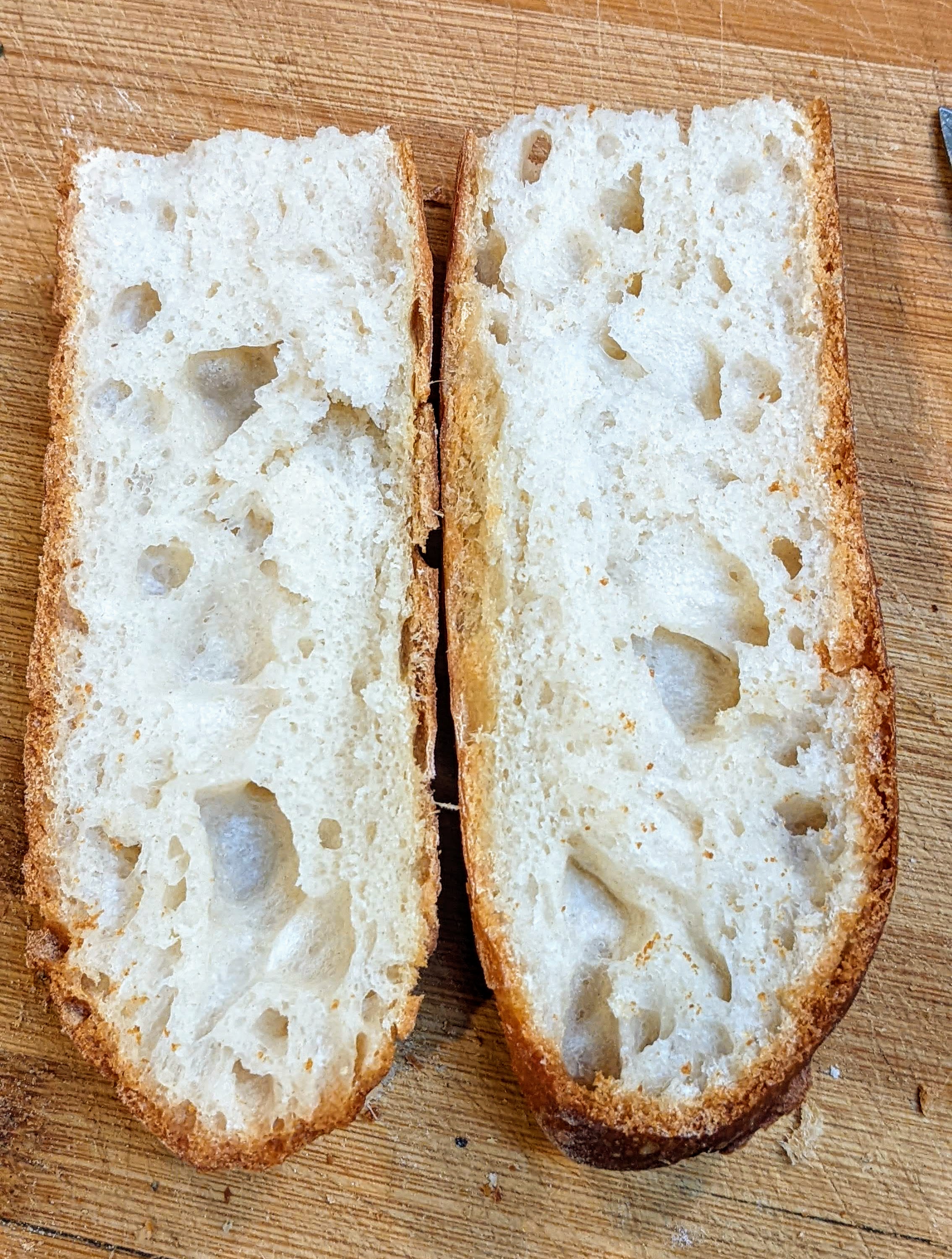
Yesterday I posted an article discussing that salt does not kill yeast. It’s a myth that has somehow propagated across the baking world. There’s a lot of misunderstanding about the relationship between salt and yeast. I’ve even read articles where even well-known bread chefs really didn’t have an understanding of how salt truly affects yeast. Pretty amazing.
In my research on the subject, I came across a number of articles from academics and laypeople discussing and experimenting with salt-stressing yeast prior to mixing and how it affected the rise and texture of the dough.
What is salt-stressing the yeast?
Basically, it’s a process of exposing the yeast to a slightly saline environment to make it go into osmotic shock. When it gets shocked like this, its reaction is to produce chemicals that protect it from leaching. Once it gets over the shock, it becomes resistant to further osmotic shock events. What this means with respect to baking bread is that salt-stressed yeast can then be added to high-salt or high-sugar dough and still function.
For standard, straight dough, using salt-stressed yeast shortens fermentation time. With the typical straight dough, when you dump everything together and mix it, the yeast initially goes through osmotic shock. There is a lag period where the yeast needs to recover from the shock, then it becomes active again and starts producing gas. With salt-stressed yeast, there’s no lag as the yeast has already gone through osmotic shock and it starts fermentation immediately.
Another effect of using salt-stressed yeast is that the chemicals that get released apparently act as a natural dough conditioner, increasing the gas-retention ability of the dough and producing a softer crumb.
Of course, after going down the rabbit hole of salt-stressed yeast, I had to try baking bread with it. So I took my traditional poolish baguette recipe and baked the loaves above. I bake a lot baguettes and I have to say that the crumb was indeed softer with the salt-stressed yeast. What about the fermentation time? It was shorter, especially bulk fermentation. Normally my dough finishes bulk fermentation in about 3 hours at 78ºF. This dough took less than 2 hours to finish bulk fermentation, so the yeast activity was definitely higher.
The reason I used a poolish method was that since I was expecting a faster bulk fermentation, I wanted make sure there was some taste in the dough which the poolish would provide. Luckily I did that because the bread would have probably turned out insipid. Given that this technique really picks up the yeast activity, in the future, I will use less yeast to ensure flavor development.
But with regards to texture, wow! This technique is really awesome!
How to Salt-Stress Your Yeast
The scientific experiments that were run used a 7% saline solution, so I wanted to duplicate that in my own bake. So here goes:
- First let’s assume you want to use more salt than the recipe calls for. Most salt is about 2%. But let’s use 3% for this.
- Take the weight of the salt that represents the 3% and divide it by 7% (0.07). This will give you the amount of water you’ll need to create a 7% solution.
- Now measure out that amount of water calculated above (I recommend that it is at least 95ºF so the salt dissolves), then dissolve all the salt called for in your recipe into the warm water.
- Once all the salt is dissolved, add all your yeast to the solution, mix it well, then let it stand in a warm environment for at least 30 minutes, up to a few hours.
- When you’re ready to mix, add the rest of the water called for in your recipe to the solution. Mix this well.
- Add the liquid to your flour and mix. That’s it!
 The Dawg House!
Pingback: Making Bread More Flavorful | The Dawg House!
Hello Sir,
Can you please share a recipe for Italian bread made with poolish and salt stressed yeast.
Thank you.
As I mentioned in the article, you can easily increase the salt in any recipe. As for Italian bread, what bread are you interested in?
Hello Chef,
Thank you very much for the response. Honestly, I was not expecting any response.
I love breads and do make Italian, Turkish and Indian breads.
Last month I visited to Vancouver in Canada. There is a shop name Pure Bread Berkery. I bought their Rustic Italian bread. This was mind blowing. Nice crispy crust and very airy crumb. I came home and tried to make something similar. I used 100 % hydration (King Arthur Bread Flour) dough recipe with 2 % salt and 20% poolish. Bread turned out to be good but nothing like the one I ate. My crumb was open but not the same. While searing for any better recipe I saw some articles on salt stressed yeast, then google directed me to your website. I am wondering if I can use salt stressed yeast to improve the structure of my bread. Also any suggestion on using dough improvers.
Thanks again.
Sorry I didn’t respond to your latest reply. To be clear, salt-stressed yeast speeds up fermentation, but doesn’t necessarily do much to improve structure, that is, strengthen it, but because the yeast activity will be increased, it will help create a more open, airy crumb. This increase in activity is due to the production of higher amounts of glycerol during salt stressing. Glycerol has been shown to increase yeast activity (I know, a little science-y).
So, as far as structure is concerned, it won’t help you much. And actually, using 100% hydration will never get you much structure, especially with KA Bread Flour. It has good absorption, but 100% is overkill. Drop your hydration down to no more than 80%, though I’ve found the 75% to 78% works best with that flour.
Going back to that bread you had Vancouver, you must remember that you don’t have the same kind of flour that they used in that bakery. King Arthur bread flour is awesome, but it’s kind of generic. What you might try is blending it with different kinds of flour like rye, Kamut, or whole wheat flour. These will alter the taste. Rye has a distinctive flavor (don’t confuse it with caraway seed that is often added to rye bread) that is best described as slightly spice. Kamut provides a nutty flavor profile while also creating a creamy texture on the finish. Whole wheat provides a grainy flavor profile and a little rough on the finish.
Than you so much. Very impressed with your knowledge. Will order some Rye Kamut flour
You can get Rye and Kamut flours at Whole Foods, or if you want larger quantities, I suggest Azure Standard organic flour. It’s free shipping if you’re willing to pick it up at one of their local drop points. You’d have to check the website if they have a drop point near you.