
I am SO giddy about this flour! In my previous post, I sang the praises for the Azure Market Organics 100% Whole White Wheat Flour and now, I’m even MORE giddy about this bread flour. It not only goes through the Unifine process, Azure also performs an extra sifting stage to remove about 10% of the sharp bran particles.
So what we’re dealing with here is a high-extraction flour that has so much more nutrition than regular bread flour. And get this: It has 14.7% protein content! That’s 2% more than King Arthur at 12.7%! It’s amazing!
The first thing I noticed when I opened my bag was that the flour color is pretty dull, and Azure states it will get even more dull over time. But it’s silky-smooth in texture and it is an absolute DREAM to work with!
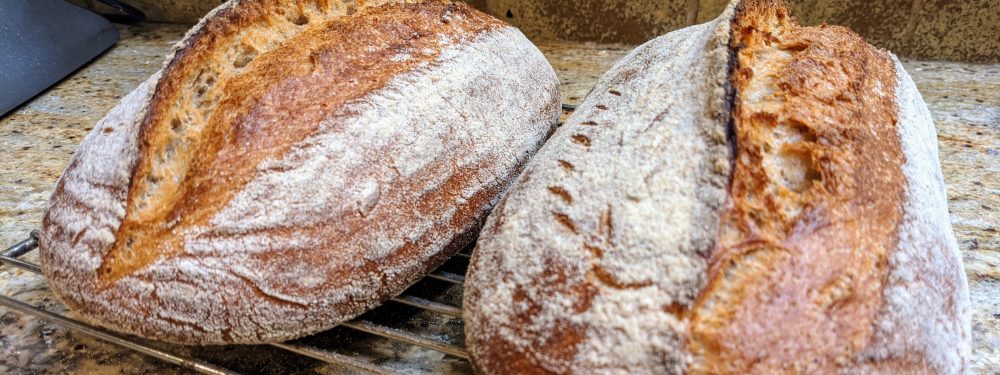
This morning, I made two 50-50 white whole wheat/bread flour batards. I used the whole wheat flour for a poolish and the bread flour for the final dough. The overnight ferment really helped smooth out the wheat flour (though to be honest, that flour’s already smooth). The results were spectacular. The poolish was nicely puffy with a distinct tang in the morning.
As for the final bread, as expected, it didn’t spring up as much as other loaves because of the high wheat flour content. But with the bit of extra protein in the bread flour, the crumb was not nearly as tight as with other white flours I’ve used.
 The Dawg House!
You’re literally the only person commenting about this flour on the entire internet. It looks great on paper and caught my attention. I typically bake with 2:1 Graincraft high protein flour to home ground red winter wheat. Could this be substituted 1:1 for high gluten white flour without destroying rise/oven spring? Any other caveats?
Yeah… I realized that I was probably the only person talking about it. But I was pretty excited by it because it’s all certified organic flour. But though it costs more than other flour, it’s still a lot more affordable than some of the boutique mills out there like Janie’s Mill.
As far as the Bread Flour is concerned, from a protein content perspective, yes, you could substitute the GrainCraft 1:1 with the Azure Standard flour. However, note that the Azure standard flour is not enriched, so it doesn’t have the added amylase and other additives that an enriched flour has. It also is a high-extraction flour, which means that there are still bran particles in it, however small, that will make it act a little like whole grain flour, though the rise is definitely better than with whole wheat.
But because it’s not enriched, yeast activity will be a little slower with this flour, so you’ll have to adjust your times. If you want to maintain the kind of timelines you normally have, use some diastatic malt powder (about 0.1% – 0.3% of the total flour) to help boost the yeast activity. When I bake with this flour exclusively, I add some diastatic malt to help break down the starches.
If you do get some of this flour, start with a small bag to test it out. I did that with all the Azure Standard Flour I buy (I now get their Kamut, Red and White Whole Wheat, and Semolina flour as well as the Bread Flour). Now that I’m used to using them, I buy them in 25 and 50 lb bags. But I always start small. Though I love this flour, the icing on the cake was the FREE SHIPPING! 🙂 I just have to go to a local drop to pick it up.
Ok, it’s taken me a while to acquire and test this flour. My first impression was, “Wow, this dough has some muscle!” I’ve been tweaking my bakes a bit and now I have a rockstar 50/50 Azure to home ground red winter wheat loaf with good rise and fantastic oven spring. I’ve always preferred a whole wheat loaf but was never satisfied with mine so tend to split it down the middle with a non-glyphosated, white, enriched baking flour. No more! (see below)
In addition to your Azure baking flour recommendation, I thank you for recommending the key ingredient missing from my repertoire; diastatic malt extract. I’m sure it was recommended to me in the past but perhaps I dismissed it in some misguided quest for the bread equivalent of Reinheitsgebot. Hearing it from you opened my ears. Even at a mere 1%, this is a game changer. Combined with the Azure Unified Ultrafine bread flour, my 100% whole wheat loaves are finally light and delicate, with a tender crumb.
Thanks Dawg, I will be forever grateful.
~J
Thanks for the kind words! That diastatic malt powder is a real game-changer and really helps with the yeast activity. At first I was concerned about using it, especially with my association with the Real Bread Campaign. But this is one of those “additives” that’s allowed and when using pure, unenriched flour, it makes up for the stuff that’s added to flour like King Arthur and Bob’s Red Mill.
I’m SO glad you’re enjoying that flour! It really is a dream to work with!
Thank you for posting the information on this flour. I just received the bread flour from Azure and I have been experimenting with my current bread recipes. I made an olive bread with my basic white loaf recipe and it was very soft and fluffy (although it did lose its crispy crust once it cooled down). Yesterday, I tried my white sandwich loaf recipe (milk bread) and it didn’t rise the way it should. The crumb was very dense but still soft with just a little bit of chew. I was wondering if it was the yeast or the milk that didn’t let it rise properly in the same amount of time. I will adjust the yeast or the rise time and see if that helps.
You might try using a little diastatic malt powder to help boost the yeast activity. Azure Standard flour is 100% organic with no additives. Store-bought flour always includes diastatic malt powder which contains amylase that helps to break down starches into sugar, thus providing more food for the yeast. This isn’t a chemical, but malted barley flour so it’s totally natural. I usually add 1% diastatic malt powder to pure organic flour.
Another thing you might try is pre-stressing your yeast. Look up “salt-stressed yeast” on my site to see how to use it.