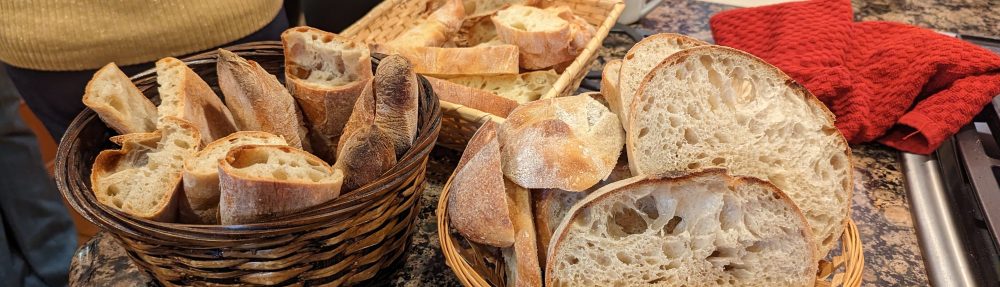

If you follow baking blogs or participate in online baking forums, you’ve probably heard this: The stiffer – lower hydration – the starter the sourer the taste. The thinking is that a stiffer starter promotes aerobic metabolism, thus creating more acetic acid, while a more liquid starter promotes anerobic metabolism which favors the creation of lactic acid. The difference is that acetic acid tastes more sour than lactic acid.
That’s all well and good. But as with so many things in making sourdough, there are several variables that can affect the sourness of your bread. For instance, with the loaf at the top, I used a 100% hydration starter to ferment the bread. It was 20% inoculation relative to the flour (BTW, I hate using that word with respect to bread because it has a specific scientific meaning). But at that hydration level, the yeast density was low, and it took 24 hours for final fermentation in my fridge. That loaf was nice and tart!
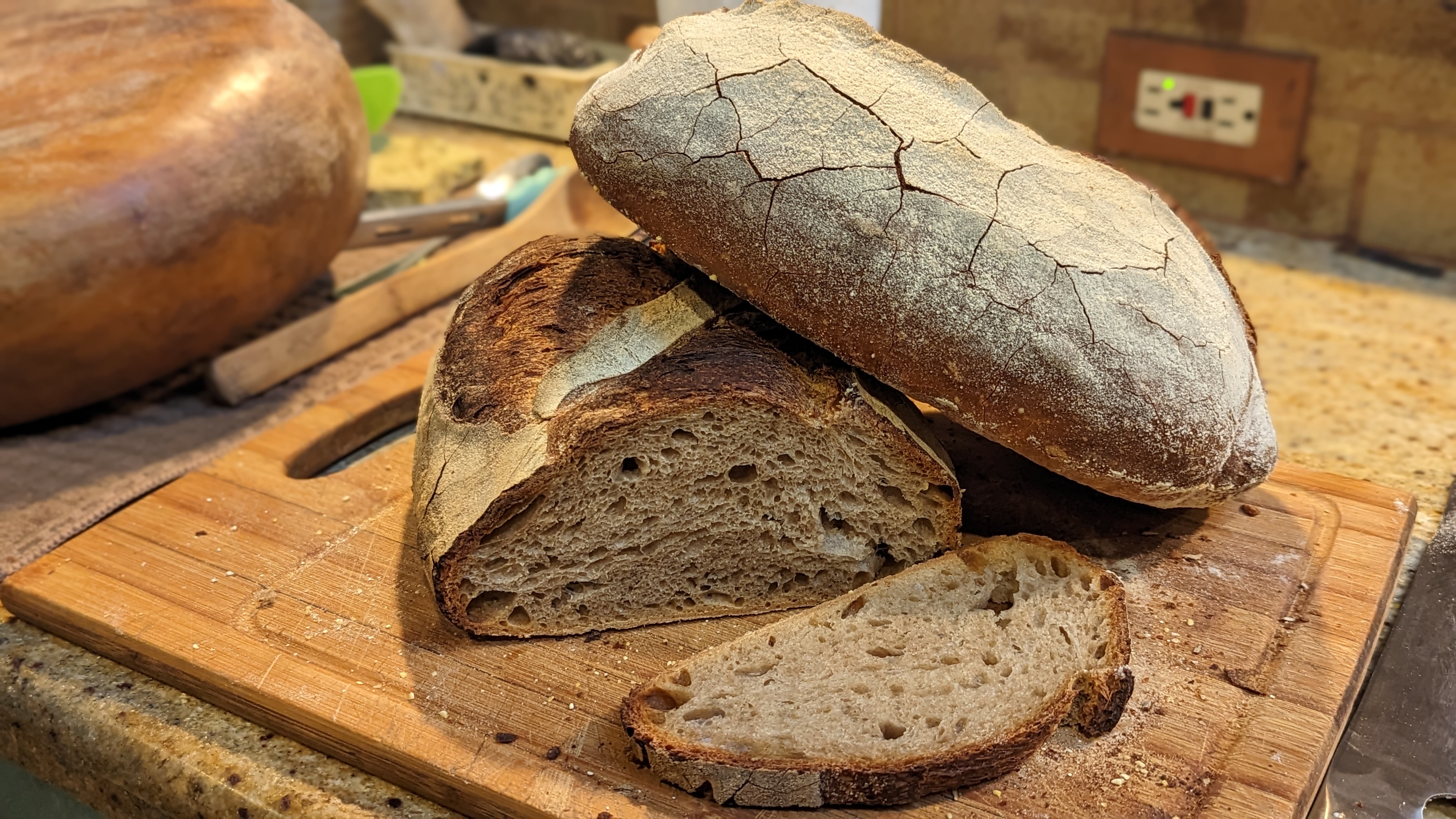
On the other hand, with the loaves immediately above, I used a 60% hydration starter, with the same inoculation level of 20%. But the yeast density was so much greater than the liquid starter, that final fermentation was barely 10 hours and I was pushing it, which accounts for the less open crumb. It hardly has any sour taste.
Myself, I’ve never bought into that rule of thumb that a stiffer starter will make a more a sour tasting loaf of bread. I’m quite familiar with the food science behind that and agree that aerobic metabolism promotes the production of acetic acid which will be perceived as more sour. But baking as long and as much I have, the best way I know that making a sour loaf involves a lot more than just the starter. The stiff starter gives you a head start as it favors the production of acetic acid. But other factors such as the environment, fermentation time, type of flour, and amount of starter also affect sourness.
As far as a long, cold fermentation is concerned, while yeast metabolizes, it creates inhibitors that block bacterial activity, effectively mitigating or eliminating competition. So, using a lower inoculation level will ensure a lower relative yeast density and will help mitigate fungal activity, and in turn, allow the bacteria to flourish during bulk fermentation. Then when bulk fermentation is complete, doing a cold fermentation of around 38℉ (and no higher than 40℉) will slow down yeast activity even further and let the bacteria continue do their thing. These principles apply to using all sorts of starters, from pure liquid fruit-based starters to high hydration starters, to super-stiff starters. So, at least for me, the type of starter isn’t as relevant as the dough fermentation techniques I employ.
That said, I could be completely full of it, and there are folks who will disagree with me vehemently. I get that. But for me, it’s time and technique that will dictate how sour my bread is, not my starter.
 The Dawg House!
What exactly do you mean by 500% hydration starter? Could you please give grams of starter, water, flour. Thanks.
Sorry, that was a typo. It’s supposed to be 100%. Basically, a 1:1:1 ratio of starter to flour to water (assuming the starter is 100% hydration).