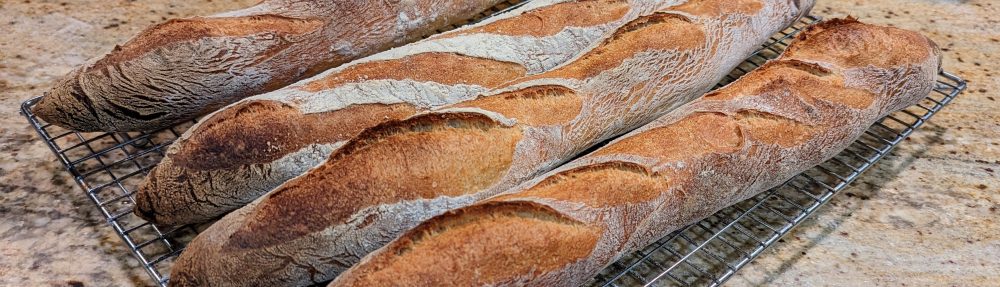

Yesterday afternoon, my family was enjoying subs that my kids made from the baguettes I had baked the day before. I asked them how they liked the bread and they all said it was great. But one of my daughters asked said, “Dad, we love your baguettes, but can you make a real sour loaf like you used to?” Of course I agreed because any excuse to bake some bread is fine with me.

So, last night, I worked out my formula, then fed my starter in preparation for making the dough early this morning. While I was reviewing the formula, I thought of numerous ways to make bread sourer. But I have a tried-and-true method that will ensure my bread comes out sour. Actually, it’s a combination of things. Here they are:
First, I use mature, unfed starter straight out of my fridge that has hooch formed. I mix the hooch back into the starter, measure out what I need for my recipe, then I feed the starter and put it back into the fridge. I know, it seems counterintuitive, but at the stage I use it, even though there’s still live yeast in the culture, the bacteria have taken over.
Second, the starter is made entirely from whole grain flour or at a minimum T85 flour that still has a substantial amount of germ and husk in it. That’s where the little beasties (bacteria) reside. I will sometimes use a mature rye levain – and always past its peak.
Thirdly, I make a flour blend that is at least 20% whole grain flour. Today I used unsifted 100% organic whole grain Kamut™ flour. In addition to introducing bacteria, it adds a nice nutty component to the flavor profile along with a tiny bit of sweetness. Yum!
I also use a more standard hydration of 70%. This is a little low for the flour that I use which has high protein content. But the lower hydration promotes anerobic metabolism which favors the bacteria.
Next, I use significantly less starter than I normally would for other loaves. Usually, the amount of starter I use is 20% of the total flour, but when I want sourer bread, I reduce the amount down to 12%. This lower amount of starter lengthens fermentation time forcing the yeast to compete more with the bacteria during bulk fermentation. This also promotes bacterial fermentation over yeast fermentation.
Then finally I do a long final fermentation in the fridge for a minimum of twelve hours. This slows down the yeast but lets the bacteria continue doing their thing. Importantly, I didn’t want to completely stop yeast production because it was already slow to start with. So I turned up my fridge temp to 42°F (don’t worry, I have a small dedicated fridge for cold fermentation.
With the smaller amount of starter, bulk fermentation is SLOW. I mixed my dough at 7am this morning and didn’t shape until 6pm! And it was a hot day today. That got me a little worried because with my kitchen ambient temperature at 85°F, I thought it would speed up yeast fermentation. But it looks like there was enough competition from the bacteria to attenuate the yeast activity even at that temperature.
With a lower hydration dough combined with the different ways to promote bacterial fermentation, I had to be extra gentle with shaping. Normally I don’t have a problem degassing the dough because I tend to make loaves that favor yeast production. But with such low yeast activity, I handled the dough much gentler to avoid popping as few bubbles as possible.
This may seem complicated because I explained each item, but it’s not. Here’s everything I talked about in summary:
- Use unfed starter
- Use a whole grain flour starter
- Use a flour blend that includes some whole grain flour
- Use a lower hydration (68%-70%) to promote anerobic metabolism
- Use less starter
- Do final fermentation in the fridge for at least twelve hours
As I said, it’s not complicated. You can even skip some of these things. But from experience, I know doing those things above will create a sour loaf of bread!
How Sour Is Sour?
All that said, my technique above favors lactic acid production rather than acetic acid production. Lactic acid is sour, but it doesn’t have a bite, like acetic acid. The loaf above is high in lactic acid. Its sourness comes off as nutty and fruity as opposed to vinegary. I prefer this kind of sourness because there’s a complexity in the flavor profile. If I want a tangier loaf, I’d use a stiff starter that favors acetic acid production, but I’d use a bit more than a liquid starter.
 The Dawg House!