
When you get into any hobby or craft, it so easy to dive down deep into the minutiae and explore every aspect of the craft down to the nitty-gritty. I can’t tell you how many rabbit holes I’ve gone down in my pursuit of bread baking knowledge. I’ve read countless books, blogs, and academic papers. I’ve experimented with a bunch of different techniqes and even taken classes.
All that knowledge is great and I encourage everyone to learn about different techniques and methods. Even delve into the food science part of it. All it does is help you become a better, more adaptable baker.
And speaking of techniques, I finally tried a technique that I kept forgetting to try, and that’s the 1:2:3 method. Basically, it’s measuring the amount of starter, multiplying that by two to get your water, then multiplying the starter amount by three to get your flour amount. For salt, multiply the flour amount by 1.8% (0.018).
This is what it looks like in real numbers:
| Starter | 165g |
| Water (2x starter weight) | 330g |
| Flour (3x starter weight) | 495g |
| Salt | 9g |
| Total Loaf Weight | 999 |
BTW, I have a calculator available for this. I know, it’s just 1-2-3, but the cool thing about the calculator is that you can set different starter amounts to achieve the loaf weight you want without having to work it out on paper.
As for processing, we don’t need no stinkin’ processing. Just kidding… Once you have your ingredients measured, throw them all together in a bowl and mix them. That’s right, no autolyse. You can if you want, but it’s really not necessary. I used a stand mixer and mixed until the dough started climbing my hook (about 4 minutes).
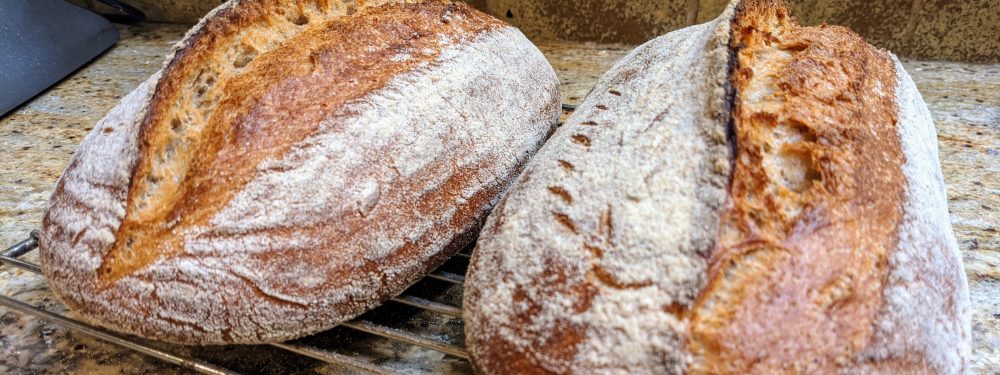
Bulk ferment until the dough has expanded about 50%-75%. For me, that took about three hours in an oven with the light on. Fold every hour until the dough has built up strength. It only took two folds for my dough to develop good strength. After that, I gently shaped the loaf (no preshape) into a batard, then put it in a banneton and let it rest overnight. Bake it like you normally would.
That’s the process I used in a nutshell. But honestly you can use whatever method you want. For me, I wanted to keep it as simple as possible.
Circling back to education, as I mentioned above, acquiring knowledge makes you better. The more you know, the better you can adapt to different conditions and situations; the better you can recognize and identify issues that may come along. Especially with baking bread, as they say, there’s more than one way to skin a cat, and it’s important to at least be aware of the different approaches available.
The reason I’m saying this is because I’ve seen so many folks who’ll latch onto a particular method or technique or belief and become so parochial and dogmatic about it that they close themselves off from learning anything else. But bear in mind that bread has been baked for thousands of years and in all sorts of conditions and environments. Don’t get so fixed on a particular method. Try different things out.
What I love about this 1:2:3 method is its simplicity. I’ve got my own recipes that I just know by heart, but a method like this makes it super-easy for anyone, especially new bakers, to execute. And think about this: You can apply this method with a poolish or biga. Those are just preferments, but prepared in a different way. The link to the calculator I made for this also allows you to specify the hydration of your starter. So, for instance, if you’re using a 75% hydration biga, it’ll calculate the correct amount of salt. You can still use the 1.8%, but the calculator, does it more accurately, considering all the flour that’s used in the recipe and not just the starter X 3.
 The Dawg House!
Pingback: My husband wants to get into sourdough, so i may try that one. Sourdough scares me lol. – The Busy Bee Homemaker