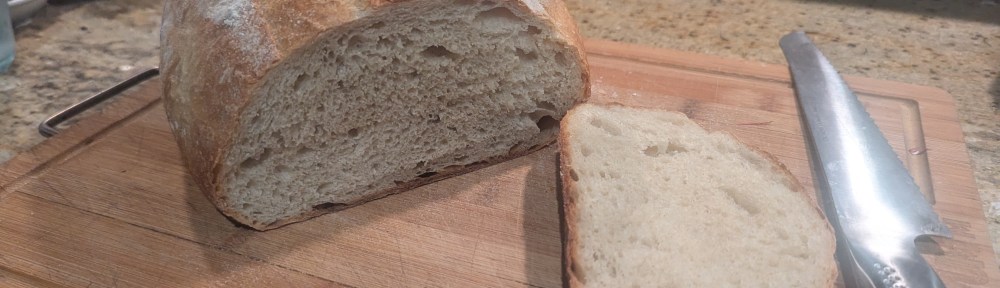
There are times when I want some bread and don’t have the patience nor time to make a loaf of sourdough. Today was one of those days. I had meetings solid in the morning, had a major architectural problem to solve, and though I knew that I wanted some bread for dinner this evening, I didn’t have the time to get a levain started; truth be told, I just didn’t want to fuss over a starter. It was a bit of a dilemma
So, to solve my dilemma, I turned to a yeasted same-day recipe that I’ve developed over the years. I got the inspiration for this loaf when I attended a retreat, and the chef had a huge mixing bowl filled with proofing dough. I asked her about her process and decided to develop my own same-day bread.
The challenge with making a loaf like this is that it can turn out to be insipid and with a crumb that dries out easily. But this bread has plenty of flavor due to the addition of a bit of honey and the use of T90 bread flour for a bit of whole grain and diastatic malt powder. The diastatic malt powder is optional. It provides a bit of flavor but more importantly, it will produce a soft crust and a moist but not gummy crumb. This is a perfect loaf for making sandwiches!
Formula
| Flour | 100.00% |
| Water | 72.00% |
| Salt | 2.00% |
| Yeast | 1.00% |
| Diastatic Malt Powder | 0.50% |
| Honey | 3.00% |
Final Dough
| High-Gluten Bread Flour (I recommend using 12%+ protein content flour) | 577g |
| T85/90 or Whole Wheat Flour | 102g |
| Water (~95-100℉) | 489g |
| Salt | 14g |
| Yeast | 7g |
| Diastatic Malt Powder | 3g |
| Honey | 20g |
| Total Yield | 1 loaf X 1212g |
Mix. Thoroughly combine all the dry ingredients together in one large bowl. Dissolve the honey in the water then add the water in batches to the dry ingredients until there are no dry ingredients in the bowl. Mix to a shaggy mass.
Bulk Fermentation. (about 1 1/2 to 2 hours) Do two sets of stretches and folds every half-hour in the first hour, then resting the ball on the seams. Make sure you stretch the dough to its extents during folding. You really want to develop the gluten network! After the final stretch and fold, allow the dough to expand in volume to almost double. With this amount of yeast, plus the addition of honey and malt, on a warm day like today (it’s 75º in my kitchen), a half-hour after the last fold was all I needed to complete bulk fermentation.
Pre-Shape/Bench Rest. Pour the dough out onto your work surface, then shape it into a boule, making sure the skin is nice and taut. Pop any large bubbles that form – there may be a lot! Cover it with a tea cloth then let it bench rest for twenty minutes.
Now would be a good time to preheat your oven and Dutch oven to 475℉
Shaping/Final Fermentation. ~45 min to an hour. Turn the dough over, then gently punch it down. Don’t be too rough! Shape it into a boule or a batard, then place it seam-side-up in a well-floured banneton, then place the banneton in the fridge for final fermentation. Do the poke test to make sure it’s ready. As with any bread, you want to make sure that final fermentation completes, less you get a fool’s crumb.
Bake. Bake at 475℉ for 20 minutes covered I also thrown in a couple of small chips of ice to add to the steam. Remove the lid and finish baking at 425℉ for 20 minutes.
Cool for at least an hour before slicing! Happy Baking!
Update 9/18/2024: I just made patty melts for my kids’ dinner this evening and they both said the bread was FIRE! My son made a huge sandwich with it earlier in the day. Looks like I will be making yet another loaf. 🙂
Notes
- There’s an obsession in the home baking world with creating an ear. Having baked this loaf many times, this will not create an ear or make a small ear at best, even if you make a deep cut. There are a few reasons for this: 1) The crust is thin on this type of loaf; 2) The diastatic malt moistens the dough, making a soft crust; 3) Finally, the yeast action is so dramatic during baking that the loaf expands too fast for an ear to form.
- You may be concerned about the loaf not having much flavor since both bulk and final fermentation add up to just over two hours. That’s the reason for using a bit of whole grain flour, honey, and diastatic malt. The addition of these ingredients provides subtle but important flavor enhancement.
- As I mentioned above, this makes a perfect sandwich loaf! Looking at the picture, you’ll notice there aren’t any large holes. But there are many, many small holes. Squeezing the loaf after it cools feels like you’re squeezing a sponge; the crumb is exceptionally light and airy! And using high-gluten flour helps the loaf keep its structure during baking.

 The Dawg House!