
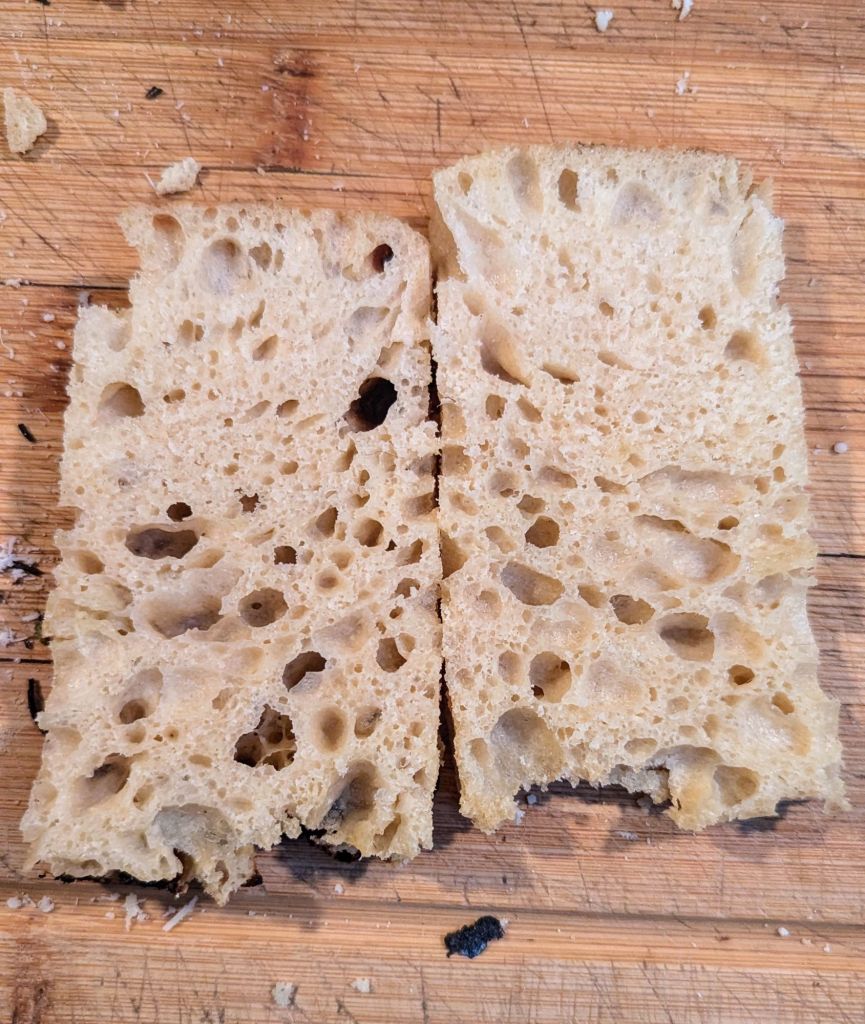
Now that I’ve gotten into making wood-fired pizza, I’m back to making dough on a regular basis. And more importantly for me, I’ve revived my mother culture to create levain which I use for all my dough now. Yeah, I know… Yeast is typically used for Italian breads, but there is nothing like the texture and flavor of a dough risen with a sourdough culture.
In doing my research on focaccia, like other Italian breads, there are various kinds depending on the region. This recipe is a sourdough riff on Ligurian focaccia which tends to be a thicker, puffier kind as compared to a Genovese focaccia which is thin like flatbread. Also, even though I list honey as part of the formula, I didn’t include it in my final dough because I baked it in my wood-fired pizza oven. And even though it is baked in a pan, I didn’t want to risk the sugar burning. However, if you’re baking in a regular oven, by all means, include the honey! Either way, it’s still delicious.
And finally, I wanted to add a little complexity to the flavor profile by using whole grain, fine ground semolina flour. The results were spectacular!
Formula
| AP Flour | 70.00% |
| Finely Ground Semolina Flour | 30.00% |
| Water | 75.00% |
| Salt | 1.50% |
| Yeast | 1.10% |
| Olive Oil | 6.25% |
| Honey | 1.80% |
| Total % | 185.65% |
Final Dough
The final dough will fit in a standard 9″ X 13″ baking pan.
| AP | 248g |
| Semolina | 129g |
| Water ~100℉-105℉ | 269g |
| Salt | 6.46g |
| Olive Oil | 27g |
| Honey | 8g |
| Levain | 108g |
| Total Yield | 800g |
Make the Levain. Make a 1:5:5 levain; that is, one part starter to five parts flour and water each. If you make the levain the night before, you can let it ferment overnight on the counter, then mix the dough in the morning. If you want to do a same-day bake, once you’ve mixed the levain, place it in the oven with the light on and maintain a temperature of 78℉-82℉. This will favor yeast activity over bacterial activity.
Mix. In a small bowl, measure out the levain you’ll need, then add all the water to it and dissolve the levain. Add the honey and whisk to dissolve. Add the olive oil to this mixture (don’t worry, it won’t mix). In a separate, large bowl, combine all the dry ingredients and mix thoroughly to ensure even distribution. Add the liquid mixture to the dry ingredients and mix to a shaggy mass, making sure there are no lumps or dry ingredients. Scrape down the sides, cover, then rest for 10 minutes.
Bulk Fermentation, Folding. 2 1/2 to 3 hours. Fold the dough every 30 minutes in the first hour and half of bulk fermentation. By the third fold, you should have achieved a nice windowpane. If you haven’t, then do one more fold. Allow the dough to rest until it has almost doubled in volume.
Final Fermentation. Punch down the dough, shape it into a rough rectangle in the shape of a 9″ X 13″ pan. Place into the pan, then use your fingers to spread out the dough and distribute it evenly in the pan. Let the dough rest for 20-30 minutes. After resting, sprinkle flaky salt on top and fresh rosemary all over the top. Sprinkle good extra virgin olive oil over the entire surface, then dimple the dough to let the oil pool in the dimples.
Bake. In a conventional oven, bake at 450℉ for 25 minutes or until the top becomes a nice chestnut brown. If baking in a wood-fired pizza oven, the focaccia will only take about 10 minutes. Don’t let it get too close to the flame to avoid burning and turn the pan every 30 seconds to achieve and even bake. Like a Neapolitan pizza crust, you should get charred spots.
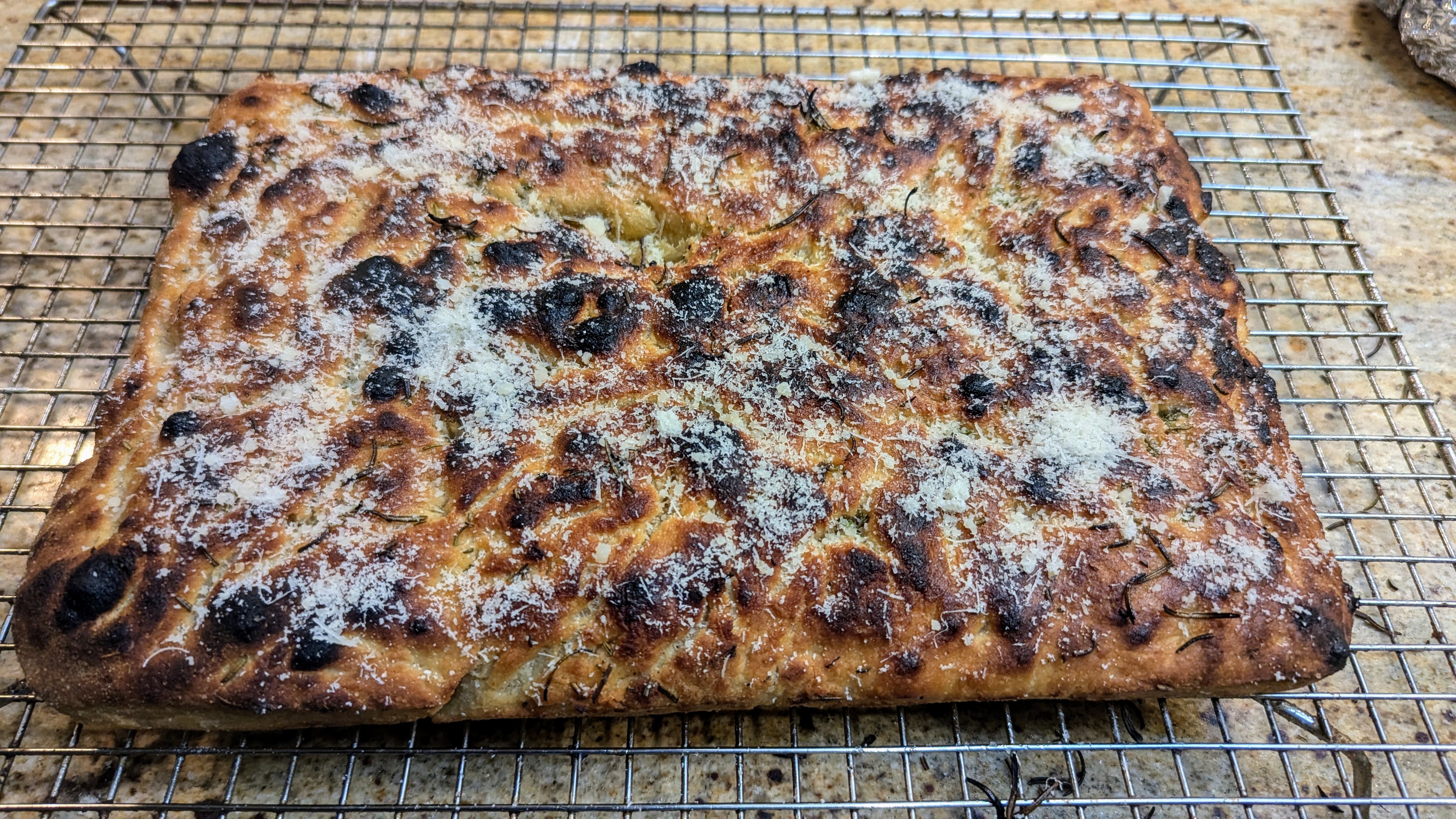
Remove from the oven. Spray or sprinkle more olive oil on top, then lightly powder with freshly grated Parmesano Reggiano. Let it cool for at least 15 minutes. It’s best when it’s warm!
 The Dawg House!