tl;dr
Knowing what to expect out of your dough is half the battle when it comes to artisan bread baking. And the only way you can get to the point where you can expect to achieve certain results takes time, practice, and incredible amounts of patience.
The artisan bread baking world is filled with lots of publications, both print and electronic. Of course, included with those are pictures of perfect loaves of bread with amazing crumbs and blistered crusts. There really is a lot of great bread out there made by incredibly talented and skilled bakers!

Sadly, though the pictures in the publications are beautiful and set a general aesthetic for prospective bakers to achieve, they don’t really tell the whole story and oftentimes end up building unrealistic expectations in the readers. Look at all the craze behind achieving an open crumb! You can blame Tartine Bread books for this! 🙂
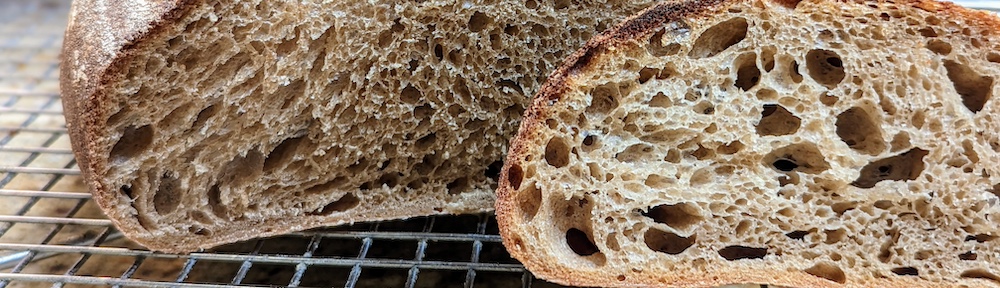
The picture of the bread above was taken from the book, “Tartine No. 3” by Chad Robertson and is a picture of his White-Wheat Blend loaf. The flour blend for that loaf is: 50% high-extraction, 25% whole wheat, 25% white whole wheat flour. That crumb is gorgeous! And it’s a fitting example of presenting something in such a way that it sets expectations on how a slice from an ideal loaf of bread should look.
Unfortunately, most people wouldn’t even question the picture and would take it at face value that the whole loaf was like this partial slice. But if my experience with baking with flour blends that include a high ratio of whole grain flour has taught me anything, there are certain things I’ve come to know and expect. And though I won’t go as far as saying the picture’s misleading, I will say that it doesn’t really tell the whole story.
First, notice how the photographer only took a picture of the end of the slice and from the butt-end of the loaf. Especially with flour blends that have a high amount of whole grain and high-extraction flour, you don’t get as open a crumb as you move towards the middle of the loaf. The loaf is the heaviest there, so void formation is much lower in that area, even if you build good dough strength. But the sides will present a much more open structure; hence, the picture of the end of the slice.
Also, notice the shape of the slice above. Based on its widest point, that loaf didn’t get much vertical rise, which is consistent with whole-grain flour blends with super high hydration. That White-Wheat recipe has a hydration of 85%+! People might think that with the open crumb that’s shown in the picture that the loaf must be getting some incredible vertical rise. But it’s not. I immediately asked: Where’s the cross-section of an entire loaf?
Even Chad Robertson said in Jon Favreau’s Chef Show that the crumb pictures in his books are of the aspirational crumbs when Jon made mention of the open crumb. So, Chad knows exactly what’s going on! 🙂 Mind you, I’m not trying to rip on Tartine at all. Rather, I’m elucidating the inconsistencies between what gets shown to the world and – for lack of a better world – reality.
Whether published in hard copy or digitally, most pictures are expressions of the publisher putting their best foot forward. We look at these pictures and say, “Damn! I want to do that!” Then we follow the author’s instructions, create some dough, process then bake it, then once it has cooled, we cut it open, see the crumb, and exclaim, “Where the f$%k is the open crumb? I followed the instructions to a ‘T!'”
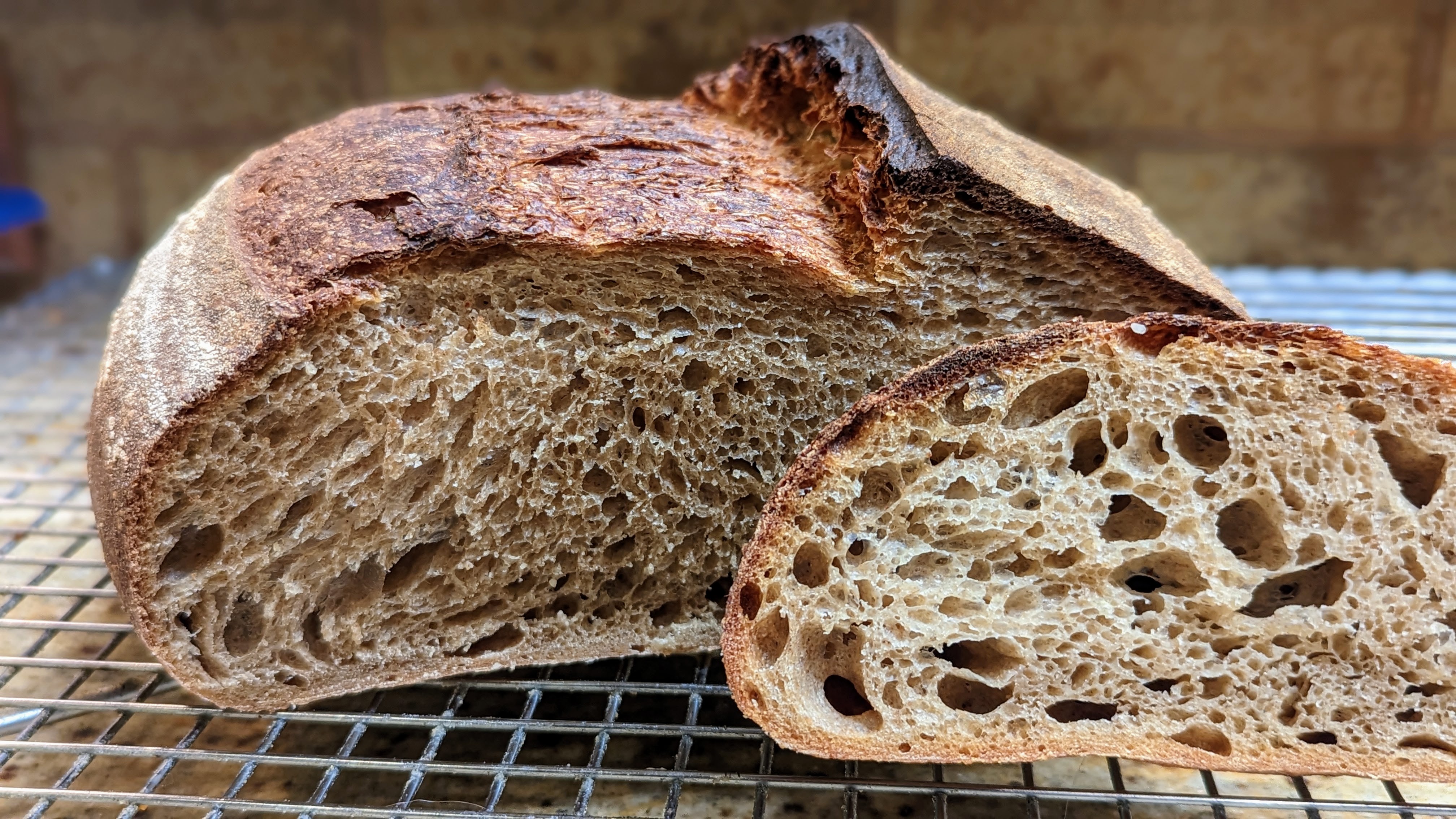
For example, with the crumb shot of the loaves directly above, I wanted to demonstrate the difference in crumb openness from the butt-end of the loaf and what it looks like in the center of the loaf. As you can see, the butt-end slice is super-open while the middle is moderately open. Though I know that some will marvel at the super-open crumb of the slice, it was not something I desired as I prefer a much more consistent, moderately open crumb like the middle of the loaf. But I wasn’t mindful of my dough temp during bulk fermentation, and it was WAY too high at 85℉. I had to cut bulk fermentation short because the yeast was going crazy! So I expected the result.
If you are after a certain aesthetic in your bread, like an open crumb, you must bake enough with your ingredients and under your conditions to understand how it all works together. It’s repetition that gives you that sense of what to expect. Put simply, the only thing you can expect is to set your own expectations based on YOUR set of ingredients and baking environment. And you can only achieve a level of expectation with reps – plain and simple.
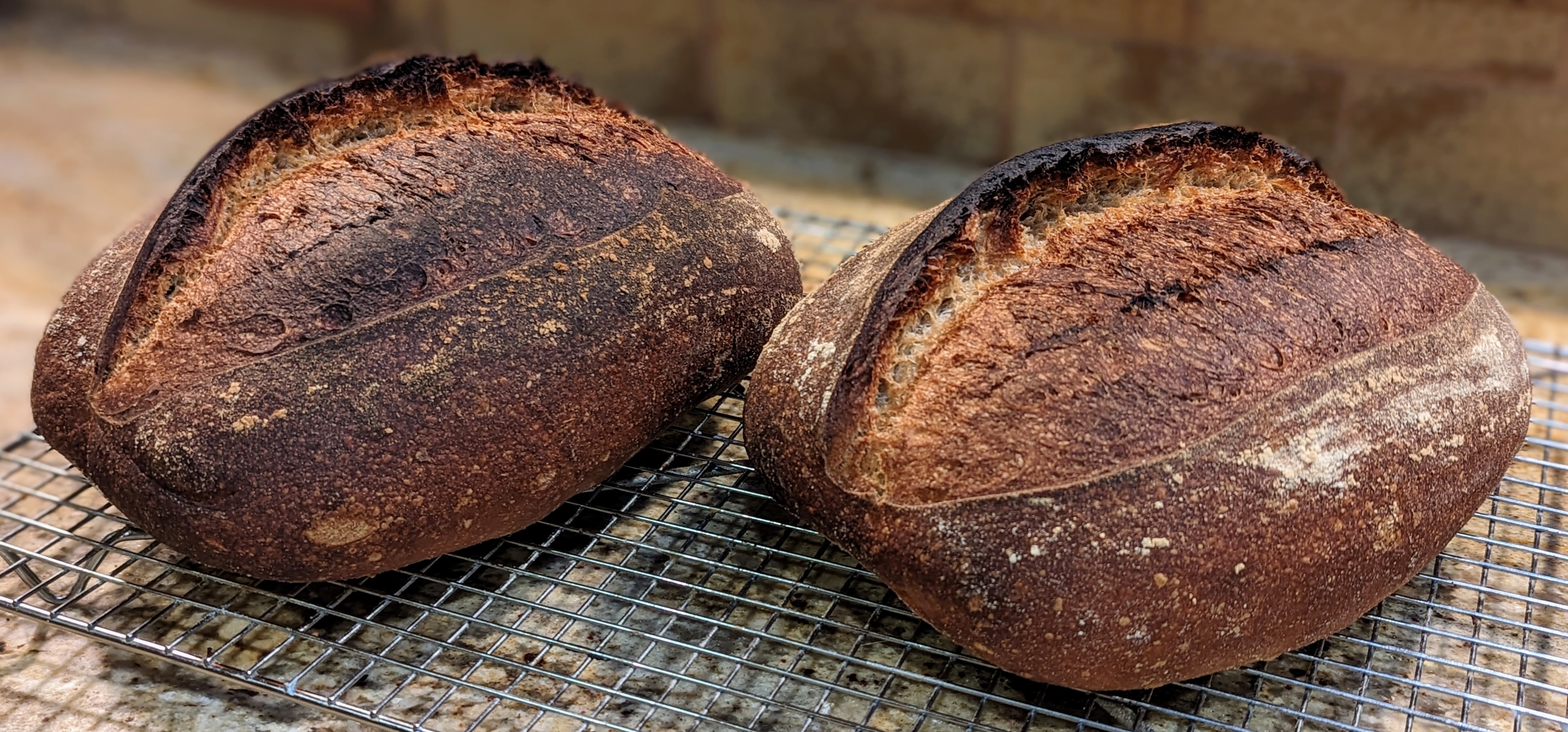
As another example, I made the loaves below a couple of days ago:


I used a flour blend like the Tartine No. 3 White-Wheat Blend recipe, though I used 50% high-extraction, 25% whole wheat, and 25% whole-grain dark rye. My overall hydration for the loaves was about 87%. As you can see from the pictures, I got a great oven spring, but not much vertical rise. Consistent with what I discussed above, the centers of the loaves weren’t as open, while the sides presented a nice, open structure. I expect to get results like this every time, and I do unless I mess something up along the way, which is rare. But mind you, I’ve only been able to achieve this by doing it – a lot!
The loaves had a nice, long nap in my retarding fridge of about 20 hours, but it took several hours for dough to come down to a temperature that would slow down yeast activity; thus, that super-open crumb because the yeast was still active. Based on experience, I implicitly knew this was going to happen.

And hey! As an aside, I can do the same thing as Tartine! The picture to the right is of a similar loaf I baked a while ago. It was 88% hydration and used a combination of high-extraction and Kamut flour. Look at that open crumb! But truth be told, the middle wasn’t as open as the sides and the rise wasn’t as vertical as a loaf baked with regular flour. In fact, the crumb was more consistent with the loaves above.
Speaking of using regular flour, look at the loaf below. That was made with 25% high-extraction and 75% unbleached white flour. Hydration was about 80% for that loaf. But notice how much more even the crumb structure is in the picture. It’s a real contrast to the crumb of a loaf that contains much more whole-grain flour. Moreover, look at the vertical rise. Because there’s not as much bran in the flour to cut the gluten strands, that loaf popped right up!
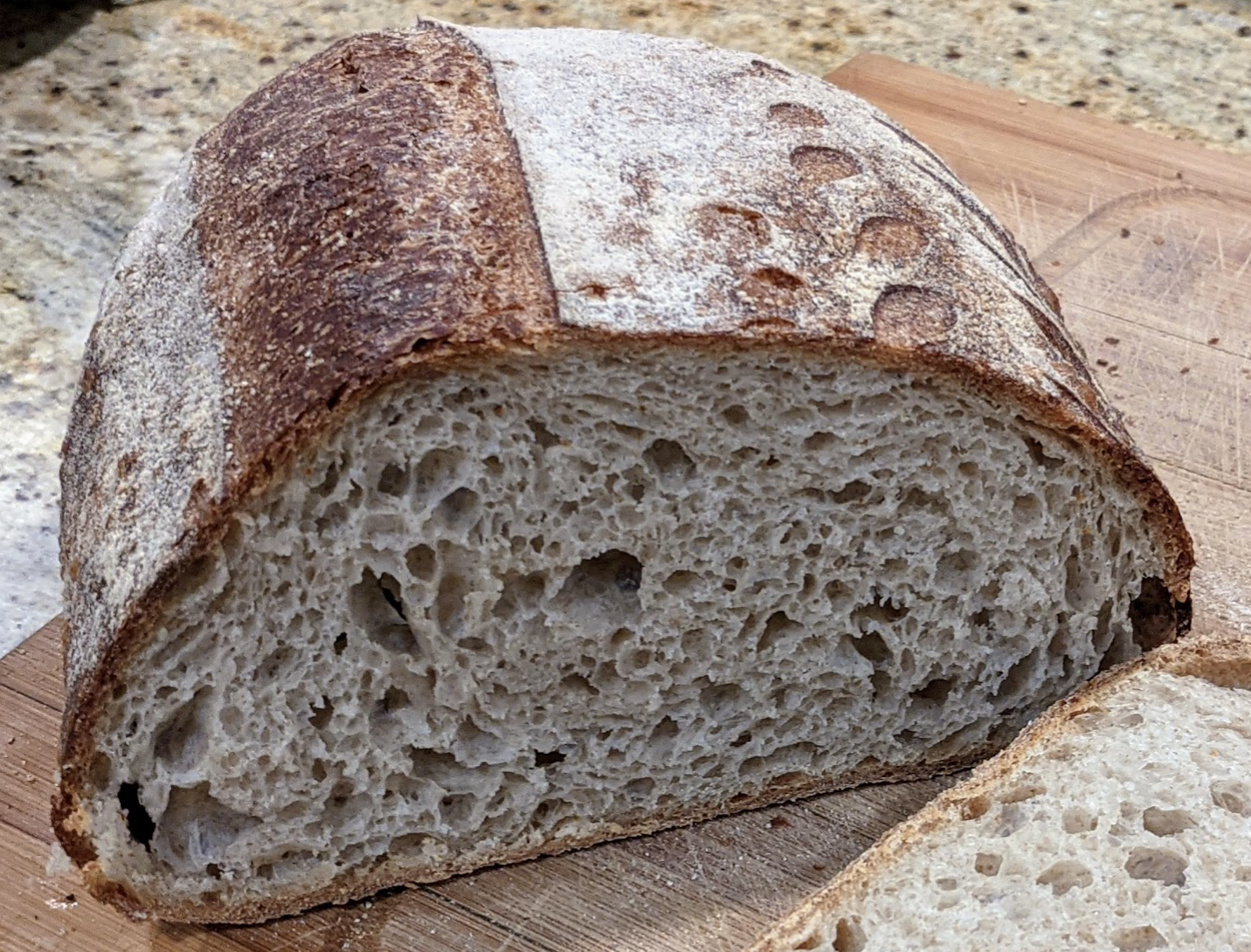
I realize that it might look as if I’m just showing off the bread that I bake. I’m proud of them for sure, but those results aren’t novel for me. I’ve baked these loaves many, many times, and over time I’ve developed both technique and familiarity with my ingredients that baking these has become SOP.
 The Dawg House!